Just as archival research can lead to new knowledge, so too can the gathering and sorting of a prolonged curatorial process generate surprising juxtapositions and connections—allowing for new insights as contexts shift.
The three of us—a university professor, a retired financial advisor, and a former schoolteacher—are all Life Members of JASNA as well as members of the Grolier Club, America’s oldest and largest society for bibliophiles. Together we have curated a public exhibition entitled Paper Jane: 250 Years of Austen, as an homage to our favorite author. Our exhibition is housed on the second floor of the Grolier Club’s premises at 47 East 60th Street in Manhattan, where it is free and open to the public Monday through Saturday, from 10 a.m. to 5 p.m. It opened on 4 December 2025 and will run through Valentine’s Day 2026.
Individually, each of us has collected Austen though favoring completely different materials—with Janine rescuing cheap mass-market reprintings; Sandra spending a lifetime hunting for important editions of Austen; and Mary emphasizing works about Austen, including biographies, literary criticism, plays, illustrations, and unusual film memorabilia. Accordingly, we felt that our accumulated books and interests posed distinctly different questions: How have book prices impacted her audience? Did school children in nineteenth-century America encounter Austen differently than children in Victorian England? What biographies or illustrations most influenced Austen’s reputational history? Austen’s dual public personae, combined with our different collecting impulses and curiosities, conjured a lively kaleidoscopic mix that we wanted our exhibition to reflect and refract.
We therefore expected rare first editions and original manuscripts to sit irreverently among popular reprintings, giveaways, movie posters, illustrations, theatre playbills, and all manner of paper ephemera—from Austen’s first appearances in print to her latest fan fictions. Because Austen has been in print for more than two centuries, her novels have witnessed every innovation in book production over that time. This simultaneity allows an exhibition about one author’s growing fame to tell a broader story about changes in publishing and reading that, we felt, might be of interest even to non-Janeites. The combination was, as one Grolier Club bibliophile put it, “a no-brainer.”
The resulting Paper Jane: 250 Years of Austen exhibition possesses two strong throughlines: book production on the one hand, and Austen family involvement on the other. Ever-lowering prices for books made Jane Austen a household name, growing her audience as the cost of reading her novels fell. With the help of Sandra’s collection, Janine had already written a book about unsung, stereotyped reprints, The Lost Books of Jane Austen (2019), so our claim that cheap books helped make Austen canonical did not come as a surprise.
We also knew from the start that generations of Austen family descendants had offered new materials: biographies, letters, juvenilia, and even alternative endings and fan fictions of their own. At first, we thought that this family throughline was also familiar territory, since modern literary criticism and JASNA publications both acknowledge and resist stodgy Victorian accounts of “Dear Aunt Jane” offered by relations—especially the first stand-alone Austen family publication, A Memoir of Jane Austen, published in 1870. Modern critics have frequently observed how Austen family lore is often at odds with the daring persona of “Miss Austen” evident in her novels and letters.
What we did not expect was how the sheer number of Austen family contributions—along with the manifold surnames this involved as descendants married—had formed a constant trickle of new publications released by Austen descendants over the decades. By isolating the books, editions, memoirs, letters, and fan fictions written or edited by descendants of the brothers of Jane Austen, the resulting family inventory demonstrates, both for good and for ill, the persistence of the influence of the Austen clan across the centuries.
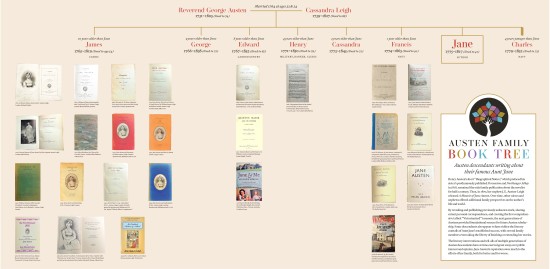
Strictly speaking, the information we have isolated is not new. None of us, however, had ever systematically catalogued the family publications—not even on our own shelves of books about Austen. We found among us that there were continuations by family members that each of us (and in a handful of cases, all of us) had missed. Two of us possessed several Austen continuations that neither owner had recognized as written by a member of the extended Austen clan. To teach ourselves the intimate connections between these family publications, we built a family book tree of their authors. As that tree grew in both size and narrative explanation, we realized that it needed to be a part of our exhibition, even at the risk of presenting all the family publications as equal contributors to Austen’s literary reputation. We recognized how some books merely rode the coattails of “Aunt Jane’s” literary success. Yet Austen family descendants fed a world hungry for knowledge of Miss Austen with rich and meaty details—even when larding some offerings with priggish or gratuitous commentary. Other works simply, but importantly, kept Jane Austen’s name in active circulation. Taken in their entirety, Austen family productions proved a larger—and surely more generative—part of the story than we had initially acknowledged.
As Austen reception steps across the threshold of the next fifty-year interval, we now wonder whether we are witnessing the ground shifting yet again—particularly as it relates to the legacy of Jane’s beloved sister, Cassandra Austen (1773–1845). Cassandra’s erstwhile public image as the despised censor and destroyer of Jane’s letters seems to be undergoing a radical change.
Cassandra’s public condemnation as the burner of her sister’s letters is well-rehearsed. From the several thousand letters that Jane Austen has been conservatively calculated to have penned over her short lifetime, only 161 survive. Because Austen’s nephews and nieces (fifty years after their aunt’s death in 1817) blamed their Aunt Cassandra for this curtailed inventory, so did the general public. That blame began with a niece’s remembrance in 1867, ostensibly to assist her brother Edward Austen-Leigh while he was writing his A Memoir of Jane Austen (1870). Penning her reminiscences more than twenty years after her Aunt Cassandra’s death, Caroline Austen recalled that her aunt had “looked over” surviving letters “and burnt the greater part, (as she told me), 2 or 3 years before her own death.”1 The first to repeat Caroline’s decades-old remembrance was Constance Hill in Jane Austen: Her Home & her Friends (1904), followed by Mary Augusta Austen-Leigh in Personal Aspects of Jane Austen (1920). All this was cemented by editor R. W. Chapman in his edition of the letters in 1932. In other words, Cassandra was re-indicted by each successive generation on the basis of the same scant hearsay.
In 1971, public ire was further inflamed by the so-called “discovery” of a letter from Cassandra to her brother Charles, dated 9 May 1843. Hitherto unknown to scholars, the letter—which contained Cassandra’s instructions about her possessions in the event of her death—came to light in a Somerset auction catalogue. To promote the sale, the catalogue neatly lifted a few incendiary lines, seemingly incriminating Cassandra on the evidence of her own words:
As I have leisure, I am looking over & destroying some of my Papers—others I have marked ‘to be burned,’ whilst some will still remain. These are chiefly a few letters & a few Manuscripts of our dear Jane, which I have set apart for those parties to whom I think they will be mostly valuable.2
Soon it was open season on Cassandra. She was roundly accused of having labeled bundles of Jane’s letters “to be burned.” A year later, Jane Aiken Hodge angrily speculated in her Only a Novel: The Double Life of Jane Austen (1972) that “the gaps in the letters can be expected to correspond with crises in their author’s life” (13). In his much-lauded biography, The Life of Jane Austen (1984), John Halperin, leaning for support on Hodge (whom he quotes), fired one of the most resounding shots of modern critical resentment: “And what about all that burning and pruning of her letters carried out so assiduously by Cassandra a few years before her own death—and witnessed by a niece? The effect of the destruction and the bowdlerization was to suppress anything of a peculiar intimacy” (5). Lost in this 1970s–80s enmity was the recognition that Caroline’s twenty-year-old recollection repeated something Cassandra allegedly told her. She had not “witnessed” any destruction. Yet the Hodge-cum-Halperin guilty verdict of “Cassandra’s careful work of destruction” echoed through the halls of academe, where Cassandra remained persona non grata in Austen studies well into the next century (Sutherland 30).
A few valiant souls tried to turn the tide. Jo Modert, in her 1990 Introduction to her facsimile edition of Jane’s letters, weighed in by publishing a full three paragraphs from that supposedly incendiary 1843 letter and pointed out how Cassandra’s instructions actually contradicted Caroline’s recollections. Modert reasoned that the phrase “my Papers” implied that what Cassandra aimed to destroy were writings by her own pen, and that Jane’s letters and manuscripts were “being ‘set apart’” to be reverently passed on to others. Modert points out that it was “Cassandra, who alone of the siblings seemed to keep all the letters she received” (xxi). Yet no one seemed to heed the cautionary Modert.
More than a decade later, Peter Sabor gallantly reinforced Modert’s reasoning by pointing out that all the 66 letters preserved from the years before the publication of Sense and Sensibility in 1811 were addressed to Cassandra. She was the only family member who “took pains” to preserve the voice of the youthful Jane. Like Modert, Sabor inventories the missing letters to other family members, noting that only one extant letter was addressed to her brother Charles, and that two of the eight letters to Jane’s brother Francis survive as “merely mutilated scraps.” Many nieces and nephews either expurgated passages when letters were first published or failed to safeguard family manuscripts entirely. For example, Fanny Austen, daughter of Francis and his first wife, Mary, destroyed all of Jane’s letters to her mother. “Cassandra cannot be held responsible,” Sabor pleaded, for the subsequent loss of correspondence by others. “In some cases, the surviving manuscripts show that passages offensive to Victorian sensibilities, about physical appearances, pregnancies, details of illnesses, coarse humour, etc. were deleted from the printed versions” published by later descendants, rather than fed to the flames by Cassandra (130). Rather than assuage ill feeling towards Cassandra, all such logic seemed simply to tar the rest of the Austen family with the selfsame brush of censorship and callous disregard for the truth.
It took a further decade and a work of fiction to ameliorate the antagonistic public perception of Cassandra. Gill Hornby’s novel Miss Austen (2020) offered a thoroughly sympathetic portrayal of a relentlessly supportive Cassandra who fought for her sister’s legacy—even to the detriment of her own happiness. While Hornby’s fiction is a work of imagination that plays fast and loose with chronology (as novels may), her story champions Cassandra’s alleged decision to destroy some letters and to keep certain intimacies out of the hands of other family members. Her novel makes important personality distinctions within the Austen family, who were not monolithic in their approach or motivation. By providing a wider context for some burnings in a world where women had but little legal recourse and limited power, the recent 2025 BBC television production of Miss Austen, starring Keeley Hawes, has begun to popularize a new sympathy for Cassandra.
Hornby’s novel was followed, at long last, by the publication of fuller facts. In 2022, John Avery Jones, Devoney Looser, and Peter Sabor planted new evidence in the soil of the public sentiment that Hornby’s novel had softened. For the first time, they published the complete text of Cassandra’s 9 May 1843 letter to her brother Charles—showing all of Cassandra’s instructions for the disposition of her jewelry and other possessions, including her sister’s manuscripts. The full letter alters the tone, context, and timing of Cassandra Austen’s instructions, and allowed the trio (echoing Modert) to urge that “Cassandra, instead, should be given credit for preserving the limited number of Jane’s letters that had come into her possession” (Avery Jones et al. 39).
This year, one more mark of growing sympathy for Cassandra is evidenced by the unprecedented, albeit small, “Art of Cassandra” exhibition at the cottage museum that is Jane Austen’s House in Chawton (it ran from 29 April to 7 September 2025). Guest-curated by Janine Barchas, the exhibition of ten artworks was the first-ever gathering of Cassandra’s extant artworks, sympathetically showcasing the amateur sketches and watercolors of Jane’s older sister. Janine’s research shows how many of Cassandra’s drawings were copied from books and popular prints. An exhibition about Cassandra as a fellow artist would surely have been a non-starter five, four, three, or even two decades ago. Not only was Janine surprised by the museum’s invitation to curate an exhibition devoted entirely to Cassandra during Jane’s big anniversary year, but she did not expect the show to solicit such empathy for Cassandra, whose possible letter burning, while not completely exonerated, seems now to be comprehended with much more understanding. Significantly, both the research into Cassandra’s copy-work and the resulting exhibition were made possible, in part, by Austen descendants who offered Janine access to artworks that no one outside the Austen family circle knew to exist—and then loaned and in some cases donated these precious works to the museum.
None of these telling and shape-shifting events feature directly in our Paper Jane exhibition at the Grolier Club—neither Hornby’s novel nor its television adaptation, nor the article by Avery Jones, Looser, and Sabor, nor the museum exhibition in Chawton. They also do not fit on our Austen family book tree. Yet, looking back, we realize how these recent events have influenced our approach to the Austen family. By means of this adjacent publication to our exhibition catalogue, Paper Jane: 250 Years of Austen, we can point JASNA readers to the wider context in which our show, too, was conceived—and will surely be perceived. Curating the past has made us bravely predictive about the future.
Our family book tree, therefore, comes at a time of important reassessment. We hope that it helps others to see both the extent of the Austen family commitment to (and interferences in) Jane’s legacy. Some of these works cry out for individual re-evaluation. So does their cumulative effect, since many of them build upon or repeat earlier family comments—like the denunciation of Cassandra for letter burning—in ways that reinforce long-held opinions without providing new evidence. It is impossible to know whether individual family publications responded to a public desire for all things Austen or whether they helped to shape that public taste. Likely both.
Our family book tree begins with Henry Austen’s short “Biographical Notice,” which prefaced his sister’s posthumously published Persuasion and Northanger Abbey in 1818. He revised it for Bentley’s Standard Novels series in 1833. Henry’s notice remained the only published family account of the novelist for half a century, even as one of Francis’s daughters published a novel in 1850 based upon the unfinished manuscript of The Watsons, dedicating it to her late aunt. Only after the death of Jane’s longest-lived sibling, Admiral Francis Austen, in 1865 were the family memories mined and the vaults opened. In 1867, when Caroline Austen put pen to paper to document her own meager remembrances of her aunt, she felt compelled to write because “the generation who knew her is passing away” (166). By that same impulse, nephew Edward Austen-Leigh released A Memoir of Jane Austen in 1870. Its inception prompted other nieces and nephews to offer additional family perspectives on the author’s life and world. Although Jane’s nearer siblings had never published any private family documents, the next generation released not just memoirs of their now-famous aunt but also surviving letters, juvenilia, manuscripts, and continuations.
We have not represented Caroline Austen’s account and the even shorter memorandum by her older half-sister, Anna Lefroy, as foundational early works on our Austen family book tree because these were written for family consumption and remained unpublished until relatively recently. While Caroline’s account is dated 1867, it was first published only in 1952 as My Aunt Jane Austen by the Jane Austen Society. Anna’s recollections date to 1864, but only became known after these were included in a Sotheby Park Bernet auction in 1977, and published by the Chiron Press in 1983.3 We leave it to others to decide if our Austen family book tree needs a feminist expansion to perhaps start with these crucial early manuscripts, since the recollections of Edward’s sisters greatly influenced his Memoir (1870) and the leading published accounts of other (male) family members—as the already recounted story about the accusations of letter burning proves.
By revealing and publishing previously unknown works, by sharing extant personal correspondence, and by creating the first comprehensive (albeit “Victorianized”) memoir, the next generations of Austens provided foundational sources for future scholarship. Many Austen descendants assiduously saved materials. Some authors on the book tree indeed appear to have appropriated Aunt Jane’s established success to promote their own separate projects, with a handful of family members cheekily finishing or extending her original stories. At intervals, descendants still continue to share never-before-seen objects and manuscripts with the public.
Jane Austen’s reputation owes much to the efforts of her family, both for better and for worse. The literary interventions and tell-alls of multiple generations of Austen descendants have at times exerted great sway over public interest and opinion.
1818
Austen, Henry. “Biographical Notice of the Author” and “Postscript.” Northanger Abbey and Persuasion. Vol. 1. London: John Murray. v–xix.
The posthumous publication of Austen’s two Bath novels marks the first time that Jane was publicly named as the author of her novels. Attributed to her brother Henry, the Biographical Notice is dated 13 December 1817, while his Postscript is dated 20 December 1817. Henry adjusted his notice in 1833 for Richard Bentley’s reprinting as part of his Standard Novels series.
1850
Hubback, Mrs. The Younger Sister, A Novel. 3 vols. London: Thomas Cautley Newby.
Jane’s sister Cassandra read The Watsons aloud to her nieces from the manuscript fragment that her sister had abandoned. Francis’s daughter Catherine Anne (1818–77), born too late to know her Aunt Jane, grew up to continue its story in a novel of her own. The work is dedicated to “the memory of [her] aunt.”
1870
Austen-Leigh, J. E. A Memoir of Jane Austen, by Her Nephew. London: Richard Bentley.
Edward was eighteen when Jane Austen died. “More than half a century has passed away since I, the youngest of the mourners, attended the funeral of my dear aunt Jane,” the memoir begins. Austen-Leigh presents “Aunt Jane” to Victorian society as a reassuringly God-loving, polite, and conservative spinster of genius, comfortable with her small two inches of ivory.
1871
Austen-Leigh, J. E. A Memoir of Jane Austen by Her Nephew. Second edition, to which is added “Lady Susan” and Fragments of two other unfinished tales by Miss Austen. London: Richard Bentley.
This revised and enlarged edition appeared within a year of the initial publication of the Memoir. New material included Lady Susan, additional letters, a description of the unfinished Sanditon manuscript, two cancelled chapters from Persuasion, and a fragment of The Watsons.
1884
Austen, Jane. Letters of Jane Austen, edited with an introduction and critical remarks by Edward, Lord Brabourne. 2 vols. London: Bentley.
Upon the death in 1882 of Fanny, Lady Knatchbull (née Austen, later Knight), her eldest son and heir, Lord Brabourne, discovered his mother’s trove of family letters. He published ninety-six letters from Jane to her sister, Cassandra, and to her oldest nieces, Anna and Fanny. Though Lord Brabourne’s heavy-handed editing drew significant criticism—including a Times review comparing him to the Reverend William Collins—this family publication gave readers access to Austen’s authentic voice beyond the pious Victorian portrayal in the Memoir, transforming Austen scholarship and her reputation.
1895
Anonymous. Charades &c. Written a Hundred Years Ago by Jane Austen and Her Family. London: Spottiswoode.
The copy in the Bodleian Library contains a note dated 4 July 1895 from Mary Augusta Austen-Leigh, stating that the text had been “printed to be sold at a Bazaar held last week for the benefit of St. Mary’s Hospital, Paddington London.”
1906
Hubback, J. H., and Edith C. Hubback. Jane Austen’s Sailor Brothers: Being the Adventures of Sir Francis Austen, G.C.B., Admiral of the Fleet and Rear-Admiral Charles Austen. London and New York: John Lane.
The grandson of Sir Francis Austen teamed with his daughter to explore the naval careers of Jane’s two seafaring brothers and their influence on her fiction.
1911
Austen-Leigh, William A., and Montagu George Knight. Chawton Manor and Its Owners: A Family History. London: Smith, Elder & Co.
This volume chronicles the history of the Great House in the village of Chawton, Hampshire. This family history stresses the adoption of brother Edward Austen by wealthy distant cousins, Thomas and Catherine Knight, who made Edward their heir. This enabled him to provide a cottage in Chawton as a residence for his unmarried sisters, Jane and Cassandra, and their widowed mother.
1913
Austen-Leigh, William, and Richard Arthur Austen-Leigh. Jane Austen: Her Life and Letters; A Family Record. London: Smith, Elder & Co.
Following in his father Edward’s footsteps, William Austen-Leigh (1843–1921) and his nephew Richard A. Austen-Leigh (1872–1961) created this biography, a foundational source for those interested in Austen’s life and family. R. A. Austen-Leigh’s heirs later entrusted Austen scholar Deirdre Le Faye with incorporating additional family notes and three-quarters of a century of further discoveries when she published a revised and expanded edition, Jane Austen: A Family Record, in 1989.
1920
Austen-Leigh, Mary Augusta. Personal Aspects of Jane Austen. London: John Murray.
Although it had been at least fifteen years since Henry James and Mark Twain wrote disparagingly about Austen’s fictions, Mary Austen-Leigh’s biography addressed patronizing misconceptions that apparently still rankled. The author challenged lingering myths of Austen’s supposed narrow and uneventful life, as well as her alleged dislike of children and animals. Neatly marking the fiftieth anniversary of her father’s 1870 Memoir, Mary’s own memoir chides readers for disregarding subsequent biographies and for reverting to the attitudes of Victorian pundits.
1927
[Lefroy, Anna Austen.] Mary Hamilton, By a Niece of the Late Miss Austen. London: Elkin Mathews & Marrot, Ltd.
Jane’s eldest niece (daughter of James Austen), Anna Lefroy, produced about a dozen stories for children (four of her six daughters published too). This novella, of which 500 copies were printed as a stand-alone book in 1927, first appeared anonymously in a British annual called the Literary Souvenir for 1834. Anna’s story has all the appearance of her aunt’s influence. We know that she confided her literary aspirations to her Aunt Jane and submitted at least one youthful manuscript for her critique.
1928
Austen, Jane, Edith Brown, and Francis Brown. The Watsons, by Jane Austen, Continued & completed by Edith (Her Great Grand-Niece) & Francis Brown, in Accordance with Her Intentions. London: Elkin Mathews & Marrot, Ltd.
The preface tells how Aunt Cassandra would read the manuscript fragment aloud to her nieces—including Edith Brown’s grandmother, Catherine Hubback (née Austen, daughter of sailor brother Francis)—and tell them how their Aunt Jane had meant to end the novel.
1929
Brown, Mrs. Francis. Margaret Dashwood, or Interference. London: John Lane, The Bodley Head, Ltd.
The author, born Edith Charlotte Hubback (1876–1947), was the great-granddaughter of Francis Austen, Jane’s brother. This story extends Sense and Sensibility.
1930
Brown, Mrs. Francis. Susan Price, or Resolution. London: John Lane, The Bodley Head, Ltd.
This story is a sequel to Mansfield Park.
1937
Austen-Leigh, Emma. Jane Austen and Steventon. London: Spottiswoode, Ballantyne & Co., Ltd.
Rather than provide new details, the book’s stated aim is to compile for the visitor to Jane Austen’s birthplace the known facts about the neighborhood with some anecdotes of Austen family life there. This modest booklet also provides illustrations of the old Steventon rectory and church, an Austen family pedigree, and copies of pages from the parish register at Steventon into which young Jane famously inserted an imaginary marriage between “Henry Frederic Howard Fitzwilliam of London” and “Jane Austen of Steventon.”
1939
Austen-Leigh, Emma. Jane Austen and Bath. London: Spottiswoode, Ballantyne & Co., Ltd.
Jane Austen lived in Bath from 1801 to 1806. Her familiarity with this Regency spa town provided the partial settings for both Northanger Abbey and Persuasion.
1939
Brown, Helen. Jane Austen: A Play. London: Duckworth.
A. A. Milne’s own stage adaptation of Pride and Prejudice was published in 1936. Written by the daughter of Edith Hubback (see above) and Francis Brown, this theatrical work by a great-great-grand-niece was prompted by Milne’s published remark that Jane Austen must have spoken like Elizabeth Bennet. Believing instead that Jane’s own words best represented her speech, Brown dramatized the letters to Cassandra: “I have been talking to you almost as fast as I could the whole of this letter.”
1940
Austen-Leigh, Richard A. Pedigree of Austen of Horsmonden, Broadford, Grovehurst, Kippington, Capel Manor, etc. London: Spottiswoode, Ballantyne &Co., Ltd.
This privately printed genealogical compilation by Richard Arthur Austen-Leigh (1872–1961) has served Austen scholars as a reference text for documenting the ancestry of Jane Austen’s family in Kent.
1941
Austen-Leigh, R. A. Jane Austen and Lyme Regis. London: Spottiswoode, Ballantyne &Co., Ltd.
The book explores Jane Austen’s relationship with the coastal town of Lyme Regis in Dorset, which features prominently in Persuasion. A note by the author acknowledges how he took up his sister Emma’s work on this book after her death in January 1940.
1942
Austen-Leigh, R. A. Austen Papers, 1704–1856. London: Privately printed by Spottiswoode, Ballantyne & Co., Ltd.
Two years after publishing his genealogical compilation of the ancestry of the Austens of Kent, the same author compiled this collection of surviving Austen family correspondence. As his preface asserts, while any epistolary collection spanning a century and a half would surely contain something of historical interest, these letters “provide a background for the one famous member that the family has produced, namely Jane Austen.” As longtime chairman of the publishing house of Spottiswoode, Ballantyne & Co., R. A. Austen-Leigh shepherded a number of Austen-family publications through that press.
1949
Austen-Leigh, R. A. Jane Austen and Southampton. London: Spottiswoode, Ballantyne & Co., Ltd.
Fourth in the series of “Jane Austen and [Place]” family books—first penned by Emma Austen-Leigh and then by her brother Richard—this one narrates the years between 1806 and 1809, when the widowed Mrs. Austen, her two daughters, and their friend Martha Lloyd lived on Castle Square in Southampton with sailor brother Francis and his wife, Mary.
1975
Mason Hurley, Joan [née Joan Austen-Leigh]. Our Own Particular Jane. Victoria, BC: A Room of One’s Own Press.
Joan Austen-Leigh (1920–2001)—a great-granddaughter of Edward Austen-Leigh, who wrote the 1870 Memoir—co-founded JASNA in 1979. This Canadian citizen edited or co-edited the society’s annual publication, Persuasions, for most of JASNA’s first nineteen years. She also donated Jane Austen’s portable writing desk to the British Library in 1999.
1977
Austen, Jane, and Another. The Watsons. London: Peter Davies.
This anonymous continuation of Catherine Hubback’s 1850 novel (itself a continuation) was penned by educator David Martin Hopkinson (1914–2002), the husband of Diana Hubback, a great-grandniece of Catherine and niece of Edith Brown (a.k.a. Mrs. Francis Brown). Although not strictly a descendant himself, when Hopkinson married into the Hubbacks, he apparently caught the family fever for continuations. Hopkinson strips away Catherine’s Victorian interventions to offer a story he deems closer to the spirit of Jane Austen’s fragment.
1983
Lefroy, Anna Austen. Jane Austen’s Sanditon: A Continuation by her Niece. Together with “Reminiscences of Aunt Jane.” Transcribed, edited, and with an introduction by Mary Gaither Marshall. Chicago: Chiron Press.
Lefroy’s continuation of Sanditon and her recollections of her aunt, which stress her “unusually quick sense of the ridiculous,” were virtually unknown until this manuscript appeared at auction in 1977. Anna (aged twenty-four when her Aunt Jane died) had composed these brief reminiscences in 1864 to help her half-brother, Edward Austen-Leigh, with his Memoir, which indeed lifted a number of observations from her account.
1993
Austen-Leigh, Joan. Mrs. Goddard, Mistress of a School. Victoria, BC: A Room of One’s Own Press.
The first in a trilogy, this epistolary fan fiction retells the story of Emma through the eyes of Mrs. Goddard, who runs the school attended by the heroine’s protégé, Harriet Smith. A Visit to Highbury (1995) and Later Days at Highbury (1996) were later published by St. Martin’s Press in New York and are hereby implied.
2018
Knight, Caroline Jane. Jane & Me: My Austen Heritage. Victoria, Australia: Greyfriar Group.
Identified as “Jane Austen’s Fifth Great-Niece,” the author promises that “[f]ifteen percent of the profits from the sale of this book will be donated to the Jane Austen Literacy Foundation.”
NOTES
1Caroline Austen (174). In 1867, Caroline penned her remembrances for private use by the family, but these were not printed until much later. Sutherland’s edition of the Memoir includes Caroline’s early remembrances, as well as those of Anna Lefroy (see 155–82).
2The letter was unknown to scholars until 1971, when it was quoted in a sale catalogue for Lot 340 by T. R. G. Lawrence & Son, Crewkerne, Somerset. It was bought at auction for £70 by Richard Hatchwell, Malmesbury, and eventually resurfaced as part of the Gordon N. Ray Collection bequeathed to the Pierpont Morgan Library, where it now resides.
3For a full publication history, see Sutherland’s edition of the Memoir (259–62).
