In May 1813, Jane Austen wrote to her sister, Cassandra, about her visit to the Royal Academy exhibition at Somerset House, London, in the company of their brother Henry. She joked about searching the rooms for portraits of Mrs. Bingley and Mrs. Darcy, finding “great amusement” among the pictures (24 May 1813).1 She does not mention J. M. W. Turner by name in the letter, but she certainly would have seen his paintings Frosty Morning and The Deluge on display there and heard his name as the Academy’s Professor of Perspective. 1813 was a year in which Austen and Turner might have met or lingered in the same rooms.
Austen and Turner were both born in 1775, and their paths intersected in tantalizing ways over their lives and creative work. Turner’s uncle, the Reverend Henry Harpur, knew Austen’s father, George, and oversaw his first curacy in Shipbourne, Kent. Just as Austen would have seen Turner’s paintings on view at Somerset House, it would have been hard for Turner to ignore the growing popularity of Austen’s novels in the final years of her life or her burgeoning reputation in the years between her death in 1817 and his own in 1851.
In 2025, the joint 250th anniversary of their births, Austen and Turner did meet at a major exhibition at Harewood House, West Yorkshire: Austen & Turner: A Country House Encounter (May 2–October 19). Across thirteen historic rooms, our curatorial team imagined a conversation between these two icons of art and culture at their shared meeting ground of the country house. Harewood was the ideal home for the exhibition. A Palladian mansion completed in 1771 and designed by John Carr with Robert Adam interiors, it was built by the Lascelles family, whose enormous wealth was derived from profits made from the transatlantic traffic in and enslavement of African people. Edward “Beau” Lascelles (1764–1814) was a patron of Turner’s, and Turner first visited Harewood at the age of twenty-two to paint multiple portraits of the house and landscape. Harewood’s Austen connection comes via Mary Lascelles (1900–95), literary scholar, editor of Austen’s works, and author of the groundbreaking Jane Austen and Her Art (1939). Lascelles was the granddaughter of Henry, 4th Earl of Harewood. Harewood House also has an impressive library that includes many first editions published during Austen’s and Turner’s lifetimes, including Sense and Sensibility (1811), and many later editions of Austen novels that were read by generations of the Lascelles family.
The idea for the exhibition was originally conceived by Richard Johns. It was a major research collaboration between Harewood House Trust and the University of York’s Centre for Eighteenth Century Studies (CECS). It was co-curated by Johns, Jennie Batchelor, and Chloe Wigston Smith of CECS; Marjorie Coughlan in History of Art at the University of York; and Rebecca Burton, curator at Harewood House. Jade Foster and Diane Howse also contributed as independent curators. In what follows, we share how our exhibition was shaped by the question of “what if” and “how” that prompted our conversation with the past. What if Austen and Turner had met? What would they have said to one another? How are their works in conversation with a complex and evolving Regency world? And how do these works continue to speak to us today?
Our exhibition proposed a speculative encounter that we felt resonated with a sketch by Turner from the 1820s (Figure 1), part of a group made during a visit to Petworth House, the Sussex estate of his patron George Wyndham, 3rd Earl of Egremont. Turner’s watercolor captures a fleeting moment between a man and a woman. True, the style of the woman’s clothes is later than the fashions Austen could have worn. But this glimpse of conversation and its potential allusiveness and elusiveness felt immensely suggestive when we imagined Turner and Austen together in the same space. The man on the left stands, his hands in his pockets, his head and body angled toward the woman as if in mid-conversation. She sits on a chair, her back toward us, her head turned slightly to the right. Is she listening to him? Perhaps she hears him but isn’t interested in what he has to say. Are they exchanging polite words about the weather, or are they engaged in a more intimate or perhaps tense conversation that we are not supposed to hear?
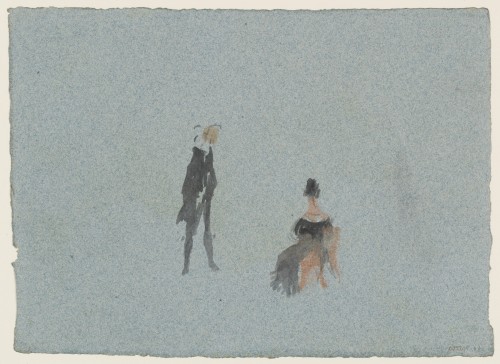
J. M. W. Turner, Two Figures (1827). Courtesy of Tate Britain.
Accepted by the nation as part of the Turner Bequest, 1856.
Turner’s watercolor omits the architectural setting for the conversation—a setting that might have been the subject of their discussion or might have conditioned what was possible to say within its confines. Rather than allowing the setting to recede into the background, as it does in Turner’s sketch, we chose instead to center the country house in our exhibition and to present it, in the words of Johns, as a “third actor” in the conversations we endeavored to stage. Neither Austen nor Turner took the country house at face value. Indeed, a key narrative for the exhibition was the positioning of Austen and Turner as astute observers rather than as privileged intimates of the country house’s lavish interiors and expansive exteriors. In Austen’s case, we wanted to ensure that exhibition-goers did not imagine the author as a heroine in a period drama. Both she and Turner were, of course, visitors to rather than residents of the country houses they knew. Turner enjoyed long stays at Harewood House, Farnley Hall, and Petworth House, but always in the role of a professional artist at a patron’s home. When Austen visited her brother Edward’s Kent estate, Godmersham Park, she logged long hours entertaining her nieces and nephews. She was notoriously embarrassed during a stay when she could not adequately tip Susannah Sackree (24 August 1805), the children’s nurse, and she observed the “happy Indifference of East Kent wealth” with a wry distance that only an outsider could possess (25 September 1813).
Our exhibition foregrounded how Austen’s and Turner’s work was shaped by this double perspective on the British country house, its social and cultural life, and its place in the world. In paper, with ink and paint, Austen and Turner mined the country house’s potential as a stage for the human drama of everyday life, looking both to what could be enacted in the foreground and what might be lurking in the wings. They also saw past the country house’s performance of taste, politeness, and refinement to consider the foundations of its stately rooms, imposing architecture, gardens, and walks. In the case of Harewood House, these foundations were built on the traffic and exploitation of children, women, and men from the west coast of Africa.
The Lascelles of Harewood were one of many British families and institutions that profited from the traffic in and enslavement of African people in this period. The family invested in the transatlantic slave trade as well as in sugar plantations in Barbados, Jamaica, Grenada, and Tobago, where, by the late eighteenth century, they enslaved thousands of men, women, and children across twenty-four plantations. It was the labor of these people over several generations that sustained Harewood. The family’s profits from the trafficking of people, funded the building of the house, and, later, their income from their plantations was used to fill rooms with Chippendale furniture, mahogany furniture, and other luxury commodities. The foundations and fabric of Harewood remain inseparable from human suffering and colonial exploitation. These facts were widely known in Regency society. Toward the close of Mansfield Park (1814), Austen mentions a fictional Lady Lascelles in a fleeting reference that relies on the known association between the Lascelles name and enslaved labor on Caribbean plantations (456; see Kaplan 205).
Our exhibition foregrounded four key themes that sought to illuminate convergences in Austen’s and Turner’s work, organized in the form of an ambitious display of Harewood’s own collections and over forty loans: the picturesque; creative innovation; sociability; and slavery and empire. Jade Foster encouraged us to envision these themes as intertwined threads, rather than as sequential topics—an idea that enabled us to weave the thread of empire and slavery across the whole. In what follows, we piece together how we traced these threads through a large range of objects, many of which were being shown in the North of England for the first time. We cannot itemize every work and object we exhibited, but we hope to convey the exhibition’s conceptual organization and the rich and sometimes unexpected connections we surfaced.
Before guiding you through the exhibits themselves, we should note some of the most significant curatorial issues we had to negotiate over months of planning. Chief among these were the stunning architecture and interiors of Harewood House itself. In many ways, it would have been easier to stage the exhibition, rather as Turner set his Two Figures, against the backdrop of a more neutral gallery space. Devising a curatorial route through a historic house with a succession of rooms of unequal size, populated with rich collections of historic and contemporary art, porcelain, furniture, and soft furnishings, was challenging. Added to this were environmental conditions, light levels, and security, carefully considered by Rebecca Burton, Jocelyn Anderson-Wood, and the Harewood team. As we worked through different conceptual and spatial groupings of materials and objects, we began to recast this challenge as a unique opportunity to recontextualize Austen’s and Turner’s work in spaces that would have been, partly at least, legible to them. A further challenge was how to display printed works and manuscripts by Austen, her family members, and contemporaries alongside the often larger and, for the most part, more visually arresting artworks of Turner. Where conditions allowed, we focused on presenting juxtaposed groupings of thematically linked items, the connections between which were identified in discursive room panels and suggestive quotations from Austen’s novels that were reprinted on large hanging banners. We hoped that these curatorial decisions would allow Austen and Turner to “meet . . . in conversation” (Emma 5) in and with the country house in ways that allowed us also to re-encounter their work; to explore how they influence how we view the country house today; and to imagine what meanings might emerge when we see such a house’s interiors, landscapes, foundations, and global connections anew.
Austen meets Turner
Our exhibition opened with an invitation to think about the ubiquity of Austen and Turner in the cultural imagination. Visitors stepped into Harewood’s Old Library, lined with bookshelves and furnished with a large mahogany desk, to encounter the many afterlives of Austen and Turner, including costumes from the BBC Pride and Prejudice (1995), Autumn de Wilde’s Emma. (2020), and Ang Lee’s Sense and Sensibility (1995); posters for the Tate’s annual Turner Prize; the £10 pound note featuring Austen next to the £20 note with Turner; and fiction, postcards, and music inspired by, or adapted from, their works. The items were designed to prompt exhibition-goers to consider how the reputations of Austen and Turner have evolved as successive generations of readers and viewers have discovered their work. Austen’s literary legacy, of course, is a worldwide phenomenon, shared through translations of her novels and numerous adaptations in multiple media. Equally, the modern reach of Turner’s work seems limitless. Every age has found new meanings in Austen and Turner, turning to their work as touchstones and sources of inspiration. We carry them in our pockets, on our banknotes, and in our imaginations.
From here the route continued into the China Room, where temporary gallery walls allowed us to conjure a plainer backdrop more suited to Austen’s and Turner’s humble beginnings, as shown in Ben Lefroy’s 1820 drawing of Steventon Rectory and a reproduction of John Wykeham Archer’s watercolor of Turner’s childhood home at 21 Maiden Lane, Covent Garden, London. Their houses, and their portraits (Cassandra Austen’s portrait of about 1810; Turner’s self-portrait, about 1799) were displayed alongside Turner’s 1797 watercolor Harewood House from the South-West and an 1827 interior view of Harewood’s picture gallery by John Scarlett Davis to introduce the overlapping conversation between Austen, Turner, and the country house.
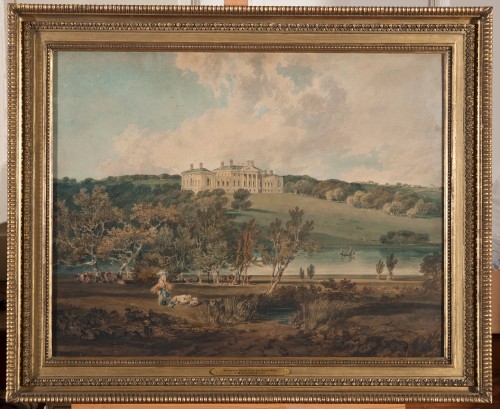
J. M. W. Turner, Harewood House from the South-West (1797).
Courtesy of Harewood House Trust.
(Click to see a larger version.)
We were careful here and throughout the exhibition to stress the convergences, rather than any direct meeting, of our two subjects. Their lives did intersect—on the streets of London, through country roads, and in the English towns and great estates that provided such a fertile subject for their creative endeavors. They both came of age in a shifting Regency world, and in important respects, their early years were shaped by the same global cultural, economic, and political forces and their lives by a protracted world war. Theirs was also a nation built on the extreme violence and doublethink of the slave trade, and characterized by growing campaigns for abolition and the slow, hindered path to liberation for millions of enslaved people across the British empire. As we sought to establish from the start, these global events had a bearing on everything that Austen and Turner did—often implicitly, as an underlying presence in their material world, but occasionally in more immediate and visceral ways.
The picturesque
Having introduced some early contexts for Austen’s and Turner’s lives, the exhibition then invited visitors to journey with them through the landscapes in which they walked and worked. The next four rooms focused on the aesthetics and politics of the picturesque, linking this artistic movement to wider ideas around creative composition, the visual and textual experience of moving through a landscape, and its global contexts. These rooms positioned the picturesque as a deliberate viewing strategy that turned the landscape into an aesthetic composition—and one whose popularity was fostered by a wealth of commercial products.
First, visitors entered a room usually staged as Princess Mary’s Dressing Room to find a wide variety of objects illustrating how the picturesque was accessed through the visual, textual, and material. This room showcased key discussions of the picturesque in the form of William Gilpin’s Three Essays: On Picturesque Beauty (1794), Thomas Rowlandson’s satirical A Tour to the Lakes (1807), Uvedale Price’s Essays on the Picturesque (1810), and a hand-colored copy of Humphry Repton’s Sketches and Hints on Landscape Gardening (1794), which cleverly shows before-and-after views of landscaped gardens. Tools such as a pocket telescope,a pedometer, a portable compass and sundial, and a Claude glass demonstrated how the picturesque required new products for walking and rambling. These were displayed alongside many of the outdoor-dress accessories mentioned in Austen’s fiction, including two parasols (one with an ivory handle in the shape of a pagoda), pattens, men’s riding boots, women’s ankle boots, a bonnet, and a shawl—all to equip those in search of picturesque views for a variety of weather. Such accessories were revealed to be essential for newly popular practices of walking and rambling, as shown by the windy and wet conditions in Nicolaus Heideloff’s Gallery of Fashion (to which the real-life Lady Lascelles was a subscriber).
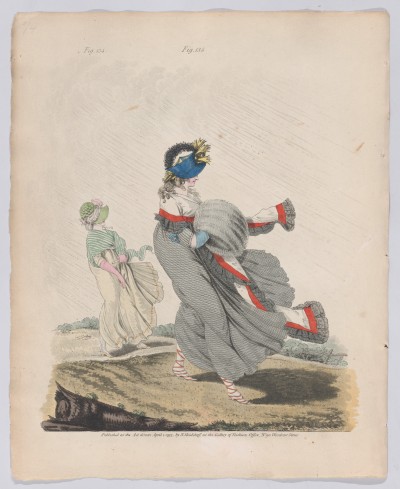
Nicolaus Heideloff, Plate from the Gallery of Fashion (v. 4 [Apr. 1797–Mar. 1798], London). Courtesy of the Metropolitan Museum of Art,
the Elisha Whittelsey Collection, 50.611.1(4).
A collection of paintings and sketches further underscored how picturesque aesthetics influenced professional and amateur artists alike. Items on display included a reproduction of Cassandra Austen’s portrait of Fanny Austen (early 1800s), where she shows her niece seated at a table and painting, as well as the sketchbook of Harriet Lascelles (1802–89), in which she drew views of the Harewood estate and local tourist spots like Bolton Abbey. Two Turner paintings illustrated the popularity of taking in scenic views of expansive vistas and ruins. A Turner watercolor, The Wharfe, from Farnley Hall (c. 1818), depicts a small group of women in the act of viewing the landscape before them; the telescope on a tripod in front of them draws our attention to perspective. Turner’s much larger and more imposing watercolor The Dormitory and Transept of Fountains Abbey—Evening, 1798, shows the famous ruins of a Benedictine abbey near Ripon, close to Harewood. Turner plays with an atmospheric mix of dusk and light in the evening scene, positioning the abbey as a picturesque view. Hints we drew out more explicitly in subsequent rooms of connections between Turner’s visual picturesque and Austen’s textual picturesque were teased here by copies of later editions of Northanger Abbey (1818).
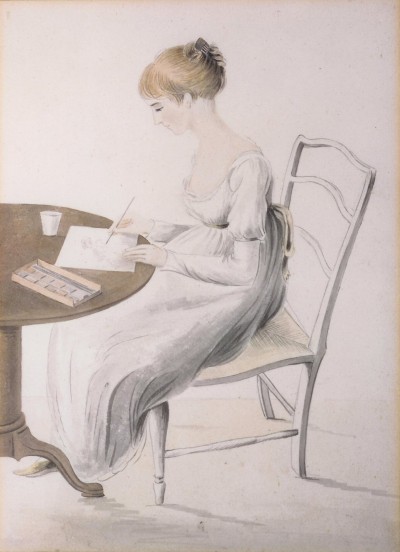
Cassandra Austen’s portrait of Fanny Austen (early 1800s).
Courtesy of Jane Austen’s House.
The rise of the picturesque coincided with the increasing popularity of domestic tourism, as any reader of Pride and Prejudice (1813) will know. In the later eighteenth and early nineteenth centuries, the Napoleonic wars made travel to the Continent increasingly difficult. As domestic tourism swelled, country houses, including Harewood, opened their doors to curious visitors. New guidebooks to country estates offered detailed information on picturesque parklands and interior décor, much of which was itself the product of tourism, sourced from travel abroad. A guide to Harewood from 1819 noted that the house was open to the public every Saturday, from eleven in the morning until four in the afternoon.
Tourists could purchase souvenir enameled writing sets, hand-painted with the exterior of Harewood on the outside and on the inside, the words “A Trifle from Harrogate.” These enameled metal boxes, with brass edging, were small enough to cradle in the palm of one’s hand or nestle in a pocket. Inside, two small ink pots made writing en route about one’s travels accessible to the picturesque tourist.
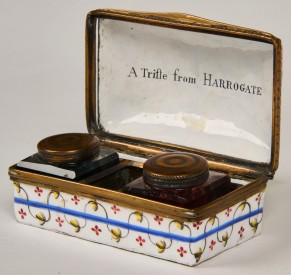 |
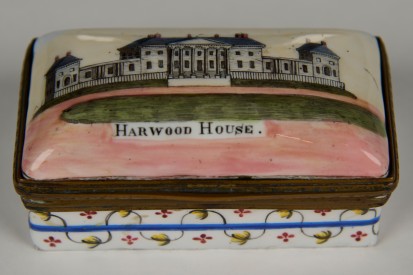 |
| Pocket writing sets (early 1800s). Courtesy of Harewood House Trust. |
|
After leaving Princess Mary’s Dressing Room, visitors walked through the East Bedroom, decorated with an eighteenth-century Chinese wallpaper mural featuring an idealized scene of industry in China, to arrive in a small gallery-style space (Watercolor Room 1) that opened into a larger room beyond (Watercolor Room 2). In the first Watercolor Room, we punned on the initial title of Pride and Prejudice to focus on “first impressions,” thinking about how Austen and Turner moved through the landscape, like Lizzy Bennet, to approach the exterior of the country house. As Cynthia Wall discusses, the approach to Pemberley possesses the “easy order and unaffected dignity of a Repton estate” (48). Here and elsewhere, we sought to communicate Austen’s deep knowledge of the picturesque and its key practitioners, as well as her innovative deviations from it through her skilled use of free indirect discourse and the “narrative picturesque.”2 A first edition of Pride and Prejudice was a focal point of this room, around which we displayed views of Harewood House from the southeast by Turner and his friend Thomas Girtin (1775–1802) from 1797 and 1801, respectively.
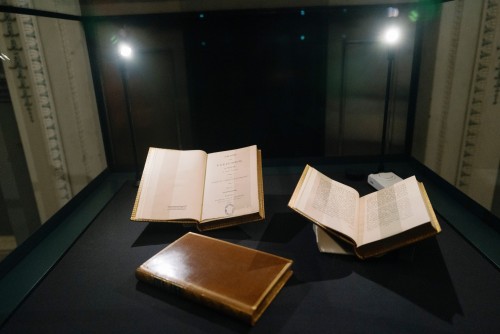
Jane Austen, Pride and Prejudice (1813).
Blackie House Library and Museum, Edinburgh. Photo Credit: Tom Arber.
(Click here to see a larger version.)
As visitors transitioned into the adjoining Watercolor Room 2, we delved deeper into the connections between approach, movement, and creativity. Organized around the concept of “creative journeying,” a central display case featured an 1813 letter written by Austen as she traveled to visit Henry in London and one of Turner’s portable watercolor sets and one of his sketchbooks, to convey the importance of travel to Austen’s and Turner’s lives and professional practice. The shifting perspectives and revisions made possible by movement were further emphasized by Turner’s series of prospects of Harewood House, including some of his preparatory sketches.
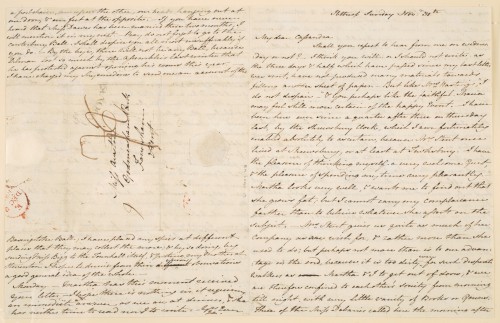
Jane Austen, Letter to Cassandra (20 May 1813). Courtesy of Jane Austen’s House.
(Click here to see a larger version.)
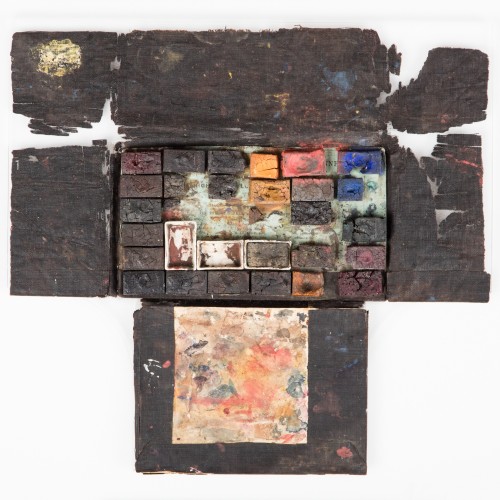
J. M. W. Turner RA, Traveling watercolor box owned by J. M. W. Turner, R.A. (c. 1842), 296 mm x 317 mm x 9 mm. © Photo: Royal Academy of Arts, London.
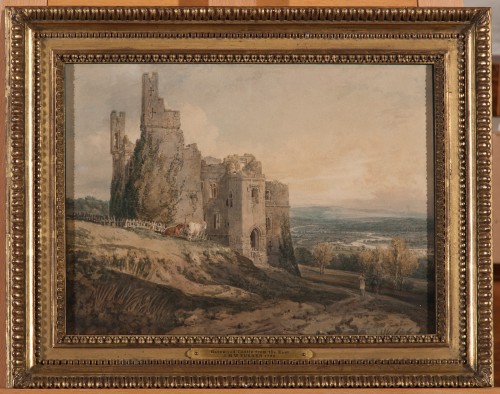
J. M. W. Turner, Harewood Castle from the South East (1798).
Courtesy of Harewood House Trust.
(Click to see a larger version.)
From here, the exhibition broadened from domestic landscapes and travel to consider how the picturesque aestheticized Caribbean landscapes as part of the colonial settler project. Turner’s mysterious scene Figures in a Storm (c. 1835–45) felt emblematic of the conversation we hoped to elicit, as the thread of empire and slavery was pulled increasingly to the forefront of our interpretation. In this watercolor, two figures walk away from us and seemingly toward a wet and blustery horizon. Grey, blue, and black hues swirl around them, in tumultuous strokes that seem to push against the composition’s dividing line of land and sky. It evokes the troubling complexities and moral compromises of the Regency period.
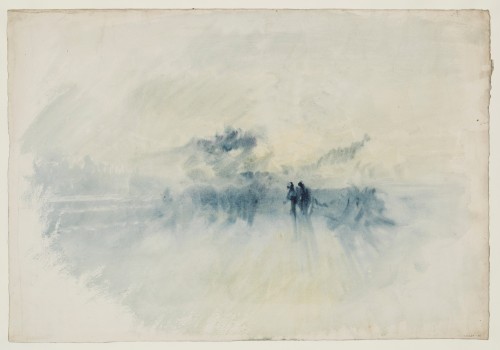
J. M. W. Turner, Figures in a Storm (c. 1835–45). Courtesy of Tate Britain.
Hoping to harness some of the disorder of Turner’s image, we reconceived Lord and Lady Harewood’s Sitting Room to focus on the “global picturesque,” which both reframed Caribbean spaces within a British aesthetic and frequently erased enslaved laborers and indigenous people from agricultural and plantation house views. The pieces on view in this room illustrated how the picturesque was complicit in colonialism and was used to impose a British colonial perspective on other places (Finch). The texts and images in this room worked to erase the enslaved people and plantation economy that continued to fund genteel Regency life abroad and at home.
In Turner’s 1798 view of Harewood from the south (on display in this room), laborers are shown working in harmony with the land. Like many landscape views, the perspective abstracts manual, agricultural labor, turning the rural poor into visually pleasing accessories (Barrell). The global picturesque mirrors this impulse by minimizing the presence of enslaved workers on British-owned plantations and denying the brutality of colonial life—a dynamic revealed in many of the images we exhibited in this room, including plans of plantations and estates such as Hole Town, Barbados, and illustrations in James Hakewill’s Picturesque Tour of the Island of Jamaica (1825). An 1838 monochrome pen-and-ink drawing of the Belle Plantation in Barbados, one of twenty-four plantations owned by the Lascelles family, is similarly typical in its grotesquely picturesque minimization of the horrific conditions in which enslaved people worked in the sugar cane field on the image’s righthand side.
Austen and Turner were aware of the effects of slavery on those living under its yoke and of slavery’s presence in the everyday lives of Britons who took sugar in their tea and wore clothes made of cotton. Austen and Turner also—and typically for Britons at this time—held family and personal connections to slavery on the one hand and the abolitionist movement on the other. An additional panel in this room identified Austen’s and Turner’s specific familial, social, and financial connections to slavery and empire. Early in his career, Turner invested in shares in a Jamaican cattle farm worked by enslaved people, and many of his patrons had direct involvement in the trafficking of enslaved Africans. He also supported abolition campaigns. The Austen family’s own complex ties to slavery are well-documented, most recently by Devoney Looser (Wild for Austen 189–200). Extended family, including the Leigh-Perrots, had investments in Caribbean plantations; John Cope Freeman, the Reverend George Austen’s cousin and godfather to Charles Austen, was owner of the Belvidere Estate in Jamaica, a hand-drawn plan of which we had digitally reproduced for this room. This plan was central to our curatorial approach for the way it makes visible the individuals erased from sources in a reference key that named enslaved laborers such as Peggy and Jack.
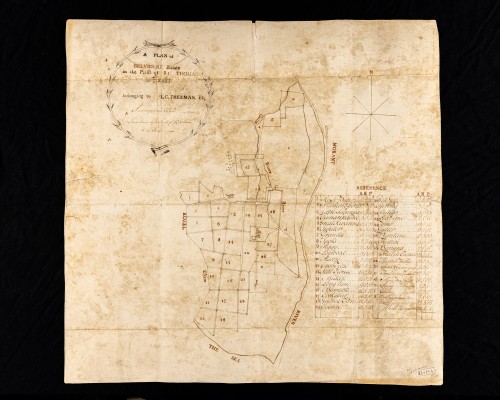
Plan of a Section of Belvidere Estate, St. Thomas in the East, Jamaica (1772). Courtesy of John Carter Brown Library, Providence, Rhode Island. Photo credit: Rythum Vinoben.
(Click here to see a larger version.)
George Austen was also linked—ambiguously, as Looser and John Avery Jones have elucidated—to an Antiguan sugar plantation owned by a former student through a trusteeship (Looser, “Breaking the Silence” [25–32] and Wild for Austen [192–94]; Avery Jones 33–48). Austen’s naval officer brothers, Frank and Charles, both traveled to the West Indies. When Charles died in 1852, his obituaries made much of his career after 1807, when he intercepted those involved in the, by then, illegal trafficking in enslaved people across the Atlantic. The same obituaries noted without contradiction that Charles’s wife, Fanny (1789–1814), whom he met in Bermuda, was the daughter of the island’s former Attorney General—as was his second wife, Fanny’s sister Harriet (1786–1867). Journals and sketchbooks by Austen’s brothers offered written and visual accounts of militarized harbors and colonized Caribbean landscapes that helped us to tease out further the Austen family’s links to empire and war. Here, as throughout the exhibition, we strove to write in clear and precise language about the human costs of country houses like Harewood. This cultural capital—many of the new mansions and country houses built in the period—depended on human capital, including the 3.5 million Africans who were trafficked by the British and forced to toil as enslaved laborers on British-owned plantations between 1662 and 1838.
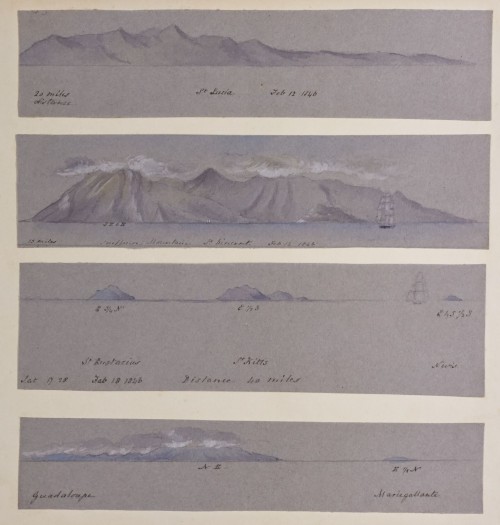
Admiral Sir Francis Austen, Cassandra Eliza Austen, & others,
Album of Sketches (1840s). Courtesy of Jane Austen’s House.
(Click here to see a larger version.)
We were eager to communicate to exhibition-goers that the global picturesque remains a live and ongoing subject, by placing contemporary artworks alongside historic artifacts and sources. The continuing conversation between the past and present featured prominently in the exhibition’s opening room, and we returned to it here, drawing on artworks in Harewood’s collection that call attention to the historic connections between the estate and the traffic and enslavement of African people. These included Emefa Cole’s 2024 untitled sculpture, in clay, bronze, and paint, of seven baobab trees, which speaks to the resilience of enslaved African people, and which was created for the 2024 Harewood Craft Biennial. Chris Day’s Under the Influence (2021) features large glass bottles encircled by copper piping, in which the distorted shape of the glass appears to resist the piping, gesturing toward the defiance and autonomy of enslaved communities. Day’s piece starts a conversation with the rum bottles, some 200 years old, that were found in Harewood’s cellars and were likely made by enslaved people who worked on Caribbean properties belonging to the Lascelles family. Lastly, Paul Hodgson’s large photograph shows a scene commemorating Dr. Geraldine Cooper’s musical showcase, Carnival Messiah, when it was staged at Harewood in 2007, to commemorate the 200th anniversary of the Abolition Act. Cooper reinterprets Handel’s Messiah, in music, dance, and costume, through the cultural history and practice of carnival, and Hodgson’s photograph shows an exuberant and vivid scene of performers from the same view painted by Turner in 1798, in Harewood from the South, which was displayed across the room. Hodgson’s use of scale and subject matter offer interventions to Turner’s perspective and use of the picturesque—themes very much in keeping with our curatorial approach to the global picturesque. These contemporary pieces also helped to prepare visitors to encounter newly commissioned works for the exhibition on show later in the route.
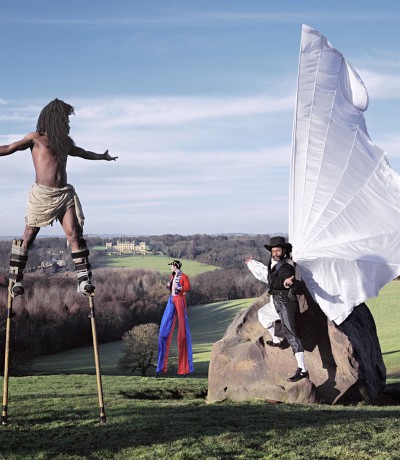
Paul Hodgson, Carnival Messiah 2007 (2007).
C-type photographic print. Courtesy of Harewood House Trust.
Empire, slavery, and the country house
Following the global picturesque, a room that was full of multiple kinds of objects (print, manuscript, visual, and sculptural), we slowed the pace in a smaller room, the Anteroom (to the State Bedchamber). This space, which we named “Silence and Slavery,” allowed us to pause on Austen’s and Turner’s most explicit references to slavery in their creative works.
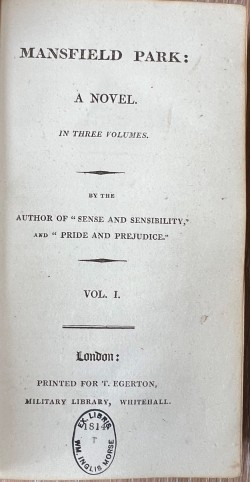
Jane Austen, Mansfield Park (1814). Courtesy of Blackie House Library and Museum, Edinburgh.
A first edition of Mansfield Park (1814) was exhibited in a small display case on the right-hand side of the room, open to the page where the notorious “‘dead silence’” (MP 231) that meets Fanny Price’s unspecified question about the slave trade is recalled. The conversation was reprinted on a large hanging banner above the case. A label on the text and accompanying room panel outlined specific allusions to the trafficking in enslaved people as well as the abolition campaign in Austen’s novel, and sketched out the immediate historical and political context of Mansfield Park (published seven years after the passing of the Abolition Act, but two decades before enslaved labor was abolished on British-owned plantations, in 1838). While seeking to avoid shutting down conversations about what the silence might mean, we wanted to emphasize how Austen’s readers would have heard in the Bertram family’s “‘dead silence’” on the slave trade, one of the most vital and politically urgent conversations of their day.
On the opposite wall, we exhibited a photogravure print of Turner’s Slave Ship (print 1900; original 1840), widely thought to have been prompted by the 1781 Zong massacre, in which 132 enslaved people, including children, were thrown overboard by the ship’s captain for insurance money. The print, which is considerably smaller than the original painting and lacks the visual and emotional intensity of its colored oils, was created for editions of art critic John Ruskin’s work. Ruskin’s family bought the painting in the early 1840s, and this version of the disturbing image was the one with which most nineteenth-century viewers would have been familiar. An accompanying label documented Ruskin’s attempt to come to terms with both the horrific violence of the image and its visual appeal. We are grateful to the Museum of Fine Arts, Boston for allowing us to show its important short video Perspectives on Turner’s Slave Ship, which explores the complexities of the picture in more detail, to visitors in the same room as the image and Austen’s novel.
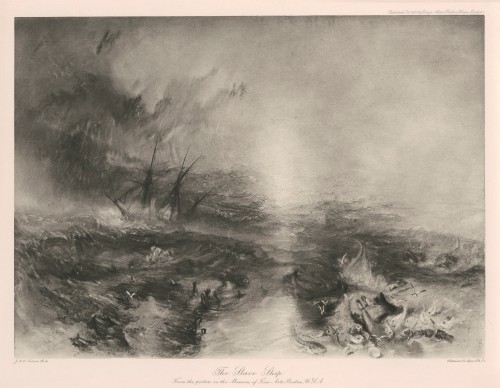
Allen & Co. after J. M. W. Turner, The Slave Ship (Slavers Throwing Overboard the Dead and Dying—Typhoon Coming On) (1900; orig. 1840).
Courtesy of Yale Center for British Art, Paul Mellon Collection.
(Click here to see a larger version.)
We sought to balance these depictions by white artists with the voices of Black authors from the period in a Chippendale bookcase, which was moved into the room. Here we displayed Harewood’s first editions of Olaudah Equiano’s The Interesting Narrative of the Life of Olaudah Equiano (1789) and Ignatius Sancho’s Letters of the Late Ignatius Sancho (1802). These books were placed prominently, open to the frontispieces of Equiano’s and Sancho’s author portraits, at eye level on the shelves. They were surrounded by the books of white authors who argued, to varying degrees, for abolition, including works by Thomas Clarkson, William Cowper, and William Wilberforce.
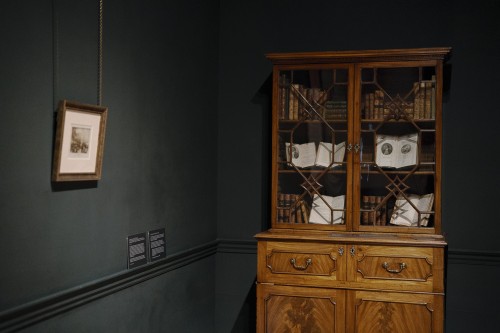
Chippendale Bookcase with Books by Olaudah Equiano, Ignatius Sancho, Thomas Clarkson, William Cowper, and William Wilberforce. Courtesy of Harewood House Trust. Photo Credit: Tom Arber.
(Click here to see a larger version.)
From the “‘dead silence’” of the Antechamber, the route continued into the State Bedchamber—a space we could not redisplay as part of the exhibition, for practical reasons. This presented an awkward spatial interruption to our narrative, and so we decided to insert an additional interpretation panel, “From Silence to Conversation,” that we hoped would encourage visitors to see through the performance of luxury in country house show rooms like this one. In it, we acknowledged that the state bedroom might appear worlds away from Turner’s depiction of the murder of enslaved people at sea, or Austen’s exposure of the Bertrams’ attempt to disconnect themselves from the slave trade through silence. Still, global connections and ties to slavery and empire are everywhere in state bedrooms like these. A commode in this room is decorated with satinwood, tulipwood, and ebony—materials imported from different parts of the British empire and cultivated and logged by enslaved people. Adorned with classical references to the Roman goddesses Diana and Minerva, the commode communicated not only the Lascelles family’s taste and classical learning but also their purchasing power and global connections.
Creative innovation
From the State Bedchamber, visitors moved into a succession of rooms where we shone a light on the creative practices, processes, and innovations of Austen and Turner as they evolved over the course of their careers. The first of these rooms, the Spanish Library, took Austen as its focus. Titled “Unfinished Endings,” the room juxtaposed Austen’s first and last novels in a rectangular display case. On the right, we exhibited two editions of Austen’s first published novel, Sense and Sensibility (1811): three slightly rougher and readier volumes still (remarkably) in their original boards; and the immaculate first edition bound in leather by the Lascelles family, embossed with the family crest and complete with neatly cut pages and marbled ends. We couldn’t help reflecting on what Austen would have thought had she known that her debut novel about the displacement of the Dashwood women had found its way onto the smart bookshelves of Harewood House. Scanning to the left, visitors could compare these public-facing, printed editions of Austen’s novels with the neat, small, and carefully filled pages of one of the notebooks in which she began, but of course did not finish, Sanditon (1817). Avoiding our own speculations, we nonetheless sought to prompt visitors to think privately about what might have come to pass if Austen had been able to complete what could have been her best and most ambitious novel—and, of course, her only novel to have included a character explicitly of African descent. This thread was followed also by the exhibition’s Artist in Residence, Lela Harris, who created a stunning, unfinished charcoal portrait of Austen’s West Indian heiress on a collaged ground of found papers from Harewood’s archive, which Harris chose “to anchor the drawing in Harewood’s complex colonial history” (“Miss Lambe”).
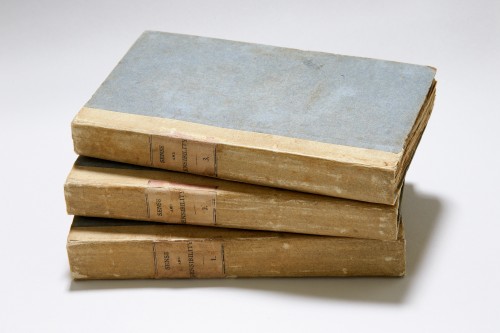
Jane Austen, Sense and Sensibility (1811). Courtesy of Jane Austen’s House.
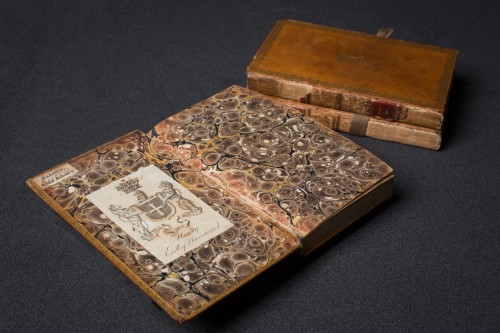
Jane Austen, Sense and Sensibility (1811). Courtesy of Harewood House Trust.
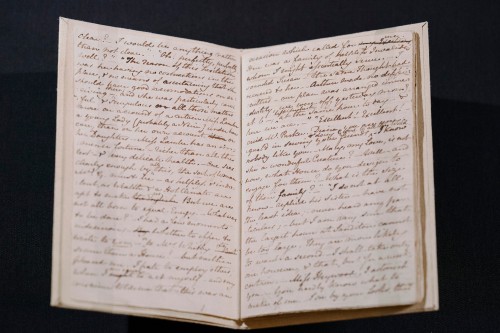
Jane Austen, Sanditon (1817). Reproduced with the agreement of the Provost and Fellows of King’s College, Cambridge. Photo Credit: Tom Arber.
(Click here to see a larger version.)
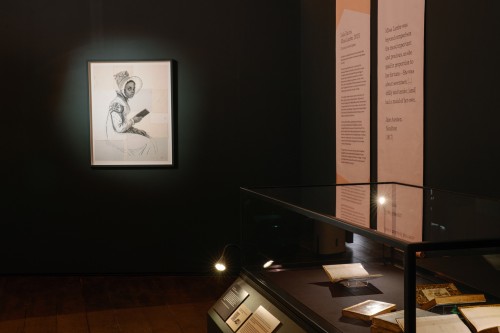
Lela Harris, Miss Lambe. © Lela Harris 2025. All rights reserved.
Photo Credit: Tom Arber and Harewood House Trust.
(Click here to see a larger version.)
From the Spanish Library, visitors moved to one of the most impressive rooms in Harewood House: the Main Library. Lined with books and paintings and with panoramic views of the mid-nineteenth-century Terrace and “Capability” Brown’s more naturalistically sculpted landscape beyond, the Main Library is a key room in the house: the site where visitors were first welcomed by the family. It is a room in which we felt both Austen and Turner would have been both comfortable and inspired. Indeed, it is in this space that their creative works do meet—in Austen’s books on the library shelves and in Turner’s two large oil paintings of the local nature spot Plumpton (then spelled Plompton) Rocks, which were commissioned specifically for this room.
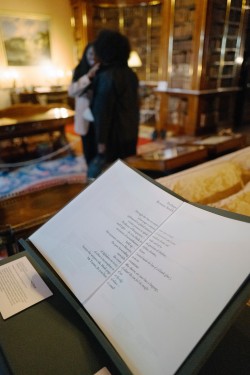
Rommi Smith, “Perhaps.” © Rommi Smith 2025. All rights reserved. Photo Credit: Tom Arber.
(Click here to see a larger version.)
For our exhibition, it was also the location of the work of Dr. Rommi Smith, Writer in Residence for the exhibition (and, indeed, the first official Writer in Residence for Harewood House). For her residency, Dr. Smith produced a series of poems engaging the historic materials and threads of the exhibition and drawing on her own research. The first two poems in the series, “Perhaps” and “Landscape #1,” were specially printed for display in the Main Library in collaboration with Thin Ice Press, at the University of York.
The large windows in the Main Library encouraged visitors to look out and into the expansive and attractive estate. But in Turner’s and Austen’s works, the country house also offered a window into the interior worlds of houses and humans. In the next room, the Yellow Drawing Room, we looked to Turner’s interiors. On one side of the room, we showcased a series of works associated with Turner’s visits to Petworth House, West Sussex. These sketches were displayed alongside the 1818 interior view of the drawing room at Farnley Hall, which similarly attends to the domestic interior and women’s activities within (Turner even depicted his own painting on the far wall). Less popularly known than his vivid scenes of sea, sky, and land, these gouache and watercolor scenes nonetheless use light and color atmospherically to depict intimate gatherings of men and women reading, in conversation, or at play, in ways that resonate with Austen’s novels. These small works were contrasted with Turner’s large, unfinished, and ambiguous oil painting Interior of a Great House (c. 1830), which hung on the opposite wall and which depicts an impressive, though hard-to-decipher, interior of a grand country house suffused in light, color, and mystery.
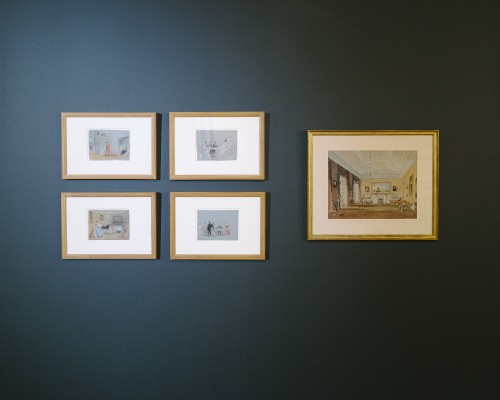
J. M. W. Turner, Four Sketches from Petworth House (1818, 1827). Courtesy of Tate Britain. Accepted by the nation as part of the Turner Bequest, 1856. Drawing Room, Farnley Hall (1818). Private Collection. Photo Credit: Tom Arber.
(Click here to see a larger version.)
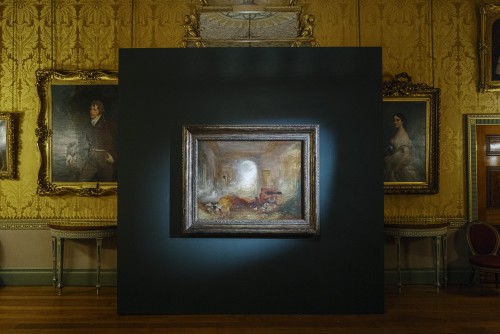
J. M. W. Turner, Interior of a Great House: The Drawing Room, East Cowes Castle (about 1830). Oil on canvas. Courtesy of Tate Britain. Accepted by the nation as part of the Turner Bequest, 1856. Photo Credit: Tom Arber.
(Click here to see a larger version.)
The age of sociability
The long eighteenth century is often described as an age of sociability—a time when polite conversation, pleasing manners, and easy relations between people carried new social importance. Our exhibition attempted to set Austen and Turner within their social contexts, pushing back against stereotypes of the isolated creative genius. We were eager to stress that sociability was about much more than taking tea and visiting neighbors; rather, it was a way of being in the world. Indeed, it was a reaction against the rigid standards of an earlier age, an untethering of the stiffness and formality associated with the courtly manners of the past. A dramatic social shift, already underway at the dawn of the eighteenth century, brought new opportunities for social exchange: coffeehouses, art exhibitions, museums, assembly rooms, and bright, airy shops. Imported goods—from tea, coffee, and porcelain to the Indian muslins Mrs. Allen and Henry Tilney discuss in Northanger Abbey—proved easy and fertile talking points. Domestic occasions fostered sociability, but so did shopping, walking, and visiting new cultural attractions, such as the Royal Academy summer exhibition. Britons talked and gossiped about art, novels, and each other.
In Austen’s hands, we wanted to suggest, the age of sociability is an opportunity to shine a light on those who speak with care, and those who still have lessons to learn about how to express themselves in the world. We foregrounded these themes in the Cinnamon Drawing Room with Harewood’s editions of Emma (1816) from 1909, 1912, and 1922. Emma was the ideal novel to exemplify how Austen’s novels mine both the comedy and drama of sociability, revealing their potential to pulse through a single setting or conversation. We drew attention to how the novel’s heroine entertains herself by observing and manufacturing drama in a series of sociable gatherings. These dramas are set against the backdrop of music, conversation, game playing, and shopping. Easy sociability—the adhesive of the Highbury community—comes unstuck when Emma Woodhouse ridicules Miss Bates at the Box Hill picnic. Other exhibits in this room shone a light on different technologies of sociability. A gossipy letter from Jane to Cassandra, written at Ibthorpe on 30 November–1 December 1800 and full of news about the comings and goings of the hours, weather, and local community, allowed visitors to see how Austen cast her perceptive eye on the telling details of everyday life. It also emphasized the importance of letter writing as a mode of communication, community building, and knowledge sharing in this period. The letter sat in a case alongside another sociable mechanism of Austen’s time and novels: music. Here we were fortunate to be able to exhibit one of the Austen family’s music books: a volume of handwritten music that was copied and compiled by Jane Austen, her sisters-in-law, and her nieces. Labeled “Songs, Duetts & Glees,” it includes four songs copied in Austen’s precise, confident hand.
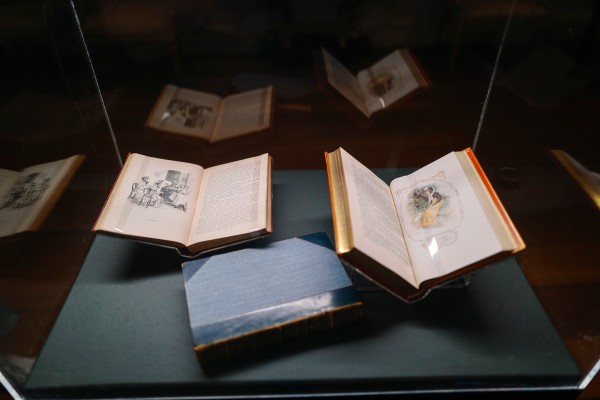
Editions of Emma 1909, 1912, and 1922. Courtesy of Harewood House Trust. Photo Credit: Tom Arber.
(Click here to see a larger version.)
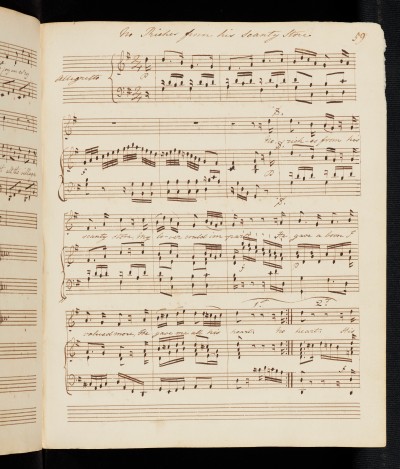
Jane Austen, Elizabeth Austen, Eliza Austen, Fanny Austen Knight, and Elizabeth Austen, Knight Album of Manuscript Music (c. 1798–1835). Courtesy of Blackie House Library and Museum, Edinburgh.
(Click here to see a larger version.)
As a regular artist-guest at Harewood, Farnley Hall, Petworth, and other country houses, Turner trained his eye not only on the architecture and surrounding landscape but also on the people who inhabited both stately spaces and private rooms. His candid sketches of domestic and family scenes at Petworth offer a glimpse into casual and familial moments, of music making, reading, and conversation. But Turner could also shade communication with drama and danger, a moment captured in his elusive 1830 canvas Two Women with a Letter, which was displayed in the Cinnamon Drawing Room, among Harewood portraits. Turner’s piece is magnetic, arresting, and mysterious all at once. In this oil painting, Turner draws us inside to show two women: one who looks out at us, and another with her back to us. His composition centers the neck and shoulders of the woman with the dark, swept-up hair. She holds a letter behind her waist, away from the fair-haired woman. What does the letter say? Why is it being withheld in such a dramatic way? Who are these women to each other? Turner hints at the tensions of letters and the desired, or perhaps unwanted, intimacies they might bring. His painting shows a less familiar side to his creative expression, where human forms shape the tensions of the canvas.
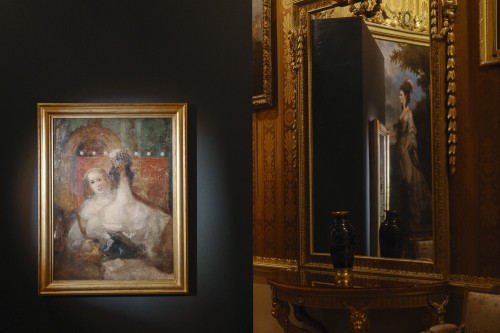
J. M. W. Turner, Two Women with a Letter (c. 1830). Oil on canvas.
Courtesy of Tate Britain. Accepted by the nation as part of the Turner Bequest, 1856.
Photo Credit: Tom Arber.
(Click here to see a larger version.)
Conversations with Austen, Turner, and Harewood House
Our thread of sociability continued into the exhibition’s final room, the Dining Room, where we returned to our emphasis on conversation: what would Austen and Turner have said to each other? What would we say to them? We concluded by inviting visitors to add their voices to the conversation by completing conversation cards that were set on a long plinth stationed before the enormous dining table.3 Our conversation cards were featured alongside creative writing prompts devised by Writer in Residence Dr. Rommi Smith. On these many cards, which we have carefully read and filed, we have responses from visitors of all ages and many countries. Some wrote poems about Austen and Turner or wrote inquiring and admiring letters to them. Some drew pictures or imagined what Austen and Turner would have thought if they could have seen the exhibition. Many visitors reflected on how the exhibition had prompted them to think about Austen and Turner differently, or documented what Austen’s and Turner’s work means to them now in our own difficult and turbulent world. In the same room hung the exhibition’s largest Austen quotation banner featuring words from Persuasion (1818): “‘My idea of good company . . . is the company of clever, well-informed people, who have a great deal of conversation; that is what I call good company’” (162). Austen and Turner have certainly provided us with “good company” over months of planning and staging the exhibition, and we hope that “Austen & Turner: A Country House Encounter” starts new lines of conversation about these figures’ works and advocates for the animating potential of the imaginative encounter as a means to shine new light on familiar figures.
NOTES
1This was one of three London art exhibitions Austen visited in May with Henry. On May 21, she visited the exhibition in Spring Gardens and on May 24, she visited the British Institution to see a retrospective of the works of Sir Joshua Reynolds. The latter exhibition is one of the subjects of Janine Barchas’s digital reconstruction What Jane Saw.
2See Wall’s persuasive analysis of Austen’s “narrative picturesque” (212–21). See also Julie Park on Repton and landscape design in relation to Mansfield Park, and Mary Beth Tegan on the picturesque as a narrative strategy in Persuasion.
3These conversation cards were adapted from previous public events organized by Chloe Wigston Smith and Jon Mee, at the V&A, London, and Mansion House, York, thematized around the “art of conversation.”
