Introduction
Jason D. Solinger
Every literary achievement is an adaptation, or a creative retelling. Some of the best British satires of the early eighteenth century adapted the work of the ancients. Shakespeare retold English histories. The novel genre itself is an adaptation, twisting and twisting together such genres as romance, epic, travel writing, captivity narrative, and criminal biography. Despite being by definition derivative, retellings often achieve their own canonical status, at once avoiding and spurning the stigma of derivativeness; recall Bertolt Brecht and Kurt Weill’s The Three Penny Opera, Jean Rhys’s Wide Sargasso Sea, David Henry Hwang’s M. Butterfly, or Percival Everett’s James. From Harold Bloom’s “anxiety of influence” to Deleuze and Guattari’s “deterritorialization,” critics and theorists supply a rich vocabulary linking the impulse to retell to creative innovation. And, yet, if we’re being honest, are not most Austen retellings conspicuously derivative and joyfully so? What literary pleasures, what kinds of Austen-related (and unrelated) knowledge are made available by Austen’s bad copies, the beach reads and spinoffs? “I can imagine no greater waste of energy than an elaborate demonstration that Jane Austen is a better writer than Georgette Heyer,” Lillian Robinson remarks in her essay, “On Reading Trash” (220). Following in Robinson’s footsteps, the flash essays that follow are more interested in the pleasures and prolificness of Austen derivatives—the ever-accessible satisfactions that Pauline Kael called “the fun of trash” (221).
In the first essay, on one of my favorite Pride and Prejudice retellings, Paula Marantz Cohen’s Jane Austen in Boca (2002), I discuss what makes Austen’s fiction a useful template for ethnic stories in modern pluralistic settings. The “beachy-ness” of this beach read, I argue, ultimately owes less to its South Florida setting than to its unapologetic derivativeness, the chutzpah with which it uses its source material. Indeed, a big part of what makes retellings so much fun for many Austen fans, and for the writers in this forum, are the substitutions that provoke a kind of double reading: a playful oscillation between the copy and the original, through which readers may come to better understand Austen by delving into something else: Jewish humor, Beltway scandals, faculty politics, Los Angeles neighborhoods. Reading retellings involves decoding, figuring out how and why this setting or that situation or that character corresponds to places, circumstances, and people in Austen’s built worlds.
In her essay on Julia Sonneborn’s By the Book (2018), an adaptation of Persuasion, and Lauren Edmonson’s Ladies of the House: A Modern Retelling of Sense and Sensibility (2021), Carolyn Brown suggests that such adaptations offer at least two pleasures: appreciating clever translations of Austen’s characters, milieus, and problems, and identifying new spheres of experience that cry out for Austenian commentary. As Robin Henry observes in her essay on Carrie Cracknell’s Persuasion (2022), retellings potentially expand Austen’s audience while fostering a community of insiders, whose detection of Austen allusions is a Janeite shibboleth. Austen retellings in recent years have certainly expanded their representational inclusiveness. Against the backdrop of this trend, Alice Villaseñor examines the 2011 romantic comedy From Prada to Nada, illustrating how Austen’s self-described focus on three or four families in a country village enables a new generation of storytellers to explore wider vistas of colonial and racial histories. Where several of the essays intimate that the genius of Jane Austen lies in her inimitable style—as D. A. Miller quips, when Austen’s wit “is not sharp, keen, cutting, or incisive, then it is brilliant, dazzling, crystalline, sparkling, glittering, coruscating, diamondlike, lapidary, precious” (23)—the final contribution, from Rachel Gevlin, describes a classroom assignment that helps students to see why generative artificial intelligence (AI) has a long way to go before it can hope to replace Jane Austen.
On Jane Austen in Boca
Jason D. Solinger
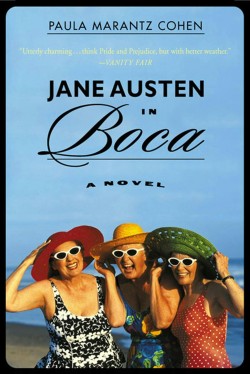
The first line of Jane Austen in Boca (2002)—“Mrs. Grafstein is DEAD!” (1)—does not have the ring of Pride and Prejudice’s opening maxim. But the bathos of the implied comparison sets the comedic tone for a novel that’s more Yiddish than British. Set in the Jewish-American environs of Boca Raton, Florida—that real-life borscht-beach town for New York and New Jersey retirees—Paula Marantz Cohen’s retelling foregrounds what makes Pride and Prejudice so adaptable: the novel’s preoccupation with conduct. In his brilliant study The Country and the City, Raymond Williams characterizes this preoccupation as “a testing and discovery of the standards which govern human behavior in certain real situations” (113). Austen’s status as a classic author makes it easy to forget that her novels’ situations are not simply universal but also historically peculiar, provincial, regional, ethnic, and even tribal, which is to say Austen writes about “certain real situations” (emphasis added).
Never mind Regency nostalgia, the fantasy of a placid, bygone era. Williams reminds us that Austen’s world is “no single, settled society” (115). Rather, her novels are “chronicles of confusion and change” viewed not from 30,000 feet but rather from up close: in country village assemblies, across dinner tables, in chance meetings on the road into town. What makes Austen so compulsively adaptable is that the times are always changing. So the preoccupation with conduct—this testing and discovery of the standards that govern human behavior—is, paradoxically, an historical constant. New people are always moving into the neighborhood, social arrangements are always shifting, new alliances come into being. Emma decides to go to the Coles’ dinner party, Darcy and Mr. Gardiner (I imagine) become hunting buddies, the sea-faring Crofts reconfigure domesticity and hospitality at Kellynch Hall and abroad. As the world turns, we look to conduct to figure out how to get along. And by get along, I mean not just get along with each other but also to get along in the world, to meet life’s challenges, to weather its seasons and dislocations, to succeed and survive on new terrain, figuratively and literally.
Is it any wonder that artists continue to regard Austen as a useful template for testing, discovering, generating, and disseminating the standards that govern human behavior? The rhetoric of Austen Updated—all the book blurbs promising a modern twist—reveals that Austen’s afterlives are as long as modernity. Jane Austen in Boca, after all, takes place in one of South Florida’s many retirement communities, whose residents strive to reconcile their old younger ways with the new older ways: locating the best Jewish deli in Boca, reprising New York cultural life at the Jewish Community Center (where the characters watch a documentary on the New York Intellectuals), infusing their new lives of leisure with the Yiddish humor of Lower East Side shopkeepers. Where Austen’s fiction raises the question of what constitutes gentility once status is detached from land, Jane Austen in Boca tackles a problem endemic to late-stage capitalism and later stages of life: to what extent are we defined by our work?
The residents of the Boca Festa retirement club do not exhibit symptoms of the retirement identity crisis described in today’s wellness discourse. But they do size up people according to their past careers with the precision with which Austen assigns income to estates. Where the novel warns against the dangers of bogus “big machers” (the Jewish-American Wickhams of the world), it reserves some compassion for its version of Mr. Collins, a Mr. Hy Marcus, who hangs his hat on the status and successes of his children. Generational progress, after all, is the ethnic American dream, a key motif of twentieth-century Jewish-American fiction. Embedded in Cohen’s novel of arthritic-era courtship is this American narrative, one that tracks the progress of Jewish immigrants and refugees from the margins of American life to the centers of economic and cultural activity. In addition to its namesake, Jane Austen in Boca evokes the writing of Philip Roth—for example, this passage from Goodbye, Columbus (1959):
The neighborhood had changed: the old Jews like my grandparents had struggled and died, and their offspring had struggled and prospered, and moved further and further west, towards the edge of Newark, then out of it, and up the slope of the Orange Mountains, until they had reached the crest and started down the other side, pouring into Gentile territory as the Scotch-Irish had poured through the Cumberland Gap. (64)
Roth’s Neil Klugman, the narrating protagonist tongue-in-cheekily evoking America’s expansionist mythology, is of the generation depicted in Jane Austen in Boca. Forty-three years later, these Jews of the Silent Generation have found comfort and in some cases prosperity an additional 1,200 miles south, in a beach town where they would not have been welcome in 1959. Cohen’s Darcy, Stan Jacobs, is a professor emeritus, and her Bingley, Norman Grafstein, an importer—one with cultural capital, the other with actual capital—two sides of the same coin, achieving forms of success neither available to earlier generations nor to all Americans in their generational cohort. One of those is Cohen’s version of Elizabeth Bennet, Flo Kliman. Reflecting on her life and late husband, this twenty-first-century Lizzy thinks like I imagine Austen’s heroine thinking, if Lizzy Bennet lived into her 70s: “Flo felt she’d been lucky in her husband, as she had been in her career, but she still suffered pangs of envy when she saw women a generation younger who’d been able to embark more aggressively on their own paths. And her envy turned to awe when she looked at the present generation of young women” (55). Flo is the only female character to have had a career, as a librarian, an occupation often stereotyped as boring and gendered as feminine. Her pangs of regret make sense. She’s funny and sarcastic, self-deprecating and quick with insults—less like Lizzy Bennet than Joan Rivers, the comic pioneer who was lauded and reviled for her “undisguised and ‘unladylike’ desire for success” (Dockterman). You’ll find Rivers’s blurb on Cohen’s book jacket. Her measure of the novel: “I can’t imagine a more perfect afternoon than sitting by a pool reading Jane Austen in Boca.”
Is Cohen less lyrical than Roth, or more of an age and less for all time than Jane Austen? Does it matter? If Jane Austen in Boca is a beach read, in large part that’s because the novel demands that we think about another novel. Cohen’s novel is “derivative.” But I mean that in a neutral, not a disparaging way. Jane Austen in Boca uses Pride and Prejudice to make anthropological sense and satirical fun of a particular subset of society at a particular moment in time. In the words of Flo Kliman’s niece, a documentary filmmaker who channels Cohen, “Here we have an enclosed, homogeneous community in which very intricate and elaborate relationships are generated. It’s the ideal narrative material” (172). Austen’s readers, including authors like Cohen, continue to use Austen’s fiction to demystify the “intricate and elaborate” relations governing “enclosed, homogeneous communities,” which are never entirely enclosed nor entirely homogeneous. In fact, that’s the point. Austen’s fictions may be about courtship and romance, but as courtship narratives they are themselves vehicles for apprehending as well as enabling historical change, the most conspicuous manifestations of which are changes to the neighborhood. No wonder Austen keeps being used to tell stories about ethnic communities and generational change.
Desperately seeking the best Austen adaptation
Carolyn J. Brown
From Jane Austen in Boca to From Prada to Nada to the 2022 film version of Persuasion, my co-authors and I traverse the adaptation spectrum, seeking answers to the multitude of questions that Austen adaptations raise. My question for consideration—“What distinguishes a successful Austen adaptation from one that is not?”—reminded me of the response of Supreme Court Justice Potter Stewart, who famously said, “I know it when I see it” when attempting to define pornography. After reading and watching a plethora of Austen adaptations, I had a similar reaction. Two recent novels, however, stood above the rest and led me to more precise criteria for a definition of a “successful adaptation.” Julia Sonneborn’s By the Book (2018), an adaptation of Persuasion, and Lauren Edmondson’s Ladies of the House: A Modern Retelling of Sense and Sensibility (2021) are accomplished twenty-first-century works of fiction that share identifiable markers with their Austen counterparts, such as recognizable characters, narrative elements, and themes, along with a sharp sense of humor and wit, making them particularly effective adaptations that successfully stand on their own.
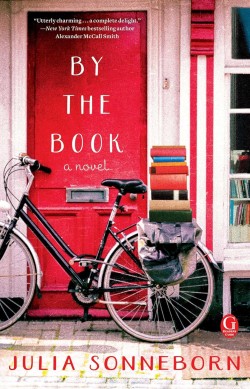
First, both novels stay true to the familiar plot lines of their predecessors but find contemporary equivalents in setting and characters that, as Inger Brodey states, “maintain the spirit of [Austen’s] work, especially her incisive depth and incomparable wit.”1 For example, By the Book, like Persuasion, begins in the fall and ends in the spring, cleverly following a single academic year at a small fictitious California college. The protagonist—thirty-one-year-old, tenure-seeking Victorian literature professor Anne Corey—remains heartbroken ten years after ending her engagement to her college boyfriend, Adam Martinez. When the novel opens, Anne Corey, like Anne Elliot, is not at her best: her office is in a “disheveled” (2) state, filled with overdue library books, empty Starbucks cups, and a broken clock. Sonneborn enforces the parallels to Persuasion throughout: from Anne’s declaration in chapter 1 that “[a]t Princeton, I was a nobody” (13); to Adam’s rescuing her when her young nephew “fastens himself upon her” (86) at the fall carnival; to Adam’s overhearing that Anne rejected his brother’s marriage proposal; and, finally, to a romantic letter and re-engagement to Adam at the end. Sonneborn also includes characters with familiar counterparts, like a college mentor aptly named Professor Russell, who dissuaded Anne from marrying Adam a decade earlier, and Anne’s father, who, like Sir Walter Elliot, contributes much comedy.
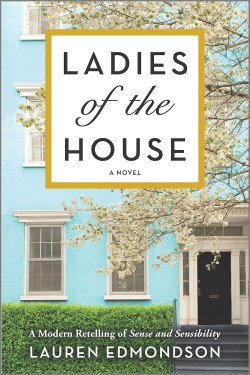
Ladies of the House follows a similar formula. Like Sense and Sensibility, the novel opens with a family of women facing much-reduced circumstances: these women are posh Georgetown elite forced to dramatically downsize after the death of their beloved father and husband. The memory of the family patriarch, however, is not so sweet: the Senator-father of Daisy and Wallis Richardson (Elinor and Marianne, respectively) had a much younger secret mistress on whom he spent the family’s fortune, and the ensuing scandal has left the family destitute, isolated, and vulnerable to attacks from both D.C. society and the angry taxpayers whom he represented. Complicating matters further, Daisy is in love with her best friend, who is already engaged, and Wallis has rival Willoughby- and Brandon-esque characters fighting for her affections. As one reviewer writes, “shift[ing] the action from Regency England to present-day Washington D.C., a place with a social scene every bit as byzantine and ruthless as that of the ballrooms of 19th-century London” is extremely effective. “In both a single misstep can have devastating consequences” (Elliott).
Finding a parallel setting and set of characters goes a long way towards achieving a successful adaptation, but more is required to make it truly engaging. According to Devoney Looser, “What’s most challenging for any adapter [is] capturing [Austen’s] fiction’s incredible combination of comedy, irony, and social criticism” (Andrew). William Galperin states that since the “marriage plot is the mere scaffolding,” a successful adaptation will be concerned, as Austen is, with “familial duty, conformity, and precious independence” (Andrew). Both By the Book and Ladies of the House achieve these criteria. By the Book, for example, not only smoothly blends the comic and serious, but also includes strikingly original and modern characters, like Anne’s ailing father. No pretentious Sir Walter, he introduces a poignant theme of parental caregiving that many readers can relate to. Sonneborn includes hilarious English Department colleagues, who are easy targets of ridicule; laugh-out-loud contemporary satirical scenes, such as a Beverly Hills book club where too much preparation is frowned upon; a hilarious Twilight/Jane Eyre movie adaptation entitled “Jane Vampire”; and allusions to Pride and Prejudice that take By the Book in a darker direction—for example, a “Wickham-like” predator of young female students who also is guilty of shocking academic plagiarism. Finally, Sonneborn cleverly incorporates emails that move the narrative and echo Austen’s use of letters to achieve the same effect.
Ladies of the House closely adheres to its predecessor, too, successfully building upon Sense and Sensibility’s foundation while showcasing Edmondson’s own spin on the material. The most prominent example is the author’s expansion of the role of Mrs. Dashwood, giving her counterpart, Washington widow Cricket Richardson, a stronger and more sensitive storyline. She must overcome the ugly truth of her husband’s infidelity and, destitute and dependent on her daughters, must start a new life on her own. Intense D.C. political scandal and intrigue may update the plot, but the gossip and familiar female financial drama remind readers that the eighteenth and twenty-first centuries are not that far apart.
Both Julia Sonneborn’s By the Book and Lauren Edmondson’s Ladies of the House blend Austen old with twenty-first-century new to create original works of fiction. The contemporary settings accommodate the plot lines of Persuasion and Sense and Sensibility, resetting episodes and characters within their new frameworks. But what makes these novels stand out from the crowded adaptation field is their modern and creative re-imagining of the heroines and the struggles they face. Julia Sonneborn’s version of Anne Elliot as a tenure-seeking, research-driven young professor with a messy life, dealing with eldercare issues, dangerous men, and college politics, works beautifully as an update of Austen’s novel. Daisy Richardson also succeeds as a modern-day Elinor Dashwood: when presented with similar financial and romantic straits that threaten her own career and her family’s welfare, she stays reasonable and relatively calm amid the associated chaos and scandal. Daisy is surrounded by a cast of characters similar to Elinor’s, but they are not exactly the same: her mother is given a greater and needier role; her rival for the affections of the man she loves is actually likable and not a cunning Lucy Steele; and her father’s sudden death in the arms of a lover is a sordid business. Within the pages of these updated stories, we still easily recognize our favorite heroines and familiar frameworks, but they have been redesigned in completely new configurations.
What Austen fans want
Robin Henry
Austen fans are spoiled for choice in adaptations, and the demand is high. Although many elegant exemplars exist, it seems that fans are always willing to entertain another adaptation of the work of their favorite author. Adaptations take many forms: they can be books or films set in the Regency period, updated versions, fanfictions, and even mashups—time travel and zombies come to mind. What do Austen fans want in an adaptation? Why are some adaptations hailed as fan favorites, while others languish, nearly universally loathed?
Creating an adaptation, whether a book, film, or work of fanfiction, requires the adaptation to be in conversation with the adapted text. Linda Hutcheon and Siobhan O’Flynn argue that “[a]daptation is repetition, but repetition without replication” (7). The intertextuality may come in the form of Easter eggs, references to the adapted work or other related works, or even in some cases to other adaptations. These references serve as inside jokes to fans of the original. By nodding to the existence of the parent text, the adaptation signals “in-group” affiliation to its fans (Henry 59).2 Other criteria for a successful Austen adaptation include capturing the essence of the original, reproducing the sparkle and wit of the original work, and maintaining fidelity to the original characters (Macdonald 6; Moore 196). These additional criteria allow the Austen fan to identify the intertextuality of the adaptation—the way in which the adaptation interprets their favorite author’s wit and charm. As we will see, in some cases fans find the adaptation acceptable in terms of its nods to the parent text, while in others they do not.
Two adaptations of Persuasion will help develop these ideas. Persuasion is a frequently named favorite novel for mature Austen readers. Though readers may come into Austen’s orbit via Pride and Prejudice, Anne Elliot’s quiet strength delights readers as they age. Most fans will list the 1995 film version, directed by Roger Michell and starring Amanda Root and Ciaran Hinds, as the definitive one, though others exist. Syrie James compares the film versions of Persuasion in a blog post, calling the 1995 version “[t]he most faithful adaptation to the source material.” In an unofficial poll of Austen fans at a dinner table at the 2018 AGM, everyone except me preferred the 1995 version over others. The 2022 Netflix version, with Dakota Johnson and Cosmo Jarvis, is widely derided among Austen fans and others for many reasons. Amanda Diaz quoted Claire Watson, a student at Australian National University, who summed it up beautifully: “The newest Persuasion film feels less like a genuine attempt to engage with Austen’s novel and more like a patchwork of everything that they thought might appeal to Gen Z.” If we look at the ways the Netflix adaptation engages with the source text, we will perhaps see where director Carrie Cracknell went wrong.
The essence of the novel is Anne’s second chance with Captain Wentworth and her blossoming at the advanced age of twenty-seven. Anne begins the novel as the responsible sister who must manage for the rest of her family, though they consider her inferior. She accepts her responsibility in refusing Wentworth initially, but dares to hope when she learns of Louisa’s engagement to Benwick. Several exchanges, notably with Captain Harville, indicate Anne’s intellectual depth, and comic relief is provided by the vapid Sir Walter and Anne’s pretentious sisters.
In the 2022 adaptation, the tone or essence of the film does not align with Austen’s story; neither does the “representation of Anne’s character,” as the filmmakers “drastically altered the disposition of the protagonist” (Vandenberg 127). Anne has been transformed from a character who knows her duty and loves deeply to one who day-drinks and lies around feeling sorry for herself. As for sparkle, it is completely missing (Brown 21). Take, for instance, the scene in which Anne drones on about how she’s been pining for eight years (eight years of melancholy). Although Austen’s Anne may regret her decision and may still love Frederick, she has not let her despair become her defining motive. She continues to be of service to her family, and even tries to encourage Benwick to throw off his depression by reading something other than melancholy poems. Austen’s Anne knows her worth.
The Anne of the Netflix production does not. Trying to gain attention and to make herself desirable, she breaks the fourth wall to intone, tipsily, at the dinner party with Wentworth that Charles wanted to marry me first.” Her drinking has caused viewers to link this adaptation to the television show Fleabag rather than to Austen’s novel. By contrast, in Austen’s text, Anne does not use the information that Charles has asked for her hand to hurt her sister or gain attention. She keeps it private.
A good Austen film adaptation may have many fine qualities—period costumes, beautiful locations, perhaps even a wet linen shirt—but without including the essence of the original, the sparkle and wit of Austen, and remaining true to her characterizations, it will be unsatisfying to Austen fans, and in most cases to other viewers. One benefit of adaptations is that they bring new readers to the source texts. Sales of Austen’s books and new editions inevitably follow film adaptations (Troost and Greenfield 1). In fact, polling Austen fans at any JASNA regional meeting will reveal that many members have come to Austen through first viewing a film adaptation. Good adaptations can draw them into exploring her entire oeuvre. Whatever the Austen reader thinks of adaptations, bringing more readers into the fold is surely a goal worth striving for.
Colonialism and color-conscious casting
Alice Marie Villaseñor
When it comes to films of Austen’s novels set in modern times, several adaptations feature multiracial casts but make little or no direct comment on race. For example, while Pemberley Digital adaptations like The Lizzie Bennet Diaries (2012–13), Welcome to Sanditon (2013), and Emma Approved (2013–14) feature racially and ethnically diverse actors, the dialogue and plot lines do not include explicit references to race or ethnicity. And while Clueless (1995) plays on some racial stereotypes, for the most part, race and ethnicity are not directly spoken about. One important exception is the scene in which Cher insults Lucy, the El Salvadorian maid, by reminding her to speak to the gardener (José) about clearing out the bush because Cher does not “speak Mexican.” Lucy snaps back: “I am not a Mexican!” And Josh explains to Cher why her comment is offensive: “Lucy is from El Salvador. It’s an entirely different country. You get upset if someone thinks you live below Sunset.” While this scene provides another example of Cher’s cultural ignorance and self-centeredness, her comments are not read as malicious by Josh, who calls her “a brat” as she storms out of the room.
In other adaptations written by persons of color (POCs), conversations about geography and language are much more intentional, as they contribute to larger arguments about race in contemporary culture. For example, when discussing Indian adaptations of Austen’s work, several critics have written about color-conscious casting and the “cultural and political tensions that result as a consequence of adapting canonical work of one’s former colonizers” (Villaseñor and Blandón 233).3 From Prada to Nada—a Latinx version of Sense and Sensibility—is also a film that employs color-conscious casting to highlight its themes about colonialism and racism more generally.
In a 2022 Persuasions On-Line article, I discuss how From Prada to Nada adapts Austen’s ideas of displacement—specifically, the Dashwood family’s move from Norland Park in Sussex to a small cottage in Devonshire—to explore Anglocentrism in Los Angeles. The screenplay went through two major rewrites, as Fina Torres and Luis Alfaro adapted the original version by Craig Fernandez (Fernandez, Interview). Since the publication of that Persuasions On-Line piece, writer Craig Fernandez has shared with me the original version of his screenplay, “Sensibilidad.” This initial version emphasizes the layering of colonialism on the Los Angeles area through a map motif. The first images of the film, for example, were envisioned as a map of North America that “rachets” down to the Los Angeles area where “a tiny drawing of a single mission appears to the south, and then like PIMPLES, the LINE OF MISSIONS continue northward” (1). Layers of maps show different years and different colonizers: from the 1780s “TERRITORY OF THE SPANISH EMPIRE,” to the 1820s “TERRITORY OF THE UNITED STATES OF MEXICO,” to the 1860s “TERRITORY OF THE UNITED STATES OF AMERICA” (1). The influence of different cultures—including the erasure of the Spanish influence on the very name of the city—is emphasized as the map motif continues to take us to the present day:
Black lines NOW cross out “El Pueblo de Nuestra Senora, La Reina de . . .” leaving only LOS ANGELES as the cities name . . . and then in rapid succession, FOUR NEW MAPS in thirty year leaps (1890, 1920, 1950, 1980, 2002). (1)
This map motif appears throughout Fernandez’s “Sensibilidad” manuscript, emphasizing the similarities between the displaced Dashwood family and the displacement of the Spanish culture by Anglo influences. Furthermore, the plot of this first version is organized around three Mexican holidays: Cinco de Mayo, El Grito de Independencia (the only Mexican holiday to remain in the final version of the film), and an engagement party on November 20, the Anniversary of the Mexican Revolution. Organizing the storyline around these celebrations of territorial battles further emphasizes the colonial themes of the film.

Signage (instead of a Map) Denoting the Sisters’ Move from Beverly Hills to East Los Angeles. From Prada to Nada © 2011 Pantelion Films.
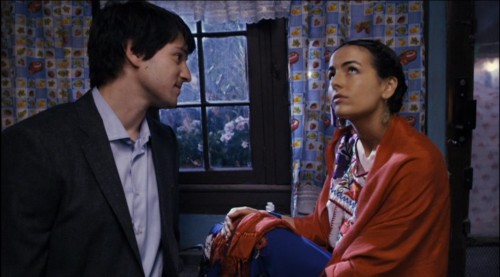
Nora/Elinor (Camilla Belle) and Edward (Nicholas D’Agosto) Celebrating El Grito de Independencia. From Prada to Nada © 2011 Pantelion Films.
As I argued earlier, the Spanish language—who speaks it and how it is perceived as “foreign”—is an important running theme of the final version of the film. I argue that the film “calls into question what a foreign language is, who defines these terms, and on what grounds” (Villaseñor). Both Nora/Elinor and Mary/Marianne learn to speak Spanish through the course of the story as a means of getting to know their own Mexican ethnic identities. The white Edward Ferris/Ferrars who, in sharp contrast to his racist white sister Olivia/Fanny, speaks fluent Spanish, uses his linguistic skills to take on a pro bono case in which he helps some Latinx janitors fight their employer. In short, the film’s Edward is much more worthy than Austen’s, as his ability to speak Spanish, eagerness to attend the El Grito de Independencia party, and willingness to help the janitors indicate. (And unlike Austen’s Edward, the film’s Edward is unattached to Lucy when he involves himself with Nora/Elinor.) Similarly, the girls’ half-brother Gabe/John proves his worthiness by befriending his half-sisters and divorcing Olivia/Fanny, who critiques his desire to embrace his father’s Mexican roots.

Image from the Final Credits Repeating Questions from the Mural at Nora's Wedding. From Prada to Nada © 2011 Pantelion Films.
From Prada to Nada ends with snapshots from Nora and Edward’s wedding, including scenes of Mary/Marianne and Bruno/Colonel Brandon together. The questions in the mural in the background of the wedding celebration (repeated in the film’s end credits) echo the questions about their Mexican identities that the Dominguez/Dashwood sisters negotiate throughout the film (Villaseñor).
The ending of Fernandez’s “Sensibilidad” is very different. Most striking (and the change I appreciate the most) is the fact that in the original draft the Colonel Brandon character is paired with the Mrs. Dashwood character (who is deceased in the final version of the film). Moreover, the imagery is less ambiguous regarding the importance of embracing Spanish culture. The final scene brings back the map motif from the beginning, but this time the Spanish language replaces English:
And then we slowly ascend upward, GOING HIGHER AND HIGHER until the city SPREADS OUT BEFORE US: A GIANT MAP . . . In the bottom corner of this image, the words, “Welcome to Los Angeles” are slowly scratched out and replaced by “Bienvenido Al Pueblo de Nuestra Senora, La Riena de LOS ANGELES” . . . (103)
This ending, like Fernandez’s “Sensibilidad” as a whole, reinforces the importance of the Dominguez sisters’ return to their cultural roots as an essential component to their happy endings.
Jane Austen vs. the Machine
Rachel Gevlin
As my co-authors demonstrate, Jane Austen’s writing has provided rich fodder for adaptation across many forms of media. Despite the seemingly endless attempts by writers to imitate Austen’s distinctive prose style, however, few (if any) have come close to producing fiction that matches her ironic tone and keen observation of character. While numerous critics of Austen’s work have put forward theories on the author’s singularity—from D. A. Miller’s book-length exploration of the subject to the 2025 JASNA AGM dedicated to Austen’s genius—the question of what makes Austen’s writing so difficult to imitate remains a topic of considerable critical debate.

Jane Austen Using a Computer. Gemini 6 Aug. 2025.
(Click here to see a larger version.)
This past spring, I asked students in my Jane Austen course to consider this question with the help of an unlikely tool: ChatGPT. In a three- to four-page essay, students articulated what they saw as the most characteristic elements of Jane Austen’s writing style; to make their case, they had to compare Austen’s writing to imitations of her prose. Students had two choices in this initial part of the assignment: they could compare Austen’s writing to a piece of fanfiction, or they could ask ChatGPT to write a short story “in the style of Jane Austen.”4 In either case, the subject of the imitative variable could be anything, so long as the author (whether a human fan or AI) was clearly attempting to imitate Austen’s style. Many of my students asked ChatGPT to write a sapphic romance in the style of Jane Austen; several had AI stage Austen-esque romances on college campuses; and one student, somewhat inexplicably, asked ChatGPT to write a story about two people falling in love on a lavender farm (“it just sounded like a nice setting,” she later explained). Whatever the content of the story, the writing style had to be reaching toward Austen’s sharp sense of humor, her ability to reveal nuances of character through dialogue, her use of free indirect discourse, or any other stylistic attributes the students had picked up on in the first half of the semester.
For those of us concerned about the expanding reach of AI, one thing is certain: despite its impressive capabilities, ChatGPT is no Jane Austen. Without exception, student essays reflected a mixture of dismay and gratification at the flatness of AI’s narrative capabilities. There were a few undeniable typos (ChatGPT generated a story for one student with the title “A New Beginnings”), and several stories revealed the lack of a human touch in more alarming ways (for example, the sapphic romance in which the two love interests were named Elinor and Marianne). But equally obvious to all students—including those who struggle with close reading generally—was the woodenness of these imitations, compared with Austen’s writing.
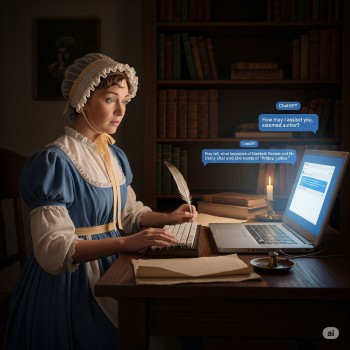
Jane Austen Using ChatGPT. Gemini 6 Aug. 2025.
(Click here to see a larger version.)
The majority of AI-generated stories took their cue from Pride and Prejudice, offering narratives that presented either (1) two people (or, in one student’s case, pets) whose personalities seemed at odds but who grew to understand each other, or (2) two people who loved each other from the start but who needed to overcome external circumstances to be together. In both scenarios, students noted the lack of character growth or any compelling narrative problem, pointing in contrast to how Austen uses characters like John Thorpe or Willoughby to teach heroines about themselves, proper female comportment, and what constitutes real love. One student noted Austen’s signature “poised control,” which is exhibited in her careful use of letters to forward the plot incrementally—not, as ChatGPT did, to reiterate plot points or character descriptions already stated by its bland narrator. Many students noted AI’s inability to write compelling dialogue—or to write dialogue at all—and how this lack immediately downgraded AI’s capacity for effective character development; to quote one student, the main love interest “is captivated by her intelligence and wit, but her intelligence and wit are not actually present in the story.” Across the board, students noted how decidedly unfunny these stories were: “Austen’s style,” one student wrote, “is elusive because of her humor,” which reads as “forced” when imitated.
As unfunny as the AI-generated stories were, the essays themselves were a delight to grade, both for the opportunities the assignment gave students to flex their own senses of humor and for the critical capacities it put on display. High-school and college-level English teachers alike know how difficult it can be to teach students to look beyond a story’s plot to the complex web of nuanced stylistic choices that make up a work of literature. Although I remain deeply skeptical of AI’s capacity to do more good than harm—in the classroom and in our lives more broadly—this particular assignment produced strong results and received positive reviews from students, who found it interesting as well as useful for better appreciating both the material they’d already read and the novels that were coming up in the second half of the semester. For all the talk of how AI will reshape education, then, perhaps one of its greatest benefits lies in its shortcomings, which put into sharp focus what makes us human and, for students, what makes Austen uniquely Austen.
NOTES
1Following the 2022 Netflix adaptation of Persuasion (directed by Carrie Cracknell and starring Dakota Johnson), Scottie Andrews interviewed Inger Brodey, William Galperin, and Devoney Looser for “How to Adapt Jane Austen—and Why It’s So Hard to Get Right.” I believe their comments apply to fiction as well as film.
2Another answer is provided by Sarah Glosson, who argues that fandom is performative; it is through the act of performing their beloved works of literature that fans engage with it in new ways—even experiencing “imaginative time travel” (5–6). Adaptations allow fans to experience the novels anew, to engage with content that has the possibility of being both familiar and fresh.
3See also Sharmini Kumar’s discussion of Bride and Prejudice and Jasmin Malik Chua’s “The Battle over Jane Austen’s Whiteness.”
4I offered a second option for this assignment for students who did not want to dirty their hands with generative AI. About one-third of the class of twenty-eight students took the fanfiction option, while the remaining two-thirds chose to use ChatGPT.
