John Millar’s eighteenth-century Observations Concerning the Distinction of Ranks in Society has some interesting echoes in Jane Austen’s Pride and Prejudice. Millar’s title calls to mind Mr. Collins’s officious advice about Lady Catherine de Bourgh, that “‘[s]he likes to have the distinction of rank preserved’” (161). The novel contains Millar’s name as well as his phrasing; it was Colonel Millar’s regiment over whom the young future Mrs. Bennet cried her eyes out when it left her village (229). An additional highlight is that Millar’s Distinction of Ranks was published in 1771, 1773, and 1781 by John Murray, the firm that later published four of Jane Austen’s novels. Notwithstanding that Austen designated the younger John Murray “a Rogue of course, but a civil one” (17–18 October 1815), she closed with him to publish all her mature works and the retrieved and retitled Northanger Abbey.
Millar’s observations on rank extended to the slave system: “In whatever light we regard the institution of slavery, it appears equally inconvenient and pernicious” (300). Millar does not confine himself to the summary point but goes on to argue the benefits, including economic benefits, of individual liberty: “The introduction of personal liberty has therefore an infallible tendency to render the inhabitants of a country more industrious” (300). The argument necessarily faces some cold-blooded justifications. As Millar observes, “SOME persons have imagined that slavery is conducive to population, on account of the frugality with which the slaves are usually maintained, and on account of the attention which is given by the master to their multiplication,” and he goes on to refute the claim (300–01). More importantly, Millar draws this ethical conclusion: “slavery is not more hurtful to the industry than to the good morals of a people. To cast a man out from the privileges of society, and to mark his condition with infamy, is to deprive him of the most powerful incitements to virtue; and, very often, to render him worthy of that contempt with which he is treated” (302).
In my view, there is no mystery as to how Jane Austen chose potential publishers: she deliberately submitted her manuscripts to firms that published anti-slavery authors. There are no exceptions. The firms include Thomas Cadell, to whom Austen’s father proffered First Impressions in 1797; Benjamin Crosby, who purchased but did not publish Austen’s Susan in 1803; and Murray, who was civil enough to publish anti-slavery writing in both book and journal formats. Even Thomas Egerton, the first publisher of Sense and Sensibility and Pride and Prejudice, joins the overall continuum. Anthony Mandal has commented that “Thomas Egerton seems an odd choice of publisher for a novelist: although established and respectable, the firm issued mainly military and political documents rather than fiction, along with historical treatises and travel writing” (49). True enough, Egerton published books appealing to military men and their families. His inventory, however, reveals not just militaria in general, but books specifically by British officers who opposed the slave trade or were tasked with combating it. All these firms openly transmitted their point of view in both nonfiction and fiction. And for all four firms, the abolitionist publishing became a legacy as well as an enterprise; descendants and successor firms sustained the anti-slavery editorial voice as part of their companies’ brands.
Austen’s intentional choice of anti-slavery firms has become lost to scholarship. Amid broader de-emphasis on enslavement and the slave trade after the U.S. Civil War, it was not a focus among readers or critics in the later nineteenth century and remained out of focus through the late twentieth century. In the broader historical amnesia, eighteenth- and nineteenth-century publishers’ anti-slavery work is also not widely heralded now; publishing presents quieter arenas than those of kidnapping and piracy, land and sea warfare, or the infamous trade itself. Still, there is no question that publishers in Britain and in America used their presses for the cause before and during Austen’s lifetime, as well as afterward. And clearly, Jane Austen’s stance was perceived during her lifetime and shortly after. If she deliberately chose anti-slavery firms, the other side of the coin is that such firms deliberately chose her, strengthening their bona fides by publishing not only Austen’s works but works by abolitionist writers who paid early tribute to Austen—thus favoring authors who boosted both the cause and Austen.
The focus here is on Austen’s lifetime, with the pattern of her choices bookended by the firms of Thomas Cadell, before Austen succeeded in breaking into print, and John Murray, the last and most prominent of a successful Austen’s publishers. In between, in chronological order, came Benjamin Crosby and Thomas Egerton. This paper treats all four firms, with emphasis on the years before Austen submitted her work to them.
Thomas Cadell
Austen’s publishing efforts began with the firm of Thomas Cadell “the younger” (1773–1836), who published openly anti-slavery books, pamphlets by prominent abolitionists, and other works by anti-slavery authors, whether on the issue or not. Cadell was a son and grandson of two previous booksellers named Thomas Cadell. The second Cadell, “the elder,” was in business before Jane Austen’s birth and became sole proprietor thirty years before George Austen offered First Impressions to the then Cadell & Davies, headed by his son, the third Thomas Cadell (Mandal 45–47). As Mandal has observed, “There is no documented reason why the firm was chosen, although an obvious one lies in association with [Frances] Burney,” whose Camilla Cadell had published (45). The reason for the rejection is also not documented, although Mandal discusses hypotheses including the firm’s emphasis on nonfiction (45).
What is not conjectural is that despite changes of decade, century, and leadership, the firm consistently opposed enslavement. In 1767, while still in his twenties, the elder Cadell published a work on Jean-Jacques Rousseau displaying Rousseau’s reiterated opposition to slavery and the slave trade (Fuseli 5–6, 14, 75). The next year, Cadell published sermons by Hugh Knox, the anti-slavery minister in the West Indies who became a lifelong influence on Alexander Hamilton, with a preface calling slavery in the islands a “polluted fountain” that vitiated the morals and taste of the colonialists themselves (xxii). Throughout the 1770s, Cadell also published (singly or among other firms) works that candidly discussed the extent and profitability of the slave trade, not all anti-slavery but all frontal about material causes and consequences—most notably Adam Smith’s famous Wealth of Nations.1 Unlike some of Cadell’s later publications, the foundational economics works did not emphasize anti-slavery polemics, but they conveyed data that would be necessary to oppose the trade.
Meanwhile, Cadell also published works that explicitly condemned enslavement. In 1781, he brought out Welsh churchman Josiah Tucker’s Treatise Concerning Civil Government, lamenting that “detestible Practice” of which “the English, those professed Patrons, and Guardians of the unalienable Rights of Mankind, are, alas! more guilty than any Nation under Heaven: For they carry on a greater Slave-Trade than any others” (184; see also 167–68). In 1783, Cadell and Strahan brought out the sermons of Beilby Porteus, the abolitionist and reformist Bishop of London, who supported the anti-slavery Clapham Group. Porteus not only criticized the trade but suggested economically beneficial alternatives (409). The same year, Cadell published a new edition of the fiery anti-slavery Abbé Raynal’s Philosophical and Political History, which the firm had previously published. Raynal’s History condemned slavery, and most editions used the traditional phrase “pride and prejudice” to do so, like several of Cadell’s other publications (Burns, Abolitionist 19–21, 167–68). In 1788, when Parliament passed Dolben’s Act, the first British legislation limiting the slave trade, Cadell published poems by abolitionists Hannah More and Helen Maria Williams as separates.2
Further in connection with the movement, Cadell, like the other publishers discussed here, published works in multiple categories that used the specific phrase “pride and prejudice”; for Cadell’s firm, the obvious examples include repeated publications of Frances Burney’s Cecilia (in 1782, 1783, 1784, and 1786).3 Burney’s influence on Austen has long been recognized, but in 2025 it would be counter-constructive to pit one influence on Austen against others rather than set the dominant influences into context. By the 1790s, the phrase “pride and prejudice” had become prevalent as a critique of slavery and was associated with issues that cut deep even when not used in connection with enslavement (Burns, Abolitionist 174–84).
The year 1797 alone would have solidified Cadell’s bona fides by the time the Reverend George Austen corresponded (1 November) about First Impressions.4 In that year, Cadell and Davies published several books by authors who took an openly anti-slavery stance and who interpolated their position into various discussions.5 The publications included abolitionist M.P. William Wilberforce’s Practical View of the Prevailing Religious System of Professed Christians, pointedly “contrasted with real Christianity” (79). The work, while not about the slave trade, argued passionately that genuine Christianity meant paying attention to one’s behavior, among other things, and it became a bestseller (Greenman 188–93). Unquestionably, it enhanced Wilberforce’s stature in the abolitionist movement.
Thomas Gisborne’s Enquiry into the Duties of Men, published by Cadell the same year, explicitly links the evil trade to all walks of life that benefit from it; “all who encourage its continuance, while they are conscious of its guilt, become in a greater or less degree responsible”:
The Government that shall allow its subjects to continue the slave trade, now that its nature and effects are thoroughly understood; the merchant who shall fit out the ship; the captain who shall command it; the manufacturer who shall furnish it with manacles and fetters; will have to answer each according to the just scale of divine retribution, not merely for the blood spilt and the iniquities committed on the coast of Africa; but for the general misery, the blindness, and the barbarism created and upheld by a traffic repugnant to the fundamental principles of justice, and bidding defiance both to the spirit and the precepts of Christianity. (2: 202)
Gisborne follows up with an eloquent two-page footnote on the related evils of trading rum to the Indians in North America (2: 203–304). He also condemns British impressment of troops by analogizing it to “the villany of the slave trade” (1: 302).
Cadell and Davies made no bones about their support of author Gisborne. The firm published Gisborne’s kindred Enquiry into the Duties of the Female Sex later the same year—read by Jane Austen, on her sister Cassandra’s recommendation. Doubling down on both the anti-slavery voice and the author, Cadell also advertised Gisborne’s Principles of Moral Philosophy, with an Appendix on Parliament and the slave trade, in each Enquiry. All in all, Cadell’s output in 1797 alone was enough to catch the eye of sympathizers to the cause.
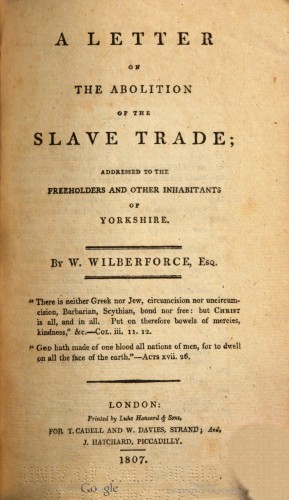
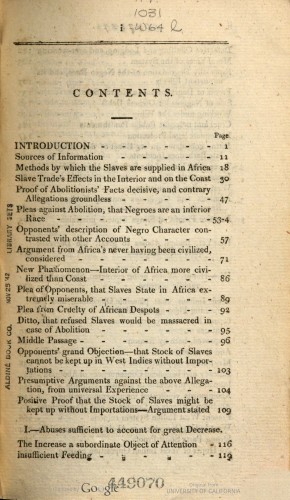
The foregoing overview is a reminder that such publications were known to the bookish Austen family by 1797, not a suggestion that Cadell ceased publishing anti-slavery writing later, or published less of it. On the contrary, the firm not only republished most of the relevant works but added new releases. Directly pertinent and notable examples include Wilberforce’s Letter on the Abolition of the Slave Trade in 1807 (see table of contents, pictured) and, in 1812, sermons by anti-slavery minister Claudius Buchanan that referred favorably to abolition of the trade and dismissed reactionary arguments against abolition (43–44).
Benjamin Crosby
In 1803, Austen submitted the manuscript of her novel Susan to the firm of Benjamin Crosby. Seemingly, this second attempt to publish met with immediate success; Crosby not only bought the book instantly but advertised it in multiple newspapers and in some of his other publications (Burns, Publishing 6–20). The firm, however, never published Susan; in 1816, Benjamin Crosby’s son Richard sold it back to Austen’s brother Henry, and it was published posthumously as Northanger Abbey.
Less prominent than Cadell, Crosby was a realistic prospect for an aspiring author; the firm published novels, and it published female authors. Jane Austen had more than one reason to find Crosby’s firm appealing. Crosby, like Cadell, had a pattern of publishing anti-slavery writers. In 1803 alone, Crosby published six works by one of his regular stable of authors, John Corry, three of which contained explicit criticisms of the trade. Furthermore, one of Corry’s works was a biography of Austen’s favorite poet, William Cowper, that did justice to Cowper’s emphatic opposition to enslavement (57, 59). In another, a polemical Address to the People of Great Britain, Corry warned the public about the dangers presented by Napoleon; the work was not only anti-Bonaparte but anti-slave trade (55–56). Both books had multiple publishers, but Crosby’s firm maintained a particularly strong ongoing relationship with Corry.
It is telling that each new edition of Corry’s Satirical View of London became more satirical and specifically more anti-slavery, and that Crosby published the two latter, progressively stronger editions of the work. The 1803 second edition added passages on the slave trade not contained in the first edition, from other publishers (32–33). The third edition, in 1804, with only two publishers besides Crosby, added yet more pages on the same subject (55–57). The passages referring to the slave trade are scathing. In short, Crosby’s firm was demonstrably not deterred by either the satire or the editorial position taken by the author.
Nor were Corry’s books the only Crosby publications in 1803—again, the year that Austen submitted her manuscript to Crosby—containing such references, which would be findable by anyone exploring Crosby publications in a local bookseller. The same year, Crosby published two compilations of the writing of Dr. John Moore (Prévost and Blagdon), an ardent opponent of slavery (Burns, Publishing 34–36, 77).
Crosby had already established the relevant pattern before 1803. In the 1790s the firm published several nonfiction works by authors explicitly antagonistic to the trade.6 Like Cadell’s, Crosby’s publications often reveal such opposition even where the main subject is not slavery. One such case is the high-profile trial of Scottish minister Thomas Hardy, recorded in State Trials for High Treason, published in 1794. Hardy (1748–98) was a professor of ecclesiastical history, whose open political positions included opposing slavery. Abolitionism, while not officially on trial, was part of the subtext, as barrister Thomas Erskine made clear in defending Hardy. Speaking on abolition, Erskine reminded the court—and spectators—that he himself was a member of Parliament, “that it was right of the people to collect opinions, and when these opinions were known to be universal they must be heard and attended to by Parliament” (62). To support the same point, Erskine shared his own change of mind:
The Parliament, after repeated applications, had refused to accede to the abolition of the slave trade; but when the universal voice became loud in reiterated remonstrances, it was finally obeyed. He was himself one of those, who, from his own knowledge of the treatment of slaves in the islands, and for political reasons, also was against the abolition; but when he found it to be the will of the people he could no longer oppose his own opinions to those who appointed him their representative. (62)
It is remarkable that Hardy, a chaplain to King George III, was implicated by terms of sedition or treason in the first place. Successfully defended by Erskine, he continued his successful and politically moderate career. In a related example, Crosby sold another trial narrative the same year, the Trial of Wm. Winterbotham, by another minister who opposed slavery and the trade (109).
A different kind of evidence is presented by author Bryan Edwards (1743–1800), a British colonialist and barrister in Jamaica who returned to England and became a member of Parliament in 1792. Having inherited several plantations in Jamaica, he was a large slaveholder and a committed apologist for slaveholding, although he condemned slave trading. Edwards first published his highly successful History, Civil and Commercial, of the British Colonies in the West Indies in 1793, after he was safely back in Britain. The History is notable both for its candid and detailed examination of the traffic in slaves and for its attempts to excuse and defend the plantation owners as much as possible; on both counts, it is painful to read, although valuable as history.
Edwards’s History came out in at least nine editions from 1793 to 1819, published by firms in Ireland, Scotland, England, and the United States. Of these, only one (1798) was published by Benjamin Crosby, and that sole edition differs from all the others, condensing the work into a single, less expensive volume that put it into more hands and created a sharper edge. No doubt Crosby commissioned the shortening, but the style stems from the editor, William Playfair (1759–1823). Playfair, a Scottish writer, draftsman, creator of graphs and diagrams, political economist, and inventor (among other occupations), had already written pamphlets published by Crosby and had written on the commerce of England. Among Playfair’s numerous cuts, frequent mentions of “Christian” and “Christianity” in the original are excised even where religious denominations are discussed, thus eliminating pious claims about the benefits of conversion for the enslaved.
All editions of Edwards’s work refer to the Elizabethan slave trader John Hawkins, because all the editions, including Crosby’s, present a version of the origins and history of the trade. To their credit, all versions treat Hawkins’s expeditions unfavorably; in every narrative, including Playfair’s, the underlying editorial choice is to condemn the origin of slave trading while excusing inheritors of the estates and the profits. Playfair’s trenchancy makes a difference, however, undercutting the apologetics for the slave system and shortening but not softening the accounts of the trade.
Other descriptions of Hawkins’s slave-hunting expeditions follow the diffuse narrative first printed in 1793:
He made a third voyage to Africa in 1568, for the same purpose, with a squadron of six ships, which the reader will not be sorry to find terminated most miserably; and put a stop, for some years, to any more piratical expeditions of the English to the Coast of Africa. (42–43)
The statement is strong, but that of the narrator in the 1798 edition is stronger: “Hawkins (unprincipled villain!) made a third piratical voyage; but, by the mercy of heaven, perished, with all his gang, in the attempt” (141). Playfair sounds like an early Mark Twain. The account of Hawkins’s earlier voyages is also more trenchant, a clear, energetic, and succinct narrative that does not omit key facts (140–41). (Other publishers stuck with Edwards’s longer original History and, after Edwards’s death in 1800, expanded it.)
Should there be any doubt about Crosby’s editorial position in the late 1790s, a publication from 1799 further clarifies it—again, a work that would seem to have little to do with the issue of slavery—Crosby’s Modern Songster. The songs include an anti-slavery ballad titled “The Desponding Negro” (260–61). In addition, two back pages offer after-dinner toasts, the first page more serious; the second page lighter. The former centers largely on liberty or freedom: “May the sons of liberty be entitled to the daughters of virtue” (275). Alongside the generic tributes to liberty, more pointed toasts include “A speedy and total abolition of the Slave Trade,” and “Confusion to the friends of slavery” (275). For Crosby, to “party like it’s 1799” evidently meant vocal antagonism to the trade.
Thomas Egerton
Prior to Austen’s submitting Sense and Sensibility to Thomas Egerton’s firm, Egerton had published Captain Isaac Schomberg’s Naval Chronology in 1802 and Lieutenant-Colonel Robert T. Wilson’s Enquiry into the Present State of the Military Force of the British Empire in 1804. Obviously, both titles were designed to appeal to military members and their families, and both would potentially interest official policy makers. Less obviously, the contents of both reveal a firmly anti-slavery perspective—with some details strikingly relevant to Austen’s final novel, Persuasion.
Schomberg’s terse but massive chronology offers hundreds of pages of entries, organized by date, on contemporaneous naval topics, issues, and events. The prose is not gripping, and the chronicle arrangement prohibits narrative build-up; nonetheless, entries relevant to the trade make their statement effectively. Early in the first volume, for example, one finds another blunt comment about Jack Hawkins: “Mr. John Hawkins sailed to the coast of Guinea for the purchase of slaves, which was the introduction of the horrid custom of trafficking for human flesh, by Englishmen” (24). The entry, dated 1562, is the second under the reign of Elizabeth I, whom Schomberg praises for beginning to strengthen the navy immediately upon her accession.
Some of Schomberg’s data would convey more to military insiders or others in the know than to a general audience. In 1793, J. Macbride, Rear Admiral of the Blue, is asterisked as shifting to the Quebec “on particular service” (2: 227). According to Christopher Lloyd’s The Navy and the Slave Trade, this phrase denoted or could denote action to impede the slave trade, as when later implementing the Act of 1807 (61). In contrast, other naval appointments and promotions served the trade. Among the appointments listed with Macbride’s is that of John Dalrymple (1722–98) as Vice Admiral of the White, listed elsewhere by Schomberg as commander of the ship Winchester, “On the Coast of Africa” (4: 51). The august family was in fact so associated with the trade that a slave ship bound for Africa from Liverpool in 1771 was named the Dalrymple, as listed in Elizabeth Donnan’s valuable Documents Illustrative of the History of the Slave Trade to America (2: 545, 687). Not coincidentally, the related Carteret family also had a slave ship named after them; a letter of February 1723 refers to the Carteret in a disputed transaction involving “325 Negroes” (Donnan 2: 269). When Anne Elliot sighs to William Elliot in Persuasion that “‘we shall, indeed, be known to be related to them!’” (150), she voices a graver regret than satire about social climbing, as attuned readers in Austen’s time would know.
Lieutenant-Colonel Robert T. Wilson’s Enquiry on strengthening British troops, published by Egerton in 1804, is overtly anti-slavery. The address to abolitionist Prime Minister William Pitt is the first clue to the author’s position, and references to the trade further clarify it: in one asterisked footnote, for example, the author identifies “The Slave Merchants” as “the last enemies of mankind” (61). From the same author, Egerton also published Wilson’s History of the British Expedition to Egypt, in 1802 and again in 1803, which contains a moving description of girls being sold in Egypt (170).
Interestingly, Egerton started out in partnership with his brother John, and early on, the brothers published two books defending and exonerating slaveholders in Jamaica. Both works were authored by wealthy gothic novelist and slaveholder William Beckford, with a careful account of slavery after the enslaved arrived in Jamaica. Both works to some extent justify the treatment of slaves once on the island, and Beckford argued against both abolition of the slave trade and emancipation of enslaved Africans.7 After John Egerton died in 1795, however, Thomas Egerton evidently changed direction, and his publications from then on gave heart and space to the enslaved rather than to the slaveholding interests.
Whether Egerton’s course redirection was a reform, represented the views he held all along, or expressed views that both brothers had held, the firm of Thomas Egerton stuck to the anti-slavery course not only through Jane Austen’s lifetime but beyond. Augmenting the examples discussed here were popular mainstream publications—so widespread that they exceed the scope of this paper, such as Chalmers’s Biographical Dictionary, published by or sold by Egerton among many others—that freely incorporated multiple references to and quotations from anti-slavery authors.
John Murray
Rogue or not, hustling publisher John Murray was a man of business who indefatigably published abolitionist writing, as Jane Austen and other authors must have known. This shortened overview does not examine widely read books that contained anti-slavery writing sold by Murray among many publishers and booksellers, such as Samuel Johnson’s Dictionary or William Hazlitt’s The Eloquence of the British Senate. Besides the household names like Johnson’s, Murray individually published anti-slavery works and authors, such as John Millar’s previously mentioned Observations Concerning the Distinction of Ranks in Society.
In addition to the observations quoted at the beginning of this paper, Millar argues that a slavery system diminishes a society’s population. Not only does personal liberty enhance individual industry and productivity (300), but
[i]f slavery be always unfavourable to industry, and tend to hinder the improvement of a country, the number of inhabitants will be proportionably limited, in spite of all the regulations that can be made, and of all the encouragement that can be given to the propagation of the species. It is impossible even to multiply cattle beyond a certain extent, without having previously enriched the pastures upon which they are fed. (302)
If the diction sounds Swiftian, the argument is consistent with Millar’s overall strategy of criticizing slavery on practical grounds as well as ethical, a strategy widely employed by anti-slavery writers.
Remarkably, Millar’s argument here was echoed a short generation later by a man much associated with population studies but not much associated with abolitionism—Thomas Malthus. In 1798, Malthus published anonymously his famous Essay on the Principle of Population, from the press of Joseph Johnson, whose publishing interests often overlapped with Murray’s. As many are aware, Malthus’s rather pessimistic work aroused an interest that continues today. The fifth edition, with added material, was published in 1817 by John Murray.
Malthus states his position on slavery bluntly and repeatedly; the book was published in three volumes, and all three contain commentary on the ills of a state of slavery and its effects on a nation.8 In an Appendix, Malthus argues at some length that the system of slavery undermines population, much along the lines of Millar’s argument, but at more length. Particularly in the West Indies, Malthus writes,
All the checks to population were found resolvable into moral restraint, vice and misery. In a state of slavery moral restraint cannot have much influence; nor in any state will it ever continue permanently to diminish the population. The whole effect, therefore, is to be attributed to the excessive and unusual action of vice and misery; and a reference to the facts contained in the Essay incontrovertibly proves that the condition of the slaves in the West Indies, taken altogether, is most wretched, and that the representations of the friends of the abolition cannot easily have been exaggerated. (385)
The same Appendix was printed in both the second and the third volumes—reprinted verbatim—to help readers avoid missing it.
Like the other publishers discussed, Murray published books in categories unrelated to enslavement, such as those of Millar and Malthus, that nonetheless included strongly anti-slavery passages. Travel books provide an example. The category itself might seem innocuous, but the works often included frank observation of the conditions of slavery. Thus a gentleman or gentlewoman of leisure, reading about travels on the other side of the globe, could come across a passage like this in William Thomson’s narrative, published by Murray in 1782:
A PEOPLE enjoying, like the English, the blessings of liberty themselves, should be the last in the world to impose slavery on others: but the history of the world sufficiently proves, that the freest governments have been the severest masters to their dependents; so little influence in public as well as in private conduct, has that just maxim in morality, “To do unto others whatever, in their situation, we should think reasonable in them to do to us.” (74)
Recommending the temperate Golden Rule pushes the envelope in the context of slavery.
In 1793, Murray published a French travel book, translated into English, with similar commentary. Among relevant passages, the author, Pierre Pagès, recommends that when Europeans settle in the Antilles, they should perform manual labor as well as take higher positions; “citizens . . . should be made to fill the hard and laborious as well as the easy and more respectable departments of the colony” (1: 264). Pagès continues: “This is the arrangement of nature, and arises from the ordinary progress of human society—an arrangement, however, which was checked in our western islands by the early introduction of a system of slavery, which, for moral turpitude, has no example in the history of mankind” (264). As he concludes, “The European no sooner arrives in the colony than he conceives himself a man of rank, and would blush to exercise the same manual occupation he used to practise at home” (264).
Captivity narratives published by Murray were even more emphatically anti-slavery. While these adventure stories concerned kidnappings and enslavement of Westerners, not indigenous peoples, the stories had a consistent moral. Murray published two such works in 1816 and 1817, respectively: The Narrative of Robert Adams, a Sailor: Who Was Wrecked on the Western Coast of Africa, in the Year 1810, and James Riley’s Loss of the American Brig Commerce, Wrecked on the Western Coast of Africa, in the Month of August, 1815. The author-narrators were both seagoing men; Adams was British, while Riley was a Connecticut Yankee (Riley 1). One obvious common denominator, aside from the captivity genre, is that both titles cast ventures in the known slave-trading zone off the west coast of Africa in a negative light. Nor do the contents of the two narratives brighten it up, detailing minutely the sufferings of Westerners under slavery.
Having experienced slavery, both men come away with an understandably negative view of it, graphically described through the lens of firsthand observation. Adams presents maps and description designed to help Europeans navigate inner Africa, and his perspective overall is more Kipling-like than Riley’s. At the end of his narrative, but before the helpful geographical appendixes, Adams writes,
We shall therefore conclude, by noticing only two important circumstances, respectively propitious and adverse to the progress of discovery and civilization, which the present Narrative decidedly confirms; viz. the mild and tractable natures of the Pagan Negroes of Soudan, and their friendly deportment towards strangers, on the one hand, and, on the other, the extended and baneful range of that great original feature of African society—Slavery. (192)
In this respect, his conclusions show similarities to Riley’s.
The last several pages of James Riley’s narrative present an impassioned appeal on behalf of the enslaved. Recounting his own sufferings in slavery, rejoicing in his freedom, and thanking Providence, Riley follows up with the reminder that “yet, strange as it must appear to the philanthropist, my proud-spirited and free countrymen still hold a million of the human species in the most cruel bonds of slavery” (588). He goes on to say that he will henceforth devote himself to opposing slavery:
I have now learned to look with compassion on my enslaved and oppressed fellow creatures, and my future life shall be devoted to their cause: I will exert all my remaining faculties to redeem the enslaved, and to shiver in pieces the rod of oppression; and I trust I shall be aided in that holy work by every good and every pious, free, and high-minded citizen in the community, and; by the friends of mankind throughout the civilized world. (589)
Writing in 1816, Riley does not advocate total and immediate emancipation. But he makes an otherwise strong statement at some length, concluding with his “earnest desire” that
such a plan should be devised, founded on the firm basis and the eternal principles of justice and humanity, and developed and enforced by the general government, as will gradually, but not less effectually, wither and extirpate the accursed tree of slavery, that has been suffered to take such deep root in our otherwise highly-favoured soil. (590)
Adams’s and Riley’s anti-slavery conclusions thus constitute a significant back-to-back campaign from Murray, drawn from both sides of the Atlantic.
Topping off the already copious inventory of anti-slavery writing published by Murray in books came the formidable corpus of Murray’s Quarterly Review, founded in 1809. The Quarterly Review contains too many examples of anti-slavery writing to list, and the periodical’s reviews also reprinted many passages—for example, from the speeches of the anti-slavery advocate John Philpott Curran, author of the phrase “the irresistible Genius of Universal Emancipation” (Quarterly Review 1: 96–107).9 To sum up, references to slavery and the slave trade appeared in each of the first ten volumes of the Quarterly Review; relevant issues of the journal were swiftly reprinted in New York; and by 1817 Murray had taken up the cause of manumission and had published on cases of contested freedom, as well as on the institution of slavery and the broader movement against it.
After Austen’s lifetime
Printing and publishing in Austen’s later life and afterward indicate that Austen’s own anti-slavery alignment was recognized. After her death in July 1817, signs abound that other writers loved her work, were influenced by it, hoped to piggyback on its critical esteem, or some combination of all. During the next two decades, several novelists used the traditional phrase “pride and prejudice” in their own fiction, some in more than one novel (Burns, Abolitionist 67–70, 83–85). Some novelists plugged the actual Pride and Prejudice in fictional dialogue (73–77). Aside from the most superficial imitations of Austen’s title or character names, the authors were anti-slavery themselves, as were the publishers who brought out their books. The pattern is apparent on both sides of the Atlantic, emphatically in the firms of Matthew Carey in Philadelphia and Richard Bentley in London, although the trend lines continue well beyond Carey and Bentley. If “Follow the money” is an axiom for investigating the history of the slave trade, an axiom for investigating the history of abolition is “Follow the printers.” They were the ones with the presses.
NOTES
1Thomas Mortimer, Elements of Commerce; Adam Smith, Wealth of Nations; Charles Whitworth, Political and Commercial Works of […] Charles D’Avenant.
2More, Slavery; Williams, A Poem on the Bill Lately Passed for Regulating the Slave Trade.
3Frances Burney’s use of the phrase is referenced and discussed in Burns, Jane Austen, Abolitionist (39–42).
4The letter in full is reprinted in the Cambridge Companion to Pride and Prejudice (Mandal 42).
5For example, Bertrand de Molleville, Private Memoirs (1: 332, 337, 351); Robert Southey, Letters (277–78).
6See, for example, Bryan Edwards’s History, Civil and Commercial, of the British Colonies in the West Indies; Thomas Oldfield’s Entire and Complete History, Political and Personal, of the Boroughs of Great Britain (2: 266); State Trials for High Treason (62).
7Beckford, Remarks upon the Situation of Negroes in Jamaica, 1788; Descriptive Account of the Island of Jamaica, 1795. See also Tara Moore’s “Austen’s Social Circle and the Wildman Legacy of Slavery and Sugar.”
8See, for example, Malthus, Essay on the Principle of Population (1: 191–92, 308, 310, 352–55, 434–35; 2: Appendix 383–87; 3: Appendix 383–87).
9For more on the journal, see Paula Dumas, “The Edinburgh Review, The Quarterly Review, and the Contributions of the Periodical to the Slavery Debates.”
