In December 2024 I was invited to give a talk to the Greater Chicago Region of JASNA on diversity in education. I was delighted to accept, for as a lifelong educator, I love nothing more than to talk, especially with a group of literature lovers. And as a proponent of diversity throughout my career, I was pleased to address this topic in particular. I will admit at the start that I am not a Jane Austen scholar. My major author is Virginia Woolf, herself an avid reader and devotee of Austen. However, as a critical theorist—one who examines the underlying frameworks, principles, and assumptions that shape our individual acts of interpretation—I have long taught Jane Austen and scholarship on her from feminist, queer, and postcolonial perspectives. My 1999 book Passing and Pedagogy: The Dynamics of Responsibility deals explicitly with what it means to teach literature in terms of race, gender, sexuality, and social class. And I am currently writing an academic memoir that reflects on contentious debates early in my career that stemmed from efforts to diversify the academy in relation to similar debates today. What it means to diversify our classrooms, our teaching, our reading, our histories, and our communities has preoccupied me throughout my thirty-five-year career.
Yet I must confess, delighted as I was to receive the invitation to speak at Jane Austen’s birthday tea, I did worry that a seventy-year-old cisgender white woman married to a man is hardly a poster child for diversity! Diversity for me, though, is not simply a matter of identity politics; it is a matter of cultural history, educational enrichment, and social justice. It is less about who you are than what you do. In fact, Virginia Woolf’s assessment of Jane Austen, whom she credits with taking intellectual and artistic risks, thinking in ways “she has never yet attempted” (“Jane Austen” 147), captures the work I do as a critical theorist; for theory “helps us to appreciate the depth, variation, and even paradoxical qualities of our cultural, aesthetic, political, communal, and individual experiences,” to quote Michael Kramp in his introduction to Jane Austen and Critical Theory (1). In studying diversity through critical theory, as in reading Jane Austen, “we learn to think differently, explore diverse possibilities, and understand numerous complications by exploring alternative critical and creative directions” (Kramp 1).
But I get ahead of myself. Let me begin by defining the key term in my title. During the recent U.S. presidential election, especially the primary season, we heard charges of “woke” leveled against individuals, companies, and universities. We heard that Disney is woke for its inclusive casting and support of Pride Week; we heard that Bud Light is woke for its ad featuring a transgender TikTok celebrity, Dylan Mulvaney; we heard that universities are woke for allegedly indoctrinating students on “woke” topics like critical race theory and transgender studies. More surprisingly, perhaps, we heard that Tractor Supply, John Deere, Harley-Davidson, Caterpillar, Black & Decker, Jack Daniel’s, Lowe’s, Ford, and Toyota are all woke because of their company policies, such as offering anti-bias training, vaccination incentives, transgender healthcare, or gay pride paraphernalia. Shortly before my JASNA talk, a 2024 Christmas ad for Boots, the British equivalent of Walgreens, featuring a Black Mrs. Claus (Adjoa Andoh) was dismissed as “woke on steroids” (Norris).
What it means to be “woke,” though, would seem rather innocuous. The term, which derives from African American Vernacular English, originally meant being alert to racial prejudice and discrimination. Used in a song by blues legend Lead Belly as early as 1938, by the mid-twentieth century “woke” had come to mean culturally well-informed or socially and politically aware. One would hope that we all are “woke” in that sense. By the 2010s, to be “woke” was to be aware of a range of social inequities, not just racial injustice but also sexism and the denial of gay and trans rights (Wikipedia). “Woke” today has become a shorthand for identity politics, understood as the fight for the rights of specific groups. As such, it is tethered to DEI policies.
DEI—diversity/equity/inclusion—also has a long history. It dates from the corporate world of the 1960s, when DEI was implemented to rectify the underrepresentation of minority groups in businesses and then to mitigate the tensions associated with a more diverse workplace (Brest and Levine). DEI migrated to universities in subsequent decades, initially as affirmative action. Then administrative bloat set in, and a whole industry evolved to train faculty in anti-racist pedagogy, unconscious bias, microaggressions, sexual harassment, and inclusive language. Hiring committees began requiring job candidates to submit diversity statements laying out what they had done to diversify their teaching. Universities crafted land acknowledgment statements, recognizing their grounds as originally belonging to Native American tribes. The University of Michigan’s English Department described its core subject as “a language brought by colonizers to North America.” Faculty and students were routinely asked their preferred pronouns. New words and acronyms were introduced, such as “Latinx” for Latino/Latina and “BIPOC” for Black, Indigenous, and People of Color.
For many, all this was a bridge too far. Identity-focused solutions to injustice were never broadly popular, Jeremy Peters claims, even though most people, I believe, agree with the broad ideals of diversity and social justice that DEI stands for. Still, many express disaffection with identity labels and pronouns, perceiving universities as hotbeds of “wokeism.”
The problem, as I see it, is the implementation, not the goals, of DEI. A case in point: When I was in graduate school at the University of Virginia in the 1980s, I took a course with the late, great eighteenth-century and Jane Austen scholar Irvin Ehrenpreis. Professor Ehrenpreis had recently been disciplined by the university for consistently denying A-level grades to women because, he allegedly said, the best woman was not as good as the most mediocre man.1 I never knew whether I earned my A in that class or whether it was bestowed upon me as a kind of reparation for past sins. The point is, the university confronted this professor on his biases and took action; they did not require every professor in the university to undergo hours of anti-bias training in the form of online platforms developed by for-profit companies.
When it comes to classroom teaching, however, worry over “woke” is overblown, more about perception than reality. As a feminist scholar, I have never walked into a classroom hoping to make a convert that day. Nor have any of my colleagues ever expressed a desire to indoctrinate students. For me, the “woke” controversy is also déjà vu. When I was hired at Loyola in 1987, the term “woke” was not yet in vogue. The term used then to label, and stigmatize, academics who, like me, taught subjects such as critical race theory, feminist criticism, and gender studies was “PC,” politically correct. The 1980s was the decade when scholarship and teaching on identity issues and bringing work by minoritized groups into the canon and the curriculum—what is known as “multiculturalism”—took center stage. And such initiatives were mockingly dismissed as “PC,” a term indiscriminately applied to a broad range of subjects, courses, and teachers who shared no one political viewpoint. As a feminist scholar, it did not help my case any that my initials are P.C.—as if my parents’ decision decades ago to name their infant daughter Pamela were a proleptic act of poetic justice, my comeuppance, so to speak.
Before we were “woke,” we were “PC,” or “tenured radicals” as Roger Kimball termed us in his book by that title, first published in 1990. In 1987, I was one of those newly hired, if not yet tenured, radicals. We were seen as intruders in the institution, perverting its traditional values and upending its role in society, by foisting our politics on the curriculum and our students.2 In a 1990 review in The New York Times, Roger Rosenblatt said that Kimball’s book portrayed new humanities programs, such as women’s studies and Black studies, as part of “a leftist plot to radicalize, and ruin, the nation’s universities” (36). A 1995 article in The Guardian proclaimed:
English literature used to be straightforward. Academics specialised, possibly in Restoration drama or perhaps the Victorian novel. Others would look to poetry, or devote themselves to Shakespeare or Chaucer. This translated into a school curriculum that stressed the “canon”—that corpus of “great” works with which most people over, say, 40 will be familiar.
[A side note. According to Rachel Brownstein, Jane Austen was the first woman writer to be added to the notoriously male-centered reading list at St. John’s University, in 1949. My 1979 edition of The Norton Anthology of English Literature, a popular college textbook, referred to Virginia Woolf as a brilliant but “minor” figure, devoting few pages to her work. No wonder feminists used to joke that the literary canon is what women were shot out of.]
Now [The Guardian’s review continues] a new generation of scholars is questioning the canon. Where once we had “the English novel from Sterne to Hardy,” we now have “post-colonial literature.” Analysing gender bias is now more common than studying imagery. (Hugill)
This is, I think, a fair description of the transformation of the academy in the 1980s and 1990s, but The Guardian leaves out how and why such changes came about. It was less about politicizing the academy than responding to changing demographics.
Still today, arguments persist that college curricula have drifted off course, emphasizing “shallow diversity” over developing core values. New laws in Florida prohibit “a curriculum that teaches identity politics” and courses “based on theories that systemic racism, sexism, oppression, and privilege are inherent in the institutions of the United States” (Moody). Drawing the line between teaching and indoctrination, genuine inquiry and partisan politics, as such legislation attempts to do, is never simple or straightforward. To set it up as a clear-cut choice, as if we all should know when that line has been crossed, is not just misleading but potentially dangerous in condoning a partial (in both meanings of that word: limited and biased) perspective on history, literature, and core values. Students are sometimes “indoctrinated” not because research protocols are abandoned for political agendas, but because research protocols are necessarily biased—not in the sense of unfairly prejudiced, but predisposed toward particular assumptions, perspectives, and values (Caughie 55). As Virginia Woolf says in discussing Jane Austen, the values of a woman often differ from the values of a man, and the masculine values prevail. An important novel deals with war, Woolf says dryly; an insignificant novel deals with the feelings of women in the drawing-room (A Room 73–74). What saves students from indoctrination is that they learn with a diverse group of professors and students. As the late Barbara Johnson observes, true learning begins with the contradiction between teachers (83).
Labels like “woke” obscure fine distinctions, tarring everyone with the same brush. Labels are fighting words meant to elicit strong emotions. So why would I scream in bold print
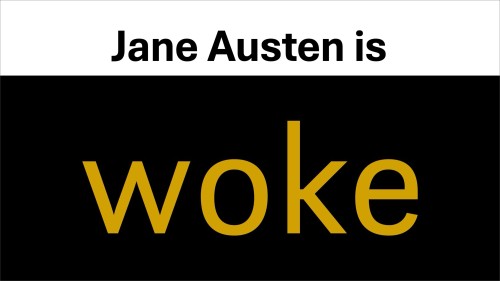
in the title slide for my JASNA talk? Why attach that fraught adjective to that revered author? Is it accurate or fair to apply words like “woke” or “queer” or “feminist” to people who lived, and writings that were produced, at a time when these terms either did not exist or had different meanings? What does all this academic and political brouhaha over “woke” have to do with reading and teaching and appreciating Jane Austen?
For starters, Jane Austen is having a moment. A “woke” moment, we might say. In a chapter provocatively entitled “Jane Goes Gaga,” Marina Cano connects the contemporary pop star Lady Gaga and the Regency-period author as avatars of a new kind of feminism that pushes cultural boundaries and points to wider sociocultural changes. Gaga Austen, as Cano terms this phenomenon, manifests itself in an “unruly reinvention” of Jane Austen. (I think of the 2022 Netflix film version of Persuasion.)
“Jane Goes Gaga” appears in The Routledge Companion to Jane Austen, one of several recent books that reconsider Austen from the perspective of contemporary critical theories. It was published in 2021, as was the previously cited Jane Austen and Critical Theory. These join earlier publications like The Postcolonial Jane Austen (2000), Romantic Austen: Sexual Politics and the Literary Canon (2006), and Jane Austen, The Secret Radical (2017). The 2023 issue of Persuasions includes an article by Rachel Gevlin on Austen as “protofeminist, postfeminist, bad feminist.” All are indebted to the “politically correct” era dating to the 1990s, the era when Claudia Johnson brazenly declared, “I cast my lot with the queer Austen” (146). (Johnson began her 1995 article “The Divine Miss Jane” with an epigraph from Rosenblatt’s review of Tenured Radicals cited earlier.) All these writings could be labeled “woke.”
Feminist scholarship on Austen was the first to elicit charges of politicization.3 In 1929, Virginia Woolf wrote at length about Austen in her famous feminist essay, A Room of One’s Own. Woolf makes her feminist reading explicit as one that connects women’s writing with their lives and circumstances, their material conditions. That is, whereas literary studies long focused on reading for imagery, structure, and style—what was known as a “formalist” reading, interpreting what the author said and appreciating how she said it—theoretical investigations like feminism read for what it is possible to say given the locatedness of the author, the specifics of their particular sociohistorical contexts.4 Early in her essay Woolf shows the importance of reading women in terms of their material conditions: “Here am I asking why women did not write poetry in the Elizabethan age, and I am not sure how they were educated; whether they were taught to write; whether they had sitting-rooms to themselves; how many women had children before they were twenty-one; what, in short, they did from eight in the morning till eight at night” (46). She ties the differences between the material lives of women and men to their different values. Woolf praises Austen for exposing this difference in view “without hate, without bitterness, without fear, without protest, without preaching”:
If Jane Austen suffered in any way from her circumstances it was in the narrowness of life that was imposed upon her. It was impossible for a woman to go about alone. She never travelled; she never drove through London in an omnibus or had luncheon in a shop by herself. But perhaps it was the nature of Jane Austen not to want what she had not. Her gift and her circumstances matched each other completely. (68)
Hatred, bitterness, protest, and preaching, as Woolf well knew, have long been attributed to feminists. Woolf’s feminist reading of Austen also serves to counter naïve views of feminism.
Feminists like Woolf attend to the historical context of the world Austen and her women characters navigated; others see Austen’s feminism in “the mere fact that she was a woman writing at the turn of the nineteenth century”; and still others read in Austen’s novels a feminist agenda, representing Austen as “a politically radical author” (Gevlin 149). Yet focusing on her women characters as avatars of feminism before its time also risks putting the onus for change on women’s choices, especially in marriage, rather than on systemic changes that feminists pursue, such as the Married Women’s Property Act of 1870 that allowed married women to inherit property and keep their wages.
Devoney Looser, perhaps the best-known feminist scholar of Austen, asks the important question for any criticism that introduces a politics of reading: Why does the question of Austen’s feminism matter? When does it matter, and to whom? A rebellious Austen may sound odd to some modern readers, but in the suffrage era, Austen was increasingly seen as “promoting social change for women” (Looser, Making 174). A feminist approach trains its critical lens not just on the author but on ourselves as readers, as Rachel Gevlin says, asking us “to interrogate honestly the varying standards to which we hold our beloved . . . novelists” (155). That interrogation of ourselves and our ways of reading is at the heart of teaching for diversity.
The most notorious instance of a politicized reading of Austen dates to 1989, when the Modern Language Association conference program listed a paper by Eve Kosofsky Sedgwick, whose title, “Jane Austen and the Masturbating Girl,” ignited a firestorm over perceptions of academic work as self-indulgent, out of touch, even perverse. That paper also inaugurated queer studies in the academy. Roger Kimball cited Sedgwick’s title in his book Tenured Radicals as an example of academic idiocy, the absurdity of—and the dangers posed to—the humanities by left-wing academic extremists, proponents of women’s studies, Black studies, gay studies, queer studies, and the like (xi, 146). “Jane Austen and the Masturbating Girl” was often cited, and rarely read. As Sedgwick put it in her published version of that paper, “Jane Austen and the Masturbating Girl” became “an index of depravity in academe” for the many journalists who “righteously” (818) reiterated the title—without reading the article. So if we are to turn a critical lens on ourselves, we may want to ask what it means to offer opinions on a work we have not even read.
Reading Sense and Sensibility, Sedgwick says that the “erotic axis” of the novel is “most obviously the unwavering . . . love” of Elinor for Marianne (826–27). This kind of observation is not new, for as early as 1944, before we were “woke,” Edmund Wilson proffered a homoerotic reading of Emma, noting that Emma Woodhouse “is not interested in men” and is instead “inclined to infatuations with women” (qtd. in Greenfield 344). But what Sedgwick does is new. Focusing on the bedroom scene with the two sisters following Willoughby’s snub of Marianne (and joking that bedroom scenes are not common in Austen), Sedgwick says the mention of the absent Willoughby “marks this as an unmistakably sexual scene” and, by the same gesture, displaces its “heterosexuality” onto the homoerotic tension between the sisters (823). She is not saying that the sisters are homosexual; rather, she says, the scene functions to disrupt and denaturalize the hetero/homo binary that divides up the universe of sexual orientation and functions today, though not in Austen’s day, as sexual identities. Homosexuality and heterosexuality were not named until fifty years after Austen’s death. One sexual identity that did exist in Austen’s day, though, was that of the onanist, or masturbator.
Masturbation was, in Austen’s time, a prohibited form of sexuality and the primary “sexual perversion” before homosexuality took on that dubious distinction. Drawing on medical treatises of the time, Sedgwick remarks on the similar language used to describe Marianne’s volatile sensibility and that used in case histories of masturbation, also known as self-abuse. Sedgwick chronicles the ways masturbators were historically “surveilled, punished, jawboned, imprisoned, terrorized, shackled, diagnosed, purged, and physically mutilated” (821) to prevent a behavior that medical science today considers innocuous. She links treatments of masturbators to the “space of same sex tenderness, secrecy, longing, and frustration” (823) signified by the bedroom scene with which she began.
In Epistemology of the Closet, Sedgwick sums up a queer critical position this way: “An understanding of virtually any aspect of modern western culture must be, not merely incomplete, but damaged in its central substance to the degree that it does not incorporate a critical analysis of modern homo/heterosexual definition” (1). Whereas feminists like Devoney Looser and Mary Poovey argue that Austen “undercuts the marriage plot to create space for women’s autonomy and independence” (Washington 163), queer theorists like Sedgwick take this argument further, attributing to Austen the insight that it is not just the economics of marriage that oppresses women, but the gender binary that is its foundation—a binary that historian Thomas Laquer says was consolidated in the eighteenth century.
Since Sedgwick’s notorious essay, queer readings of Austen have flourished. In “Jane Austen’s Angry Inch,” a chapter in Jane Austen and Critical Theory, Chris Washington writes: “It is a truth that should be universally acknowledged that nonbinary and trans stand in the background throughout [Austen’s] novels so glimmeringly—like her anal sex joke in Mansfield Park—that it is ostentatiously so, and so correspondingly foregrounds this backgrounded, hidden concern” (169). (The anal sex joke is Mary Crawford’s remark that at the home of her uncle she became acquainted with a circle of admirals: “‘Of Rears, and Vices, I saw enough’” [60].)
Foregrounding “the backgrounded, hidden concern” is what teaching for diversity means. Washington reads what might strike many as a minor scene in Pride and Prejudice when Lydia and Kitty dress a young man, Chamberlayne, as a woman. There is no shame, no humiliation, no laughter at the cross-dressed subject, Washington notes. Instead, the joke is on the men who cannot recognize “what is staring them in the face,” and their ignorance would seem to suggest that a man can transition into a woman, that the gender binary is not so stable as one might think (171). The joke is also on us as readers, Washington says, if we miss the “transgender possibilities in Austen” (171). Additionally, the gender switching in Mansfield Park among Mary, Edmund, and Fanny in the rehearsal scene (which is more pronounced in the 1999 film version) “suggests how infirm gender ‘truly’ . . . is as male and female genders triangulate amongst the three” (172). The “gender fluidity in this scene,” writes Washington, “sunders the novel’s resolutely dimorphic gendered matchmaking” (174).
“After Emma,” writes Susan Greenfield, “Mansfield Park is the novel most frequently queered” (344). And Mansfield Park brings me to my third and final example of theoretical readings of Austen that might be called “woke”: Edward Said’s chapter on Austen in his book Culture and Imperialism (1993), excerpted in Rivkin and Ryan’s Literary Theory: An Anthology, the textbook I used in my critical theory courses. Said’s postcolonial reading of Mansfield Park focuses on the scene where Sir Thomas returns from Antigua and puts his household back in order. “What sustains this life [at Mansfield Park] materially is the Bertram estate in Antigua,” he writes (1116). “More clearly than anywhere else in her fiction, Austen here synchronizes domestic with international authority” (1117), making clear that the values of British culture are grounded in the possession of and rule over territory, betraying the imperialist logic at the heart of the novel. “The Bertrams could not have been possible without the slave trade, sugar, and the colonial planter class” (1122). Said concludes by emphasizing the main objective of introducing diversity into our critical approaches: namely, that “interpreting Jane Austen depends on who does the interpreting, when it is done, and no less important, from where it is done” (1122), echoing Looser’s comment on feminist approaches. So do we jettison Austen’s novels from the canon, given that she is of a slave-owning society? Not if we learn to read “what is there or not there,” Said says—if we make connections, see interdependence rather than isolated experiences (1124). That is, not if we see how “it is possible to read these texts . . . in a politically useful way” (849), to quote another postcolonial theorist, Gayatri Spivak. Reading in “a politically useful way” is to be “woke” in the best sense of that word.5
By way of concluding, I want to channel my inner Virginia Woolf and say something that may sound so outrageous, so audacious that I risk giving credence to those who dismiss “woke” readings as self-indulgent, out of touch, even perverse. And that concession is this: I enjoy reading Edward Said’s reading of Mansfield Park more than I enjoy reading Mansfield Park. Let me hasten to explain. Of course, I enjoy Austen’s wit and humor, her subtle (and not so subtle) deflation of social manners and mores. Still, when rereading Mansfield Park for my JASNA lecture, I found the endless discussions over the play to be performed frankly tedious. “Just pick a damn play!” I cried out.
What Said enables me to see in Austen’s writing, however, is what I value in Virginia Woolf’s: the way her prose mimics the very social situation it presents. Sir Thomas’s protracted absence that stretches over months and into the new year is mimed in his children’s protracted debates over the play to be performed. And as the discussion drags on, the situation worsens. At first it is the very idea of performing a play in Sir Thomas’s absence that is appalling; then it is the proposal to use Sir Thomas’s billiard-room as a theatre and his study as a green-room; then it is the selection of a play of dubious morals; and then it is the suggestion that they bring a stranger into the intimacy of this familial production—all work to chip away at the moral foundation of the home. As does Sir Thomas’s work in Antigua. The laborious work entailed in squeezing profit from the land and labor of the enslaved workers likewise erodes the moral foundation of the British home. The children’s squabbles and unscrupulous behavior mimic what is happening off stage, so to speak, on a distant plantation we never visit, the exploitation we never see that keeps the home fires burning. It is the exploitation Austen mildly alludes to when Fanny asks Sir Thomas about the West Indies slave trade (Mansfield Park 198). Had the children simply chosen a play and staged it, Sir Thomas’s restoration of order upon his return would have been the same. But Austen’s tedious stretching out of that production suggests that the moral restoration of the home may be beyond reach.
I would like to close with Austen’s words, since her voice has been attenuated in this essay—in particular the passage in volume 2, chapter 13 of Pride and Prejudice, where Elizabeth Bennet reads the letter Mr. Darcy has given her after she rejected his proposal and realizes she has misjudged him.
She grew absolutely ashamed of herself.—Of neither Darcy nor Wickham could she think, without feeling that she had been blind, partial, prejudiced, absurd.
“How despicably have I acted!” she cried. “I, who have prided myself on my discernment! I, who have valued myself on my abilities! who have often disdained the generous candour of my sister, and gratified my vanity in useless or blameless distrust.—How humiliating is this discovery! Yet, how just a humiliation!—Had I been in love, I could not have been more wretchedly blind. But vanity, not love, has been my folly.—Pleased with the preference of one, and offended by the neglect of the other, on the very beginning of our acquaintance, I have courted prepossession and ignorance, and driven reason away where either were concerned. Till this moment, I never knew myself.” (208)
Teaching for diversity can produce a similar response in students as they come to know themselves in reading about others who live very different lives. The experience can be as humbling and enlightening to them as was Elizabeth Bennet’s in coming to see her own biases, blindnesses, and ignorance. Ignorance is not simply a gap in knowledge to be filled; it can be a willful effort to ignore, a desire not to know, as Barbara Johnson has shown. In “Teaching Ignorance,” a 1987 essay that had a profound impact on me as I began my teaching career, Johnson asks:
Are our ways of teaching students to ask some questions always correlative with our ways of teaching them not to ask—indeed, to be unconscious of—others? Does the education system exist in order to promulgate knowledge, or is its main function rather to universalize a society’s tacit agreement about what it has decided it does not and cannot know? (76)
The question is one I cannot answer, but one I must ask every time I teach.
Diversifying higher education through new ways of reading now vilified as “woke” functions, as literature does, to disrupt our automatic, unreflective responses to the things around us. Once one comes to see the world differently through what and how we read, one becomes a different kind of person, and a more socially and politically aware citizen—precisely the point of higher education.
NOTES
1Perhaps, though, we students were attributing the sentiment of British professor Oscar Browning to Professor Ehrenpreis. In A Room of One’s Own, Virginia Woolf writes: “Mr Oscar Browning was wont to declare ‘that the impression left on his mind, after looking over any set of examination papers, was that, irrespective of the marks he might give, the best woman was intellectually the inferior of the worst man’” (53).
2When I was hired by Loyola, a Jesuit institution, as the first feminist theorist, my department still began its faculty meetings with a prayer. At my first faculty meeting, an elderly professor retiring that year (not because of age but because she could not abide how the department was changing) was asked to give the opening prayer. She prayed to God to save the department from theorists.
3An early instance is Bertha Brewster’s article “The Feminism of Jane Austen,” published in the suffrage journal Votes for Women in 1917.
4Referring to a generic author with the feminine pronoun “she,” or the singular “they,” as I do here, is an instance of gender-neutral language that some today would dismiss as “woke.”
5Reading in a politically useful way distinguishes Said’s postcolonial reading of Mansfield Park from Helena Kelly’s historical reading. In an informative and fascinating chapter, Kelly details the many references to slavery, property, and possession in the novel, asserting that “the title, the literary and historical references, the pointed vocabulary Jane selects—all of them point in one direction, and one direction only. Mansfield Park is about slavery” (180). Her focus, though, is on Austen’s personal antipathy to slavery; Said’s is on the “imperialist logic” that structures the novel, and British cultural productions more generally.
