While the East Indies fired the imagination of the young Jane Austen, that of the mature writer turned toward the Americas. The appeal of the East Indies for the teenage Jane (who began Catharine, or the Bower in 1792 and Elinor and Marianne around 1795) makes sense. How many times must the story of her aunt Philadelphia Austen’s 1752 emigration to India to find a husband have been told before it provided a backstory for Kitty’s friend Cecilia Wynne? Philadelphia’s daughter, Eliza, whose godfather was Warren Hastings, later the first Governor-General of Bengal, was raised in India and married a French count guillotined in the Revolution. This “outlandish” cousin (Le Faye) visited the family in Steventon, participated in their theatricals, and charmed them all, including Jane, who dedicated Love and Freindship to her.
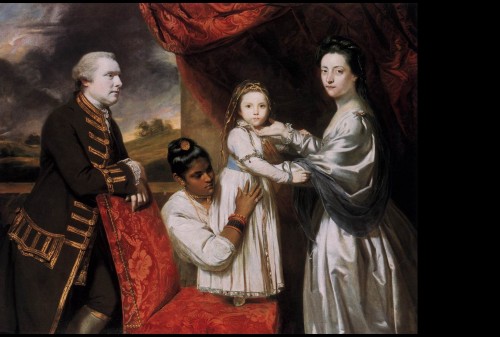
Tysoe Saul Hancock, Clarinda, Eliza, and Philadelphia (1765), by Joshua Reynolds. Wikimedia Commons.
The East Indies also makes its way into Sense and Sensibility. One of Austen’s inspirations is Jane West’s A Gossip’s Story (1796), a conservative novel contrasting the rational, prudent, and dutiful Louisa to her passionate and idealistic sister, Marianne—with just deserts meted out to the two heroines. Mrs. West looks to the West Indies to explain the separate upbringings of the two sisters, as well as to explain how Louisa’s suitor Sir William Milton “resided [there] several years in a military station, and amassed a fortune sufficient to restore that ancient family to the respectability it formerly possessed” (34). But while the West Indies in the literature of the 1790s often stands as a symbol of luxury and dissipation, in Jane West’s conservative novel the prudent Louisa, rather than the passionate Marianne, is the sister brought up in Barbados. Though Austen adopts several aspects of A Gossip’s Story for Sense and Sensibility, she turns away from the West Indies, fixing her attention squarely on the East as the place that allows Colonel Brandon to repair the family fortune while preventing him from protecting his cousin Eliza.
 |
 |
 |
|
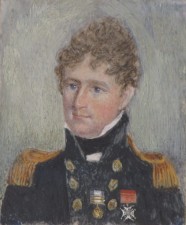
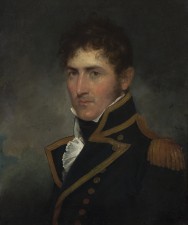
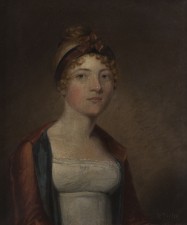
Miniature of Francis Austen (1806). Courtesy of Jane Austen’s House. |
||
The Chawton novels—Mansfield Park, Emma, Persuasion, and Sanditon—all point to the West Indies and, by implication, the slave trade. One reason for the shift might have been the experience of her naval brothers and the likelihood they shared with her something of what they saw. In 1805–06 Francis Austen, in command of the Canopus, sailed to the West Indies and participated in the Battle of San Domingo. In July 1806, directly after his return to England, he married Mary Gibson, and the couple formed a household in Southampton with the Austen women and their friend Martha Lloyd. Conversation doubtless ensued. Jane’s brother Charles spent five years on the North Atlantic station (1804–09), moving between Bermuda and Halifax. Not only did he correspond with his mother and sisters, but between November 1811 and September 1814 he was captain of HMS Namur, a ship based at the Nore, on the Thames—allowing opportunities for visits with the Chawton family. Charles’s first wife, Fanny, was a daughter of Bermuda’s Attorney General. In an 1811 letter to their cousin Philadelphia Walter, Cassandra called Fanny Charles’s “Bermudan wife.” (This description was not negatively charged: she described her as “a very pleasing little woman, . . . gentle and amia[ble] in her manners” [R. A. Austen-Leigh 249].)
The close Austen family relationships and frequent correspondence make it likely that her brothers’ and her sister-in-law’s knowledge of the West Indies and British America would have been shared with a curious Jane. Her nephew James Edward Austen-Leigh writes in his 1870 Memoir of Jane Austen that “with ships and sailors she felt herself at home, or at least could always trust to a brotherly critic to keep her right” (18). Surely the same would have been true as to her representation of the Americas. Unfortunately, those letters and conversations have been lost. We can only guess at what they would have included.
We do know that Frank was an attentive student of the landscape, producing drawings, charts, and descriptions of the coasts, resources, and character of the inhabitants near which he was stationed (Memoir; see also Benis). Though Frank’s memoir (now published online by Jane Austen’s House) is mainly a third-person, often colorless relation of his naval career, in his later years he added a vivid account of a trip he took with his family in the 1840s, while Commander-in-Chief of the West Indies and North America, from Nova Scotia to Toronto and into New York State. Although his description of “the manners & habits” of the Americans he observes in the resort town of Saratoga has little to do with my focus here, it’s too delicious to pass by:
The men have some vile habits especially that of frequent discharges of saliva, and that without much regard to the where they may be, whether in a carpeted room or wooden floor, and there was a sort of flippant air amongst the women which seemed rather at variance with the retiring modesty so pleasing in the generality of English women. (39)
Such a moment provides a glimpse of the kind of observations he might have shared with his sister Jane thirty years earlier.
Where else might Jane Austen have formed her ideas about the Americas? Her reading would, of course, have allowed her genius to roam. What can we learn from the discourse on transatlantic issues available to Austen through imaginative and discursive writing—the novels, poetry, travel narratives, and political treatises—that she read (or probably read)? These texts—including fiction by Charlotte Smith, poetry by William Cowper, Anne Grant’s Memoirs of an American Lady, and Thomas Clarkson’s The History of . . . the Abolition of the African Slave-Trade—provide images of the natural world, investigations of mores and morals, depictions of class and social change, and polemic having to do with slavery, abolition, and the complex politics of British imperialism. Here I’ll focus only on what she learned about slavery.

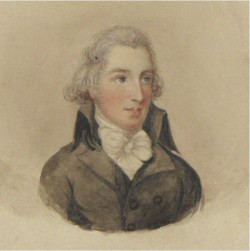
James Austen,
possibly by Cassandra Austen.
Courtesy of Jane Austen's House.
Jane Austen would certainly have been confronted with the issue of slavery through family writing and conversation. Despite the Rev. George Austen’s role as a trustee on a marriage settlement that included an Antiguan estate (Looser), the Austen family seems to have been solidly opposed to slavery. As far back as July 1789, James Austen ends a Loiterer essay extolling English commerce as “our distinguishing characteristic” (142) by looking forward to the abolition of the slave trade, then being argued in Parliament:
I cannot neglect this opportunity, the only one which may perhaps offer, of congratulating my countrymen on the probable approach of that period, when the only blot that disgraces the annals of trade shall at length be erased, and the benevolence of commerce be equalled only by its utility. I cannot neglect this opportunity of congratulating myself, for living in an age, when the rights of humanity rise superior to the dictates of interest; when parties, in other respects the most opposite, become the joint advocates of misery; when the liberty we ourselves feel shall be diffused to the most remote parts of the world, and the religion we ourselves enjoy, shall spread its refining influence over nations at present immersed in barbarity. (144)1
Although these congratulations were almost two decades early, James’s linking of the abolition movement to the “rights of humanity” and “the liberty we ourselves feel,” and his ending the essay on the word barbarity, make a strong argument.
Francis Austen encountered slavery through his naval experience. Writing in 1808 and recalling what he’d observed two to three years before, he describes the treatment of the enslaved people on the island of St. Helena (off the coast of Africa) as better than “that harshness and despotism which has been so justly attributed to the conduct of the Land-holders or their managers in the West India Islands.” Then he concludes:
but Slavery however it may be modified is still Slavery, and it is much to be regretted that any trace of it should be found to exist in countries dependant on England, or colonized by her subjects; Jealous as [England] has ever been of her own liberty, she should pay equal attention to the inalienable rights of all the nations, of what colour so ever they may be, and in particular should take care that the blessing be fully and equally distributed to all who live subject to her own sway. (“Remarks” 53–54)
Frank’s language is not far from James’s.2
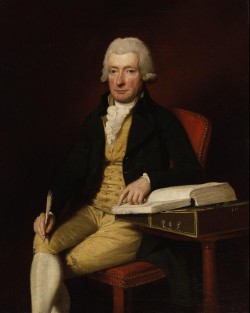
William Cowper (1792), by Lemuel Francis Abbott. Wikimedia Commons.
In addition, Austen’s reading would have continually brought her into contact with the efforts of the abolition movement to highlight the barbarity of slavery and the slave trade. Her favorite poet, William Cowper, whose books the Rev. Austen purchased in 1798 and read to the Steventon household in the evenings (18–19 December 1798), writes against the slave trade several times.3 Thomas Clarkson, in his History of the Abolition, writes that “many thousand copies” of Cowper’s poem “The Negro’s Complaint” (1788) were printed on hot-pressed paper and, as part of the sugar boycott, distributed “almost over the whole island” under the title “A Subject for Discussion at the Tea-table.” The poem was also set to music (2: 189–91). In The Task (1784), a poem Austen often alludes to and quotes from, Cowper confronts slavery’s inhumanity:
He finds his fellow guilty of a skin
Not colour’d like his own; and, having pow’r
T’ enforce the wrong, for such a worthy cause
Dooms and devotes him as his lawful prey. . . .
And, worse than all, and most to be deplor’d,
As human nature’s broadest, foulest blot,
Chains him, and tasks him, and exacts his sweat
With stripes, that mercy, with a bleeding heart,
Weeps when she sees inflicted on a beast.
Then what is man? And what man seeing this,
And having human feelings, does not blush,
And hang his head, to think himself a man? (45–46)
Cowper challenges his readers to “let [liberty] circulate through ev’ry vein / Of all your empire; that where Britain’s pow’r / Is felt, mankind may feel her mercy too” (46). Clarkson names Cowper “a great coadjutor” in the abolition movement for the value of “his sentiments, and the extraordinary circulation of his works,” and devotes one and a half pages to quoting The Task: “There are few persons, who have not been properly impressed by [these] lines” (1: 108). Surely James, Francis, and Jane Austen were among those properly impressed. (Given Charles’s complex role in patrolling the West Indies in 1826 to prevent the slave trade and Henry Austen’s position as delegate to the World Anti-Slavery Convention in 1840—which Devoney Looser has explored [“Sisters” 48–53; Wild 195–200]—they might be added to the list.)
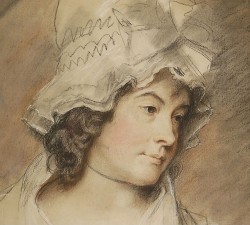
Charlotte Turner Smith (1792),
by George Romney. Wikimedia Commons.
From her earliest work Jane Austen is in conversation with Charlotte Smith, as Jacqueline Labbe has argued. In The Old Manor House (1793) Smith mentions slavery only twice, first in comparison to the conditions under which British soldiers are shipped to America to put down the colonists’ rebellion. Connecting these two kinds of misery, Smith shifts from the horrors of the slave trade and back to the inhumane treatment of soldiers (345). Toward the end of the novel, she further develops the picture of the slave trade.
The merchant, who sits down in his compting-house, and writes to his correspondent at Jamaica, that his ship, the Good Intent of Liverpool, is consigned to him at Port-Royal with a cargo of slaves from the coast of Guinea, calculates the profits of a fortunate adventure, but never considers the tears and blood with which this money is to be raised. He hears not the groans of an hundred human creatures confined together in the hold of a small merchantman.
By comparing the slave trader to roguish lawyers and physicians in a “catalogue of human crimes” (501), however, Smith minimizes his criminality.
Smith engages more fully with slavery and the slave trade elsewhere, including The Wanderings of Warwick, The Old Manor House, and “The Story of Henrietta” in Letters of a Solitary Wanderer (1800). Both depict the horrors of slavery. In Jamaica with his regiment—a detail that underscores British possession—Warwick sees “droves of black people going into the fields under the discipline of the whip” and “turn[s] with horror and indignation from such a spectacle” (45). Another episode presents the seventeen-year-old Marianne Shaftesbury, who has wept over sentimental novels, enjoying the whipping of a ten- or eleven-year-old enslaved girl (53–54). But despite her opposition to the trade, Smith depicts the Black enslaved people and servants in terms of racial stereotypes.4 Although Smith and her characters oppose the slave trade and slavery, she gives no hope of abolishing it.
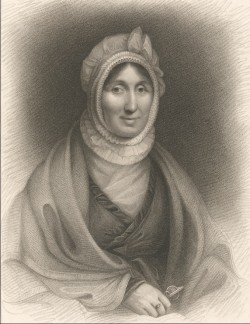
Mrs. Anne Grant (1815).
Engraved by W. T. Fry.
In Memoirs of an American Lady (1808), which the Austens read in January 1809, Anne Grant represents slavery around Albany, New York, in terms as idyllic as the other aspects of her history. Though she disclaims being an “advocate for slavery,” her vision is unrelievedly positive.
even the dark aspect of slavery was softened into a smile. . . . I think I have never seen people so happy in servitude. . . . They were baptised . . . and shared the same religious instruction with the children of the family; and, for the first years, there was little or no difference with regard to food or clothing between the children and those of their masters. (1: 51–52)
Even the sale of children is idealized: “They were never sold without consulting their mother, who, if expert and sagacious, had a great deal to say in the family” (1: 53–54). Grant’s version of slavery around Albany exists with little “servility and fear” and “harshness or even sternness of authority” (55). But for enslaved people presenting habitual disciplinary problems, “the terrible sentence, which they dreaded worse than death, was passed—they were sold to Jamaica,” a necessity “bewailed by the whole family as a most dreadful calamity, and . . . were carefully watched on their way to New York, lest they should evade the sentence by self-destruction” (55). This threat is, Grant argues, a “salutary terror” (1: 315), resulting in slaves who are happier and better than servants can be amid the corruptions of Europe (55–56). One wonders what Jane Austen would have thought about this depiction.
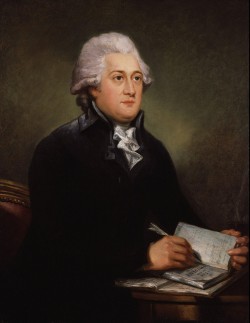
Thomas Clarkson (1788), by Carl Frederik von Breda. Courtesy of the National Portrait Gallery.
In 1813 Austen claimed to be “in love with” Thomas Clarkson, author of The History of the Abolition of the Slave Trade, published the same year as Grant’s American Lady (24 January 1813). Clarkson reveals that the Society Effecting the Abolition of the Slave Trade had made the decision to focus on the trade—as a first step that they felt could be achieved—rather than to attempt the abolition of slavery generally. Although Clarkson traces the history of abolition in America and Europe, he focuses more on the capture and purchase of Africans and the conditions on British slave ships than on the plantations of the West Indies and North America—except to argue that if conditions were improved, there would be no need to keep importing Africans. He recounts parliamentary debate describing violence even against infants, lack of religious training, lack of medical care, and lack of food (2: 228–30). Clarkson sees the American Revolution as “ultimately favourable to [the] progress” toward abolition in generating “a general enthusiasm for liberty”:
Many [Americans] talked of little else but of the freedom they had gained. These were naturally led to the consideration of those among them, who were groaning in bondage. They began to feel for their hard case. They began to think that they should not deserve the new blessing which they had acquired, if they denied it to others. Thus the discussions, which originated in this contest, became the occasion of turning the attention of many, who might not otherwise have thought of it, towards the miserable condition of the slaves. (1: 188–89)
With the abolition of the slave trade, Clarkson looks hopefully for slavery itself to be abolished.
[W]e cannot but be struck with the wonderful concurrence of events . . . that two nations, England and America, the mother and the child, should, in the same month of the same year, have abolished this impious traffic; nations, which at this moment have more than a million of subjects within their jurisdiction to partake of the blessing; and one of which, on account of her local situation and increasing power, is likely in time to give, if not law, at least a tone to the manners and customs of the great continent, on which she is situated. (2: 586–87)
Clarkson was overly optimistic, as it turned out.
One of the parliamentary debates Clarkson recounts features a response to the defenders of the slave trade by one Mr. Huddleston, who questioned the validity of “the selfish plea of interest” rather than “humanity, justice, and religion” (2: 496). Huddleston
asked how it happened, that sugar could be imported cheaper from the East Indies, than from the West, notwithstanding the vast difference of the length of the voyages, but on account of the impolicy of slavery, or that it was made in the former case by the industry of free men, and in the latter by the languid drudgery of slaves. (2: 497)
Huddleston argued that however “miserable” the conditions of the East Indian—in terms of housing, poverty, and subservience—he still resided in his native land, with his own family: “No barbarous sounds of cracking whips reminded him, that with the form and image of a man his destiny was that of the beast of the field” (2: 498). Perhaps Jane Austen’s shift from East to West was designed to access the darker moral implications of the Americas.
Not that the Americas or the West Indies play a substantial role in Austen’s novels. Perhaps too large for that “little bit (two Inches wide) of Ivory,” they lurk discreetly offstage (16–17 December 1816). Contemporary readers, however, would have noticed them impinging on the Chawton novels. They are most central to Mansfield Park. Sir Thomas, an absentee West Indian landlord (a role much criticized in the debates for the additional violence that it allowed), “found it expedient to go to Antigua” (36). Austen’s emphasis on expediency, on the “pecuniary light” in which Sir Thomas plans the trip, reflects the arguments of the West Indian planters against any limits on the slave trade, as Clarkson reports them. Tom’s return to Mansfield brings no discussion of what he’s seen in Antigua. His panicky “‘A strange business this in America, Dr. Grant!’” (140) is undefined; John Wiltshire suggests that it alludes only to the trade wars with the United States (MP 676 n8). When Sir Thomas returns, Fanny’s question about “‘the slave-trade,’” followed by the “‘dead silence!’” from her cousins (231), is a significant but ambivalent moment. Fanny says that she “‘love[s] to hear [her] uncle talk about the West Indies, . . . could listen to him for an hour together. It entertains me more than many other things have done’” (230). This language is unlikely to indicate a discussion of the horrors of slavery or the slave trade; more probably it reflects an interest in West Indian landscapes, manners, and customs. Positioning Fanny and Sir Thomas within the parameters of the debate is therefore difficult, though Marsha Huff reminds us that Sir Thomas is “a conventional member of the landed gentry and . . . a negligent patriarch.” Conversely, Fanny’s language and thinking are so permeated by Cowper’s poetry—evident as she reflects on the church, cities, and the natural world—that his arguments against slavery must just as powerfully impress her.5
In Emma the subject of African slavery seems almost accidentally introduced—as if for the residents of Highbury it is not spoken about, not considered. Outsiders must initiate the topic. When Jane Fairfax refers bitterly to “‘[o]ffices for the sale—not quite of human flesh—but of human intellect,’” Mrs. Elton’s rejoinder is immediate and defensive:
“Oh! my dear, human flesh! You quite shock me; if you mean a fling at the slave-trade, I assure you Mr. Suckling was always rather a friend to the abolition.” (325)
As a prosperous Bristol merchant, Mr. Suckling has likely profited from the slave trade. Emma, published in December 1815, is presumably set well after its abolition, so Mrs. Elton’s claim comes after it must be advisable to conceal one’s involvement in or support of the slave trade. Further, though Jane Fairfax retreats, claiming to mean only the “‘governess-trade,’” she weighs her victimization against those kidnapped from their homes and sold into slavery: “‘as to the greater misery of the victims, I do not know where it lies’” (325). Does such self-dramatization mark an intentional narrative distancing from Jane Fairfax? In any case, these unremarked-upon silences indicate that the residents of Highbury have separated themselves from Britain’s moral struggles.
One of the major problems of Persuasion is what to make of Mrs. Smith, who is the owner, like her namesake Charlotte Smith, of “some property . . . in the West Indies” (227).6 This property is the centerpiece of Persuasion’s penultimate paragraph—prime narrative real estate. Beyond its inconvenient distance for Mrs. Smith’s comfort (Hemingway, “When a Slave Island”), the only reason to locate her property in the West Indies is to associate it with slavery. Because Wentworth proves his value for Anne’s friend “by putting [Mrs. Smith] in the way of recovering her husband’s property in the West Indies; by writing for her, acting for her, and seeing her through all the petty difficulties of the case, with the activity and exertion of a fearless man and a determined friend” (274), he and, by extension, Anne are implicated in the system of chattel slavery. Although Erin Goss suggests that Austen has “learned that slavery . . . is best buried and kept fully off the page,” here again Austen gives slavery prominence, letting it color our understanding of her world, like “the dread of a future war” (275).
Most intriguing of all is Sanditon’s Miss Lambe, “a young West Indian of large fortune,” “about seventeen, half mulatto, chilly and tender” (LM 199, 201–02). What would develop, in the novel that Austen was unable to write, for Miss Lambe and her West Indian origins? Would Austen help us place her in her former environment? How would she use what she’d learned about the manners of the place? Would we find out how Miss Lambe happens to be an heiress rather than enslaved? Would that backstory lead to further legal or social complications?
Let me add another possible influence. There is a potential model for Miss Lambe in the Southampton circle of Jane Austen and her family, who lived there from 1806 until moving to Chawton in July 1809. Cheryl Butler tells the story of Anne Morse, one of five surviving children of a Jamaican plantation owner and merchant and his mistress, Elizabeth Augier, “a descendant of slaves” (First Impressions 149).7 The children were sent by their father to England to “enter English society” (150). Later Anne, with two of her siblings, traveled to India, where she met and married Nathaniel Middleton, who had been employed by the East India Company and was part of Warren Hastings’s administration. Like Eliza de Feuillide, they named their oldest son Hastings. Nathaniel was later called to testify against Warren Hastings in his trial before Parliament. (And there were other connections: John Middleton, Nathaniel’s brother, rented Chawton House more than once, and Jane Austen knew the family.)
Anne and Nathaniel Middleton moved back to England in 1784, building Townhill Park House, on the edge of Southampton, next to her father’s estate. John Morse had died in 1781, leaving a will in favor of his illegitimate children, which was contested by a nephew based on the Jamaican law that mixed-race children could inherit no more than £2,000. The lawsuit lasted from the early 1780s to 1799, being finally settled in favor of the children. The suit and the racial background of Anne and her siblings were widely discussed in newspapers. Nathaniel died in 1807 (while the Austens were living in Southampton); Anne survived until 1823.
What did Jane Austen think about all this? And what might she have written into her story of the West Indian heiress Miss Lambe? All we can guess is that Austen would have drawn on knowledge and imagination—her own local knowledge, her brothers’ global experience, her reading about the Americas, and her genius—to construct a character of interest and complexity.8
NOTES
1For more on James’s thinking, see Knox-Shaw (41–42).
2Peter Knox-Shaw (164) was, I believe, the first to reproduce the last sentence of this quotation. See also Doody (418 n44) and Hemingway (“Adjudicating”); compare Hubback and Hubback (192). Devoney Looser has discovered that Frank was “one of the leading voices” in an 1826 meeting in Gosport on “‘the propriety of petitioning parliament for the Abolition of Slavery in the West India Colonies’”—in fact, “the man who motioned for the petition’s approval” (Wild 194).
3In Charity (1782), The Task (1784), “The Negro’s Complaint” (1788), “Pity for Poor Africans” (1788), “The Morning Dream” (1788), and “Sweet Meat has Sour Sauce: or, the Slave Trader in the Dumps” (1788).
4Carroll Fry sees Smith as to some degree typical of her time: “despite her philosophical opposition to the institution, she reveals the same racial prejudice shared by many others committed to the abolition movement” (46).
5On the way that Cowper’s language saturates Fanny’s worldview, see Ford (What Jane Austen’s Characters Read 151–61, 166, 175–77).
6See Ford’s “Mrs. Smith, Charlotte Smith, and West Indian Property in Persuasion: A Note.”
7See also Butler’s account of the exhibit celebrating Jane Austen’s Southampton circle (“A Very Respectable Company”). Her essay reproduces a painting of Anne Morse Middleton and two of her siblings.
8For more on Austen’s familiarity with anti-slavery publications, see Margie Burns’s essay in this issue of Persuasions On-Line.
