At JASNA’s 2025 AGM—Austen at 250: “No check to my Genius from beginning to end”—four JASNA scholars with recently published books, Janine Barchas, Inger S. B. Brodey, Collins Hemingway, and Devoney Looser, were invited to help define Jane Austen’s Genius in five minutes. Susan Allen Ford introduced and moderated the discussion. What follows is an edited transcription of that discussion.
Susan Allen Ford
The letter from which JASNA’s AGM theme was plucked was written at an interesting moment in the life of Jane Austen. On 16 December 1800, she turned twenty-five. Within two weeks, her father announced that he was retiring and that the family would move to Bath. Her letters over the next months indicate the upheaval ahead. A new home had to be found. Furniture, pictures, the 500-volume library, horses, and even chickens had to be disposed of. Neighbors and relatives kept visiting Steventon Rectory. Jane Austen herself—whatever her initial reaction to the upcoming uprooting had been—began to make plans for her new life in Bath and for summer trips to the seaside. Jane’s most frequent correspondent, Cassandra, meanwhile, was away at Godmersham with their brother Edward’s family.
So at Steventon, on 21 January 1801, Jane Austen picked up her pen to write to her sister. She began,
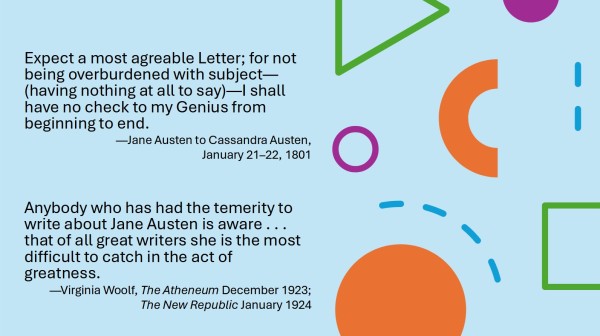
Expect a most agreable Letter; for not being overburdened with subject—(having nothing at all to say)—I shall have no check to my Genius from beginning to end. (21–22 January 1801)
As her Genius flows, she writes about their brother Frank’s promotion and his need for a new command; about having dined at Deane and played at vingt-un; that Eliza Fowle, visiting with her husband, Fulwar Craven Fowle, hasn’t quite recovered her looks; about the Fowles’ children, William, Tom, and Caroline; about her anticipated visit to Manydown; about the death of Mrs. Rider, the Basingstoke haberdasher, and the community’s anticipation of her replacement, Mrs. Rogers; and a slew of messages, commissions, and other (at least to us ) trivial matters. Then, at the bottom of page three, a letter from Cassandra arrives. “I have a great mind not to acknowledge the receipt of your letter,” Jane writes, “which I have just had the pleasure of reading, because I am so ashamed to compare the sprawling lines of this with it! But if I say all that I have to say, I hope I have no reason to hang myself.”
One thing that strikes me in this letter, and especially about that first sentence, is her winking statement that she is “not . . . overburdened with subject,” that she has “nothing at all to say.” For many years, much of the critical tradition emphasized that sense of limitation, that want of important ideas. Jane Austen, everyone agreed, was no Dostoevsky. But against that statement is her own confidence, her willingness to proclaim her Genius.
Just over one hundred years ago, Virginia Woolf proclaimed that Genius but struggled to define it. “Anybody who has had the temerity to write about Jane Austen is aware,” she wrote, “that of all great writers she is the most difficult to catch in the act of greatness.” So now, these four wonderful scholars are going to try to do something that Virginia Woolf indicates should be approached with trepidation. They will try to catch Jane in the act of greatness, to (somehow) try to define her Genius.
Janine Barchas
We are, in fact, overburdened with subject, but I’m going to restrict myself to one anecdote about how I first caught Jane Austen in the act of greatness in my classroom.
I am a reluctant Janeite. Almost twenty years ago now, I was asked by my colleagues at the University of Texas at Austin if I would please teach a Jane Austen class. My instant reaction was “Absolutely not.” I reasoned, “Hollywood is in her corner, and she really doesn’t need me. You know who needs me? Authors who don't have a T-shirt or a pillow or an ‘I ❤️ Mr. Someone’ underwear.” At the time, I was happily teaching Samuel Richardson and Sarah Fielding and Frances Burney, people who needed me. But I’m a good soldier. And I didn’t have tenure. And so I said, “Yes, I will teach Jane Austen in Austin.”
You should know that there’s one particular word that I hate my students using in their essays. It’s nugatory; it’s a throwaway; it’s a nothing word: it’s very. After all, nothing is ever very yellow. It might be canary. Nothing is ever very historical, although it might be ancient. Nothing is ever very anything because, as I tell my students, you have not chosen the next word carefully enough if you need to throw very in front of it to make your meaning clear. You mischose. So, imagine my surprise when I discovered that Jane Austen, the great genius of economy in writing, used the word very in her novel Emma (I began circling it out of annoyance) 1,212 times. Like Professor Snape, I thought, “She must be up to something.”
That something turned out to be an idiolect specific to Highbury that involves almost all its characters. It reflects a kind of early awareness of linguistics, isolation, and local idiolect, a kind of “speak” that is reflective of the insular nature of Highbury life and its claustrophobia. That recognition turned into a forty-page typescript where I compared Jane Austen’s idiolect in Emma, and the frequency of verys found in that novel, to this word in her letters, to other novelists, to her other novels. Was the frequency the same? No, no, no. And I became smitten by somebody who could control the telltale word that I was circling in my students’ essays—a verbal tic that we often read through unnoticed. I hadn’t even caught all 1,212 instances. The LION (Literature Online) database did that for me. And that initial curiosity turned into a passion that now—four books and three exhibitions later—has become my professional life. These days, I teach Jane Austen almost constantly, and always at 8:00 a.m. Why so early? Because Jane Austen would otherwise cannibalize Shakespeare, Chaucer, and Milton.
She is that good! And that popular!
Inger S. B. Brodey
Virginia Woolf’s “catch[ing] Jane Austen in the act of greatness” is what I’d like to start with. Woolf was, of course, a great fan of Austen. I’d like to focus on Austen’s subtle narrative techniques that influenced Virginia Woolf and all the modernists quite directly. Austen’s narrative tricks and moments are difficult enough to “catch” that many of us feel we’re still trying to find and define them. We “catch” more of them every time we reread; we teach those acts of greatness, going line by line, word by word with our students. Yet “catch and release” rules seem to apply—after centuries, we still work on finding ways to categorize and describe these slippery moments.
Jane Austen was a master of capturing voices—idiolects—whether they are speaking or just thinking. In her novels, her narration shifts in and out of the individual characters’ minds, often without any external indicators: the he said, she said that she talks about in her letters. The minds of her characters also shift seamlessly between true observations and those that bend reality to fit the characters’ wishes. The French author Gustave Flaubert is often credited with inventing the free indirect style, but Austen used it masterfully and increasingly throughout her career—mastering it without ever needing to name it. And this was nearly half a century before Flaubert.
Austen’s narrative shifts create little microcosms of dramatic irony. As readers, we struggle to evaluate what really occurs and why, since we can’t really trust any of her characters to have a complete grasp on reality. Take, for example, the wonderful Meryton Assembly scene early in Pride and Prejudice. Reading this scene, we need to wonder: how does Darcy’s physical appearance actually change in the course of one evening? If you remember, first he’s tall with a noble mien; then the report of his wealth makes him look even handsomer, handsomer than Bingley. Then by the end of the evening, presumably after some spurning of smiles and flattery, the crowd decides his looks aren’t even worthy of being compared with Mr. Bingley’s. Without explicitly telling us, Austen has placed us in the minds of the crowd—desperate mothers of marriageable daughters, perhaps—a crowd whose ambition is first aroused and subsequently disappointed. We experience their “first impressions” alongside them without an objective filter.
Austen’s understanding of human subjectivity provides a through-line in her work, from beginning to end. She laughs at it, she cries over it, and she celebrates it. John Dashwood’s selfish ability to twist facts and promises and Mrs. Ferrars’s irrational partialities make the world of Sense and Sensibility such a cruel and dangerous one. Yet even the mature Anne Elliot cannot help “dear self” from poking its way into her calculations and interpretations in Persuasion. Nor would we readers want her to. Even the rational Mr. Knightley gradually accepts the partiality that allows him to find Emma “faultless in spite of all her faults” by the end of that novel. Our fickle partialities are both bane and blessing.
In Virginia Woolf’s mind, such narrative shifts and her stream-of-consciousness narrations satisfy an affinity for indeterminacy—a sense, perhaps, of futility in trying to understand things rationally. In Woolf’s day, this was underscored by scientific theories such as Freud’s unconscious, Heisenberg’s limits of measurement, and Einstein’s relativity. A most brutal and pointless Great War undermined public confidence in objectivity, truth, goodness, and heroism. Woolf’s narration slips in and out of characters’ minds like Austen’s, back and forth into consciousness. Yet it does so in a poignant tone, underscored by futility and a lingering despair.
Austen never succumbs to despair. She reshapes heroism in the face of our follies and deficiencies. Take Sense and Sensibility: Sir Walter Scott would have spent dozens of pages on the duel between Willoughby and Colonel Brandon. Austen mentions it only to relegate it to the margins. She instead spends her pages on other types of duels, particularly those between Lucy Steele and Elinor. Rather than the grand, traditionally masculine, bow-wow strokes of military heroism, Austen favors what I like to think of as “parlor heroism,” a heroism available to any individual of any rank at any time. Elinor’s heroism consists in her “exertions”—a favorite word—to speak or remain silent at the most difficult times, and often at great personal cost. This is the heroism—or lesson—that can change a reader’s daily existence.
Whether because of her historical moment, or her own Genius and wisdom, Austen captures our weaknesses, our frailties, the impermanence in our human nature without succumbing to despair or relativism. To me, that’s one of her greatest gifts to humanity. Yet she gives us more: her acts of greatness don’t simply leave us with intellectual games of deciphering reality. Austen provides us with a moral imperative: listen, observe, think, and speak. Do not give up on truth, goodness, community, or love. That’s a lesson we need to hear today as well.
Collins Hemingway
Jane Austen’s Genius, her greatness, in 721 words.
One could live upon the name of Newton-Priors for a twelvemonth. (30 November 1814)
If you understand what Austen means, then you understand her Genius. Newton-Priors is the place name chosen by her niece Anna, who in 1814 was trying her hand at novels. Jane loved the choice. She knew that, among the many, many parts of a novel, the perfect name for a village helps bring the story to life. Write what you know, she told Anna. Create plausible scenarios. Get the details right. Avoid clichés (like the plague).
A hundred years early, she follows Edith Wharton’s dictum that to write well, you must “do the small thing closely and deeply rather than the big thing loosely and superficially.” So while Ann Radcliffe, Fanny Burney, and others wrote long, lumbering, generic descriptions, Austen developed brief, concrete, lively ones. “[T]he broad-faced stuffy uncle Philips, breathing port wine,” follows the officers into the drawing room, where Mr. Collins is kept “most abundantly supplied with coffee and muffin.” We can see Mr. Collins stuffing his face, and we can smell uncle Philips's breath.
Precision creates tangibility, the sense that we’re there, immersed in the action. Such tight, meaningful description peaks in Persuasion, where Lady Russell hears the carriages, the carts, “the bawling of newsmen, muffin-men and milk-men, and the ceaseless clink of pattens.” Next to her, Anne Elliot dimly sees the buildings “smoking in rain, without any wish of seeing them better, . . . for who would be glad to see her when she arrived?”
One lady happy, one sad: their surroundings and their mood captured by deft description. Physicality enables depth, for it’s easier to develop something real than something insubstantial.
Pride and Prejudice is Jane’s first novel to take a substantial dive into the mind. An unexpected meeting with Darcy leaves Elizabeth awake at night, trying to understand her feelings. She has moved from hatred to respect to gratitude to “a real interest in his welfare.” But, she wonders, should she bring on “the renewal of his addresses”? Unlike swooning heroines, she is still examining her feelings at the end of the scene.
Emma’s “wonderful velocity of thought” shows in a wonderful variety of ways. One is when she justifies her intent to remain single. She does not speak broadly of single life or spinsterhood. Her frustrations pop out in a single sexual term: “‘I shall not be a poor old maid; and it is poverty only which makes celibacy contemptible to a generous public!’”
Emma benefits from Austen’s pioneering use of free indirect style, which normally merges the consciousness of the character and the narrator. But Austen merges the consciousness of two characters, Emma and her father, when Emma broaches the idea of marrying Mr. Knightley. “Poor man!” begins a subjective comment from Emma’s point of view. Back and forth the perspective swings as she cajoles Mr. Woodhouse, and he resists. Surely, she concludes, her father would want Mr. Knightley “always on the spot? —Yes.” This interjection marks the last shift to her father as he acknowledges that he should be glad to see him every day. “[B]ut they did see him every day as it was.—Why could not they go on as they had done?”
This double indirect style enables us to simultaneously be immersed in both Emma’s patient love and her father’s anxiety over change.
But when it comes to Anne’s mental life, Persuasion looks the other way. As Wentworth hands her into the carriage, she goes blank until they are “half their way home.” At Molland’s, she “starts” at seeing him and is “lost.” Her mind splits in two, one side scolding the other back into focus. A beat later, her mind splits again and debates itself!
I’ll leave it to you to decide what Austen is doing with Anne’s mind. Or you can read my book. . . .
Jane Austen wrenched British fiction to the realist mode. She traded long, vague descriptions for short, crisp ones, and simplified narrative language by at least half. She abandoned dungeon-entrapped, waterfall-plunging, faint-on-command damsels for young women who think and feel and learn as real people do. She delved into the human mind in ways that even today have seldom seen their equal in originality.
To quote the Bard:
While others dredged up murky words by the shovel,
Jane Austen’s Genius created the modern novel.
Devoney Looser
It’s great to be here before this magnificent audience, even if the assignment we have been given is an impossible task. I will admit to you that this panel has already given me a great deal of comic mileage! I have joked to my Janeite friends that we four were charged with describing Jane Austen’s Genius in just a handful of minutes, then warned of the additional difficulty we’d face because we’d be limited as to number—only five minutes at once.
So I’m going to attempt to examine Austen’s Genius through one thing very clever—just one line of her writing. It’s from a letter to her niece Fanny, written in March 1817, a week after she set aside Sanditon. In that letter, Austen lays out what we might think of as her philosophy of fiction writing, writ small. As she puts it in that letter, “[P]ictures of perfection as you know make me sick & wicked.”
This line is a monument to Austen’s greatness in so many ways. Although it’s written in prose, we might mistake it for verse! It’s like a short poem. The first and third lines each feature six syllables, with a repeated emphasis on the first and fifth syllables (PICTures of perFECTion) (MAKE me sick & WICKed). And the second line is what’s called a molossus. It’s three equally stressed syllabus (AS YOU KNOW). This prose sentence is verse-like also because of its repeated, sing-songy consonants with its Ps (pictures, perfection) and hard K sounds (perfection, make, sick, wicked). So it’s a genius prose line that’s also exceptional versifying.
But one, I think, must admire even more than its accomplished form, its brilliant content. This is a wild line. It’s an unapologetic, open rebellion against or subversion of her day’s accepted literary, gendered, and social norms. The word perfection in this era meant flawless, faultless, and pure. So Austen’s line disavows the highest heights of morality and virtuousness in fictional representation and—beyond that—in women’s lives. For an early nineteenth-century novelist, the epitome of the really accomplished young lady was one who was a great proficient in all things—beauty, morality, and talent. This one line captures why Austen’s fiction rails against type and proudly refuses the era’s requirements for perfect heroines.
Austen rejects the idea that there is one standard to which heroines and women ought to conform. This line implicitly celebrates difference. Note that Austen doesn't say that pictures of perfection are false, or unlikely to be found in real life, or to be avoided by other fiction writers. She might well think those things, but she doesn’t dictate to dictators. She describes instead the deleterious effects these perfect female characters have on her in the strongest possible terms. The typical novelist of the day claimed to create characters that ennobled, inspired, and improved readers, especially female readers. But Austen declares that these other authors’ efforts had the opposite effect on her. Their one-size-fits-all standards for heroines made her feel sick and wicked.
Think about that for a moment. Reading about a would-be perfect moral character and its imposing a single standard for behavior on women made Jane Austen feel cruel, severe, fierce, evil, horrid, or beastly—all synonyms then for “wicked.” These pictures of perfection in accomplishment and morality were, to her, anti-role models. They brought out the worst in her—her immorality. She rebelled against them. This one sentence communicates how impossibly high, constricting, and misguided standards for femininity prompted a mischievousness in Austen that she unapologetically noticed, and perhaps even celebrated in herself, in this line.
So it’s possible that the very theme of this conference, her Genius, and all our gushing remarks this weekend, would also make Austen feel a little sick and wicked. Her sentence would instead have us celebrate the anti-perfect—to examine, embrace, and make space for a diversity of viewpoints, and for the things that bring us into productive conflict with alleged truths, universally acknowledged. Her brilliant sentence would have us rail against what the powerful tell us we’re supposed to be saying or doing or thinking. It’s absolutely central to why I continue to love her writings at the level of the word, the sentence, the chapter, and the plot, not to mention the sequel, the continuation, the adaptation, the remix, and the imperfect things inspired by her writings that no one has yet dared to imagine but that I trust and hope will emerge from the moment we’re living in and through in the years to come. Pictures of perfection, as you know, make me sick and wicked. Happy 250th, Jane Austen, and to the rest of us, onward!
Susan Allen Ford
If we weren’t sitting up here, I feel like we should charge the barricades.
Devoney Looser
You got it.
Janine Barchas
Let’s go!
Susan Allen Ford
One of the things that strikes me in listening to the four of you is the way in which nobody talked about plot. Nobody talked about a love story or romance. And that is fascinating, because I’m sure many of us got into Jane Austen with a desire to have that taste fulfilled. But what you have been talking about is narrative strategy and language, but also the range from Inger’s “parlor heroism” to Devoney’s diversity of viewpoints and celebration of difference. To bring this discussion down to something more concrete, if you had to choose, which work (the teenage writings, finished or unfinished novels, letters, poetry) would you choose that best exemplifies Austen’s difference?
Janine Barchas
Is that like saying which one is our favorite? It depends on what day of the week you ask me that.
Susan Allen Ford
No, not favorite. What do you think is her greatest achievement?
Janine Barchas
That, too, depends on the day of the week. When I’m teaching . . . unfortunately, not every syllabus can accommodate all her works, whether it be all her novels or the fragments. For teaching purposes, you end up choosing what you think—as I tell my students—what will get the students the most social currency. For me, that’s Pride and Prejudice, definitively, and then one more, so let’s choose the most difficult one: I always choose Mansfield Park. Those are the two for different reasons that end up on my syllabi and as such have to be synecdoches, representative of both her difficulty as well as the social rewards earned by reading her. Compare, for example, any mention of Samuel Richardson in an elevator: “Oh, what do you do?” “Oh, I’m a teacher.” “What do you teach?” “Samuel Richardson.” “Oh.”—That’s as far as it gets. Instead, when you say, “Jane Austen,” people lean in and invade your personal space. It’s like when I was pregnant. They lean in, and they say, “What’s your favorite?”
Susan Allen Ford
I did my job, apparently.
Devoney Looser
I think this is a Sophie’s Choice question. We all feel this way, which Janine is trying to get at. But I think for this moment, one of the texts that I am returning to over and over is Lady Susan. It’s about a deliciously villainous, lying sociopath who’s very funny, a bad mother. And it includes the terrific universal line “Facts are such horrid things!”
Susan Allen Ford
That's a great answer.
Collins Hemingway
Actually, I wish Jane had come back to Lady Susan after she had mastered her art and abandoned the epistolary, because I would love to see Lady Susan done the way Austen could have done her had she not been locked in by that old style. Probably all the best lines in Austen are in that unfinished book.
Inger Brodey
I like to think of the different challenges that Austen undertakes with each of her novels. One of the things I realized when I was writing about Pride and Prejudice, which I had thought was a romance-forward novel, was that even there Austen values other things above the romance. In that one, it’s civility. The word civility comes up in interesting ways, and she challenges us. I think one of the central ideas of the novel is how to “unite civility and truth in a few short sentences” like Elizabeth does, and it is really hard. I think that’s something very important and current; my students certainly find a great deal of resonance in that challenge.
Janine Barchas
That shows her to be a thief, too. She’s stealing that from Shakespeare’s Beatrice in Much Ado. “The Count is neither sad, nor sick, nor merry, nor well, but civil Count, civil as an orange and something of that jealous complexion.” She’s thieving that and then putting what for her is a contemporary spin on that sense of civility, or what the Greeks call xenia—that hospitality and behavior towards others, especially strangers, that’s meant to be a reciprocal expression of society.
Inger Brodey
Especially those people you don’t like—especially enemies.
Susan Allen Ford
What you’ve just said reminds me of Emma, who has difficulty being truly civil to people she doesn’t like, such as Jane Fairfax. It’s a real failure in her that we understand and yet judge her for. I think Austen keeps instructing us in those ways.
So going back, Devoney, to what you were saying, even though Austen is made wicked by those pictures of perfection and is rejecting the simplified ideal of a didactic novel, in another sense she’s very teaching-oriented, isn’t she?
Devoney Looser
I think she takes some things from the toolbox of literary convention. She doesn’t throw it all away. I think it’s a reformist approach from a literary perspective and maybe from a political one, too.
Janine Barchas
She’s a repurposer.
Devoney Looser
Repurpose is good.
Janine Barchas
Hilary Davidson talks about how she takes dresses and fabrics and repurposes them to suit the new style. I think Austen’s doing that in literature as well. She’s not throwing anything away, but she is rejecting certain old things and making them new again.
Devoney Looser
Absolutely.
Susan Allen Ford
Much like Shakespeare, who stole lots of stuff!
Janine Barchas
Thieving is good in a literary sense. It’s as much homage as it is plagiarism.
Susan Allen Ford
That’s why we dress it up in a French word.
Janine Barchas
So true. Nice one.
Susan Allen Ford
Thank you. Maybe a brief answer to this question, if you can. From her teenage writings to the poem that she wrote just before she died—“When Winchester races first took their beginning”—do you think there was a check or a redirection to her Genius?
Devoney Looser
I think one of the definitions of Genius is that it isn’t one thing. I think the check to her Genius would be if she stopped growing and trying and using it. I don’t think we should approach these as if we’re looking for the essence of Austen. I think Genius means a kind of capaciousness. That would be my answer. It’s a non-answer in a way. But I love the idea of thinking of her body of work from that beginning to end. It was a pleasure to be able to reread all the works for Wild for Austen and just to see how incredibly moving all of them are in their own ways.
Collins Hemingway
To me, I see her growing steadily across her career. I can’t remember the name of the critic who said she wrote the same at forty as she did at twenty. And some people, even in JASNA, can think everything she wrote was perfect. But that’s actually the worst thing you could say, because it means she never learned and grew. And that’s what, to me, she did with every book. My discovery was seeing her step by step learn both from tradition what to keep, what to discard, what to morph, and what she learned from her own mistakes, and how she changed with each book going forward.
Inger Brodey
I agree with that idea of her constantly changing, constantly evolving. There is a restlessness in her Genius that I really admire: she was never satisfied. She could have written six Pride and Prejudices, and they would have been very pleasing and popular. Instead, she decides to go against charm in her very next novel, to write the novel against charm after having created such charming characters. But I think there’s something similar going on between each of her old and new projects. That ambition, that sheer and restless ambition made her think: I want this other challenge. I want something new. I want to perfect this genre that I’ve adopted, the novel.
Janine Barchas
You're right, she keeps mixing it up. But there are certain things that end up on the cutting room floor that don’t get published. Lady Susan is one of those items that is clearly finished. It’s a perfect copy, i.e., she wrote it out as finished copy on 1805 paper. It is her at thirty. Whenever she started it, it’s done, and it doesn’t get published. I see in her work so many times where she’s invoking huge names for her protagonists, names that are in the newspapers and where she’s playing with fire. I think you’re right about the “parlor heroism,” but that doesn't mean that she stays in the parlor.
Inger Brodey
Oh, no. Absolutely not.
Janine Barchas
She wants to be ambitious enough to play on a world stage, but that means that not everything gets published, not everything is ready. There are certain things that just remain unfinished. If we treat them as though they came fully sprung from the head of Zeus and are finished things, then we’re not recognizing that she didn’t think that they were yet ready to share. She was an editor and self-critic. As I tell my students, she collects those criticisms as everyone should when they’re a writer. Go to somebody mean. She went to her mother: “Thought Fanny insipid.—Enjoyed Mrs Norris.”
Inger Brodey
A mirror, maybe.
Janine Barchas
Exactly. It’s that savoring of criticism, that sense that she is just a little bit wild and trying just a little bit hard.
Collins Hemingway
And gutsy. It’s gutsy to hear any criticism of your precious children, whether the real ones or the ones that you write. She was willing to throw it out there.
Susan Allen Ford
All four of you have published books either in this year of Austen’s 250th birthday, or last year when we began celebrating at the Cleveland AGM. Each of your books in some ways represents what Jane Austen’s Genius is for you at this moment in time. Why focus on the particular aspect of Jane Austen’s Genius that you explore in your latest book? Why now?
Janine Barchas
In two minutes or less?
Susan Allen Ford
You can have three.
Janine Barchas
The graphic biography The Novel Life of Jane Austen was a partnership with an illustrator. The first set of questions was about the color palette. Our choice there reflected the nature of what makes Austen special, in that everything in the biography, as Paula Byrne reflected on today with the image of mirrors, is true. So I wanted to stick entirely to the facts. The color palette is deliberately muted to reflect the relatively quiet domesticity that surrounded Austen. But when she turns on her imagination and she begins to write and create her novels, the palette flares up into a hot red-and-pink worldview that contrasts with that ordinary, muted gray and blue. That’s how we decided to indicate her creativity and what was special about it.
Inger Brodey
I was interested in how, on the one hand, Austen is known as the founder of the modern romance genre in fiction and the rom-com in film, and she’s celebrated for and often thought of primarily in terms of her happy endings. I’ve always thought that was an interesting combination or contrast with what she actually does in her novels, where she does interesting things at the end of each of her novels. She speeds things up and stops the dialogue and instead summarizes quickly, or she asks snide “Who can be in doubt of what followed?” kinds of questions. I decided to make a study of that, and what I ended up doing was a biography of Austen sequentially through her novels and the decisions she made. But along the way, what I discovered is that we have changed surprisingly little from the audiences that she wrote to. As far as I can judge from film and popular culture, I think we often smooth over the criticisms in Austen and the social commentary in favor of the romance, whereas she herself was putting romance second to other kinds of issues.
It’s really interesting: she challenges us to have an ordinary heroine in Northanger Abbey, but I don’t know that any of the actresses in Northanger Abbey film adaptations who play Catherine could be called ordinary. In fact, some of the adaptations are just all-out gothic—but that’s another issue. Austen is constantly challenging us as readers to redefine what heroines are, what the novel is. I guess I wish that in this moment our adaptations could also take her criticisms of society more seriously.
Collins Hemingway
My major interest in Austen is as a writer, as a practitioner of this very difficult art. Many commentators will talk about Jane Austen’s style, but often they don’t define what they mean, or they’ll make a comment about a very specific aspect of her style, or they’ll make a passing comment on the way to another thing they’re actually interested in. I’d never found a single book that talked about all the different elements of her style, and that’s what interested me. And so not finding it, I thought that, well, maybe I should write it down, at least my perspective. My wife always says, “Make sure you say, ‘in my opinion.’” So I’m saying, “in my opinion.”
Inger Brodey
That means she doesn't agree with you?
Collins Hemingway
No, she just thinks I sometimes express opinions as if they are facts. And those who know my wife know that she’s usually right. But the other thing in terms of right now—I’ve gotten to this point over a long time of reading and studying, but also we’re 250 years in. There are now six or seven generations, layers of commentary and criticism. It just felt to me like I needed to get back to the basics, get back, as Paula said earlier, get back to the text, look at the details, really parse them very carefully. This was my way of exorcising that demon for myself. So that's why.
Devoney Looser
I know Janeites don’t need to be told that Jane Austen wasn’t simple or conventional or boring. We don’t need this lesson. But it is strange to me how much that reputation continues to stick to her. I wrote Wild for Austen wanting to take legitimate historical facts and to show the very specific ways in which Austen uses the word wild in her writings, the ways in which she made wild choices, or was surrounded by wild people in her life, and then the last third of the book is on her legacy. You don’t need to look too far to find wild things in her legacy. They’re everywhere. The book is twenty-five chapters told in a storytelling format. I hope that it speaks not only to the people in this room but to your friends who might want to understand why there’s all this big fuss about Jane Austen. Is she really just this little person who wrote these little books? The answer is, obviously, absolutely no. So that’s why now.
Susan Allen Ford
What discoveries did you make as you were working on these projects? That’s always something that interests me. There’s a moment when you think, “Oh, my goodness, I never recognized that before.”
Janine Barchas
The animals. My daughter is studying to be a veterinarian, and I never paid attention to the animals in the stories. And yet, the more facts I was trying to find about her surroundings and the objects that surrounded her and the people who surrounded her—when, what, where—Cassandra was keeping bees and had a dog, and there were cats, and there were chickens, and there were farm animals. All of that obviously doesn’t belong indoors, unlike the 2005 Pride & Prejudice. Pardon me—I just won’t discuss that. It was about fleshing out, if you will, the world in which she moved. It’s challenging when you’re trying to remake it, and I assume that movie makers feel this way as well. But with the help of other scholars and people, I was sending Isabel all these images of locations as it looked then. This is what Southampton looked like. This is what her home here looked like. I wish I’d had the 3D version of Steventon at the time that Frank Lutz is going to talk about. All these objects fleshed things out for me and made her even more real. But the animals were the big surprise for me.
Inger Brodey
I felt like I got closer to Jane Austen the person, somehow, in thinking about what motivated her to make changes to her approach and to the endings from novel to novel. That sounds presumptuous, I realize. Then also, my favorite, if I had to pick one, would probably be Persuasion. I thought at first that it was an exception in terms of the romance being dominant at the end. But in rereading it and in thinking about it, I came to appreciate even more this idea of “resources for solitude,” a phrase from that novel, and that in every one of Austen’s works, the moment of greatest insight for the heroine coincides with a moment when it doesn’t look like she will get married. Having the resources to live a full life is ultimately so much more within our capacity to achieve and ultimately more important than whether we ever find the perfect mate.
Collins Hemingway
First, Janine’s comment about animals triggered a thought to me about children. They don't play much of a role in Jane Austen’s novels, but if you look at her descriptions of children, they are warm, they are funny, they are very specific. Even the chaos with the Middletons is done so wonderfully well. Every time a child comes into the novel, just stop for a moment and see that little bit of fun she’s having—which just jumped out at me after a long enough time. But the bigger thing for me is just that she figured so much of this stuff out on her own. When you look at all the conventions that she was working against, the traditional way of everything, she not only figured it out but decided that she would go her own way. That’s what makes her Jane Austen instead of the other 150 writers that only specialists tend to read.
Devoney Looser
And I’m probably inordinately proud of discoveries, or maybe we should call them “unearthings,” of some of the things in Wild for Austen, including the fact that three of her brothers participated publicly in the anti-slavery or abolition movement after her death. That is something we did not know five years ago that I found out about each of three brothers (Henry, Charles, and Francis). These are not horrid facts. These are wonderful facts, but they’re difficult facts. I think they allow us to re-imagine certain parts of what we’ve seen in Austen’s texts and to think about what their activism meant in a family circle. I’ve also really enjoyed writing the chapters about the time Jane Austen was in the same room with the opera diva and the international spy and to think about what that means. We’ve all heard about Aunt Leigh-Perrot’s shoplifting, but I hope I’ve reframed what that was like for Jane to be a part of. It was considered one of the most important, notable historic events of the year 1800. It was, like, “Napoleon invades Egypt,” and “Mrs. Leigh-Perrot is acquitted of shoplifting.” I think we haven’t understood how big that headline-grabbing event was in Jane Austen’s life. It’s those kinds of things that I’m proud of having reframed and given us a chance to re-imagine in Wild for Austen.
Announcer (reading questions from the audience)
Following on what Devoney was just saying, what role do you think her personal life, relatability, and her personality have on our appreciation of her writing?
Janine Barchas
I think that we have inherited—and the show for the Grolier, “Paper Jane,” struggled with this—“Aunt Jane’s” personality, the Victorianized version of Austen as someone who was very pleasant and very quiet and very pretty and Christian and everything that she was supposed to be. Then you read the letters, and you read the novels, and you realize that she is much more revolutionary and somebody you wouldn’t want to invite to a dinner party, really, because she would criticize everything you served and what you were wearing and what you said on the way home.
Susan Allen Ford
And the next day in a letter.
Devoney Looser
And the idea that, you know, Henry says she never uttered a silly or severe expression? But yet, we know that she made stillborn-baby jokes in her private letters. I think this idea that we can capture her personality in these short hagiographic terms is one that we are doing a great job of unpacking, of tearing apart. Trying to bring her back to us, in more of her complexity, seems still valuable. I think we’re still learning.
Inger Brodey
But why do we care so much about her own private life? It seems like maybe that’s something we do more with female authors than male authors. I don’t see the same kinds of questions being asked about male writers, that same kind of fascination.
Devoney Looser
People don’t comment on Shakespeare’s love life to quite the same degree, although we do hear about the bed.
(Incoherent rumblings of qualification from the panelists about the second-best bed and other things)
Janine Barchas
We don’t put boundaries on his Genius in the sense of suggesting that he must have had this sort of love life to imagine Romeo and Juliet. We do when it comes to Austen—this idea that she must have had a great love in her life to give us these great love stories. Maybe she was just a Genius.
Inger Brodey
Well, we also project our own ideals onto her. I’ve noted that in the adaptations it seems that they frequently cast Austen as the heroine, rather than using the heroine from the novel that’s being adapted into film. That’s a continuing trait I’m curious about.
Devoney Looser
She is a Rorschach test for many of us. But we can shape the biography and tell the story in better ways than have been done in the past. I hope that’s what all of us here are trying to do. I love biography. I think biography gives us wonderful insight into an author’s writing, and I’m all for it.
Announcer
We have a lot of questions around the Austen characters. Which ones are more perfect pictures of perfection than others? Can the panelists comment on which character they think gets closest to perfection and which one needs more work?
Janine Barchas
I think the one that gets closest to perfection needed the most work. The reason Mrs. Austen thought Fanny insipid is because Fanny is the most perfect heroine. She is the most generous. She is the most absorbing of the body blows around her, and she’s the most suffering. She is the ultimate Christ figure. There’s a reason she’s wearing that cross, as Paula Byrne indicated. In a man who can be active in the world and then chooses to be positive, these Christian virtues represent a heroic act. A woman can’t do that. She’s already deemed passive in that world. When she then appears with these Christian virtues, she’s insipid. Austen is interrogating, I think, the heroism of Christian virtue in a very complicated novel that says, “Look, if you emulate Christian virtues as a guy, great, but if you do it as a woman, you’re not likable.”
Collins Hemingway
The other thing, though, is Fanny never has a thought that doesn’t have its anti-thought. If she shows a Christian virtue, then she’ll follow up with a jealous thought or an angry thought.
Janine Barchas
She doesn’t act on the angry.
Collins Hemingway
She doesn’t.
Janine Barchas
She has that feeling as a thought.
Collins Hemingway
There’s this internal battle. She’s the traditional meek, mild heroine. She’s having a war inside her head all the time. That’s what makes her interesting.
Devoney Looser
Well, I think it’s Elizabeth Bennet. She’s as delightful a creature as ever appeared in print, right?
Janine Barchas
You stole that line.
Inger Brodey
Anne Elliot for me.
Announcer
Anne gets applause. Next, the fragment of Sanditon is quite exciting. Would you comment on how it might reflect Austen’s further development as a writer?
Inger Brodey
For me, the “[b]lue shoes, and nankin boots” and the proliferation of objects are just so fascinating. It’s a new mercantile world that the heroine and others must negotiate. Objects—like the toothpick case—have been so sparse in her previous novels. All these little things are so important. But in Sanditon there are so many objects that they become meaningless, perhaps. That’s one way of looking at it. The industrialized world that she’s suddenly engaging with is a new frontier.
Devoney Looser
I think opening with the carriage crash. It’s Jane Austen meets Fast and Furious.
Collins Hemingway
She also said earlier in one of her letters, I think, that she didn't like stories that opened with carriage crashes.
Inger Brodey
That’s right!
Collins Hemingway
For me, it’s just—it’s too early. I wish we had a Sanditon version draft three instead of half of draft one. I mean, there’s just not enough there. It’s so tantalizing. Actually, a lot of commentary has been written about Sanditon. Jane Austen is probably the most fearless and tireless reviser in the history of the world—and she did have time to revise, as opposed to other authors who didn’t because of the financial need to publish. But on Sanditon, Austen never even got started, really. It’s so hard to judge beyond the tantalizing bits to guess where it might have gone and what she might have had.
Janine Barchas
Then we have Andrew Davies, who decided to go in a certain direction. I cannot unsee that.
Inger Brodey
The incest?
Janine Barchas
Shhhhhh!
Announcer
We have one minute for closing thoughts.
Janine Barchas
If you have not read all her works, read more.
Inger Brodey
That’s right.
Collins Hemingway
Over and over again.
Devoney Looser
I just want to say how grateful I am for this community and for JASNA and for all the ways that we get to come together and have these conversations. This is itself a tribute to Jane Austen’s 250th. All of us are a part of it together this weekend. I couldn't be more pleased to be able to be here in person and with those of you who are joining us virtually. This is the celebration that we deserve, as well as the celebration that she deserves.
Janine Barchas
What she said.
Collins Hemingway
Yeah.
Inger Brodey
Well said. It’s been wonderful being in the “good company” of clever, informed people.
Susan Allen Ford
Thank you so much to these wonderful panelists.
