In Northanger Abbey, seventeen-year-old Catherine Morland tells Henry and Eleanor Tilney that she doesn’t like to read history:
“history, real solemn history, I cannot be interested in. . . . I read it a little as a duty, but it tells me nothing that does not either vex or weary me. The quarrels of popes and kings, with wars or pestilences, in every page; the men all so good for nothing, and hardly any women at all—it is very tiresome.” (109–10)
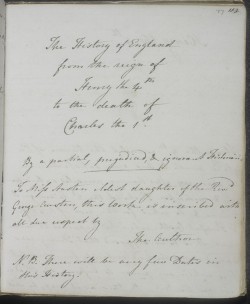
Jane Austen’s The History of England (1791), Volume the Second.
(Click here to see a larger version.)
This may or may not have been Jane Austen’s personal view. But rather than complain about tiresome texts, fifteen-year-old Jane wrote her own treatise, titled The History of England from the reign of Henry the 4th to the death of Charles the 1st, “By a partial, prejudiced, and ignorant Historian” (J 176).1 On the last page, she dated the manuscript “Saturday Nov. 26th 1791” (J 189)—a few weeks shy of her sixteenth birthday. The History is in Volume the Second of the three small notebooks in which Jane Austen transcribed her early compositions, often referred to as the Juvenilia.2
Austen’s work is, in fact, a parody of a popular four-volume treatise by Oliver Goldsmith, titled The History of England from the Earliest Times to the Death of George II, published in 1771. Jane Austen and her siblings read Goldsmith’s History in the parsonage at Stevenson, and the books are still owned by the family. The treatise is illustrated with circular woodcut medallion portraits of English monarchs. Peter Sabor, editor of the Cambridge edition of the Juvenilia, says that in the Austens’ volumes of Goldsmith’s History, the portraits are “garishly” colored in watercolor, “possibly by Austen herself or by her sister Cassandra” (J 317). For Jane’s History, Cassandra created thirteen pen-and-watercolor portraits of the kings and queens, set in circular medallions, copying the style of the illustrations in Goldsmith and signing all but one “C E Austen pinx.” Cassandra uses the abbreviation of the Latin pinxit—“painted”—assuming for herself the designation of artist, just as Austen calls herself on the title page, “The Author.” The History is dedicated “To Miss Austen eldest daughter of the Revd George Austen”—Austen’s co-creator, Cassandra (J 176, 455 n3).
Austen’s parody of Goldsmith begins on the first page, as she echoes the form of Goldsmith’s title. She boasts of being a “prejudiced” historian in direct contradiction to the claim made by Goldsmith in his preface: “it is hoped the reader will admit my impartiality” (qtd. in Sutherland and Johnston 297). Jane was not such a reader. Her extensive notes written in the margins of the family’s copy of Goldsmith (reprinted in the Cambridge Juvenilia) express disdain for many of his opinions; one note reads: “Oh! Dr. Goldsmith Thou art as partial an Historian as myself!” (J 455 n2).3
Jan Fergus notes that Austen also parodies the abridged histories that she mocks in Northanger Abbey (i). In her defense of novelists, Austen ridicules “the nine-hundredth abridger of the History of England,” whose work is rated higher than a novelist’s (NA 31). Fergus says that in their “comically” condensed History, Jane and Cassandra “parodied the simplification and distortion that abridgments entail,” and “[i]n doing so, . . . they conveyed their almost modern sense that history is a constructed text” (i).4
Jane Austen’s romp through the centuries is clearly written for comic effect. But there is, in fact, a thoughtful design underlying her structure and choice of heroines and villains among the monarchs and supporting players. On the last page of the History, Austen explains what her design has been, in this thesis statement:
my principal reason for undertaking the History of England being to prove the innocence of the Queen of Scotland, which I flatter myself with having effectually done, and to abuse Elizabeth, tho’ I am rather fearful of having fallen short in the latter part of my Scheme. (J 188)
Dr. Johnson’s Dictionary gives these definitions of scheme: “1. A plan; a combination of various things into one view, design, or purpose; a system,” and “2. A project; a contrivance; a design.”
Let’s examine Jane Austen’s “Scheme.” Elizabeth is, of course, the monarch who reigned for a good part of the sixteenth century. The “Queen of Scotland” is Mary Stuart, who—spoiler alert—was executed by order of Elizabeth. Austen calls Mary “one of the first Characters in the World” and names her the heroine of the story (J 180); Elizabeth is, of course, the villain. Once we know Austen’s scheme, her peculiar version of English history makes sense. It is decidedly madcap, but there is method in her madness. She develops her plan by selecting heroes, heroines, villains, and minor characters—as she does in her youthful fiction—who, together, defend Mary and abuse Elizabeth.
It suits Austen’s design to begin her History not, as Goldsmith did, with “the earliest times,” but with the monarchs immediately preceding her star players, Mary and the Stuart kings. Sabor says that Austen depicts English history as “the rise and fall of the Stuarts. She covers the earlier reigns briefly, presenting them primarily as paving the way for the House of Stuart” (J 455 n1). Those earlier kings are essential players in her scheme, because they are both Mary’s and Elizabeth’s ancestors. This structure—from Henry IV to Charles I—provides the arc of her lively story, cast in the form of a miniature historical treatise.
To appreciate Austen’s prejudiced view, a little real, solemn history is helpful. In her telling, Austen often borrows from Shakespeare’s version of people and events as dramatized in his history plays, rather than from historians such as Goldsmith. So I’ll begin this brief lesson with a statement by the Duke of York in Shakespeare’s Henry VI, Part 2: “Edward the Third, my lords, had seven sons” (2.2.10). Naturally, only one of them—one at a time, that is—could be king of England, and so, within a few years after Edward’s death, the heirs of his younger sons began to assert competing claims to the throne. The contestants were the descendants of Edward’s sons the Duke of York and the Duke of Lancaster. Sir Walter Scott—in one of his Waverley novels, Anne of Geierstein, or The Maiden of the Mist (1829)— popularized the nomenclature now commonly used, calling the House of York the “white rose” and the House of Lancaster the “red rose,” based on the flowers on their heraldic badges. The armed conflict for dynastic succession was thus called the “Wars of the Roses.” Austen refers to those wars, which went on for thirty years in the fifteenth century, without using the “rose” designations because they were not in common parlance at that time.
Jane Austen’s History begins in 1399 after King Edward’s rightful heir, Richard II, had been deposed by the Duke of Lancaster’s son, who was crowned Henry IV. Throughout the text, Austen employs the irony that characterizes all her juvenilia, making light of the violent means by which king succeeded king. She reports Henry IV’s armed usurpation of the crown with exaggerated civility, saying that he “prevailed on his cousin and predecessor Richard the 2d, to resign [the throne] to him, and to retire for the rest of his Life to Pomfret Castle, where he happened to be murdered” (J 177, my italics). Henry IV was then succeeded by two further generations of the House of Lancaster, who were crowned Henry V and VI.
In her account of the third Lancastrian king, Henry VI, Austen abandons all pretense to the role of historian and, in the strongest language, begins to develop her scheme. According to Goldsmith, Henry VI fell into a “distemper” for a time and was unable to rule (J457 n18). Austen alludes to this impairment:
I cannot say much for this Monarch’s Sense—Nor would I if I could, for he was a Lancastrian. I suppose you know all about the Wars between him and the Duke of York who was of the right side; if you do not, you had better read some other History, for I shall not be very diffuse in this, meaning by it only to vent my Spleen against, and shew my Hatred to all those people whose parties or principles do not suit with mine. (J 178)
Austen then tersely sums up the Wars of the Roses: “There were several Battles between the Yorkists and Lancastrians, in which the former (as they ought) usually conquered” (J 178).
Why is it that the Duke of York “was of the right side,” and in battles between the Yorkists and Lancastrians, it was the former who “ought” to conquer? Remember that Austen’s scheme in writing the History is to defend Mary, Queen of Scots, and to abuse Elizabeth, and Elizabeth was descended from the House of Lancaster. Her grandfather was Henry VII—born Henry Tudor—who, with a few zigs and zags in his lineage, was a Lancastrian. Throughout her History, therefore, Austen defends Yorkist kings and abuses Lancastrian kings.
In her entry on Henry V, Austen introduces another thread that runs throughout the History. For each monarch, she names the king’s wife and includes sympathetic observations about her, even those married to her enemies, the Lancastrians. She calls Henry V’s wife—Catherine, daughter of the French king—“a very agreable Woman by Shakespear’s account,” and says that Henry VI’s wife, Margaret of Anjou, was “a Woman whose distresses & Misfortunes were so great as almost to make me who hate her, pity her” (J 177–78). In Austen’s focus on women, she even brings in Joan of Arc, who rallied the French against England’s attempts to place its king on the French throne. As Austen puts it, Joan of Arc “made . . . a row among the English,” for which “[t]hey should not have burnt her—but they did” (J 178). By including women in every entry, Austen’s History serves as a corrective to the treatises that Catherine Morland finds “‘very tiresome,’” with “‘the men all so good for nothing, and hardly any women at all.’”
Edward IV, who took the throne by deposing the Lancastrian Henry VI, is a Yorkist, and, in accordance with Austen’s design, we should expect praise for Edward and a handsome portrait by Cassandra. Borrowing Goldsmith’s description, Austen dutifully reports, “This Monarch was famous only for his Beauty and his Courage,” but Cassandra’s picture of a common, homely man ironically belies Goldsmith’s accolade.5 Austen as usual mentions the monarch’s wife but only to interrupt herself, skip ahead, and vent her spleen against one of her chief villains: Edward’s wife was “Elizabeth Woodville, a Widow who, poor Woman!, was afterwards confined in a Convent by that Monster of Iniquity and Avarice Henry the 7th” (J 178). This is the first of Austen’s often-repeated attacks on Henry VII, who, as founder of the Tudor dynasty and grandfather of her enemy Elizabeth, is a prime villain in Austen’s scheme.
Edward IV’s son, the uncrowned Edward V, was twelve years old when he and his younger brother disappeared from their apartment in the Tower of London shortly after their father died. Austen bluntly says that Edward V was “murdered by his Uncle’s Contrivance, whose name was Richard the 3d” (J179). But she now has a problem: how can she write glowingly about a Yorkist king who arguably usurped the throne by having his Yorkist nephews murdered? She attacks the dilemma head-on in her account of Richard III by simply contradicting what she has just written:
The Character of this Prince [Richard III] has been in general very severely treated by Historians, but as he was a York, I am rather inclined to suppose him a very respectable Man. It has indeed been confidently asserted that he killed his two Nephews and his Wife, but it has also been declared that he did not kill his two Nephews, which I am inclined to beleive true. (J 179)
In the eighteenth century, as Austen knew, there was disagreement on the question of Richard’s responsibility for the death of the princes. She enters the debate with characteristic absurdity by taking both sides. In Catharine, or the Bower, which Austen wrote less than a year after completing the History, she again alludes to the question, when Kitty Percival converses with the unprincipled Edward Stanley “on the character of Richard 3d, which he was warmly defending”; Kitty’s opinion is not revealed (J 286).
Richard III was killed at the battle of Bosworth Field by Henry Tudor, a Lancastrian, the Tudor patriarch and grandfather of Elizabeth, whom Austen calls “as great a Villain as ever lived” (J 179). Cassandra’s portrait of a hirsute tramp reinforces Jane’s words.6 Henry assumed the crown as Henry VII; the name of the royal family became Tudor; and Henry’s marriage to Princess Elizabeth of York ended the Wars of the Roses by uniting the houses of Lancaster and York.
Pursuing her focus on women, Austen singles out as supporting characters Henry VII’s two daughters, whose descendants were later rivals of Queen Elizabeth. The elder, Margaret, married the King of Scotland and thus “had the happiness of being grandmother” to Mary, Queen of Scots, Austen’s heroine. At that time, Scotland was an independent country ruled by the Stuarts. Henry VII’s younger daughter was the grandmother of Lady Jane Grey, who, Austen says, “tho’ inferior to her lovely Cousin the Queen of Scots, was yet an amiable young Woman” (J 180). It is an inconvenient truth that Mary, Queen of Scots (like her cousin Elizabeth), was a direct descendant of that very “Monster of Iniquity,” Henry VII. In Austen’s view, however, Mary’s Lancastrian ancestry is overridden and forgotten because she was born a Stuart—the ancient Scottish royal house favored by Austen over the English Tudors.
Austen assumes a dismissive attitude toward Henry VIII, “whose only merit,” she says, “was his not being quite so bad as his daughter Elizabeth” (J 180). In her “slight sketch of the principal Events” of his reign, she lists only Cardinal Wolsey’s death, “the reformation in Religion, and the King’s riding through the Streets of London with Anna Bullen” (J 180–81). (Austen adopts the spelling used by both Shakespeare and Goldsmith [J 461 n48].) Leaving Henry aside, she focuses on the women in his life. Bullen, she says, “was entirely innocent of the Crimes with which she was accused, of which her Beauty, her Elegance, and her Sprightliness were sufficient proofs” (J 181). In light of Austen’s scheme to abuse Elizabeth, it is surprising that she not only defends the mother of her enemy but praises her. Throughout the History, Austen adopts the posture of supporting any woman other than Elizabeth. It’s a proto-feminist approach in direct opposition to the treatises dismissed by Catherine Morland in Northanger Abbey. It also brings to mind Jane Austen’s later sympathy for Caroline, Princess of Wales, when she was estranged from her husband, the Prince Regent: In 1813, Austen said in a letter to Martha Lloyd, “Poor Woman, I shall support her as long as I can, because she is a Woman, & because I hate her Husband” (16 February 1813).
Austen also defends Henry VIII’s fifth wife, Catherine Howard, the Duke of Norfolk’s niece, who, Austen says, was likewise innocent of the crimes for which she was beheaded. In this case, however, it’s really Catherine’s relations whom Austen wishes to praise, because, as she says, a later Duke of Norfolk, Thomas Howard, was “warm in the Queen of Scotland’s cause” (J 181). Norfolk, a Catholic, was so warm in support of Mary that he plotted to marry her, depose Elizabeth, put Mary on the throne, and restore Catholicism to England—for which he was executed. Norfolk is thus a hero in Austen’s design.
Jane Austen’s ultimate assessment of Henry VIII is both funny and serious:
[N]othing can be said in his vindication, but that his abolishing Religious Houses and leaving them to the ruinous depredations of time has been of infinite use to the landscape of England in general, which probably was a principal motive for his doing it, since otherwise why should a Man who was of no Religion himself be at so much trouble to abolish one which had for Ages been established in the Kingdom. (J 181)
The humorous element is Austen’s reference to eighteenth-century enthusiasm for medieval monastic ruins and Gilpin’s view of the picturesque, which valued tumbledown abbeys and monasteries for their aesthetic beauty.7 Austen treats seriously, however, Henry’s most significant act as king: his abolishing the religion “which had for Ages been established in the Kingdom.” Austen says, in effect, that Henry—“a Man . . . of no Religion”—had no moral or theological justification for abolishing Catholicism in England. This muted criticism of Henry’s self-proclaimed reformation looks ahead to Austen’s sympathetic treatment of the Catholic House of Stuart and Mary, Queen of Scots. She later goes so far as to say, “I am myself partial to the roman catholic religion” (J 186)—not the view we would expect from an Anglican clergyman’s daughter. Scholars point out that in adopting this pro-Catholic stance, Austen counters the position taken by most eighteenth-century historians, including Goldsmith, who wrote with a strong Protestant bias (J 466 n81; Sutherland and Johnston 308; Moore 43–44). It’s another aspect of her project to defend the Catholic Mary Stuart to a Protestant audience, and since that audience consisted of her family and close friends, she could count on them to understand the combination of comedy and sincerity in her exaggerated positions.
Austen’s entry on Henry’s heir, the boy king Edward VI, says little about him and instead introduces heroes who support her scheme. Edward VI’s protector, the Duke of Somerset, Austen says, was not “equal to those first of Men,” the Earl of Essex, Frederic Delamere, and William Gilpin (J 182). Why does she choose this odd trio? The Earl of Essex, who for many years was a favorite of Queen Elizabeth, later led an abortive coup against her government and was executed. On the principle that the enemy of my enemy is my friend, Austen includes Essex as one of her heroes. Frederic Delamere is not even a real person; he’s the ardent suitor of the heroine in Charlotte Smith’s 1788 novel Emmeline, which Austen had read and enjoyed. (Later in the History, Austen’s choice of Delamere is explained.) We know that Austen admired Gilpin’s theories of the picturesque, but he’s named here because in one of his books he made sympathetic comments about Mary, Queen of Scots (J 463 n58). Austen goes far afield in search of supporting players in Mary Stuart’s cause.
When the Duke of Somerset was deposed as the boy king’s protector, he was beheaded—a fate that Austen turns to account to remind her readers of the tragic death suffered by her heroine. In a characteristic non sequitur, she says that the Duke “might with reason have been proud, had he known that such was the death of Mary Queen of Scotland; but as it was impossible that he should be conscious of what had never happened, it does not appear that he felt particularly delighted with the manner of it” (J 182).
Fergus argues that in the foregoing passage and in her treatment of all the Tudors, Austen mentions Mary Stuart “gratuitously” as “a kind of touchstone”:
What we see in such gratuitous references . . . is Jane Austen’s double vision, her surprising ability at fifteen to laugh at her most cherished feelings, to view them ironically without relinquishing them. Her absurd allusions to and defenses of the Stuarts . . . show her ironically examining and exposing her own prejudices while maintaining them nonetheless. Austen seriously admires Mary, but she also presents her own admiration as ridiculous. (vii)
Austen is a fully conscious artist, melding historic facts with ludicrous arguments for ironic effect. Fergus says that this “intricate double vision” informs the History and “all of Austen’s novels” (viii).
Austen uses her entry on Mary Tudor to begin her attack on Mary’s successor, Elizabeth. Venting her spleen in the harshest terms, she calls Elizabeth “that disgrace to humanity, that pest of society, . . . the destroyer of all comfort, the deceitful Betrayer of trust reposed in her, and the Murderess of her Cousin” (J 183). Austen chooses such exaggerated epithets for maximum comic effect. In Catharine, or the Bower, written a few months later, her heroine, Kitty Percival, is likewise critical of Elizabeth, though in much politer terms (J 251).
 |
 |
|
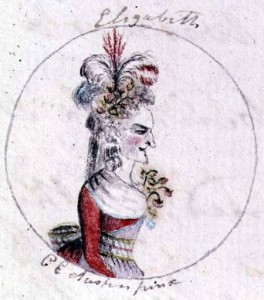
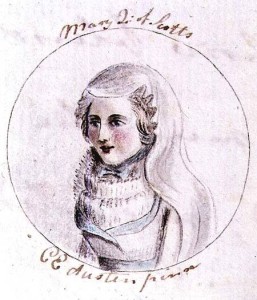
Elizabeth and Mary Qn of Scots, by Cassandra Elizabeth Austen (1791). |
|
For the medallion portrait above the entry on Elizabeth, Jane and Cassandra adopt a very different approach from the others in the History. Instead of one monarch, Cassandra draws two queens—Elizabeth and Mary—facing each other. Elizabeth is fierce and ugly, while Mary is docile and beautiful, in keeping with Austen’s project of abusing the one and vindicating the other.8 Austen’s account of Elizabeth’s long reign tells the story of both queens, focusing primarily on the mistreatment of the “ill-fated” Queen of Scotland (J 185) by Elizabeth and her ministers, beginning with Mary’s nineteen-year imprisonment and concluding with her execution. Among Elizabeth’s ministers, Austen singles out as special villains Lord Burleigh and Sir Francis Walsingham, calling them “vile and abandoned Men” who were “Scandals to their Country” (J 183–84).
Austen praises Mary’s “Steadfastness in the Catholic Religion which reflected on her so much credit,” and says that “zealous Protestants,” by abusing Mary’s unstinting faith, gave “striking proof of their narrow Souls and prejudiced Judgements” (J 184). Austen, who proudly proclaims her own prejudice, accuses fellow English Protestants of the same shortcoming. It’s perhaps worth noting that the conflicting doctrines of Protestants and Catholics in England were, in the words of Catherine Morland, the result of “‘quarrels’” between a pope and a king.
While the History is ostensibly a work of nonfiction, Austen’s writing, particularly in the section on Elizabeth and Mary, reads almost like historical fiction. Juliet McMaster makes this point in Jane Austen, Young Author:
Although much later Jane Austen told the Regent’s Librarian, James Stanier Clarke, that she could not write a “Historical Romance” to save her life . . . , when she writes here of Mary Queen of Scots she pulls out all the romantic stops. “This bewitching Princess,” she calls her: “Abused, reproached and vilified by all, what must her noble Mind have suffered when informed that Elizabeth had given orders for her Death! Yet she bore it with a most unshaken fortitude.” (167)
Abandoning her usual comic stance, Austen portrays Mary as the romantic heroine in a tragedy.
In the same vein, Austen treats as romantic heroes the Earl of Essex and Frederic Delamere, whom she praises a second time. She classes Delamere with Essex as another “unfortunate young Man,” saying, “The simile may be carried still farther, and Elizabeth the torment of Essex may be compared to the Emmeline of Delamere” (J 185–86). Kathryn Sutherland and Freya Johnston explain Austen’s convoluted “simile”:
Essex, like Delamere, is daring and impetuous; both men could be viewed as the servants and tormentors of the women they purportedly love. Delamere pursues and abducts Emmeline, demanding that she marry him; when she breaks off their engagement, Delamere dies in a duel. Essex’s reckless and treasonable behavior culminated in a rebellion and his execution. (308)
The young “imaginist” ignores the difference between a real Elizabeth and Essex and a fictional Emmeline and Delamere, and, viewing the men as characters in a romance, she dramatizes their suffering as she does Mary’s.
In her vindication of the Queen of Scots, Austen calls to witness as fellow supporters the historian John Whitaker (author of Mary Queen of Scots Vindicated [1787]); her friend and neighbor Anne Lefroy; and her brother Edward’s adoptive mother, Catherine Knight (J 184). It is likely that Austen discussed her views of Mary with those women. James Edward Austen-Leigh later recalled that Austen was a “vehement defender of Charles I and his grandmother Mary” (71), and his sister Caroline said that Aunt Jane “always encouraged my youthful beleif in Mary Stuart’s perfect innocence” (C. Austen 173). Austen’s attachment to Mary and the Stuarts was thus constant, extending beyond her teenage composition.
Concluding her defense of Mary, Austen says: “I now most seriously do assure my Reader that she was entirely innocent; having never been guilty of anything more than Imprudencies into which she was betrayed by the openness of her Heart, her Youth, and her Education” (J 185).9 Austen again portrays Mary as the unjustly accused heroine in a tragic tale. Whitaker and other defenders have similarly argued that Mary was the innocent pawn of men whose goal was to depose Elizabeth and assume the power of the crown through Mary.
Austen’s chronicle of the rise and fall of the Stuarts reaches its apogee on the death of Elizabeth and the accession of the first Stuart king, James I. We might expect lavish praise for James, but, pursuing what Fergus calls her “double vision,” Austen acknowledges that “this King had some faults,” though “considered on the whole I cannot help liking him” (J 186). She goes so far as to make risqué puns and jokes about James’s purported homosexuality, treating him more like a character in a farce than a revered Stuart monarch, the son of her heroine.
For her account of James’s son Charles I, Austen, the storyteller, focuses on the drama of the Civil War, when he was deposed and executed. Once again, she names heroes and villains. Oliver Cromwell and the Parliamentarians are “detestable Characters” and “Villains,” while five “noble” men remained loyal to Charles: “The King himself, ever stedfast in his own support,” Archbishop Laud, the Earl of Strafford, Viscount Faulkland, and the Duke of Ormond, all of whom defended Charles during the Civil War (J 187–88). The Earl of Strafford, Thomas Wentworth—a remote ancestor of Cassandra Leigh, Austen’s mother—was of particular interest to the Austen family. Margaret Anne Doody and Douglas Murray note that Austen later combines “the names of the hero of Emmeline [Frederic Delamere] and the ancestral martyr to Charles I’s cause in the name of the hero of Persuasion, Frederick Wentworth” (332). In Persuasion, Austen herself highlights the connection between her hero and the Leigh ancestor. Sir Walter Elliot thinks of “‘the Strafford family’” on hearing the name “‘Mr. Wentworth,’” and, learning that he is only a country curate, Sir Walter says, “‘One wonders how the names of many of our nobility become so common’” (26).
Throughout the History, Austen has educated the reader to believe in the innocence of Mary Stuart, the villainy of Elizabeth, and the superiority of the Stuarts. In her concluding defense of Charles, she proclaims her success: “with one argument I am certain of satisfying every sensible and well disposed person whose opinions have been properly guided by a good Education—and this Argument is that he was a Stuart” (J188–89).10 She has “guided” the “well disposed” reader to agree with her opinions. As Sabor says, Austen depicts English history as “the rise and fall of the Stuarts,” culminating in the death of Mary’s grandson Charles I. Though the House of Stuart was restored for a period after the Civil War, Austen’s choice to end with the martyred Charles ensures a dramatic and sympathetic conclusion to her chronicle, which is both impassioned and hilarious.
In The History of England, Jane Austen is decidedly “partial” and “prejudiced,” though far from “ignorant,” as she disingenuously claims on the title page. While the History is ostensibly a work of nonfiction, the young author pursues the project as she does her comic fiction. She goes to great—sometimes ridiculous—lengths to identify heroines, heroes, villains, and minor characters to fulfill her stated “Scheme,” which is an extended argument to persuade readers of the innocence of Mary, Queen of Scots, and the glory of the Stuarts. The first-person narration of the History—so unlike Austen’s usual objective comic stance—allows us to hear her voice and invites us to share her feelings of affection for the Stuarts and righteous indignation at Mary’s fate. With characteristic irony, Austen expresses serious views about English history, but never takes herself too seriously. The History is a surprisingly mature commentary that goes well beyond parody.
ACKNOWLEDGMENT
I would like to thank Juliet McMaster and Susan Allen Ford for their generous advice and assistance and for sharing additional scholarly sources and avenues of inquiry.
NOTES
1Quotations from Austen’s History are taken from The Cambridge Edition of the Works of Jane Austen. In “A Note on the Text,” the editor of Juvenilia explains that Austen’s use of the ampersand (&) in her hand-written text has been replaced with “and” (J lxviii).
2The full manuscript—including all Cassandra Austen’s illustrations—is available in Jane Austen’s Fiction Manuscripts: A Digital Edition, edited by Kathryn Sutherland: https://janeausten.ac.uk/search/blvolsecond/153.html?hl=The%20History%20of%20England.
3Juliet McMaster analyzes Elizabeth Bennet’s “hour of self-discovery” after reading Darcy’s letter and concludes that the realization that she has been “blind, partial, prejudiced, absurd” (PP 230) “is no accidental echo, but Austen’s deliberate reference to her earlier work and her earlier self” (169). Jan Fergus’s edition of the History also notes Austen’s repetition of “partial, prejudiced” in Pride and Prejudice (24).
4Fergus and others have pointed to another famous parodic history composed in the abridged format used by Austen: 1066 and All That (1930), by W. S. Sellar and R. J. Yeatman (Austen, History, ed. Fergus 24). Deirdre Le Faye calls Austen’s work “uncannily prophetic” of 1066 (xi). Sabor not only analyzes the similarities in the two works but makes a persuasive case that Sellar and Yeatman read Austen’s parody before writing their own and were influenced by it.
5See Jane Austen’s Fiction Manuscripts for this image: https://janeausten.ac.uk/search/blvolsecond/158.html?hl=The%20History%20of%20England. Fergus demonstrates that Cassandra’s portrait is based on the picture of an unattractive man in an engraving by W. H. Bunbury, called “Recruits.” Her portrait of Henry V as an officer dressed in uniform is from the same engraving (iii).
6See Jane Austen’s Fiction Manuscripts for this image: https://janeausten.ac.uk/search/blvolsecond/161.html?hl=The%20History%20of%20England.
7Kathryn Sutherland, in “Jane Austen: Fragment Artist,” locates the source of Austen’s quip about the English landscape in William Gilpin’s Observations, Relative Chiefly to Picturesque Beauty (1786), which she quotes: “Certain however it is that no man, since Henry the eighth, has contributed more to adorn his country with picturesque ruins.”
8Annette Upfal analyzes the portraits, concluding that Cassandra’s Elizabeth is a “cruel caricature of Mrs. Austen,” the sisters’ mother (xliii), and that Cassandra’s image of Mary, Queen of Scots, is Jane Austen (xix). Fergus says that she is “increasingly suspicious” that Cassandra’s Mary Tudor is “a portrait of Jane” (iv).
9In Vicesimus Knox’s Elegant Extracts, Jane Austen read a passage titled “The Character of Mary Queen of Scots,” taken from William Robertson’s The History of Scotland, during the reigns of Queen Mary and of King James VI (1759). The passage and Austen’s notes written in her family’s volume are included in the Cambridge edition of the Juvenilia. In the marginalia, young Jane Austen expresses disagreement with Robertson’s criticism of the queen, but in her History, she adopts two of his phrases. Robertson wrote that Mary “was often imprudent” and that “her heart was warm and unsuspicious” (J 353–54). Ryoko Doi also notes Austen’s use of Robertson’s words.
10Peter Sabor transcribes the word “Stuart” in bold font because Austen writes the word in much larger characters than the rest of the manuscript (J 189).
