Francis Austen (1698–1791) is a familiar figure in the literature on Jane Austen. Born on February 25, 1698,1 he was the second son of Elizabeth Weller (1671–1721), Jane Austen’s great-grandmother, and the most successful of all her children. He pursued a career in law and built up a highly lucrative practice, which has survived to this day as Knocker and Foskett, operating out of Francis’s former home, the Red House, in Sevenoaks, Kent, since 1935 (Killingray and Purves 150). Francis was the uncle of Jane Austen’s father, George, and therefore her great-uncle. He secured for his nephew his clerical post at Deane (Le Faye, Family Record 25), and he stood godfather to James, George Austen’s eldest son, in 1765 (18). Uncle and nephew kept in touch later in life; Mr. and Mrs. Austen, along with Cassandra and a twelve-year-old Jane, visited Francis at Sevenoaks in July 1788 (64). George Austen was also remembered in Francis’s will, receiving the sum of £500 (72). George benefited greatly from the care and attention he received from his uncle. Without Francis and his support, Jane Austen the novelist might never have come into being.
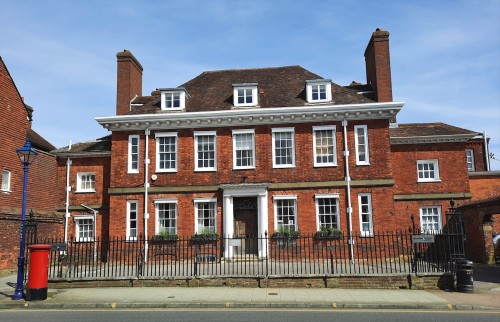
The Red House, Sevenoaks. © Azar Hussain.
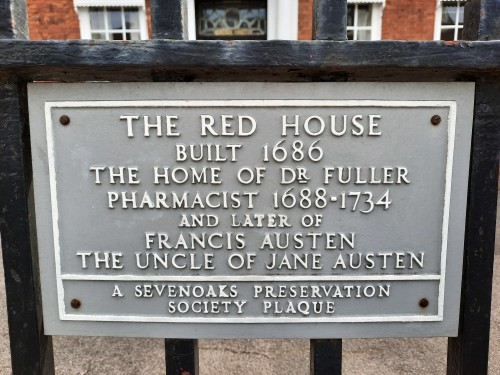
The plaque outside the Red House. © Azar Hussain.
We are fortunate therefore to have a portrait of Francis, now in the Graves Gallery in Sheffield. The painting is a three-quarter portrait, showing the upper body; a bewigged Francis appears in a grey-colored suit with gold edging, directing his gaze away from the viewer. The portrait has been reproduced a number of times and is familiar to many. A date span of 1780–82 has been assigned to it, and Ozias Humphry (1742–1810) has been named as the painter.2 Although little known today, Humphry was a respected artist, whose career reached from around 1760 to 1797. The painting itself was specifically commissioned by John Frederick Sackville, the third duke of Dorset (1745–99), one of Francis’s high-profile clients and one of Humphry’s patrons.
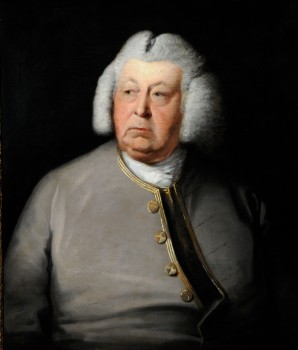
Francis Austen, by Ozias Humphry. © Sheffield Museums Trust. |
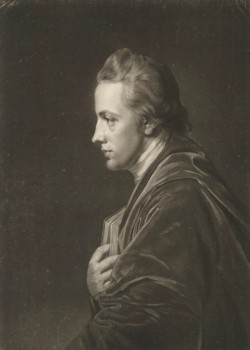
Ozias Humphry, after George Romney (1772). © National Portrait Gallery, London. |
These points, however, have been called into question, and the portrait’s history has been the subject of some discussion and debate. Nonetheless, although references to the portrait are few and frustratingly fleeting, we do have at least four items of evidence that can help us piece together parts of the portrait’s history. The first appearance of the portrait in print that I have been able to trace is in Emma Austen-Leigh’s 1937 Jane Austen and Steventon (facing p. 20), although no date or artist is given. The portrait itself was sold by the Austen family in 1931 and given to the Graves Gallery in Sheffield in 1935 by its purchaser, John George Graves (1866–1945), a local benefactor.3 The portrait has been reproduced in at least three other publications (Keith-Lucas 88; Southam 35; Hackworth ff. 192). In their captions accompanying the portrait, Keith-Lucas and Southam identify the artist as Humphry but ascribe no date; Hackworth mentions neither date nor artist.
As a starting point for investigating the date and provenance of the portrait, we will begin with both the printed and unpublished work of Deirdre Le Faye, who was the first to question the date and the artist. Le Faye sought information from the Graves Gallery and drew heavily on the testimony of Henry Austen as recorded in the Lefroy Manuscript.4 I have retraced Le Faye’s steps but also examined material in the British Library, the National Art Library at the Victoria and Albert Museum, the Paul Mellon Centre, the Royal Academy Archives, and the Kent Archives and Local History Centre. I have also examined the portrait in person in Sheffield. My research has led me to a different conclusion from Le Faye’s. I believe that a significant body of evidence indicates that Humphry was indeed the painter and that the period traditionally ascribed to the portrait is correct.
A key question is why the portrait remained in the Austen family’s possession if it was commissioned for the duke of Dorset. I will examine and assess the probability of four possible scenarios:
1. Humphry made a copy, which Francis Austen kept. The original was sent to Knole and is still there, undiscovered.
2. Humphry made a copy, which Francis Austen kept. The original was sent to Knole and was lost, moved, or discarded.
3. There was no copy, and the portrait was not actually intended for the duke’s collection.
4. There was no copy, and the original was sent to Knole but subsequently returned to the Austens by the Sackville family.
Our starting point is Le Faye’s Family Record: “The picture of Francis Austen to which Henry [Jane Austen’s brother] referred was probably painted c.1750 at the time of his marriage” (44). This claim will be examined in more detail, but it is worth noting that Francis married on January 2, 1747, and his wife, Anne Motley, died that year on November 8, the day after she gave birth to Francis Motley Austen. If the portrait were related to Francis’s marriage, it is unlikely it would have been painted post-1747 (Le Faye, Chronology 17–18).5 Aside from Francis’s marriage in 1747, noted above, I have found no documentary evidence to support the date c.1750; other sources usually provide a timeframe of 1780–82.
Le Faye’s research papers, now deposited at Chawton House, provide further detail on the evolution of her position over the course of her research. In a letter to the Graves Gallery dated January 22, 1984, Le Faye wrote,
I would say that the suggested date of painting as 1782 is very doubtful indeed, and from documentary evidence I would think it should be at least ten if not twenty years earlier [i.e., 1762–72]. . . . Obviously then the picture was painted before 1780 by this evidence alone. Secondly, the picture itself shows a burly man in middle- to late-middle-age, no more than 70 at the most. As FA was born in 1698, this means the picture is probably between 1760–1770—indeed, I would think it ought to be 1762 rather than 1782. (Research 34A)
Ten years later, in 1994, Le Faye questioned the ascription to Humphry and backdated the portrait to an even earlier period. “The date of the portrait is also unknown; but as it would seem to show a burly middle-aged man, I should think it can’t be much later than 1750” (96A). Shortly before the publication of the 2004 second edition of the Family Record, Le Faye tied the portrait to Francis’s first marriage:
Ozias Humphrey MAY have painted a portrait of Old Uncle Francis Austen; but if so, it is probably not the one now in the Sheffield Art Gallery. That one was already in existence in 1780 (see HTA’s comment), and by then little HTA also noticed Uncle F’s grey coats were no longer adorned with the gold braid as in the portrait; hence my suggestion in FamRec (p 44 of new edn) that the portrait should date to ca.1750, and the time of his first marriage, which would have been the normal social-etiquette reason for having it done. (45A)
This thinking in turn was crystallized in Le Faye’s Chronology, where she suggested a date of January 2, 1746/7: “Possibly at this time that he [Francis Austen] has his half-length portrait painted in oils—modernly ascribed to Ozias Humphrey” (17).
In the above statements, we find the following assertions:
1. Ozias Humphry may or may not have painted a portrait of Francis Austen.
2. If Humphry did paint a portrait of Francis, it is not the one in the Graves Gallery because this portrait already existed in 1780 when Henry Austen saw it at Francis’s home, the Red House, in Sevenoaks.
3. The portrait cannot date from 1780 as Francis was wearing gold braid in it, and Henry stated that when he saw Francis in 1780, he had left off wearing gold braid.
4. Francis looks more like a middle-aged man in the portrait, as opposed to a man in his eighties.
5. The Graves portrait was more likely painted in 1747 to commemorate Francis’s first marriage to Anne Motley.
In addition to the testimony of Henry Austen that Le Faye mentions above, there are three other relevant items of documentary evidence to which Le Faye does not refer. We will now review these in turn.
Did Ozias Humphry paint a portrait of Francis Austen?
A useful starting point here is the Royal Academy archives, which contain Humphry’s voluminous papers. Among them is an odd document titled “A Rude Statement of the Advantages I have Derived from My Connexion with the d of d [duke of Dorset]” (HU/4/65). The document appears to list various commissions and advantages Humphry derived from his patron with monetary values against them. This document is mentioned in George Williamson’s 1918 biography of Humphry (162–63) and was quoted by Madeleine Marsh in 1985.6 According to Marsh, the document contains the line
Francis Austin or Mrs Bates .. .. .. .. £26 4s 0d (351)
On viewing the original document at the Royal Academy, however, I noticed that there are actually two sums on this line—i.e., £15 15s and £26 4s 0d—and that what Williamson had rendered as “or” could perhaps be “and.” Nonetheless, this entry strongly suggests that Humphry did indeed paint a portrait of Francis, possibly being paid fifteen guineas.7
Another document within the Royal Academy archives is a letter from Francis Austen himself to Humphry dated 11 July 1780 (HU/2/106). Although it seems unlikely that Le Faye did not examine this document herself, she did not include it in the first edition of her Chronology (80), although it does appear in the second edition (79). This letter was partially transcribed by Marsh, but Marsh was unable to decipher a number of words (351). I have therefore examined the original and prepared a new transcript:
Senoake 11 July 1780
Dear SirThe Duke of Dorset does me great honour in wishing to have my picture and as tis to be your hand I feel myself very happy with the thought of its being in his Grace collection and will suit my self to sit to you when ever will be convenient to yourself I mean after this weeke as I return home from Maidstone a Fryday or Saturday and don’t know any particular engagements that will interfer. I shall have company at my house a Monday—but not till about or near dining time and I know of no other engagements I am
Dr Sr
yr most Obedt Servt
F. Austen.
Here we have clear evidence that a portrait of Francis Austen to be painted by Ozias Humphry was commissioned. We also know from a third item of documentary evidence that Humphry did indeed paint the portrait. Among the holdings of the Kent Archives and Local History Centre is a receipt issued by the frame-making firm of Isaac Dallain, which states, “Recd March 16 1782 of His Grace the Duke of Dorset the sum of one pound fifteen for a three quarter frame for a portrait by Mr Humphrey.” On the reverse in Humphry’s hand, we find “a frame for his Grace the duke of Dorset made by order of Mr Humphry for the portrait of Mr Austin,” dated 16 March 1782 (U269/A243/12).
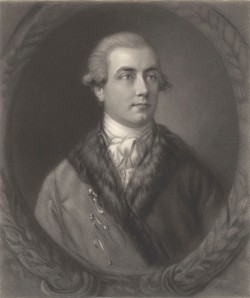
John Frederick Sackville, third duke of Dorset, by James Scott, after Thomas Gainsborough. © National Portrait Gallery.
The above three sources, then, indicate that Ozias Humphry painted a portrait of Francis Austen at the request of the third duke of Dorset, John Frederick Sackville. Francis’s association with the Sackville family stretched back two generations, when he had acted as parliamentary agent for the first duke, Lionel (1688–1765), John Frederick’s grandfather, in 1734 and again in 1754 (Southam 36). The first duke appointed Francis Clerk of the Peace in 1753, a post he held for twenty years and which was passed on to his son Francis Motley (Keith-Lucas 88, 93).8 A letter to the third duke from 1780, the period we are interested in, describes Francis as “your honest attorney” (Goulstone 82). The Clergy Database indicates that Francis’s nephew Henry Austen (1726–1807) was the third duke’s domestic chaplain, his appointment perhaps being secured by his uncle.9 By 1780 Francis would have been in the family’s service for upwards of half a century, and the close and longstanding relationship goes some way to explaining why the duke had commissioned his portrait. Since Le Faye objected to a 1780 date on the grounds that Henry Austen saw the portrait in 1780 and that therefore the portrait must have already been in existence, we will turn next to Henry’s testimony.
When did Henry Austen see the portrait?
In her Chronology, Le Faye dates Henry’s statement to September 1847, based on the Lefroy Manuscript (669), a manuscript volume of family history notes that Anna Lefroy is thought to have composed from approximately 1855 onwards (Letters 545). Le Faye notes, however, that Henry wrote a similar but not identical letter to his nephew, James Edward Austen-Leigh, which appears in Austen Papers (16–19). The version in the Lefroy Manuscript gives an account of Henry’s words:
All that I remember of old Frank Austen is, that he wore a wig like a Bishop, and a suit of light grey ditto, coat, vest, and hose. In his picture over the chimney, the coat & vest had a narrow gold lace edging, about half an inch broad, but in my day he had laid aside the gold edging though he retained a perfect identity of colour texture, and make, to his life’s end.
Henry does not say that this visit occurred in 1780 although he adds further information:
The widow [Jane Lennard] was legally attacked by the nearest male relatives of her deceased husband, & flung her cause into the hands of my great Uncle, Mr Frank Austen. He won the cause and with it the wealthy widow’s heart and hand. I remember her in 1780, a pleasing, amiable & handsome woman.
In addition to becoming Francis Austen’s second wife, she would also be Jane Austen’s godmother. This section in the manuscript (8–15) appears under the heading “Recollections of my late Uncle The Revd Henry Thomas Austen—Written from Tunbridge Wells to my Sister September 1847.” It reads as a general recollection and gathering of Henry’s memories of his Kentish relations and what he knew about them. Henry’s childhood recollection of the portrait from one portion of this section does not necessarily date from 1780, the year named in a subsequent passage.
If we examine the second source, Henry’s letter to James Edward, we find an interesting variance. The first passage on Francis is largely identical to the Lefroy Manuscript, but the second passage reads, “I remember her about [emphasis added] 1780” (Austen Papers 17, 18). I have not been able to trace a surviving manuscript for this source, although a text that is largely the same as the version in Austen Papers exists in the Hampshire Record Office in Anna Lefroy’s hand (23M93/84/2/1). In addition to these three versions, there appears to have been a fourth.10 The text for Henry’s statement thus has a high degree of variability, so it is not certain that he saw the portrait in 1780. Even if he did see the portrait in 1780, however, given that Francis’s letter to Ozias Humphry is dated July 1780, if Henry visited later in the year, the portrait might have been completed by that stage. Le Faye states in the Chronology that the visit took place over the summer of 1780, although the sources she cites, Austen Papers (16–19) and the Lefroy Manuscript, do not appear to specify this dating (78).
Henry was seventy-six in September 1847. At this point, he would be recollecting events from just under seventy years before, when he was a boy of around eight or nine. How accurate anyone’s memory could be at such a distance is open to question, but in the case of Henry we have a specific opinion from Ernest Austen: “Great Uncle Henry T A was very versatile and not always correct about detail” (Chapman JAH161122 71).
When was the portrait painted?
As we have seen, one of the key reasons that Le Faye doubted that Humphry was the artist was her dating the portrait before 1780–82. Le Faye argued that Henry stated that during his visit Francis was not wearing gold braid anymore—leading Le Faye to backdate the portrait to a period when he did. But it is worth recalling that in his letter to Humphry of 1780, Francis states that he will “suit myself.”11 One reading of these words might be that Francis will wear his best clothes for the sitting. It is possible that when Henry saw Francis, Francis was simply wearing his everyday clothes, which did not have gold braid, rather than that Francis had changed his apparel from that of a previous period. In any case, Henry’s testimony does not appear to bar either a 1780 date for the portrait or Ozias Humphry as the artist.
As noted above, Le Faye put forward another reason for backdating the portrait. She stated that Francis does not look like a man in his eighties in the Graves Gallery portrait and that, therefore, the portrait should be backdated to the period of his first marriage (c.1747), when he would have been approaching fifty. The question of Francis’s age in the portrait cannot be resolved by factual evidence—and, in fact, is very much a matter of opinion. Further, as with any portrait, the artist may not have caught a likeness of the sitter or may have deliberately made the sitter look younger.
Although Le Faye backdated the portrait by over thirty years, I could not find any evidence that she had consulted a costume historian, so I asked a number of experts for their views on the portrait and a potential dating. Although fashion shifted much from 1747 to 1780, it is unfortunately not a straightforward matter to assign a date based on clothing. The difficulty is partly because certain key elements of Francis’s costume are not visible—e.g., the cuffs and the lengths of his coat and waistcoat. Brian Allen, former Director of Studies at the Paul Mellon Centre for Studies in British Art, stated,
I see no reason to doubt the attribution to Ozias Humphry of the portrait of Francis Austen. It is the type of Humphry influenced strongly by his better-known contemporary Thomas Gainsborough, and on the basis of style and costume (especially the style of the wig) the portrait cannot possibly date from 1747 or anywhere near as early as that. It seems to me to be entirely consistent with a portrait painted c.1780–1785.
Considering all the above, I see no need to backdate the portrait from its traditionally ascribed date.
One point worth touching on is the fact that Francis Austen’s letter to Humphry is dated 11 July 1780, but the receipt for the frame is dated 16 March 1782. Why was there a gap? Unfortunately, the portrait itself is not dated, but through the kindness of the Graves Gallery, I was allowed to view the portrait, which was not on display at the time of writing. A closer examination of the portrait, including the frame and the reverse of the canvas, yielded no further clues, with one exception. Written on the reverse of the frame on a new stretcher are the words “Ozias Humphrey / Painted 1782.” It is unclear when this inscription was written and by whom—although it would appear to date from the twentieth century. The information may have been influenced by the Christie’s auction catalogue of 1931, which gave a date of 1782 and identified Ozias Humphry as the artist (14).12
Francis’s letter and the receipt above provide a terminus a quo and terminus ad quem of July 1780 to March 1782 respectively. To narrow this window further, I have reviewed Humphry’s correspondence at the Royal Academy from 18 May 1780 to 12 December 1782. (See also Appendix 2B.) Although Humphry did sometimes keep copies of letters he sent among his papers, I could not find a response to Francis’s letter. There is, however, a letter written in November 1780 to Humphry while he was staying in Sevenoaks at the house of Stephen Woodgate, a member of a prominent Kentish family and an attorney (Bailey 899–901). Humphry’s clergyman brother William (1743–1816), was vicar of Kemsing in Kent, an appointment he received due to Ozias’s influence with the duke of Dorset, as Humphry himself noted in his “Rude Statement.” William Humphry had married Stephen Woodgate’s sister Elizabeth—apparently the “Mrs Humphries” Jane Austen referred to in her letter of 8 April 1798, who announced the death of George Austen’s half-brother, William Hampson Walter, to the Austen family (Letters 374).
The letter to Humphry in Sevenoaks is dated November 13 (HU/2/114), and Humphry’s correspondent mentions his lack of surprise at Humphry’s inability to return to London due to the charms of Anne and Sarah Woodgate, Stephen’s sisters. Humphry did in fact paint portraits of the two sisters in 1780, presumably at this time. Could he have painted Francis at the same time? We also know that Humphry painted a portrait of Stephen Woodgate in 1781 (Add MS 49,682 12). Unfortunately, Humphry’s correspondence for 1781 does not allow us to effectively pinpoint his whereabouts. But if Humphry did return to Sevenoaks in 1781, this visit perhaps might have been the point at which Francis’s portrait was painted. A date in 1781 might also help explain the gap between Francis’s invitation in 1780 and the date of the frame’s receipt in 1782. An alternative explanation could be that Humphry kept the portrait with him as it was completed over a period of time.
Francis Austen’s portrait or portraits?
Even if we assume that Humphry painted the portrait at some point during 1780–82, there is still an unexplained circumstance that Southam raises: why did the portrait remain in the Austen family, given that Francis’s letter clearly states that the portrait was intended for the duke’s collection at Knole? Around the time of the publication of his article, Southam emailed the Graves Gallery stating his “quite firm” supposition that “when Humphry was making the portrait for Knole, Francis asked him to make a copy for himself.” This theory would suggest that the portrait at the Graves Gallery is a copy and that the original was sent to Knole. Southam stated, however, that he had found no mention of the portrait in any of the guides to Knole that he consulted at the British Library. Unfortunately, Southam did not specify which guides he checked, but I have carried out a new search both via printed sources as well as manuscript material.13 Once again, I found no mention of Francis Austen or the portrait beyond the documentary evidence already quoted above. Although I was unsuccessful in my search, it is worth remembering that John Brewer stated that Humphry “bequeathed to posterity the largest surviving archive of any British eighteenth-century painter” (295). I would encourage anyone interested in the topic to review Humphry’s papers afresh. Another potential avenue of enquiry was Humphry’s banking records, which were examined to see if he had been paid by Francis for a copy of the portrait. Williamson noted that he was unable to find papers relating to Humphry’s account at Child’s Bank (67). Neither was I.14
The lack of any additional references to the portrait in the material I examined has led me to the same conclusion as Southam, who stated that the absence of the portrait from Knole was “an untidy and unaccounted for detail” (Email). I have therefore outlined below four scenarios that could explain it.
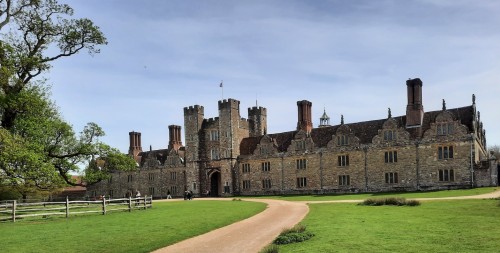
Knole, Sevenoaks. © Azar Hussain.
(Click here to see a larger version.)
Why isn’t the portrait at Knole? Four theories
The first two possibilities start with the premise that Francis commissioned Humphry to make a copy, and the original was sent to Knole. This theory is what Southam suggested, but it returns us to the question as to why the portrait is not at Knole now. I have identified two possible answers to this:
- The portrait is in fact at Knole. The inventories and lists detailed below generally focus on notable paintings, subjects, or artists. Although Humphry was a respected artist, a portrait of a country attorney would not necessarily be included in such lists. Charles Phillips noted in 1930 in his catalogue raisonné that paintings at Knole for which hanging space could not be found were “stowed away in one of the public rooms” (2: 402). Under the heading for “Retainers’ Galleries,” he explained: “One of the numerous rooms in these galleries—that over James I’s bedroom—is used as a store-room for damaged pictures, and for a few which represent subjects not considered suitable to be hung at Knole. Besides these there are a number of paintings of Sackville arms and hatchments, and some old pictures that have practically perished.” He listed a small number “worth noting,” including Humphry’s The Venus of the Tribuna (2: 446). Phillips’s comments raise the tantalizing possibility that the portrait might still be at Knole; I have been unsuccessful in my attempts to pursue this line of enquiry.
- The portrait was at Knole but at some point may have been lost or sold. In a number of inventories, the generic title Portrait of a Gentleman can be found. It appears, for example, in the 1799 inventory completed after the death of the third duke. Given that Francis Austen himself had died in 1791, it is possible that on the duke’s death in 1799, no one knew the identity of the sitter—that it was a portrait of someone who had served the family for upwards of fifty years. A letter from Reginald Sackville-West to his father George John, 5th Earl de la Warr from 1867, indicates that some portraits from Knole may have gone to Buckhurst Park in Withyham, Sussex, an estate long connected with the Sackville family. There is a reference to the third duke and paintings he bought during the period 1770–78, just before the time that concerns us (U269/C378/4). I made enquiries of Buckhurst Park as to whether they have an inventory of paintings but received no response.
The second two possibilities rest on the premise that there never was a copy and that the sole original remained with the Austens. Given Francis’s letter stating that the duke wished to add his portrait to the collection this theory seems odd. The duke of Dorset certainly seems to have paid Humphry for the portrait and its frame. The duke did much to maintain and add to the impressive collection of paintings at Knole, and the inclusion of Francis’s portrait would have been a high honor. It is unlikely that, having made this statement, the duke would have presented the portrait to Francis as a gift—unless perhaps Francis had misunderstood the duke’s original intention.
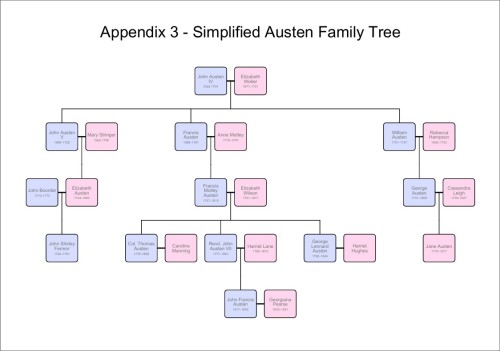
The other possibility is that, while there never was a copy and the sole original remained with the Austens, between Henry’s seeing the portrait as a boy and the 1931 Christie’s auction, the portrait’s whereabouts are unclear. One assumption, of course, is that it stayed in the Austen family for the whole of this period: following Francis’s death on June 21, 1791, at the age of ninety-three, it would likely have been handed down to Francis Austen’s son, Francis Motley Austen (1747–1815), then to his son John Austen VII (1777–1851), and then to his son John Francis Austen (1817–93). On John Francis’s death, it appears to have stayed in his home, Capel Manor, until his widow died in 1931, at which point it was auctioned (see Appendix 3).
An intriguing alternative—which I believe has not been considered before—is that the portrait may have been given to the Austen family by the Sackville family. The remainder of this article will look at the hitherto unacknowledged connections between the two families that might indicate how and why this scenario might have occurred.
What else can we learn from the archives?
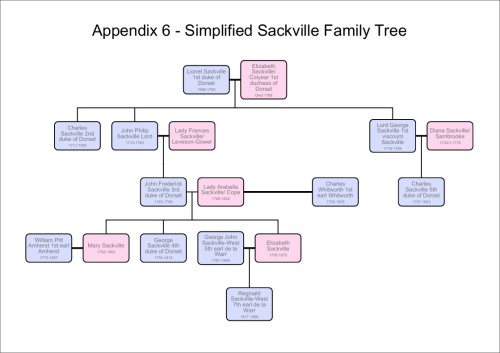
The connection between the Sackville family and the Austens did not end with the death of Francis and the third duke. The third duke’s widow, Arabella (1769–1825), married Charles Whitworth (1752–1825), 1st earl Whitworth, a diplomat (see Appendix 6). When a militia regiment was formed under the command of Whitworth in the face of French invasion, Francis Motley Austen was given command of a company with the rank of captain (Keith-Lucas 101–02). Whitworth was made Lord Lieutenant of Ireland in 1813, where one of his aide-de-camps was Thomas Austen (1775–1859), a son of Francis Motley and thus Jane Austen’s second cousin. Jane Austen may have met Thomas when she visited Kent in 1788. She mentioned his appointment as aide-de-camp in her letters (3–6 July 1813). The duchess accompanied her husband to Ireland, as The Gentleman’s Magazine reported (“Abstract” 285)
At least two of Thomas’s brothers can also be connected to the Sackville family, as we see in John Henry Brady’s The Visitor’s Guide to Knole (1839). The list of subscribers includes four Austens: the Rev. J. Austen, Chevening, i.e., John Austen VII; Mrs. Col. Austen, Kippington, presumably Caroline (née Manning), the second wife of Colonel Thomas Austen; and Mr. and Mrs. G. L. Austen, apparently George Lennard Austen and his wife, Harriet (née Hughes) (251; see also Appendix 3). George was a solicitor and, in fact, entered the firm founded by his grandfather Francis, which could explain his connection with Knole. John Austen VII was the domestic chaplain of the fourth duke, who died at age twenty-one.15 Jane Austen herself mentions the liaison of the fifth and final duke, Charles Sackville (1767–1843), with Letitia Mary Powlett, wife of Lt. Col. Thomas Powlett (20–22 June 1808). They were apprehended in the White Hart Inn at Winchester, and a highly publicized criminal conversation (i.e., adultery) trial followed in July 1808, in which Powlett was awarded £3,000 (Mahony 56–59). Austen mentions in a letter that she saw a reference to the guilty couple in a newspaper in terms comparable to the reporting of Maria Bertram’s elopement with Henry Crawford in Mansfield Park.16 Austen’s letter indicates that she took considerable interest in the story—understandable, since the Powletts lived in Albion Place, Southampton, making them near neighbors to the Austens (Butler 67).
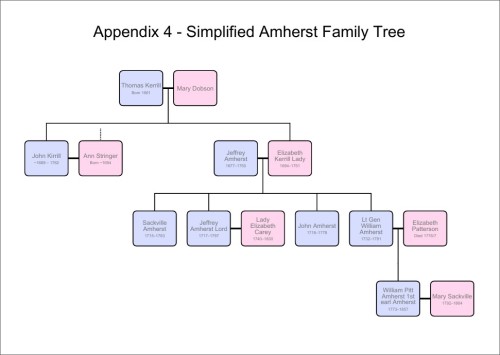
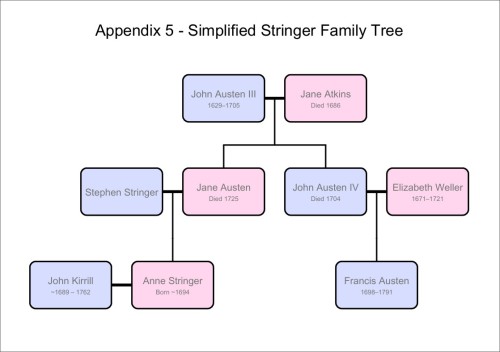
We can see further connections between the two families when we examine the life of the third duke’s daughter, Mary (1792–1864). The third duke’s widow, Arabella, left her estate to her two daughters, the fourth duke’s sisters. Mary, the elder sister, married twice but had no children. Her second husband was William Pitt Amherst (1773–1857), 1st earl Amherst. He was the nephew of Jeffrey Amherst, 1st Baron Amherst (1717–97), who captured Montreal during the Seven Years War. As a boy Jeffrey Amherst had served as a page to the first duke of Dorset. On his return from North America, he built an impressive estate at Sevenoaks, Montreal Park, not far from Francis Austen’s home (Lowe).17 Given these various connections, it is unlikely that Lord Amherst and Francis Austen would not at least know of each other. In addition, they were, in fact, distantly related. Amherst’s uncle, John Kirrill, was married to Anne Stringer, the granddaughter of John Austen III and thus Francis’s cousin (see Appendix 5).
There is also another significant connection between Francis Austen and Lord Amherst in that Amherst’s second wife was Elizabeth Cary (1740–1830). Elizabeth Cary was the niece by marriage of Sarah Viscountess of Falkland, who was Francis Motley Austen’s godmother and who, according to Henry Austen, left Francis Motley Austen a legacy of lands worth about £100,000 (Family Record 3). John Hackworth describes the relationship between Francis and the Amhersts as “close knit” (20).
There is evidence that the families kept in touch, as Lord Amherst’s nephew, William Pitt Amherst, husband of Mary Sackville, was a witness to a codicil that Francis Motley Austen made on 27 July 1813 (Chronology 453). William, by that time Earl Amherst and Viscount Holmesdale, and the second Lady Amherst, heiress of Knole, lived there after their marriage in 1839. (He died in 1857, she in 1864.) The area was already familiar to him because as an orphan he had been sent to Kent and placed under the care of his uncle, Lord Amherst (Peers). With all these connections between Knole and Francis Motley Austen and his sons, could it be that at some point the Sackville family thought it might be a kind gesture to present the portrait of Francis commissioned by the third duke to the Austens?
There is an additional important link among the Amhersts, the Austens, and Ozias Humphry. The Royal Academy archive contains four letters written by William Kerril Amherst (c.1751–1814) to Ozias Humphry spanning the period 3 October 1785 to 10 September 1786, during which Humphry was in India. William Kerril Amherst appears to have been an illegitimate son of one of Lord Amherst’s brothers, possibly the youngest, William (1732–1781). William Kerril Amherst’s middle name is worth pausing over, as Lord Amherst’s mother, Elizabeth, was a Kirrill, and Elizabeth’s brother, John Kirrill, married Ann Stringer, the granddaughter of John Austen III (see Appendices 3, 4, and 5). William Kerril Amherst was thus very distantly related to Francis Austen (Francis’s cousin was married to his great-uncle). Although this connection may sound tenuous, William Kerril’s letters to Ozias Humphry demonstrate its relevance.
The letters show that Humphry had resided at Sevenoaks and knew some of William Kerril Amherst’s connections well, and that William, in turn, knew Humphry’s brother. Humphry had been entrusted in England with letters for William, which contained much information on William’s friends and family in Sevenoaks. William even refers to a plan of Humphry’s to move to Sevenoaks on his return from India, and William too longs to be back there. Interestingly, William Kerril Amherst refers to his brother and sister, whom he assumes that Humphry has met during his visits to Montreal Park, home of Lord Amherst (HU/3/89). Lord Amherst himself is also mentioned in a letter dated 16 July 1786 (HU/3/107). Aside from these references indicating that Humphry spent a considerable amount of time in Sevenoaks, there is a reference to Francis Austen’s oldest son from his second marriage, Sackville Austen (1759–86). We know little of Sackville, godson of the first duke, except that he was a clergyman and died young. William reminds Humphry, “[Y]ou already know Sackville Austen, who married Ann Lambard is dead, he had (it appears) a rupture which he kept secret from all his friends and has been the cause of his death.” (Sackville’s untimely demise is confirmed in another source: “He dyed on Janry 3d 1786 after a severe illness of four days” [Howard 113].)
William’s letter is important for another reason. He mentions a “Jack Fermor,” whose mother Elizabeth is referenced in the primary sources as playing an important role in Francis’s household. William writes: “Jack Fermor had left Mr Austens the old man still seems hearty & I expect almost once more to have the pleasure of seeing him.” Le Faye notes this passage in her Chronology (105) but identifies neither William Kerril Amherst nor Jack Fermor. I believe that Jack Fermor is John Shirley Fermor (1754–91), the son of the Rev. John Fermor (1719–73), who was married to Elizabeth Austen (1724–1800). Elizabeth was the daughter of John Austen V (1696–1728) and therefore Francis’s niece (see Appendix 3). This relationship could explain why Francis drew up her marriage settlement (Hackworth 21). But their connection did not end there. After the death of Francis’s second wife in January 1782, Elizabeth kept house for her uncle Francis (Family Record 64), and he would leave her one hundred guineas in his will (Chronology 123).18 Elizabeth’s son, John Shirley, was therefore Francis’s great-nephew. Like Francis’s nephew George Austen, John Shirley attended Tonbridge School and won a Smythe exhibition, but he mostly lived in Sevenoaks (Hackworth 18, 34). At around the date of William’s letter, John Shirley would have been in his early thirties. William’s letter is also dated just over two years before Jane Austen, Cassandra, and their parents visited Francis at the Red House in July 1788. Presumably, they would at that time have met Elizabeth Austen Fermor, George Austen’s cousin.
All the above suggests that William Kerril Amherst knew both John Shirley Fermor and Francis Austen and passed on this information to Humphry on the grounds that Humphry was also acquainted with them and the news would therefore be of interest. William Kerril was not the only one of Humphry’s correspondents who mentioned Francis. Ozias Humphry’s brother William wrote to Humphry on 7 December 1778, “The Duke sent his comps by Mr Austen” (HU/2/76). William Humphry was private chaplain to Lord Amherst.19 These references are worth recording because they underscore the many interconnections between the Austen, Fermor, Sackville, Amherst, and Humphry families. They also suggest that further research on Sevenoaks and its inhabitants could yield additional unexpected finds.
Are there other portraits of Francis Austen?
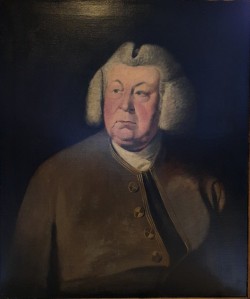
Francis Austen’s Portrait at the Red House. © Azar Hussain.
Before we conclude, there is yet another unaccounted-for detail that should be mentioned. As noted above, the law firm founded by Francis Austen exists to this day, operating out of Francis’s former home, the Red House. A copy of the portrait of Francis is there, clearly painted by an amateur, but we do not know when it was painted, by whom, or why. As part of his research into the portrait, Brian Southam made enquiries but was unable to find out more about the copy. I have found a letter from 1955 in Le Faye’s research papers that mentions that the copy was at that time at the Red House (96A), but I have not been able to find out anything further. The Red House also has a portrait of John Fellowes Claridge, Francis’s partner. Through the kindness of Knocker & Foskett, the firm who own the Red House, I was able to view both portraits. Unfortunately, there were no further clues to be gleaned from examining the portraits or their frames, and there is no documentation relating to either.20
Although there is still much that we do not know about the portrait now in the Graves Gallery, we can put forward the following summary. We know that Francis Austen wrote to Ozias Humphry in July 1780 to arrange to have his portrait painted for the duke of Dorset. We have a receipt from 1782 indicating that Humphry paid for the frame on behalf of the duke. The stretcher at the back of the portrait also has Humphry’s name on it and a date of 1782, although it is unclear who wrote this information and when. Humphry’s statement of c.1792 also confirms that he was paid for a portrait of a “Mr Austin.” Le Faye questioned whether Humphry painted a portrait of Francis, but, in light of all the above, I believe we can conclude that he did. I also believe that there is no reason to backdate the portrait to an earlier period than that associated with the documentary evidence (i.e., 1780–82).
The next question is how many portraits of Francis did Humphry paint? Was there just one—the portrait now in the Graves Gallery in Sheffield—or was there a copy, as Southam suggested, with the original being sent to Knole? This question is harder to answer, and unless and until there is documentary evidence of a second portrait, its very existence cannot be confirmed. As noted above Ozias Humphry’s papers are extensive and held in various locations. (For example, the Bodleian Library has letters sent to Humphry [MSS Montagu d 6–10]. Although I have examined as many as I could, much still remains. There are also extensive papers relating to the Austen and Humphry families in the Kent Archives and Local History Centre. It is possible that, amid all this material, further information may yet come to light that will confirm the existence of another portrait. It is also possible that further clues may be found at Knole. By one estimate, Knole has over 400 rooms. Robert Sackville-West, current guardian of Knole has written,
It takes a long time to walk from one end of the house to the other, and the main routes meander through a series of lobbies or come to sudden stops at dead ends. On the way, you encounter the most unexpected juxtapositions: an eighteenth-century fire engine here, a range of cobwebbed classical busts there; a faraway attic room where Victorian wash jugs jostle with Greek pottery; corridors where First World War military uniforms and cavalry boots tumble out of cupboards, phials of laudanum lurk in Victorian medicine chests, and love letters from another age curl on a windowsill. (xvii)
Perhaps, amid all these relics of the past, a portrait of an eighteenth-century attorney is waiting to be found.
Appendix 1A: Print sources examined relating to portraits at Knole
- Brady, John H. The Visitor’s Guide to Knole, in the County of Kent, with Catalogues of the Pictures Contained in the Mansion, and Biographical Notices of the Principal Persons Whose Portraits Form Part of the Collection. Sevenoaks: Payne, 1839.
- Bridgman, John. An Historical and Topographical Sketch of Knole in Kent: With a Brief Genealogy of the Sackville Family. London: Lindsell, 1817.
- Guide to Knole House, Its State Rooms, Pictures and Antiquities, with an Account of the Possessors and Park of Knole. Sevenoaks: Sennocke Printing, 1889.
- Guide to Knole House, Its State Rooms, Pictures and Antiquities with an Account of the Possessors and Park of Knole. Sevenoaks: Wicking, 1892.
- Guide to Knole, Its State Rooms, Pictures, and Antiquities: With a Short Account of the Possessors and Park of Knole. Sevenoaks: Salmon, 1907.
- Guide to Knole, Its State Rooms, Pictures and Antiquities: With a Short Account of the Possessors and Park of Knole. Sevenoaks: Salmon, 1910.
- Guide to Knole, Its State Rooms, Pictures and Antiquities: With a Short Account of the Possessors and Park of Knole. London: Waterlow, 1930.
- Mackie, Samuel Joseph. Knole House: Its State Rooms, Pictures and Antiquities. Sevenoaks: Harrison, 1858.
- National Trust. A Hand-list of the Pictures at Knole, Kent. London: National Trust, n.d.
- _____. Knole, Kent. London: National Trust, 1984.
- _____. Knole, Kent. London: National Trust, 1993.
- _____. Knole: Picture List. London: National Trust, 2005.
- _____. Oil Paintings in National Trust Properties in National Trust V: South. London: Public Catalogue Foundation, 2013.
- Phillips, Charles J. History of the Sackville Family, (Earls and Dukes of Dorset), Together with a Description of Knole, Early Owners of Knole, and a Catalogue Raisonné of the Pictures and Drawings at Knole. London: Cassell, 1930.
- Sackville-West, Lionel. Knole House, Its State Rooms, Pictures and Antiquities. Sevenoaks: Salmon, 1906.
- Sackville-West, Robert. Knole, Kent. London: National Trust, 2016.
- Sackville-West, Vita. Knole, Kent: The Catalogue of Pictures and Biographical Notes of Painters by Robin Fedden. London: Country Life, 1948.
- _____. Knole, Kent: The Catalogue of Pictures and Biographical notes of Painters by Robin Fedden. London: National Trust, 1952.
- Sprange, Jasper. The Tunbridge Wells Guide. Tunbridge: Sprange, 1780. [This book also mentions the “Austins” at Broadford (215). It is available online: https://www.google.co.uk/books/edition/The_Tunbridge_Wells_Guide_Or_An_Account/dBcPAAAAYAAJ?hl=en&gbpv=1&pg=PP7&printsec=frontcover]
- _____. The Tunbridge Wells Guide. Tunbridge: Sprange, 1797. [This revised edition has three references to “Austen,” one of them being “Mr. Francis Austen” residing in Sevenoaks (196) although Francis had died in 1791. The book is available online here: https://www.google.co.uk/books/edition/The_Tunbridge_Wells_guide_or_an_account/yscHAAAAQAAJ?hl=en&gbpv=1&pg=PP9&printsec=frontcover]
Appendix 1B: Unpublished sources examined relating to portraits at Knole
- “Articles from Knole valued to Lord Plymouth but taken by Lord De La Warr [including pictures and books] c.1830.” U269/E357. Kent Archives and Local History Centre, Maidstone.
- Austen, Francis. Letter on Estate Matters [to the 3rd Duke of Dorset]. 1781. U269/C196. Kent Archives and Local History Centre, Maidstone.
- “Correspondence from Various People to William Humphrey.” (nd). U1050/C35. Kent Archives and Local History Centre, Maidstone.
- “Furnishings and Pictures at Knole.” 1799. U269/E5. Kent Archives and Local History Centre, Maidstone.
- “List of Historical Personages” [?the subjects of pictures with their dates, arranged in chronological order]. Post 1840. U269/E429. Kent Archives and Local History Centre, Maidstone.
- “List of Pictures in Certain Rooms at Knole” [Most with dates when painted, 1768–1825]. Post 1825. U269/E427. Kent Archives and Local History Centre, Maidstone.
- Manuscript Extract from a “Guide to Knole” [Containing details about the collection of pictures written on writing paper headed with an etching of Knole House and Park dated 1841]. c.1845. U269/E430. Kent Archives and Local History Centre, Maidstone.
- Millar, Oliver. “Journal of Historical Portraits of the Stuart Period [Principally] Noted in Visits to Private Collections, Sale-Rooms, Dealers’ Shops, or Public Galleries of which No Adequate Catalogue Exists.” Oliver Millar, vol. 3, July 1947–Feb. 1948. ONM/1/2/3. Paul Mellon Centre, London.
- Parson, Francis. Bill to the 3rd Duke of Dorset [for cleaning and repairing certain pictures; details given]. 1796. U269/E426.nbsp; Kent Archives and Local History Centre, Maidstone.
- Sackville-West, Reginald Windsor. Letter from [George John, 5th Earl De La Warr’s] third son, Reginald Windsor Sackville-West [to 1843 West]. c.1832–1867. U269/C378. Kent Archives and Local History Centre, Maidstone.
- Seguier. Bill to the Earl of Plymouth [for removing pictures from Knole for cleaning and returning them; details given]. 1826. U269/E428. Kent Archives and Local History Centre, Maidstone.
- Two Lists of “Pictures in the Collection of Lord Sackville at Knole.” Photographed by the Courtauld Institute, undated (5pp & 7pp). EKW/3/15. Paul Mellon Centre, London.
- Upcott, William. Correspondence to William Humphrey from William Upcott the collector. 1810–1818. U1050/C33. Kent Archives and Local History Centre, Maidstone.
Appendix 2A: Unpublished Sources Examined Relating to Ozias Humphry and His Work
As a note to future researchers, Remington’s entry on Humphry in the Oxford Dictionary of National Biography includes among the archival sources Humphry’s sketchbooks in the British Library (Add MS 15,958–15,969). At the time of writing, the online manuscript catalogue at the British Library was still unavailable, but from reviewing the print catalogue of manuscripts, it is not clear that three of the items in this list (i.e., 15,966–15,968) relate to Humphry (143–45).
For material examined at the Royal Academy, see Appendix 2B.
- Austen Various: Edward Austen, Francis (old) Austen, Henry Austen. NPG49/3/425/13. National Portrait Gallery, London.
- Catalogue of the Collection of Books, Prints, Drawings, Manuscripts, and Autograph Letters, formed by the late William Upcott, Esq. 1846. Add MS 21,113. British Library, London.
- Humphry, Ozias. Artist Box. Miniaturists British 1775–1800. NPG016802. National Portrait Gallery, London.
- _____. Copy-Book of Ozias Humphry 28 Oct. 1754–22 Jan. 1755. Add MS 22,947. British Library, London.
- _____. Account-Book of Ozias Humphry, R.A., with Lists of Pictures, Prints, etc.; Aug. 1767–Dec. 1772, Jan. 1778–Jan. 1779. Add MS 22,948. British Library, London.
- _____. Memorandum-Books of Ozias Humphry, R.A., Containing Notes of Travel, Observations on Paintings, Diaries of His Own Occupations, and Miscellaneous Entries; 1772–1797, 1777–1795. 2 vols. Add MS 22,949 & 22,950. British Library, London.
- _____. Memorandum-Book of Ozias Humphry, R.A., Containing Notes on Money Matters, Pictures, etc., During a Tour in India; 1784–1787. Add MS 22,951. British Library, London.
- _____. Cash-Book of Ozias Humphry, R.A.; Being His Debit and Credit Account; 3 Mar. 1788–26 July, 1794. Add MS 22,952. British Library, London.
- _____. Correspondence to the Reverend William Humphrey from his brother Ozias Humphrey. 16 March 1780. U1050/C29/15. Kent Archives and Local History Centre, Maidstone.
- _____. Fragment of Letters from Ozias Humphrey. nd. U1050/C29/43. Kent Archives and Local History Centre, Maidstone.
- _____. Sackville of Knole MSS, Bills. 1782. U269/A243/12. Kent Archives and Local History Centre, Maidstone.
- Jane Austen–Icon Notes Jane Austen Research Correspondence with R. W. Chapman 1932–1948/9. NPG49/3/425/1. National Portrait Gallery, London
- Jane Austen Rice Portrait Research Study by Madeleine Marsh and Henry Rice 1985. NPG49/3/425/10. National Portrait Gallery.
- Upcott, William. Catalogue of the Art Collection of Ozias Humphry c.1799–1845. Add MS 49,682. British Library, London.
Appendix 2B: Ozias Humphry Material Examined at the Royal Academy
The links to the Royal Academy catalog provide summaries of the content of each entry.
Click here for table including reference codes, dates, and titles.
ACKNOWLEDGMENTS
I would like to thank the following institutions and their staff: the British Library, Chawton House, Graves Gallery, Hampshire Record Office, Kent Archives and Local History Centre, the National Portrait Gallery, the Paul Mellon Centre, the Royal Academy, and the Victoria and Albert Museum. I would also like to thank the following for their kind assistance with my enquiries: Mick Bright, Jo Strong, Dr. Brian Allen, Mark Ballard, Stephanie Emo, Oliver House, Barry Landa, Elizabeth Lindley, Susan North, Mark Pomeroy, Sophie Reynolds, Aileen Ribeiro, Nida Shah, Jacob Simon, and Emma Yandle.
NOTES
1Francis’s date of birth is sometimes given as February 25, 1697/8 (Chronology 5) because, prior to 1752 and the adoption of the Gregorian calendar in Britain, the calendar year began from March 25, Lady Day, and dates prior to March 25 could be considered as falling in either year. For simplicity, in this article I have used the year as per the modern Gregorian calendar—i.e., the later year in these cases.
2Humphry appears to have spelt his name without an “e,” but the spelling “Humphrey” appears frequently both in Humphry’s lifetime and to the present day. I have chosen the first spelling but used the second without correction when it appears in quotations.
3Graves paid eighteen guineas for the portrait (via email from Elizabeth Lindley, Sheffield Museums Trust, 30 October 2023).
4The Lefroy Manuscript is in private hands, but a copy is among Le Faye’s research papers at Chawton House (54A). I consulted the latter.
5Le Faye does not provide a year of birth for Anne Motley (Chronology 728), but parish records available on Ancestry.com indicate that she was baptized on 10 April 1719. She would have been just twenty-eight at her death.
6Agnew states that Williamson’s “is the only biography of Humphry but, unfortunately, it is full of inaccuracies. The papers referred to as being in the author’s possession are understood to have been destroyed in the Blitz” (4). Unfortunately, there has been no new biography of Humphry since Agnew’s time.
7A guinea was twenty-one shillings—i.e., one pound and a shilling. Professional fees were often charged in guineas.
8The first duke, Lionel (1688–1765), was godfather to Francis’s son Sackville (U269/O308). Lionel was succeeded by his eldest son, Charles (1711–69), who died without leaving an heir. Charles’s tenure was brief (1765–69), and I have not come across any documentary evidence to link him to Francis. John Frederick, the third duke, was Charles’s nephew. (See Appendix 6.) There are various letters between Francis and the third duke—for example, on estate business (U269/C196).
9https://theclergydatabase.org.uk/jsp/locations/index.jsp?locKey=237229.
10This version is referenced in a letter in the archives of Jane Austen’s House Museum to R. W. Chapman from Ernest Austen—apparently Ernest Leigh Austen (1858–1939), grandson of Jane Austen’s brother Frank. Ernest wrote that he enclosed a copy made by Fanny Caroline Lefroy (1820–85), Anna Lefroy’s daughter, of Henry’s recollection of his great-uncle Francis. Frustratingly, Ernest concludes, “Please return the 2 H.T.A.& Fanny Lefroys copy to me.” It is likely that Chapman did so, as the enclosures are not with the letter (JAH161122 70/71). Whether Fanny Caroline’s wording was a copy of one of the existing versions or a new one with additional variants is therefore unknown.
11Marsh was unable to decipher these words, so I believe they are appearing here in print for the first time.
12Some of John Francis Austen’s paintings had been previously included in a Christie’s catalogue of 1921 (Christie, Manson, and Woods 17–21) although some of these appeared yet again in the 1931 catalogue. The portrait of Francis Austen is not in the 1921 catalogue.
13Due to the unfortunate cyberattack on the British Library in October 2023, and its ongoing consequences, my efforts to examine Humphry’s manuscripts were much hampered, but I believe I have examined all the relevant material. I am deeply grateful to the staff at the British Library for their courtesy and efficiency during this difficult time. I did not examine some of Humphry’s notebooks at the British Library as they were not easily accessible in the aftermath of the cyberattack and they did not seem relevant—e.g., Add MS 15,958, which spans Humphry’s time in India and which appears to contain sketches relating to his time there, such as “costumes of the natives of Lucknow, drawn in 1786.”
14I also made enquiries of various other banks including NatWest (Child & Co, Drummonds), Barclays (Gosling & Sharpe), Coutts, Hoares, and the Bank of England for records relating to either Humphry or Francis. Although there were some results, none appears relevant to this investigation. The British Library holds a cash book belonging to Humphry, but it covers 1788–94, and I found nothing relevant in it (Add MS 22,952).
15https://theclergydatabase.org.uk/jsp/persons/CreatePersonFrames.jsp?PersonID=153053.
16Le Faye states that when Lord Sackville and Letitia Mary met at the White Hart at Winchester they “eloped,” which echoes the statement in The Morning Post (401, 564), but the meeting at Winchester does not appear to have been an elopement. The ensuing trial only occurred as on this occasion the couple were detected (Mahony 57, Jones 103). See also Tucker (165–67) and Fullerton (148–49). It is also possible that Eliza de Feuillide refers to Lord Sackville in a letter of 13 December 1796 (Le Faye, Outlandish Cousin 132–33).
17There is a surviving miniature of Lord Amherst by Ozias Humphry: https://www.artnet.com/artists/ozias-humphry/field-marshall-amherst-kcb-wearing-red-coat-the-NyZVwqIeY2eh7KGleh2p4A2.
18Note that Le Faye identifies Francis’s will with the reference PROB/11/1206/313, whereas the current number is PROB/11/1206/250. The National Archives confirmed to me that the references have changed from the ones previously found because digitization of the wills in PROB 11 resulted in different numbers. Researchers should be mindful of this change when quoting from Le Faye’s Chronology. For example, Sir George Hampson’s will is identified as PROB 11/1015/17, whereas it is now PROB 11/1015/112 (58, 63, 66).
19https://theclergydatabase.org.uk/jsp/locations/index.jsp?locKey=237572.
20Both portraits have labels on the back indicating that they had been included in the Kent Portrait Survey in 1997. Subsequent inquiries of the Maidstone Museum and the Heinz Archive at the National Portrait Gallery did not provide further information.
