Though little-known today, Bishop William of Wykeham (1324–1404) rose from a modest background in the small town of Wykeham (now “Wickham”) in Hampshire to become one of the most illustrious Englishmen of the fourteenth century. As an administrator he was appointed King’s Surveyor and supervised many royal construction projects, including part of Windsor Castle. As a cleric he rose to become Bishop of Winchester in 1367. As a statesman he occupied the second highest position in the land, serving as Chancellor for two English monarchs: for Edward III between 1367 and 1371, and for Richard II between 1389 and 1391.
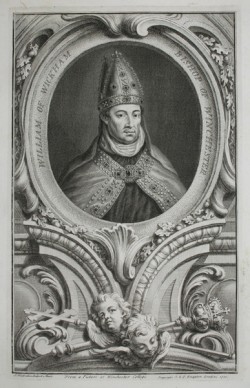
Portrait of Bishop William of Wykeham (1324–1404), here spelled “Wickham.” Engraving by Jacobus Houbraken, 1738. Author’s collection.
During his lifetime Wykeham was known both for his stern correction of ecclesiastical abuses and for his remarkable philanthropy. With his personal wealth, he established three educational establishments for clerical students: New College in Oxford University (1379) and two “feeder schools” for his college, New College School in Oxford (1379) and Winchester College (1382). After his pioneering work in education Wykeham’s last project, in 1395, was to fund and supervise the remodeling of the nave of Winchester Cathedral in the Perpendicular Gothic style. Over six hundred years later, Bishop Wykeham remains a celebrated and widely commemorated figure in Winchester.
This article proposes that Wykeham’s life, achievements, and personal motto, “Manners makyth man,” inspired Jane Austen, and that in Pride and Prejudice Austen goes so far as to acknowledge that inspiration by parceling out his name between the two male characters who serve as opposing forces in her novel: her hero, Fitzwilliam Darcy, and her antagonist, George Wickham.
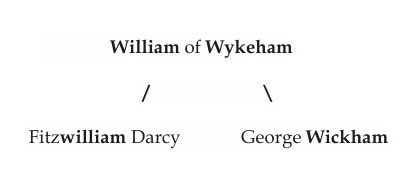
This hypothesis raises further questions: why did this medieval bishop hold such importance for Jane Austen? More puzzlingly, given Bishop Wykeham’s reputation for charitable endeavors, why did Austen bestow a variation of the name “Wykeham” upon the novel’s villain?1 This paper will discuss Austen’s personal link with the Bishop before exploring how her awareness of Wykeham’s life, character, and chosen motto became an organizing principle for the structure, characterization, and themes of Pride and Prejudice (1813).

Austen’s link with, and loyalty towards, William of Wykeham was due to a family connection. Austen had an interest in her family’s aristocratic connections (Greene 1019), so she would have paid attention when her aunt Jane Leigh-Perrot informed the Austen children that Bishop Wykeham was a Perrot ancestor (Honan 147) and hence an illustrious member of their family tree. Austen also had a second familial link with Wykeham: in 1767 her second cousin, one Elizabeth Turner, received the title of Lady Saye and Sele when she married into the Twisleton family, later renamed Twisleton-Wykeham-Fiennes (Fiennes 307). As children, Jane and her sister, Cassandra, were taken on a tour of Oxford University’s colleges (Honan 31); perhaps the statues of the kneeling Wykeham on New College’s Gate Tower and Muniment Tower were pointed out to the girls. When visiting Winchester, Jane Austen would have been aware of Wykeham’s legacy: in the city center were located Wykeham’s Winchester College, the cathedral in which he had been laid to rest, and the ruins of Wolvesey Castle, which had served as his Bishop’s Palace.
One of Austen’s probable literary sources for learning more of her distinguished distant relative by marriage was Gilbert White’s 1789 study The Natural History and Antiquities of Selborne. Austen was likely to have been familiar with the book due to its Hampshire interest: by 1811 the Austen family were on social terms with White’s nephew, John White (“Jane Austen”). In his book White described William of Wykeham’s visit to Selborne Priory in 1387 and summarized most of the thirty-six injunctions Wykeham issued to his dioceses to correct “what they have done amiss.” In White’s words, Wykeham “enjoins them, he reproves them, and threatens them with punishment suitable to their irregularities” (365–66). Wykeham’s opening in his letter to Selborne Priory sets a forbidding tone: “we came down to visit your Priory, as our office required: and every time we repeated our visitation we found something still not only contrary to regular rules but also repugnant to religion and good reputation” (366). This initial impression of censoriousness is balanced, however, against Wykeham’s paying off Selborne Priory’s entire debt—over 110 marks—in 1377 and donating another 100 marks before his death in 1404 (373). White’s verdict is as follows:
Though bishop Wykeham appears somewhat stern and rigid in his visitatorial character towards the Priory of Selborne, yet he was on the whole a liberal friend and benefactor to that convent, which, like every society or individual that fell in his way, partook of the generosity and benevolence of that munificent prelate. (373)
Austen would have taken from White’s account that Bishop Wykeham was a man of surprising contrasts, whose “stern and rigid” exterior belied an unexpectedly charitable nature.
Another possible source for Austen to learn more of Wykeham was a chapter-length biography in Joseph Towers’s multi-volume British Biography (1773). The most obvious source, however, was Robert Lowth’s comprehensive 1759 Life of William of Wykeham. Lowth’s biography contains a prefatory poem that twice references Henry Bigg, Warden of Winchester College between 1730 and 1740 (Lowth xxxi). Austen may have had access to this book thanks to a member of the Bigg family: perhaps one of her close friends, Catherine or Alethea Bigg, or even the man who unsuccessfully proposed to her—their younger brother, Harris Bigg-Wither.
In both Towers’s and Lowth’s accounts, Austen could have learned of Bishop Wykeham’s having been made the target of a smear campaign by Edward III’s third surviving son, the Duke of Lancaster, John of Gaunt. Since Wykeham was not one of Gaunt’s supporters, Gaunt took advantage of his father’s prolonged illness and his elder brother’s death in 1376 to remove Wykeham from court with false charges of incompetence and financial irregularity: John of Gaunt “procured articles of accusation to be brought against the Bishop . . . for divers crimes committed by him during his administration of affairs” (Lowth 114). In his biography, Lowth defends Wykeham against Gaunt’s trumped-up charges (119–28). Towers relates how the city of London demanded that Wykeham be tried fairly: “It clearly appears from this demand of the people, that they looked upon Wykeham . . . [as] unjustly oppressed by the exorbitant power of the Duke of Lancaster” (73). Towers concludes that however haughtily certain commentators “may affect to speak of the opinions of the Vulgar, it is certain that the general sentiments of the people in public matters are, for the most part, well founded” (73).
From these accounts, it is clear that Wykeham’s career suffered due to defamation. Given Wykeham’s sometimes stern demeanor, it must have been straightforward for Gaunt both to invent charges against Wykeham and to have found trusting listeners. This ostracism, however, was short-lived: Edward III’s grandson Richard II pardoned Wykeham on 31 July 1377, with a statement concluding that “we do not think the said Bishop to be in any wise chargeable, in the sight of GOD, with any of the matters thus by us pardoned, remitted, or released unto him; but do hold him to be . . . wholly innocent and guiltless” (qtd. in Towers 75).
Although a superficial awareness of Wykeham’s life and achievements might produce an understanding of the bishop as stern and intransigent, and might perhaps generate wonder at his choice of “Manners makyth man” for his motto, such a reaction would depend on the modern definition of manners as politeness or courtesy, rather than its earlier definition as something closer to morality. Austen was well aware of the phenomenon of what is now labeled “semantic change,” where words alter in meaning to reflect the changing values of later generations. In Northanger Abbey, Henry Tilney, for example, ridicules the word nice, which had once signified precision and discernment but had since shifted into a term of general approval (“‘Originally perhaps it was applied only to express neatness, propriety, delicacy, or refinement. . . . But now every commendation on every subject is comprised in that one word’” [108]). In Wykeham’s era the term manners meant customary good conduct: it was derived from the Latin root manus (hand), indicating the way in which things or people were handled. These correct practices were often formally codified, and for Wykeham’s educational foundation of New College, he set down “a code of ornate and intricate rules for morals and manners” for his students (Thomas 42). The writer Matthew Browne identifies the foundation of Wykeham’s educational system as chivalric in nature: “It was a natural consequence of the intimate association in the institution of chivalry, of a code of manners in the lower sense of etiquette, and a code of ethics, that good-conduct, and what we now call ‘behaviour,’ were intimately associated also in the current ideas of education” (169). Browne here sees in Wykeham’s educational system a medieval chivalric code of conduct in addition to Christian belief, and, as we shall see, Austen drew on traditions of medieval chivalry for her depiction of Darcy.
Medieval education was often rooted in classical texts, with Aristotle’s philosophy proving a direct influence on such Christian doctors as St. Thomas Aquinas. It is therefore worth considering the influence of Aristotle’s Nicomachean Ethics (late 4th century BCE) on Wykeham’s thinking—in particular, the start of its second book, which argues that virtue comprises both belief and action. In a 1797 English translation of Aristotle, book 2 begins:
Virtue being twofold, intellectual and moral, the former is produced and increased chiefly by instruction. . . . [T]he latter is acquired by repeated acts or custom. . . . [T]he habit of moral virtue, like all other practical arts, can be acquired or preserved by practice only. By building, we become architects; by harping, musicians; and, in the same manner, by acts of justice, we become just; and by acts of courage, courageous. . . . [S]uch as our actions are, such will our habits become. (Gillies 175–76)
Aristotle emphasizes the “twofold” character of virtue as both “intellectual and moral,” or, alternatively, in Browne’s summary, a higher “code of ethics” and a “lower sense of etiquette.” That the two were formerly closely aligned can be seen in the Latin equivalent of manners—mores, from which we derive the English word morality. The term manners, however, had undergone a revealing semantic change from Wykeham’s era to Austen’s. Terence Irwin points out that in 1651 Thomas Hobbes in Leviathan had defined manners not as specific behavioral habits, but as “those qualities of mankind that concern their living together in peace and unity”; however, by 1711 Joseph Addison had reversed this definition, stating, “by manners I do not mean morals, but behavior and good breeding” (157–58). The word manners, which had previously conveyed both moral behavior (ethics) and behavior that was polite or socially pleasing (etiquette), had shifted away from ethics and towards etiquette.
The potential untethering of manners from its moral foundation had already caused some unease in the Georgian era. A watershed moment in this regard came with the publication of the Earl of Chesterfield’s Letters, written to his son between 1746 and 1771 and published posthumously in 1774. In them, Chesterfield advised his son to be flexible in adapting himself to his immediate company: “A man of the world must, like the Cameleon, be able to take every different hue; which is by no means a criminal or abject, but a necessary complaisance, for it relates only to Manners, and not to Morals” (91). Such a recommendation of adaptability sounded dangerously close to duplicity and caused Samuel Johnson, one of Austen’s favorite writers, to comment that Chesterfield’s Letters “teach the morals of a whore, and the manners of a dancing-master” (Boswell 209). Jennifer Preston Wilson relates how Chesterfield’s letters caused a change of direction in later conduct manuals, which subsequently turned from pleasing one’s audience to developing one’s own character: “the difference between the pre- and post-Chesterfieldian man concerns a question of sincerity” (Wilson).
Wilson points out that subsequent English conduct manuals took inspiration from classical literature, seeking models for masculine virtue in ancient Greek and Roman culture. While Aristotelian influences are discernible within Pride and Prejudice (Kubic), this novel also reflects a more specifically northern European trend, identified by Michèle Cohen and others, of a shift from 1762 onwards towards medieval chivalry as a model for masculinity (Cohen 314–18). An English trend towards chivalry explains Austen’s use of Bishop Wykeham as a reference point within Pride and Prejudice: not only did Wykeham’s charitable donations illustrate the Christian basis of chivalry, but as a member of the medieval clergy he had also commissioned his own coat of arms, establishing his own “armigerous lineage” and gentlemanly status (Keen 147).2
Wykeham’s motto, “Manners makyth man,” also has a key relevance to Pride and Prejudice; it illustrates a chivalric code whereby external behavior, or etiquette, formed not only a public sign of a code of ethics but also a regular private practice of self-governance and self-restraint that accorded both with Christian asceticism and Aristotle’s Nicomachean Ethics. That Wykeham understood manners as analogous with self-restraint can be seen in a 1424 Latin biography by a writer who had been “a fellow either of Winchester or of New College” (Moberly xxi), most likely Robert Heete, who had been a scholar at Winchester College for three years by the time of Wykeham’s death in 1404 (xxii). This biographer recorded that
The aforesaid William, taught by the Holy Spirit . . . thought that the right progress of renewal should begin with himself, and that then he could rightly rule over others, if he had first learned to rule over himself. Therefore, subjecting his body to servitude, he taught it to be a handmaid of his spirit, to bear rule. [Spiritus sancti institutu doctus praedictus Willelmus . . . aestimavit rectum renovationis progressum a seipso incipere, et tunc se recte aliis dominari posse, si sibi ipsi prius didicisset imperare. Corpus igitur suum servituti subjiciens docuit ancillari et spiritui dominari.] (Heseltine 162; Moberly 300)
Wykeham’s asceticism demonstrates that, for him, manners signified not the Chesterfieldian pleasing of an audience according to social convention but a number of habits of good behavior indicative of self-control. These, after repeated practice, contributed towards the formation of a predictably strong character: “Manners makyth man.” We find Austen’s approval of such self-control not only in characters such as Elinor Dashwood, Jane Bennet, and Fanny Price, but in her own prayers, where she sought to cultivate a “temper of forbearance and patience” (MW 456). Furthermore, the motto itself inspired Austen artistically with its potential ambiguity: the implicit and conflicting interpretations of manners in Wykeham’s motto—the clash between medieval correct behavior and contemporary audience-pleasing, and the ways in which manners might shape men’s characters or promote them within society—would have offered Austen fertile ground for creativity within a contemporary setting.
A further motivation for this inclination towards chivalry lay in Austen’s need to establish evidence of masculine virtue beyond mere attractiveness. Her novels frequently illustrate the dangers of politeness, creating fictional scenarios where a man’s apparent thoughtfulness and warm appreciation initially conceal his unpleasant nature from a woman able to judge his character only by limited social contact. Tony Tanner summed up the potential hazard of masculine politeness in Regency society: “The crucial paradox is this: when manners are the only signs that can be ‘safely judged by’ they are, at the same time, the only signs that cannot be safely judged by” (30). The culture’s post-Chesterfieldian emphasis on a man’s objective good works dovetailed with Austen’s evident concerns about deception within courtship. Chivalry as a model for masculinity therefore offered a solution to the potential misinterpretation afforded by brief social contact: instead of employing charm and flattery, Austen’s romantic heroes ultimately prove their worth by demonstrating disinterested generosity towards others and, in particular, towards the disempowered. Though the most obvious embodiment of such chivalry in Austen’s oeuvre is Emma’s George Knightley (Cohen 326–28), Darcy can also be read as a hero in the protective chivalric mode.
The most revealing detail is the division of William of Wykeham’s name between Austen’s hero, Fitzwilliam Darcy, and her villain, George Wickham. Austen typically structures her plotlines using, in one scholar’s words, the “neoclassicism” of “balanced antitheses and symmetrical parallels” (Burns 232). In Pride and Prejudice Austen employs a similar structuring, placing her hero and her villain at either end of a historical axis. At one end stands Darcy, who embodies the best of the chivalrous past; on the other, Wickham, who embodies the worst of Austen’s Regency era. Elizabeth Bennet’s later assessment of both men—“‘One has got all the goodness, and the other all the appearance of it’” (225)—encapsulates the historical degradation of the term manners from personal morality to mere superficial attractiveness. In making her hero an exemplar of earlier chivalric values and her villain the embodiment of modern social values, Austen embeds within her novel the shift in meaning of the term manners across the centuries and, in so doing, offers an implicit critique of one way in which her society had arguably gone astray.
Though Austen’s letters to her family members and friends typically use the word manners as her correspondents would have expected it to be used—in the Regency sense of etiquette or demeanor rather than ethics—I believe she was toying with both meanings within the world of Pride and Prejudice. The word manners rings like a bell in the first half of the novel, warning the reader to be wary of superficial impressions. We can hear it in Darcy’s first contemptuous verdict on Wickham: “‘Mr. Wickham is blessed with such happy manners as may ensure his making friends—whether he may be equally capable of retaining them, is less certain’” (92). Meanwhile, we also learn that Darcy’s “manners gave a disgust which turned the tide of his popularity; for he was discovered to be proud, to be above his company” (10). Darcy’s lack of courtesy culminates in Elizabeth’s angrily refusing his first proposal, informing him that her reaction is due to “‘your manners impressing me with the fullest belief of your arrogance, your conceit, and your selfish disdain of the feelings of others’” (193). Only later does Elizabeth discern the contrast between Wickham’s unscrupulous “social powers” (206) and Darcy’s initially “disagreeable” (10) but ultimately principled character.
I would argue that the link between Bishop Wykeham and Austen’s antagonist is that the surname Wickham is a recognized later spelling of Wykeham. This can be seen in Houbraken’s 1738 engraving (above) or the caption for Caius Cibber’s statue of Wykeham on the seventeenth-century “School” Building in Winchester College, “GVILHELMI DE WICKHAM.” After Austen’s death her brother James wrote an elegy for his sister, beginning “Venta! Within thy sacred fane,” which referred to Bishop Wykeham using the spelling “Wickham” (Southam). Crucially, this was a post-medieval spelling: Austen’s employment of the more modern spelling, together with the first name “George,” indicates that her antagonist illustrates the shift from Bishop Wykeham’s medieval values to those of the Georgian-Regency era. Indeed, Austen goes further in her criticism of Chesterfieldian values. In Wickham’s treatment of Elizabeth, Georgiana Darcy, and Lydia Bennet, we can see the corruption of manners into behavior that we would now term manipulation—a term again derived from the Latin manus (or hand), but now signifying a self-centered and often unprincipled “handling” of others.
Though the phenomenon of manipulation within a social context would not be formally labeled until after Austen’s death in 1817, it is in retrospect remarkable how closely Austen’s depiction of Wickham anticipates our modern understanding of manipulative behavior. Chesterfield’s Letters had provided instruction in how a young man might employ pretense to progress in society; Austen’s portrayal of Wickham shows the other side of the coin, namely the emotional and social damage such pretense causes its (often female) victims. Stuart M. Tave notes how in Austen’s works, those characters initially deemed to be “agreeable” sometimes turn out to be suspect (121). Austen evidently understood that those who express agreement too readily may be employing insincere imitation, or mirroring, with the aim of swift ingratiation. The ideal in Austen’s novels is for a character to be not agreeable but amiable, both lovable and (crucially) capable of loving: as Tave emphasizes, the latter is a quality whose perception “requires time” (122).
As a contrast with Wickham, Austen presents a character who more closely represents Bishop Wykeham’s values: Fitzwilliam Darcy. One inspiration for this name was Austen’s distant familial links to the Fitzwilliam family through her mother (Knox-Shaw 105). When younger, she had playfully used a specimen page of her father’s parish register to write imaginary marriage entries for herself and fictional suitors, one being “Henry Frederic Howard Fitzwilliam, of London” (Austen-Leigh and Austen-Leigh 66). The surname “Darcy,” or “D’Arcy,” “entered England with one of William the Conqueror’s knights” (Doody 117). This recognizably aristocratic, Norman-derived name aligns Austen’s hero with both chivalry and the medieval era. Margaret Doody has pointed out a possible historical inspiration in Lord Thomas Darcy, who opposed the dissolution of the monasteries and was executed in 1537 for his beliefs (81). I would suggest, however, that Austen took her inspiration from an earlier ancestor in the Darcy family tree.
Since William Dugdale’s genealogical work is mentioned briefly in Austen’s last completed novel, Persuasion (4), and the scholar D. J. Greene has pointed out how Collins’s Peerage of England inspired a number of Austenian names (1019–22), it is possible that Austen read the history of the Darcy family in either Dugdale’s 1675 Baronage of England or Collins’s 1756 Peerage of England. (In this entry, Collins quotes the text printed in Dugdale almost exactly.) From both works we learn that one eminent Darcy (or d’Arcy/d’Arci) served under Wykeham’s King Edward III and was later appointed as Constable to the Tower of London for life. His son, John d’Arcy “Knight,” was known as John d’Arcy le Fitz (to distinguish him from his father, known as John d’Arcy le Pere). This John or “Johannes d’Arci le Fitz” (1317–56)
was in the Wars of Scotland; and, having for his especial services, deserved very well from the King, he in 15 Edw. III. [i.e., 1341] obtained a Grant of an Annuity of forty pound per annum, to himself and his heirs for ever. (Dugdale 372; Collins 18)
That John d’Arcy le Fitz was a knight links him with chivalry; that he fought for Edward III links him with William of Wykeham, who served as Edward III’s Chancellor between 1367 and 1371. Austen’s naming appears to indicate a search for medieval exemplars, since her hero’s name combines two figures active within the same medieval reign: the cleric William of Wykeham, and the knight John d’Arcy le Fitz.
This medieval naming establishes Darcy as representative of chivalric principles. Elizabeth first hears of Darcy’s civic duties in passing from George Wickham, who acknowledges that Darcy as a landlord chooses “‘to give his money freely, to display hospitality, to assist his tenants, and relieve the poor.’” Wickham, however, quashes any positive impression by claiming that Darcy here is motivated solely by “‘pride’” (81). This list of Darcy’s charitable endeavors as a landowner bears similarities to Lowth’s account of William of Wykeham’s generosity towards the impoverished: “his beneficence administered largely to all their wants. . . . His hospitality was large, constant, and universal” (304). Unlike his aunt Lady Catherine, whose response to her “poor” and “discontented” villagers is to “scold them into harmony and plenty” (169), Darcy is sufficiently principled to take his responsibilities towards his dependents seriously. The biographer Lowth states that “Wykeham’s munificence proceeded always from a constant generous principle” (96); similarly, Darcy’s housekeeper speaks of Darcy’s stewardship with the highest admiration: “‘He is the best landlord, and the best master. . . that ever lived. . . . There is not one of his tenants or servants but what will give him a good name’” (249).
Austen revisits and clarifies the theme of principle in her next novel, Mansfield Park (1814), with Edmund Bertram’s statement: “‘The manners I speak of might rather be called conduct, perhaps, the result of good principles’” (93). Here, in a novel whose title echoes the words manners/manus, Austen counters her era’s definition of manners as surface politeness, arguing instead for their interpretation as behavior rooted in and guided by “good principles.” Brenda Cox points out that in Johnson’s Dictionary one definition of principle is “Tenet on which morality is founded” (5). In Mansfield Park the Bertram sisters are later judged to have been lacking in “active principle”:
they had never been properly taught to govern their inclinations and tempers, by that sense of duty which can alone suffice. They had been instructed theoretically in their religion, but never required to bring it into daily practice. (463)
This emphasis on “active principle,” “govern[ing] inclinations,” and “daily practice” again shows the influence both of Aristotle and of Wykeham’s motto, “Manners makyth man.” Austen appears to argue that moral principles, while laudable, are ultimately insufficient if not reinforced with repeated practice and habitual self-discipline. We see this in Elizabeth’s pointed comment to Darcy, when he states that he lacks the “‘talent’” of sociable conversation, that those who believe they lack talent in a field, such as music, more often lack practice: “‘I have always supposed it to be my own fault—because I would not take the trouble of practising’” (175). In Austen’s use of a musicianship analogy, one can discern the possible influence of book 2 of Aristotle’s Ethics (Kubic), and in this light one might even gloss “Manners makyth man” as “Practice makes perfect.” This stress on the need for practice also explains Darcy’s feelings of shame when his incivility is made clear to him. His self-castigation to Elizabeth—“‘I have been a selfish being all my life, in practice, though not in principle. . . . I was given good principles, but left to follow them in pride and conceit’” (369)—illustrates his awareness that he has made insufficient effort in his “‘practice’” of his principles, and hence fallen short of his social obligations. From his record as a landlord, we see that Darcy embodies manners in the more important sense of honoring his duties and obligations towards his tenants: he need only learn the daily habits of self-governance to achieve the ideal.
What emerges from this study is an intriguing “current of influence” across the ages. Aristotle’s emphasis in the Nicomachean Ethics on virtue as both belief and repeated behavior (i.e., the close alignment of morals and manners) appears to have influenced the medieval Bishop Wykeham’s choice of personal motto, “Manners makyth man,” and his educational program. Four hundred years later, Austen appears to have recognized Wykeham’s motto as arguing for morality in the sense of private self-restraint and compared it with her contemporaries’ understanding of the word manners (“behavior and good breeding,” as Addison wrote in 1711 [Irwin 158]). Using Wykeham’s full name across two male characters in Pride and Prejudice points her readers towards the potential divide, in her own era, between an individual’s private morals and public manners.
In the character of Darcy, Austen vividly illustrates the proposition that good principles are not always accompanied by the arts of sociability. One might note a parallel with William of Wykeham: Gilbert White’s account of Wykeham’s “stern and rigid . . . visitatorial character” (373), placed alongside revelations of Wykeham’s charity, may have inspired the contrast between Darcy’s initially forbidding exterior and his compassionate, principled character in Pride and Prejudice. One may also trace further correspondences between Wykeham’s life and the novel’s plotline: John of Gaunt’s false allegations against Bishop Wykeham may have inspired George Wickham’s misrepresentations of Darcy, and the city of London’s support of Bishop Wykeham (Towers 73) may have inspired the housekeeper’s praise of Darcy’s character.
Austen may have added further linguistic clues to Bishop Wykeham’s presence in her novel. Scholars such as Helena Kelly see in Austen a tendency to create subtle semantic fields pointing towards a specific theme within her work, such as single-word references to Black historical or literary figures, slavery, and emancipation within Mansfield Park (183–90). Such wordplay fits with Austen’s recorded delight in charades and riddles, and I believe that similar glancing references to Bishop Wykeham appear within Pride and Prejudice. As Lowth’s biography states, Wykeham’s father’s surname was “Longe” (9). This may explain the presence of the minor character Mrs. Long on the novel’s first page, and why the Bennet residence is in the village of Longbourn: wordplay, perhaps, pointing to the man who was “born Longe.” Wykeham’s association with the Hampshire parish of Burghclere may have inspired the surname de Bourgh, though it is equally possible that Austen took the surname from John d’Arcy le Fitz’s stepmother, “Joane, daughter of Richard Burgh” (Dugdale 372; Collins 18). Perhaps, in naming Lady Catherine’s estate “Rosings Park,” Austen refers to the roses on Bishop Wykeham’s coat of arms. Finally, the surname Gardiner echoes another well-known Bishop of Winchester, Stephen Gardiner (1483–1555), who like Wykeham is buried in a chantry chapel in Winchester Cathedral.
It should be noted that Fitzwilliam Darcy is just one of many Williams in the novel. Austen gives us Sir William Lucas, William Collins, Colonel Fitzwilliam, and the reported character William Goulding (to whom Lydia coyly displays her wedding ring). In including these minor Williams, I believe Austen gives her readers further instances of the first name—which she discloses only twice for Darcy—to challenge us to make the connection with Bishop Wykeham. More importantly, this parallel naming sets up an enjoyable dichotomy in the contrast between Elizabeth’s two rejected suitors, William Collins and Fitzwilliam Darcy.
Collins and Darcy reveal their true colors once Wickham has exploited Lydia’s innocence and cast the Bennet family into disrepute. Collins evades his duty of supporting his beleaguered cousins, exulting instead in his “‘augmented satisfaction’” at now having no close connection with the Bennets through Elizabeth (297). Even after Lydia’s reputation is salvaged, Collins recommends that her family ostracize her completely. As Mr. Bennet exclaims, “‘That is his notion of christian forgiveness!’” (364). In contrast, Darcy’s conclusion to his letter to Elizabeth, “‘God bless you’” (203), indicates his freely given forgiveness for her earlier accusations: Elizabeth later describes his conclusion as “‘charity itself’” (368). Upon hearing of Wickham’s targeted seduction, Darcy works behind the scenes to correct matters, and his buying off Wickham can be interpreted not merely as bribery but as following the precedent of generosity established by William of Wykeham. As the biographer Lowth explains, Wykeham made personal financial interventions to free imprisoned debtors:
He was ever attentive and compassionate to such as were imprisoned for debt; he inquired into their circumstances, compounded with their creditors, and procured their release. In this article of charity he expended three thousand marks. (304)
Just as Bishop Wykeham freed debtors through personal intervention, so Darcy bargains with Wickham and procures the Bennets’ figurative “release” by paying off Wickham’s debts and other expenses. This is no small sum: Mr. Gardiner explains that Wickham’s “‘debts are to be paid, amounting . . . to considerably more than a thousand pounds, another thousand in addition to [Lydia’s] own settled upon her, and [Wickham’s army] commission purchased’” (324). Wickham’s commission is revealed to be “‘an ensigncy in General —’s regiment’” (312). An ensign’s commission in an infantry regiment appropriate to Wickham’s social class would have cost approximately £450 (Anderson). All told, Darcy’s expenditure to redeem the Bennet family must have been in the region of three thousand pounds.
Though the tag Fitz within a name originally had the simple meaning of son (as when applied to John d’Arcy le Fitz in the fourteenth century), by Austen’s time it had undergone semantic change to become a prefix indicating illegitimacy. I believe Austen uses this contrast between Elizabeth’s two suitors to indicate that Darcy, though a Fitzwilliam, is free from any suggestion of “illegitimacy”: of these two Williams, Collins and Darcy, the former conspicuously lacks Bishop Wykeham’s Christian charity, while the latter displays sufficient charity and largesse to be deemed Wykeham’s true and legitimate heir.
One might ask why, if Wykeham’s motto “Manners makyth man” had been one of Austen’s guiding principles, she did not signal it more obviously within her text. Perhaps Austen initially intended Mary Bennet to quote it explicitly in one of her homilies; if so, this reference may have been removed during editing (when Austen famously “lopt & cropt” Pride and Prejudice [29 January 1813]). I would suggest three reasons for its removal. First, so blatant a revelation of a central theme might have spoiled the novel’s atmosphere, changing it from “light & bright & sparkling” (4 February 1813) into something more heavily didactic. Second, for an anonymous female novelist to cite that motto in judging male characters might have awakened suspicions of the author’s covertly attacking one of the educational establishments bearing that motto: New College, Oxford; New College School; or the colleges of Winchester or Eton (with its variant “Manners maketh man”).
Finally, considering the extent of her era’s misogyny, Austen may have decided to omit any overt mention of Bishop Wykeham, or what might be termed the “morals-manners debate,” simply to avoid censure for her intelligence. As Lord David Cecil pointed out in 1978, Austen’s having had “personal experience” of misogyny is indicated by a celebrated passage in Northanger Abbey (68): “To come with a well-informed mind, is to come with an inability of administering to the vanity of others. . . . A woman especially, if she have the misfortune of knowing any thing, should conceal it as well as she can” (110–11). Hence Austen may have followed her own advice: rather than cite “Manners makyth man” directly, it would have been preferable to share both halves of Bishop Wykeham’s name between her hero and her villain, as her half-hidden tribute to her distant relative and his motto through the ages.
Ultimately, I believe that Austen would have admired William of Wykeham for his self-discipline and recorded philanthropy; however, her writing perhaps reveals a hint of amusement at his forceful self-expression. Interestingly, Bishop Wykeham would recur once again in Austen’s writing, at the very end of her life. On St. Swithin’s Day, 15 July 1817, Austen dictated her last work to her sister, Cassandra. This was her light-verse poem “Venta,” which linked the Winchester races with a children’s rhyme about the city’s ninth-century patron saint (“If on St. Swithin’s Day be rain, for forty days it shall remain”). Austen’s poem begins,
When Winchester races first took their beginning
It is said the good people forgot their old Saint
Not applying at all for the leave of Saint Swithin
And that William of Wykham’s approval was faint. (MW 451)
In this poem Austen envisions Bishop Wykeham as a ghostly presence at the first Winchester races in 1629 (Cowling 34). At this event, the “sattin’d & ermin’d” racegoers are interrupted by a vision of Saint Swithin rising from the grave to hector them (“By vice you’re enslaved / You have sinned & must suffer”). The poem ends with Swithin’s cursing the races with bad weather, “July in showers” (451–52). As may be expected of Austen’s rich wordplay, the title “Venta” contains three linguistic associations: Venta Belgarum, the Roman name for the British settlement which later became Winchester; the French word vent (wind); and finally the phrase to vent one’s spleen or express anger.
In its depiction of a religious figure condemning the modern age for its “sins,” “Venta” at first appears harshly moralistic and oddly atypical of Austen’s body of work. If we view “Venta,” however, as a narrative of a figure from the past used to critique the vices of a more modern age, this poem is no longer an anomaly. As well as mentioning Wykeham himself, Austen’s poem also refers to Wolvesey Castle, which had served as Wykeham’s Bishop’s Palace (described by Austen as “the Palace which now lies so sadly in ruins” [451]). If Austen had access to White’s The Natural History and Antiquities of Selborne in her last weeks, or if she remembered it, she may have even included details from Wykeham’s corrective visit to Selborne in this poem (a connection first noted by the researcher Arnie Perlstein in 2013). For example, White tells us that Wykeham is “very wroth with some of the canons, whom he finds to be professed hunters and sportsmen, keeping hounds, and publicly attending hunting-matches. These pursuits, he says, occasion much dissipation, danger to the soul and body, and frequent expense” (368). Elsewhere Wykeham criticizes “the affectation of [churchmen] appearing like beaux with garments edged with costly furs” (371). Perhaps Saint Swithin’s display of indignation towards sporting events and “ermin’d” clothing in “Venta” owes something to White’s account of Bishop Wykeham.
A closer focus on William of Wykeham as an inspiration and guide for Austen also provides us with a solution to a long-standing puzzle in the author’s biography: namely, why was Austen, an anonymous novelist at the time of her death, given a burial in the nave of Winchester Cathedral? David Rymill, the Cathedral’s archivist, confirms that as Austen was receiving end-of-life treatment in College Street, her residence in St. Swithun’s parish gave her the right upon her death to be buried “without fee” in the cathedral’s outer churchyard. Austen’s family, however, paid an additional fee and used their connections in the Church of England to have Austen buried not in the churchyard but inside the cathedral (Wheeler 13, 9).
Austen’s burial within the cathedral has occasioned comment in later scholarship, with one writer’s asking, “Was it really . . . necessary, to spend so much money on burying Jane in a prominent position[?]” (Kelly 286). Austen’s burial in Winchester Cathedral may be explained, however, not as a wish for prominence (since her novels are not mentioned on her ledgerstone) but as a means of enabling Austen to exercise a measure of choice and control over her final resting place. In applying for a cathedral burial for Austen, it seems that Austen’s family was following her last wishes. Austen herself hints at this in a letter dated 27 May 1817: “Mr Lyford says he will cure me, & if he fails I shall draw up a Memorial & lay it before the Dean & Chapter, & have no doubt of redress from that Pious, Learned & disinterested Body.” Deirdre Le Faye notes that to “draw up a Memorial” meant to draw up a “written statement forming the ground of a petition” (Austen, Letters 467 n2). There is a sense here of appealing to the powerful, and since the Dean and Chapter adjudicated on permissions for burials within the cathedral (Wheeler 9), this passage appears to contain a pun on a funereal “Memorial,” hence indicating Austen’s personal wish for a cathedral burial.
Austen knew in May 1817 that in her state of health she was unlikely to survive a carriage journey back to Chawton, so she chose instead to be laid to rest in a place that meant a great deal to her. In a letter to Fanny Knight, Cassandra Austen expressed “satisfaction” that her sister was to be buried “in a Building she admird so much” (20 July 1817). I would hypothesize that Jane Austen’s admiration encompassed not only the beauty of the cathedral’s nave, but also the man who remodeled it in 1395 and who had his own memorial there—William of Wykeham, an illustrious member of her family tree, whose life and motto had inspired her own writing. Spending her last weeks in College Street, in proximity to other buildings with links to Bishop Wykeham (Winchester College and the ruins of Wolvesey Castle), Austen may have felt encouraged not only to give Wykeham one final mention in her poem “Venta,” but also to request burial within the cathedral nave that housed Wykeham’s chantry chapel.
Jane Austen died at 4:30 a.m. on 18 July 1817, and her cathedral burial came six days later. Her ledgerstone is located in the nave remodeled in the Perpendicular Gothic style by William of Wykeham in 1395, and it lies on the opposite side of the nave from Wykeham’s free-standing chantry chapel. In his poetic elegy for his late sister, James Austen wrote of how in the Cathedral “honoured Wickham lies reclined / In Gothic tracery enshrined” (Southam). A walk of roughly twenty paces straight across the nave, from south to north, will take the visitor from the back wall of Wykeham’s chapel to the foot of Austen’s grave.
NOTES
1Before setting out the case for Bishop Wykeham as Austen’s inspiration, I will address previous theories for Austen’s use of the name “Wickham” for her antagonist. A ledgerstone (presently covered over) exists in St. Congar’s Church in Badgworth, thirty miles from Bath: it commemorates “Mr George Wickham Rector of this Parish,” who died on 9 July 1720 (Wade 367). If we could establish a visit by Austen from Bath to Badgworth, this would be an intriguing possibility. In Mary Robinson’s 1799 novel A Natural Daughter, the novel’s villain-hero uses the alias “Mr. Wickham” (Doody 114–15); one easily hears the echo of the word wicked in this context. It has also been suggested that William Wickham, the politician-spymaster (1761–1840), was Austen’s inspiration (Craig). I disagree with this last hypothesis: Wickham’s espionage work was not widely known; his expenses were challenged only once and briefly in Parliament, on 12 June 1806 (“Accounts”); and though Wickham purchased the estate of Binsted Wyck, five miles from Austen’s home at Chawton, he did so on 16 June 1812 (Durey 193; Mortgage of Wyck estate 1812), too late for his surname to have influenced Pride and Prejudice (published 28 January 1813).
2Its description was “argent between three red roses two chevrons azure”: the chevrons resembled the arms of the Carpenters’ Company, perhaps an echo of Wykeham’s work with master masons (Davis 171), while the Hampshire roses signified the county of his birth (Heseltine 162).
