Beyond the Bonnets: Working Women in Jane Austen’s Novels was commissioned by Hampshire Cultural Trust (HCT) for Jane Austen 250, at The Arc, Winchester, 26 July–2 November 2025, and The Willis Museum, Basingstoke, 12 November 2025–16 February 2026. The original concept came from HCT Trustee and former Director of Jane Austen’s House Louise West. She herself was inspired by the work of JASNA member Sheryl Craig on working women in Emma. The exhibition is an element of HCT’s National Heritage Lottery Fund Dynamic Collections project, Hunters and Gatherers, which explores new ways of working with local communities. Volunteers carried out much of the detailed archival research and, together with a community advisory panel, informed the final design and interpretation.
Fact and fiction are woven together as the exhibition explores specific working roles for women found in Austen’s novels. Some elements cannot be conveyed here, such as its immersive soundscape, which combines novel and archival quotes scripted by Will Jacob with specially composed music and sounds by Thomas Baynes; and a historical timeline, which sets the context in Austen’s life, in British history, and in women’s rights. What follows is a swift tour through selected exhibition highlights to give a flavor of the show.
Working women in Jane Austen’s novels
Jane Austen (1775–1817) was one of Hampshire’s most famous working women, gaining a small amount of financial independence from her writing. Her novels have stood the test of time and continue to inspire and amuse millions of people today. Books such as Pride and Prejudice, Emma, and Sense and Sensibility feature well-loved heroines Elizabeth Bennet, Emma Woodhouse, and Elinor and Marianne Dashwood. Less often noticed or remembered are the women in working roles who are incidental characters in her stories.
Beyond the Bonnets explores these lives lived in the background. It encourages visitors to discover the voices and stories of working women from Austen’s Hampshire and farther afield, and to find the parallels between fact and fiction. It follows the precarious lives of real Regency women navigating limited opportunities and rights as they worked in domestic service, education and childcare, and trade.
The author
In Northanger Abbey, the hero celebrates the pleasures of novel reading and the work of the novelist.
The person, be it gentleman or lady, who has not pleasure in a good novel, must be intolerably stupid. I have read all Mrs. Radcliffe’s works, and most of them with great pleasure.” (107–08)
Jane Austen was one of a growing number of women writers and novelists in her time. It was possible, although challenging, for a woman to earn a living as an author. Many female novelists published as “a lady” or behind a similar style to guard their respectability (Worsley 311). Some, such as Mrs. Radcliffe, were quite successful financially. Others, like Austen, supplemented their earnings with support from their families (Tomalin 209, 219, 240, 258, 265). A lucky few were supported by wealthy patrons. Those who depended on writing for their main income tended to fall on hard times in older age (Looser 21–24, 157–66; Batchelor, Women’s Work 67–107, 144–84).

Contemporary copies of Jane Austen’s novels in the exhibition.
Photo: Kathleen Palmer.
(Click here to see a larger version.)
Sense and Sensibility, Pride and Prejudice, Mansfield Park, and Emma were published anonymously in Austen’s lifetime. Northanger Abbey and Persuasion were published by her brother Henry soon after her death. In the “Biographical Notice” preceding those two works, Henry named her as the author. The proceeds from Austen’s novels usefully supplemented her family income (Worsley 346). Austen was certainly interested in the financial rewards of her writing, as she reported to her brother Frank:
You will be glad to hear that every Copy of S.&S. is sold & that it has brought me £140—besides the Copyright, if that shd ever be of any value.—I have now therefore written myself into £250.—which only makes me long for more.—I have something in hand—which I hope on the credit of P.&P. will sell well, tho’ not half so entertaining. (3–6 July 1813)
Austen’s novels remain enduringly popular, enjoying worldwide sales of over 30 million copies (Curcic).
Austen was from a respectable, but by no means wealthy, family. Although they had servants for the heaviest work, Austen would have been involved in many household duties, including making and embellishing furnishings and clothing (Worsley 134–35, 318, 334).

An ivory etui, or case, belonging to Jane Austen, containing a bobbin for winding embroidery silks. Her initials “J A” are carved on the top of the lid. © Hampshire Cultural Trust 2025.
Domestic service
Most working women in Austen’s novels are domestic servants—housekeepers like Pemberley’s Mrs. Reynolds or maids such as the Bateses’ long-suffering Patty. Domestic service was the most common form of employment for women during this period. A maid was usually hired for a year on pay of around £8 plus accommodation, meals, and sometimes clothing (Field 7–9). This agreement was a contract; leaving without permission could mean a fine or even imprisonment. Most live-in servants were unmarried, although after marriage women might continue working casually for their former employers (Steedman 36–38). Service could also offer a career, with promotion through a strict hierarchy or with skills developed and savings accrued to set up independently in trade. A few long-serving eighteenth-century servants were fortunate to be cared for or pensioned by employers in their final years.
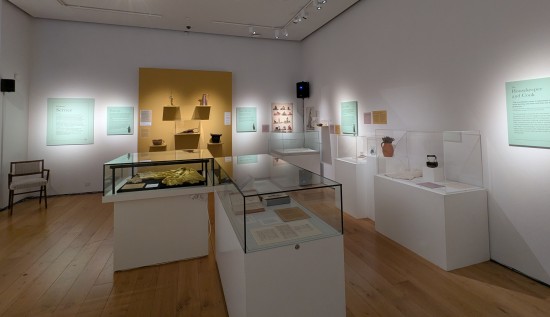
The Domestic Service section of the exhibition. Photo: Kathleen Palmer.
(Click here to see a larger version.)
The housemaid and the maid of all work
A housemaid like Austen’s character Hannah, whom Mr. Woodhouse praises, would undertake a wide range of domestic work.
“I am sure she will make a very good servant; she is a civil, pretty-spoken girl. . . . Whenever I see her, she always curtseys and asks me how I do, in a very pretty manner; and when you have had her here to do needlework, I observe she always turns the lock of the door the right way and never bangs it.” (Emma 7)
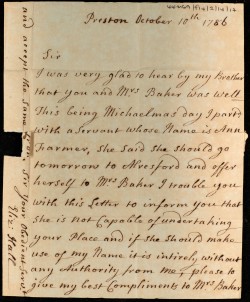
A letter from Elizabeth Hall of Preston Candover to Thomas Baker of Alresford, warning him against employing Ann Farmer. Jervoise of Herriard Collection, Hampshire Record Office 44M69/F14/2/14.
(Click here to see a larger version.)
The work Mr. Woodhouse doesn’t notice, however, could be very physically demanding. Her duties would depend on the size of the household, but could include cleaning, making beds, maintaining fires, sewing, laundry, preparing hot water, answering the door, taking messages, making and bringing tea, laying tables and serving meals, and food preparation (Female Instructor 372–76). In a larger household, there might be several maids and more prospects for promotion.
Ann Farmer’s employer, Elizabeth Hall, was an unmarried woman from the local gentry. Her letter shows the employer networks that existed. The livelihood of a servant like Ann depended on a good “character,” or reference, from the previous employer (Sambrook 2). Life, particularly for women, could change quickly from comfort to catastrophe.
In Mansfield Park, Austen gives us a memorable description of a similarly incompetent maid of all work through the eyes of Fanny Price, who feels the discomfort of her Portsmouth home:
She sat in a blaze of oppressive heat, in a cloud of moving dust; and her eyes could only wander from the walls marked by her father’s head, to the table cut and knotched by her brothers, where stood the tea-board never thoroughly cleaned, the cups and saucers wiped in streaks, the milk a mixture of motes floating in thin blue, and the bread and butter growing every minute more greasy than even Rebecca’s hands had first produced it. (508)
Fanny is distressed by the failings of Rebecca, comparing her and the entire Portsmouth household to the servants and the efficient management at Mansfield Park.
The housekeeper and the cook
Mrs. Reynolds, the housekeeper at Pemberley, is described through Elizabeth’s eyes as “a respectable-looking, elderly woman, much less fine, and more civil, than she had any notion of finding her” (PP 272). The housekeeper was the most senior female servant in a household, managing all the other female servants. She worked closely with her employers to plan and manage provisions, hospitality, clothing, cleaning, and laundry. In a smaller household, the role of housekeeper was often combined with that of cook. It was a respectable role, with some perks, and a housekeeper would have some scope to save money. Often a housekeeper would be unmarried or widowed, but on occasion she might be part of a working couple with the senior male servant, the butler or steward, in a household.
Jane Austen recounts her warm welcome by the housekeeper and the cook at her brother Henry’s home:
We arrived at a qr past 4—& were kindly welcomed by the Coachman, & then by his Master, and then by Wm, & then by Mrs Perigord, who all met us before we reached the foot of the Stairs. Mde Bigeon was below dressing us a most comfortable dinner of Soup, Fish, Bouillee, Partridges & an apple Tart, which we sat down to soon after 5, after cleaning & dressing ourselves & feeling that we were most commodiously disposed of. (15–16 September 1813)
Austen would go on to leave a legacy of £50 to Mme de Bigeon, an instance of her unusual attention towards senior servants and in line with her friendship with Anne Sharp, former governess to her brother Edward (Tomalin, 136–37, 272).
One Hampshire housekeeper during Jane Austen’s lifetime was Mary Lunn. Born in 1777 in Crondall, the eldest of eight children, she went around 1805 to work as a lady’s maid for Mrs. Elizabeth Jervoise, at Herriard Park, not far from Basingstoke.1 Mary did well, and in 1810 she was promoted to housekeeper. In 1813 she married the Herriard butler, George Mountford. The birth of a son, John, was certified on 2 December 1813, recording his “abode” as a temporary stay with Mary’s widowed mother in Basingstoke. Records show that a temporary housekeeper was employed at Herriard during this period, and Mary then returned to her duties for some years. The 1841 census records her still living in the Herriard parish. There is also an 1857 burial record that seems a likely match for her, suggesting that she lived to be about 80.
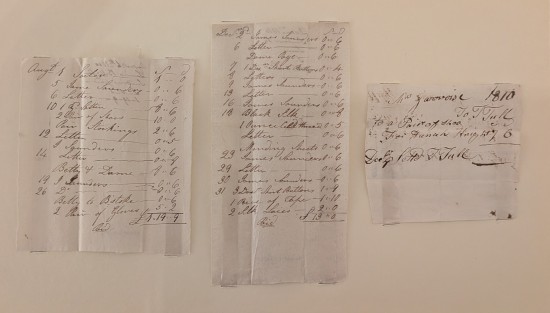
Three bills from an 1810 bundle of receipts from Herriard Park. Jervoise of Herriard Collection, Hampshire Record Office 44M69/E13/11/50.
(Click here to see a larger version.)
These receipts for petty cash expenditures by Mary Lunn include the purchase of shoes for a young female servant and small cash payments to local people for casual work such as laundering. These receipts suggest some of the responsibilities the housekeeper undertook and map her interactions with more casual domestic service workers such as washerwomen, also represented in the exhibition.
Education and childcare
It was a widely held view in Austen’s time that women were naturally suited to caring for and educating children (Female Instructor iv, 28, 29). Becoming a teacher or governess hangs over several of Austen’s characters as an unappealing fate, most notably Jane Fairfax in Emma. Perhaps the portrayal of Mrs. Goddard, the comfortable proprietor of a school in the same novel, lends balance. These roles provided a genteel woman with limited resources a chance to make her living respectably (Newby 90–94). While not without difficulties, they offered opportunities for entering the school business or for finding a marriage partner.
Childcare roles such as wet-nurse or nursery maid did not offer the same level of respectability as those in education. A nursery maid could, however, become a valued long-term servant. A wet-nurse was paid casually by a well-off family to foster and breastfeed an infant, such as Jane Austen’s nephew Brook John after the death of his mother, Elizabeth, described below. As breastfeeding one’s own child became more fashionable, that role diminished.
The nursery maid
Persuasion includes two nursery maids: young, flighty Jemima at Uppercross Cottage contrasts with the experienced and established Sarah at the Great House. Mrs. Musgrove shares her concern about Jemima with Anne:
I have no very good opinion of Mrs. Charles’s nursery-maid: I hear strange stories of her; she is always upon the gad: and from my own knowledge, I can declare, she is such a fine-dressing lady, that she is enough to ruin any servants she comes near.” (49)
A nursery maid like Jemima was a junior- or middle-level servant. Her role was to look after younger children and everything to do with the nursery. She would have—or develop—expertise in childcare, early education, and the management of minor illnesses. In a larger household, she might work for a senior nursemaid, carrying out all the duties of a maid within the nursery—cleaning, maintaining fires, making or mending clothes, fetching water, and emptying chamber pots (Steedman 232, 236–28; Watkins). This employment suited the skills of girls from large working families, and it could lead to positions further up the hierarchy of domestic service.
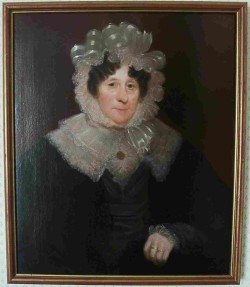
Susanna Sackree, oil painting on canvas (early 19th century).
Courtesy of Jane Austen’s House.
Susanna Sackree’s portrait is a rare likeness of a working woman known to Austen. Sackree was nursery maid to Austen’s brother Edward’s eleven children. Other than in the household of an artist, it was extremely unusual to paint a servant (French and Waterfield). The portrait speaks of Sackree’s age and long service, as well as the crucial role she played in the children’s lives after the devastating loss of their mother, Elizabeth, following childbirth. Sackree went on to become housekeeper to the family (Batchelor,“The Will”).
The exhibition includes a transcript of a letter that Sackree wrote to Miss Chapman, a former governess to Fanny and Edward’s other older children, on 16 October 1808, shortly after the tragedy. Its phonetic spelling conveys a strong sense of Susanna Sackree’s voice:
My dear Miss Chapman
I rec’d your kind note and I am happy to inform you that the ole Family is as Compose as posebel can be on such a shocking advent. What a House of Mourning is this that was the please [place] of Joy after my dear Mrs A was delivered, and she has as good a time as Ever she had of any of her dear Children and had been going on as well as posebel and eat a hearty dinner of Chiking and was going to ley down and said to nurses I am sick and in half a houre she was no more.
. . .
Dear Madam, with the greatest respect, yours S. Sackree
Susanna Sackree was born in Kent in 1761. It is thought that she may have worked for Elizabeth Austen’s family, the Bridgeses, prior to becoming her nursemaid at Godmersham. Susanna’s help with Edward and Elizabeth’s many children must have been invaluable, especially after the tragedy of Elizabeth’s death. She was known affectionately within the family as “Cakey,” the way one of the little children had mispronounced her surname.
In 1822 Susanna became housekeeper to Edward, who had by then changed his last name to Knight, when her niece, Mrs. Sayce, left the position to marry. She stayed in the Godmersham household until her death on 2 March 1851. Susanna remained close to Fanny, who recorded the loss in her diary: “Our dear invaluable & wise Susanna Sackree (Cakey) expired at ½ past 5, this morning in her 90th year. A superior and excellent woman! 58 years & ¼ in the family” (Batchelor, “The Will”).
Austen describes just such another valued veteran of the nursery in Persuasion, in the figure of Sarah, an experienced nursemaid, who is sent to Lyme Regis to help after Louisa Musgrove’s fall from the Cobb:
A chaise was sent for from Crewkherne, and Charles conveyed back a far more useful person in the old nursery-maid of the family, one who having brought up all the children, and seen the very last, the lingering and long-petted Master Harry, sent to school after his brothers, was now living in her deserted nursery to mend stockings, and dress all the blains and bruises she could get near her, and who, consequently, was only too happy in being allowed to go and help nurse dear Miss Louisa. (132)
As in the case of Susanna Sackree, the Musgroves’ long-serving Sarah remains part of the family at Uppercross.
Trade
Women in trade, with shops of all kinds, are most visible in Austen’s Emma, set in and around the bustling market town of Highbury (Craig 183–221). Shopping for luxury goods took off as a leisure activity in the eighteenth century. Britain grew wealthy through its empire, and new exotic goods flowed in (Stobart). In the early years of the nineteenth century, war with Napoleon’s France caused shortages and economic ups and downs, with volatile prices leading to some business failures (Bordo and White; Gregory; MacFarlane and Mortimer-Lee).
Many other difficulties faced businesswomen in Austen’s time. Single women or widows might experience discrimination in negotiations, be excluded from access to loans, or find key decisions made by male relatives over their heads. Married women had no decision-making or financial independence from their husbands, and they could be left destitute through their husbands’ abusive or foolish behavior (Vickery 73). Nevertheless, many women did create and lead successful businesses, becoming prosperous and independent.
The draper and the librarian
A draper’s shop sold fabric by the yard, and might also supply haberdashery, trimmings, millinery, and other sewing materials. Ready-to-wear clothes were not available until the middle of the nineteenth century, so these shops provided all the materials for making garments, either at home or with the services of a dressmaker or tailor (Staveley-Wadham). Many women worked in textile and clothing trades. Some worked from home to bring in extra income. Most worked for wages, often beginning with an apprenticeship. A few would go on to set up their own shops. The proprietor of a draper’s shop would have been a very respectable tradeswoman (Knight). One example from Austen’s work is Emma’s Mrs. Ford: “Ford’s was the principal woollen-draper, linen-draper, and haberdasher’s shop united; the shop first in size and fashion in the place” (190–91).
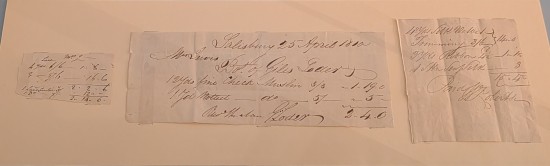
Three receipts from Herriard Park (1810). Jervoise of Herriard Collection,
Hampshire Record Office 44M69/E13/11/50.
(Click here to see a larger version.)
These receipts from Herriard Park show purchases of muslin, lace, silk velvet trimming, ribbon, and sewing silk on behalf of the Park’s mistress, Mrs. Elizabeth Jervoise. They are from a bundle of receipts for petty cash spent by Mary Lunn, Herriard Park’s housekeeper, as described earlier.
An example of a Hampshire businesswoman known to Jane Austen was Mary Martin. Born in 1730, Mrs. Martin ran the Maidenhead Inn, Basingstoke, taking sole charge after the death of Thomas, her husband of twenty-one years, in 1776. In March 1798, she sold up and took over a local millinery, haberdashery, drapery, hosiery and stationery business, much like Mrs. Ford’s. She began to make changes, selling off woolen fabrics, expanding the millinery and haberdashery, and launching a subscription circulating library.
Jane Austen was a subscriber to Mrs. Martin’s circulating library, which, unfortunately, did not help the business prosper.
Our whole Neighbourhood is at present very busy greiving over poor Mrs Martin, who has totally failed in her business, & had very lately an execution in her house.—Her own brother & Mr Rider are the principal creditors, and they have seized her effects in order to prevent other people’s doing it. (25–27 October 1800)
On 4 November 1800, a bankruptcy notice appeared in the London Gazette: “Mary Martin, late of Basingstoke, widow and draper” was required to come to the Crown Inn to “make a full discovery and disclosure of her estate and effects.”2 Her personal and business assets were liquidated and paid out to creditors as a percentage of the debt. Bankruptcy allowed her, as a trader, to avoid debtors prison. The process was less punitive when initiated and led by a supportive creditor, such as her brother (Nantes 10, 59–63, 280). On 25 April 1801, a further notice was published: Mrs. Martin would be discharged with a certificate, which drew a line under her debts. Little further trace can be found of her until her death in 1823.
The prostitute
In Pride and Prejudice, when the residents of Meryton hear about Lydia Bennet’s elopement with Wickham and then her marriage, they are first excited and then disappointed: “To be sure it would have been more for the advantage of conversation, had Miss Lydia Bennet come upon the town” (341–42). To “come upon the town” was a polite way to describe taking up sex work, which might have been the only option for a woman like Lydia, if she were abandoned by her lover—or for a deserted married woman, perhaps with children to provide for and no character reference for domestic service (Green 90–92). Others might undertake this work to supplement meager earnings from casual, seasonal, or unreliable employment. For a few very fortunate women, prostitution could provide opportunities to ascend the social ladder to financial independence or a lucrative marriage (Rubenhold 532–61). Most were not so lucky.
Prostitutes would have been highly visible in cities, especially around theatres or parks. Encounters often took place in the street, in taverns, or in bawdy houses that let rooms for the purpose. The prevalence of venereal disease meant that the consequences of these encounters for clients and providers could be deadly (White 364, 378–79). Although beauty patches were worn by women to accentuate pale skin through contrast, they could also serve to conceal sores on the skin that were characteristic of the venereal disease syphilis.

An enamel patch box, “A Trifle from Ashurst” in Hampshire, probably made in south Staffordshire or Bilston, West Midlands (c. 1790). Courtesy of Hampshire Cultural Trust.
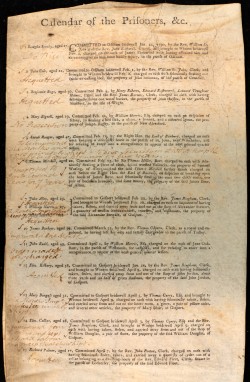
Calendar of Prisoners, 1790, detailing prisoners confined in the Winchester County Bridwell prison. Hampshire Record Office Q9/1/441.
(Click here to see a larger version.)
One local example of someone involved in sex work was Sarah Ranger, listed as being charged with keeping a disorderly house—in other words, a bawdy house, a gambling house, or some combination of the two. Sarah, age forty-seven, was imprisoned at Winchester Bridewell after refusing to enter a recognizance, which involved finding a guarantor to put up a bond. The prison put prisoners to work grinding corn in a treadmill (Shoemaker).
Although the identity match is not certain, one Sarah Wheeler, from Farnham, married Edward Ranger in New Alresford on 28 October 1777. Edward signed the marriage register, while Sarah made her mark. Their daughter Susanna was baptized in New Alresford in July 1779. In June 1780, a second daughter, Charlotte, was baptized in Winchester. Susanna was buried in November 1781 in the parish of St. John, Winchester. In December that year, a settlement certificate, accepting responsibility for the family if they needed poor relief, was sent to St. John from West Dean, suggesting that West Dean was Edward’s birthplace. In 1784, Charlotte was also buried. A third daughter, Sarah, was baptized in 1788, but she died and was buried within a few days, listed as an infant and pauper. Two years after this final loss, Sarah—if it is indeed the same woman—came before the magistrate and was committed to the Winchester Bridewell.

The exhibition Beyond the Bonnets: Working Women in Jane Austen’s Novels explores a wide variety of working women’s roles referenced in Austen’s novels, offering new insights into Austen, her characters, and her world. Only a few of those positions and only a few of the historical women included in the exhibition have been captured in this essay. Beyond the Bonnets also includes the washerwoman, the sick nurse, the school head, the schoolteacher, the governess, the lodging keeper, the milliner, the dressmaker, and even a female glazier, and matching case studies of women both known and unknown to the Austen family. Without these women in the background, bustling towns like Highbury and Sanditon, and the houses of the gentry in which the stories are set could not function. Beyond the Bonnets celebrates Austen and her fellow Regency working women—real and fictional. Their voices prompt us to consider parallels in the everyday lives of working women today and questions about what has changed over time.
ACKNOWLEDGMENTS
Beyond the Bonnets: Working Women in Jane Austen’s Novels was made possible with the National Lottery Heritage Fund. Thanks to lottery players, we were able to research and curate with the support of community volunteers. My thanks to the HCT Community Collective and to HCT Hunters and Gatherers staff and volunteers. Grateful thanks to Jane Austen’s House, Chawton House, the Royal College of Physicians, and the Hampshire Archives, which were all generous with expertise and loans. I am grateful to HCT for trusting me with such an exciting and enjoyable project and for giving such excellent support in its realization. Finally, many thanks to Louise West and Sheryl Craig for the genesis of the idea.
NOTES
1In a letter of 21–23 January 1799, Austen writes, “Our ball was chiefly made up of Jervoises and Terrys, the former of whom were apt to be vulgar, the latter to be noisy.”
