In October 2024, Jane Austen’s House opened a brand-new permanent exhibition, Jane Austen and the Art of Writing, which celebrates Jane Austen as a ground-breaking and ambitious writer in the very house where she created her six beloved novels—directly linking Jane Austen’s creative process with the domestic space from which it came.
Although the exhibition is contained within a small space—an upstairs bedroom in the house itself—it is packed full of objects, stories, and information, repaying both a casual glance and an hour’s deep study. The aim of the exhibition is to reveal as much as possible of Jane Austen’s creative process and her writing life. We hope that it will unlock a new way for our visitors to understand Jane Austen as a dedicated, driven, and professional writer and to explore how her life and living arrangements affected her writing in the very house in which she lived and wrote.
Drawing on the House’s extraordinary collection, the exhibition celebrates Jane Austen’s creative genius and shows how seriously she took her craft, animating and sharing the physical and mental processes she used to develop her works—from her earliest teenage writings to her adult novels, inspirations, pioneering techniques, and publication.
The following excerpts offer a glimpse into the exhibition. I hope they inspire you to make a visit in person!
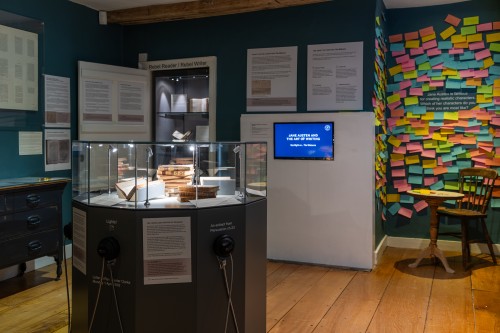
Jane Austen and the Art of Writing exhibition at Jane Austen’s House.
Photo by Luke Shears.
(Click here to see a larger version.)
Material for the novels
This section of the exhibition showcases objects that are believed to have inspired Jane Austen’s writings.
Jane Austen often recycled incidents and objects from her own life in her novels. Perhaps the most striking examples of this habit are the “Gold chains & Topaze Crosses” given to Jane and Cassandra by their sailor brother Charles in May 1801. Jane wrote teasingly of the gift to Cassandra: “of what avail is it to take prizes if he lays out the produce in presents to his Sisters. He has been buying Gold chains & Topaze Crosses for us;—he must be well scolded” (26–27 May 1801).
Years later the gift was reimagined in Mansfield Park as the amber cross given to Fanny Price by her brother William, who is also in the navy: “the almost solitary ornament in her possession, a very pretty amber cross which William had brought her from Sicily, was the greatest distress of all, for she had nothing but a bit of ribbon to fasten it to” (295). The anxiety over whose offered chain she will accept when she wears William’s cross at her first ball is one of those seeming trifles that carries enormous meaning for Fanny and eventually, too, for the reader. She settles on wearing it with a “plain gold chain perfectly simple and neat” (304), given to her by Edmund—just like these, again given by Charles, which Jane wore with her own cross.
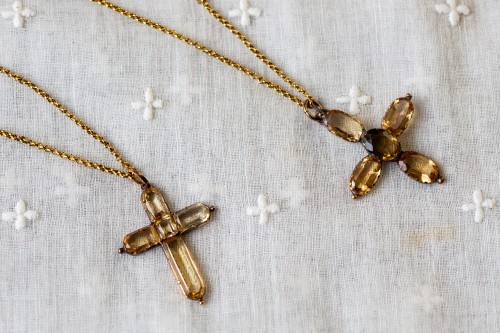
The topaz crosses belonging to Jane and Cassandra Austen. Photo by Luke Shears.
Jane Austen’s House.
(Click here to see a larger version.)
What can we learn from The Watsons?
This section uses the manuscript of The Watsons, one of Jane Austen’s very few surviving manuscripts, to explore Jane Austen’s writing process—from the size and date of her paper to the way she attached paper patches with pins to allow for rewrites.
In Jane Austen’s time, a writer’s manuscripts were only rarely prized as they are today; after publication they were usually destroyed. Jane Austen’s only surviving manuscripts therefore consist of her unpublished work: her teenage writings, a novella called Lady Susan, an unfinished novel called The Watsons, and two chapters of Persuasion that she removed at a late stage from the original manuscript. Together with Sanditon, the novel she was drafting in her final months, these manuscripts provide rare insights into her creative process.
The Watsons is the earliest surviving manuscript of a post-teenage novel by Jane Austen in the process of development. It was never finished. Jane is believed to have written it in Bath between 1804 and 1805, in a collection of eleven homemade booklets. It is likely that her published novels were written in similar small booklets. These booklets suggest Jane Austen’s great discipline as a writer: she was not just writing a draft; she was consciously making a book. They mirror in paper her art as a social miniaturist.
The working manuscripts of a great writer make us think in different ways about the books they wrote: manuscripts look different from print; with their crossings-out and revisions, manuscripts ask us to think about how meaning is made.
Short film: Spotlight on The Watsons:
Rebel Reader/Rebel Writer
This section explores Jane’s wide and eclectic reading, showcasing books that she read, including the copies of Mentoria and Elegant Extracts that she gave to her niece Anna.
Jane Austen was a voracious reader all her life. While we do not have a complete catalogue of the books she owned, we can glean much of her reading matter from those she mentions in letters to Cassandra and references in her novels. A handful of her own books also survives, frequently annotated with her thoughts, including notes scribbled in the margins or marking favorite passages.
In an age when writing for children was itself in infancy, the young Jane Austen was undoubtedly a precocious reader, but she was no snob: she devoured junk and high-end literature alike. We know she read modern classics like the multivolume novels of Samuel Richardson (Sir Charles Grandison was a special favorite) and the latest pulp fiction—extravagant and improbable tales of gothic terror and sentimental romance, such as Ann Radcliffe’s The Mysteries of Udolpho.
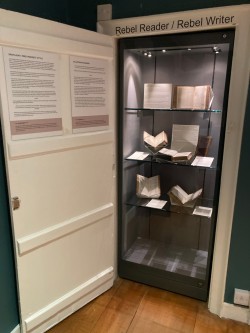
“Rebel Reader/Rebel Writer”—a section of the Jane Austen and the Art of Writing exhibition at Jane Austen’s House.
(Click here to see a larger version.)
As a writer, Jane made the books she read work for her, recycling their various ingredients and appropriating whatever she needed, including plots, characters, and settings. In her teenage stories especially, she revisited her early reading material in acts of willful, comic misappropriation, taking her favorite texts to pieces to examine their various parts and see how they worked. As she did so, she forced these works into the service of her own fledgling aesthetic—from the novels of Richardson and Fielding to the moralizing essays of Samuel Johnson, sentimental romances, and schoolroom textbooks.
Elegant Extracts, a popular anthology (one volume of poetry, one of prose, one of letters) much in use in late eighteenth-century schoolrooms, was compiled by the educationalist Vicesimus Knox and first published in 1783. Elegant Extracts consisted of passages from eighteenth-century sermons, histories, literature, and style guides, for the moral and intellectual benefit of its readers. Jane mentions it in Emma, in which Harriet Smith recalls that Robert Martin “‘would read something aloud out of the Elegant Extracts’” (28) in the evening to his mother and sisters, a sign of his efforts at self-improvement.
This copy of Elegant Extracts: Prose was owned by Jane Austen, who gave it to her niece Anna in 1801, when Anna was seven or eight years old. Scribbled notes and comments in Jane’s hand witness to her own youthful feelings as she read it. The book is open at passages from William Robertson’s The History of Scotland, where she disputes the historian’s negative verdict on Mary, Queen of Scots’s conduct. She writes: “No,” “no,” “Yes,” “A Lie,” “another lie,” “a third,” “She was not attached to him” (a reference to Mary’s relationship to Bothwell).
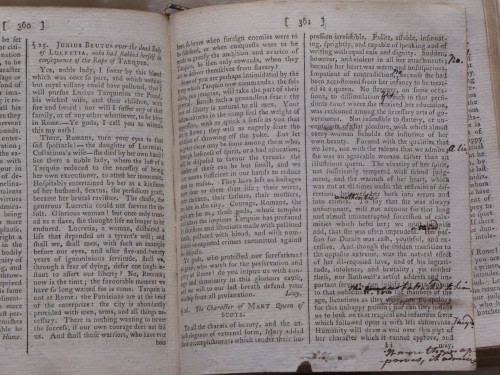
Jane Austen’s annotated copy of Elegant Extracts: Prose (1801). Jane Austen’s House.
(Click here to see a larger version.)
Publication
This section looks at the business of publishing the novels and Jane’s relationships with her publishers, Thomas Egerton and John Murray. It displays facsimile items from the John Murray Archive at the National Library of Scotland, including Murray’s account book and a cheque made out by him to “Miss Jane Austin.” Also on display are a newspaper from 31 October 1811 containing the publication announcement of Sense and Sensibility and a facsimile proof sheet for Sense and Sensibility created by student members of the Bodleian Printing Class at Oxford University.
With no independent income of her own, Jane Austen was clear that she wrote for money as well as fame. She was prepared to take financial risks. Apart from Pride and Prejudice, she published all her novels “on commission”—a bit like self-publishing today. Thus, although she was liable for losses, she retained her copyrights and covered the costs for paper and printing out of any profits; the publisher also took a handling commission—usually 10%. Austen always regretted selling the copyright for Pride and Prejudice, which proved her most popular novel.
This copy of The Morning Chronicle pictured below contains the publication announcement of Sense and Sensibility. It reads:
In 3 vols. Price 15s. in boards, a New Novel, called
Sense and Sensibility. By Lady ——
Published by T. Egerton, Whitehall; and may be had of every Bookseller in the United Kingdom.
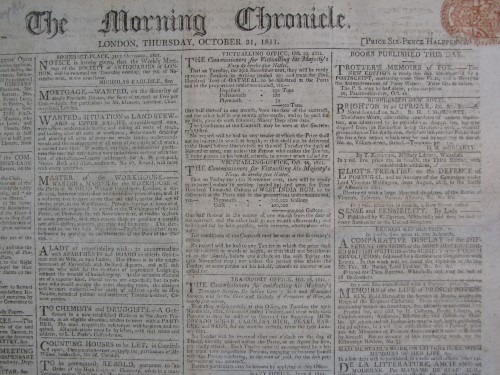
The Morning Chronicle (Thursday, 31 October 1811). Jane Austen’s House.
(Click here to see a larger version.)
First editions
At the center of the exhibition, a specially made twelve-sided display case houses a full set of first editions of Jane Austen’s novels—very rarely seen together. The display includes a first edition of Sense and Sensibility in its original publisher’s boards, Jane’s brother Frank’s personal copy of Emma, and her brother Edward’s copies of Northanger Abbey and Persuasion. Audio excerpts from the novels accompany the display.
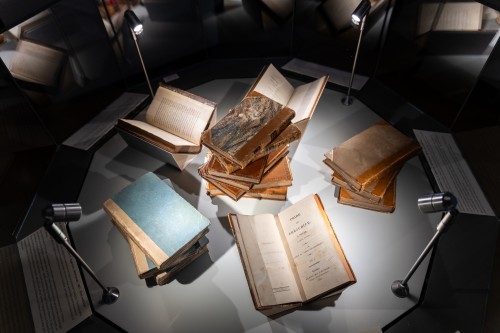
The central case in the Jane Austen and the Art of Writing exhibition at Jane Austen’s House, showing a full set of first editions of Jane Austen’s novels. Photo by Luke Shears.
(Click here to see a larger version.)
This first edition of Sense and Sensibility has survived in its original publisher’s boards. These simple pasteboard covers were intended to keep costs down at a time when new books were expensive. Those who could afford it might have their books rebound in leather, perhaps to match the rest of their library.
Like most novels of the time, Jane Austen’s works were published in three-volume sets. Volume structure was something to consider when writing. Each volume should be around the same length and should finish at a suitable break-point—ideally something to keep readers wanting more, so they would be sure to move on to (and buy or borrow from the library) the next volume. In Sense and Sensibility, volume 1 ends with Lucy Steele’s telling Elinor of her secret engagement to Edward Ferrars, leaving the reader anxious to know how this obstacle to Edward and Elinor’s relationship will be removed.
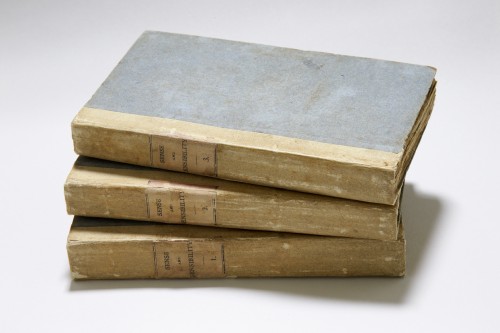
A rare first edition of Sense and Sensibility (1811) in its original publisher’s boards.
Jane Austen’s House.
(Click here to see a larger version.)
Jane Austen: Creative writing teacher
This final section turns the tables and looks at the younger generations of the Austen family—and how Jane herself helped them to become better writers. Volume the Third of her Juvenilia contains later revisions and additions in the hands of Jane Austen’s nephew James Edward Austen (later Austen-Leigh), and her niece Anna Lefroy, suggesting that she may have allowed them to use it to practice their writing skills. Was Jane actively teaching her nephew and niece how to write?
Like Jane, Anna was a would-be author from an early age, writing a number of stories, including an attempt to complete “Evelyn”—one of Jane’s own teenage writings. As a young woman, Anna also embarked on a novel of her own entitled Which is the Heroine?, but she never finished it. In 1814 Jane wrote Anna several letters offering practical advice for drafting and developing her characters, locations, and plot, such as this one, dated 10–18 August 1814:
The last Chapter does not please us quite so well, we do not thoroughly like the Play; perhaps from having had too much of Plays in that way lately.—And we think you had better not leave England. Let the Portmans go to Ireland, but as you know nothing of the Manners there, you had better not go with them. You will be in danger of giving false representations. Stick to Bath & the Foresters. There you will be quite at home.
It is tempting to regard this advice as an insight into how Jane felt about her own writing, but this may not be the case. Her confidence in Anna’s writing powers may not have been as great as her belief in her own.
This part of the exhibition also explores the physicality of Jane Austen’s writing process. Visitors are invited to sit at a scale replica of her famous twelve-sided writing table (the original is on display in the Dining Room downstairs), and to touch a variety of Georgian writing implements, including an inkwell and a pounce pot.
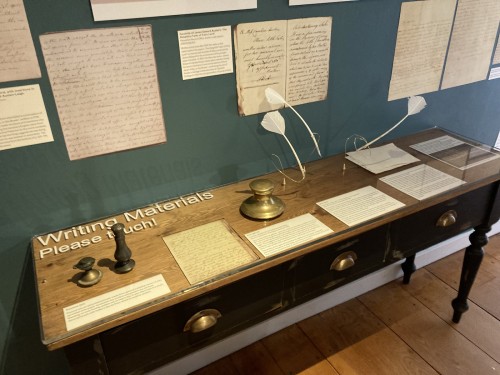
“Writing Materials”—a section of the Jane Austen and the Art of Writing exhibition at Jane Austen’s House.
(Click here to see a larger version.)
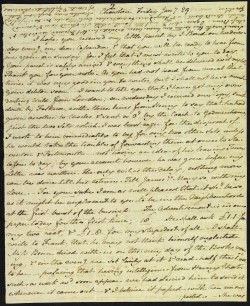
Letter from Jane Austen to Cassandra Austen (29 January 1813). Jane Austen’s House.
(Click here to see a larger version.)
Finally, the exhibit looks at Jane Austen’s letters and how letter-writing weaves its way into her novels, using large-scale facsimiles of letters drawn from the museum collection to illustrate the display.
Since the exhibition opened in October 2024, it has been wonderful to see visitors slowing down and spending long periods of time in this room, working their way around the areas of text, film, and audio, and enjoying the remarkable objects on display. The exhibition has a different look and feel to the rest of the House (which are dressed, as far as possible, as they would have been when Jane Austen lived here). The exhibition space, by contrast, is rich and glowing—inspired by the Treasures Gallery at the British Library (although of course on a much smaller scale!). It is a jewel-box, displaying some of the most precious objects in the Museum collection and unpacking their remarkable stories.
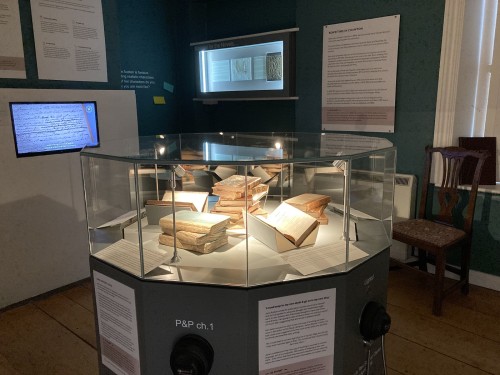
Jane Austen and the Art of Writing exhibition at Jane Austen’s House.
Photo by Luke Shears.
(Click here to see a larger version.)
ACKNOWLEDGMENT
Jane Austen and the Art of Writing was co-curated by Professor Kathryn Sutherland, a dear friend of Jane Austen’s House and our much-esteemed Patron.
