Jane Austen has long been a favorite among book collectors. Her works, in a variety of editions, rest upon the shelves of rare book institutions and private individuals alike. But beyond their appropriateness to collections as a symbol of Austen’s importance—be that cultural, historical, or personal—these books can also enrich our understanding when they are treated consciously as what they are: historical artifacts. This essay explores what we can learn through the lens of book collecting, based upon my experiences as a rare book dealer, the co-founder of the Honey & Wax Book Collecting Prize, and a collector myself. While book collecting is often a complementary activity to reading, it employs a distinct perspective. Book collecting offers a multifaceted lens—a material, book-historical approach, across multiple centuries and the lives of many owners—to assess Austen’s significance in new ways. New meanings appear in Austen’s texts, publication history, and reader reception, especially when placed into the wider context of collecting her own favorite authors.
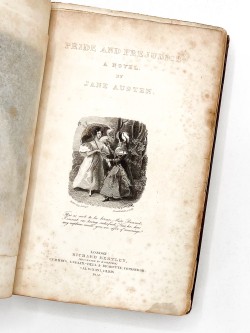
The Bentley Pride and Prejudice (1833).
(Click here to see a larger version.)
First, it is important to delineate the distinctions between “reading” and “collecting” for our purposes. Readers may be interested in the format of a text—for example, they may prefer a print copy of Pride and Prejudice over an e-copy—but, fundamentally, their choice of format is determined by their preferences. Collectors, on the other hand, see every copy of every title as its own distinct object. That object tells us something about the circumstances of its original production, as well as the lives it has lived since. For example, the first edition of Pride and Prejudice was published in three volumes without any illustrations. After Austen’s death, Richard Bentley’s 1833 edition was issued in a single volume with a frontispiece engraving (facing the title page) and title-page vignette—the first images of any scenes from Pride and Prejudice for Anglophone readers. Over sixty years later, in 1894, the famed “Peacock Edition” of Pride and Prejudice reflected the fin-de-siècle style popular in book design of that era. Ironically, this design was something of a shameless imitation of a well-established series of classic reprints called the “Cranford” series (named after the book with which its publisher, Macmillan, marked it officially a series: the 1891 reprint of Elizabeth Gaskell’s Cranford). The “Peacock” Pride and Prejudice is so iconic that its design, derivative then, now represents to us the book design of the entire era, when publishers’ pictorial cloth bindings became stunningly elaborate during the late Victorian period. One hundred years later, collectors can now acquire the BBC miniseries tie-in edition of 1995, featuring a smoldering Colin Firth on the front cover. Each of these editions tells us something about its era, as well as how its publishers viewed their audience. Reading is about the story in the book, while collecting is about the story of the book.
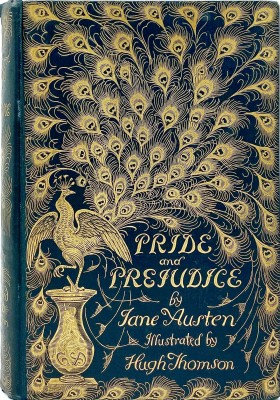
“Peacock” Pride and Prejudice (1894), published by George Allen. |
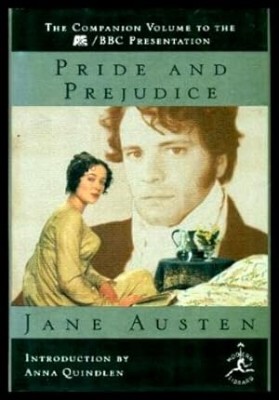
BBC tie-in (1995), published by Modern Library. |
To elaborate, two similar terms are commonly folded into each other but are in fact quite distinct: a “library” and a “collection.” A library is a group of books gathered by a reader, one who intends (or hopes, as hopeless as it may be) to read all those texts. A collection is a group of books put together by someone who treats them as historical artifacts. Collections often have a specific theme, aimed at illuminating that subject by building something greater than the sum of its parts. I took as the inspiration for one of my recent book collections the theme of “Jane Austen’s Bookshelf,” using Austen’s own reading to seek examples of books from her favorite women authors (fully chronicled in my recent book of the same name).
The material traits of books can open new modes of inquiry and enrich our perception of a text, as we see in the first edition of Pride and Prejudice in three volumes, published in 1813. By the time Austen was able to see it successfully published, the so-called “triple-decker” format had already become the standard in the industry for novels. Austen, however, had begun her earliest drafts of what would become Pride and Prejudice in the 1790s, when the number of volumes in a novel could vary substantially. One of Austen’s favorite books of the era, Frances Burney’s Camilla (1796), was issued in five volumes. In this case, Austen seems to have chosen to follow Burney’s lead in a different way, looking instead to Burney’s first novel, Evelina (1778). Austen’s father gives us a hint to this model in the letter he wrote to Burney’s own publisher, Cadell, in 1797, describing Austen’s work as “a manuscript novel, comprising 3 volumes, about the length of Miss Burney’s Evelina” (PP xi). Many have written on the similarities of Pride and Prejudice and Evelina, so I won’t dwell on them here.1 I think it behooves us, however, also to look at these books as collectors—that is, as amateur book historians—and pay attention to what details, such as a book’s format, tell us. We often take for granted today that Austen published all the works in her lifetime in the three-volume format because it was then the industry standard, but her father’s letter suggests that Austen may have originally conceived of that format for an entirely different reason: because she was writing a book like Frances Burney’s first novel.
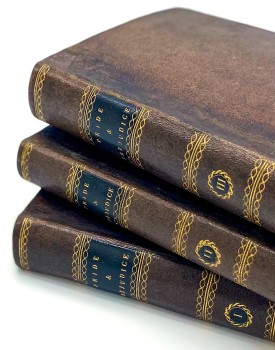
First edition of Pride and Prejudice (1813), published by T. Egerton. |
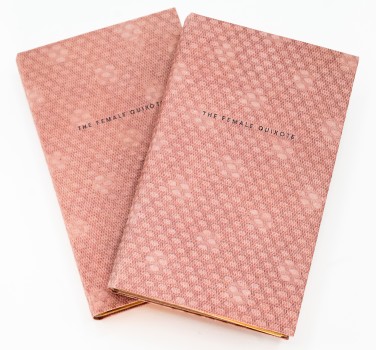
Second edition of The Female Quixote (1752) in a modern fine binding by Sol Rébora. |
Indeed, format can have a great impact upon content. An example from Austen’s own reading will serve to demonstrate how great that impact can be. In 1752, Charlotte Lennox was rushing to finish what would become her most celebrated work: The Female Quixote. She had planned the novel to extend to three volumes. In this era, however, the publishing season occurred in the spring and the fall, with a break during the summer (Raven 26). Unlike Austen, Charlotte Lennox needed to finish the work because she needed the income from its publication. Specifically, she needed it as early as possible that year. If she were able to publish the book in the spring season, that also gave her the opportunity—if it sold well—to publish a second edition in the fall season and receive a second payment for the work in the same year. But Lennox was out of time; if she wanted to make that spring season, she had to wrap up the novel in two volumes instead of three. Against her artistic inclination but at her economic necessity, Lennox published The Female Quixote in two volumes in the spring of 1752 (Schürer, 24). It was a hit, and did indeed go into a second edition that fall.
As one who also must work for a living, I am sympathetic to the fact that Lennox’s material conditions guided her decisions. I dearly wish, however, that she’d had the financial breathing room to take her time with The Female Quixote and finish it in three volumes as she originally intended. As it is, The Female Quixote’s ending wraps up entirely too quickly. Lennox filled the penultimate chapter with so many ideas—which she had apparently meant to investigate over a third volume—that the chapter lacks much of the charisma and energy of the rest of the book. In fact, its tonal difference was cited for over a century as evidence of a Victorian supposition that her friend Samuel Johnson wrote that chapter, not Lennox herself (Romney 142–43). Even issued in a condensed version of Lennox’s original plans, The Female Quixote became a classic, one that Austen read with interest more than once. She first read it probably as a teenager, as some of her Juvenilia clearly embrace its parodic style. We know for certain that she read it again as an adult in 1807, as she wrote to Cassandra that the work was “quite equal to what I remembered it” (7–8 January 1807). Had Lennox been able to execute The Female Quixote as she wished, perhaps it would still be regularly read today, as Austen’s novels are.
It is striking to sit with the material implications of this comparison: that Austen did not need to rush any of her novels to print to pay her bills. To sculpt her novels like Pride and Prejudice and Emma to perfection was a privilege that some of Austen’s models did not enjoy. While there is much to distrust in the family portrait of Austen immediately following her death in 1817, published as the “Biographical Notice” at the beginning of the dual publication of Northanger Abbey and Persuasion, the remark that she chose to “withhold her works from the public, till time and many perusals had satisfied her” (4) is worth considering again in this light.
Further, the benefits that collecting can offer go far beyond insights into the circumstances of a book’s production. When collecting books alongside reading texts, we often ironically find more richness in those same texts. Austen’s characters refer to the “circulating library” when they wish to find a book to read (Erikson 573–90). Circulating libraries were one of the main resources available to a woman like Austen—or many of Austen’s heroines—in an era when books were expensive purchases (Hume 385). Before the advent of the free public libraries that we enjoy today, circulating libraries made books available by subscription, not unlike a modern streaming service such as Netflix. For a set fee, one could check out a certain number of volumes per month. This system made books—especially novels—more accessible to a wider range of readers, as well as incentivizing publishers to issue books in multiple volumes, for which circulating libraries would pay by the volume and lend out individually by the volume to customers (Raven 96).
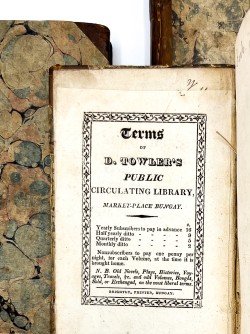
Circulating library bookplate in the first edition of Desmond (1793).
(Click here to see a larger version.)
One 1793 first-edition copy of Desmond by Charlotte Smith that I acquired for my collection tells that story across its front pastedowns. Charlotte Smith was one of Austen’s childhood favorites, if we can allow for the leap of inferring that the enthusiasm of the characters in her teenage work reflects her own. In Catharine, or The Bower, Kitty and Camilla energetically discuss the merits of “‘Mrs Smith’s Novels’”; when the more excitable Camilla suggests that Smith’s second novel, Ethelinde (1789), is overly long for her taste, Kitty counters in its favor, “‘if a book is well written, I always find it too short’” (MW 199). Each volume of my copy of Desmond contains the bookplate of “D. Towler’s Public Circulating Library” in Bungay. Yearly subscribers paid sixteen shillings for access; half yearly, nine shillings; quarterly, five shillings; or monthly, two shillings. One could also choose not to subscribe and “pay one penny per night, for each Volume.”
As Lennox did, Charlotte Smith wrote because she needed money to support herself. In her case, she took on the full financial support of her children after leaving a profligate, abusive husband. Smith vastly preferred composing poetry to novels, but, similar to the economics of the circulating library, publishers paid writers by the volume. Hence Charlotte Smith wrote three-, four-, and five-volume novels in order to receive multiple payments, as opposed to the single payment she received for her single volume of poetry. Here we see the material cause of Camilla’s complaint that Ethelinde is too long. Nevertheless, Kitty’s response in its favor aptly captures my own experience: I read her first novel, Emmeline, in one giant gulp over the course of a weekend, and Desmond is a fascinating look into English responses to the then-ongoing French Revolution. It was, indeed, one of the only English novels daring enough to be set during the Revolution while it was happening (Fletcher 144). Smith’s novels, however, are too long for many tastes, far longer than Austen’s, and the length can sometimes feel without purpose. Once again, Austen’s ability to work on her own terms—to have a “room of her own”—made a qualitative difference in her output when compared with some of her most admired models.
Attention to books as physical objects can also fill in bits of cultural context that often go unsaid, or are only implied, when reading the texts. An instructive example is the material proliferation of cheap-format gothics, which has relevance to a favorite topic among Austen scholars: how gothic novels are described in Northanger Abbey. Catherine Morland wants to know that Isabella Thorpe’s new book recommendations are “‘all horrid, are you sure they are all horrid?’” Isabella, who has lavishly recommended them, is “‘quite sure’”—not because she has read them herself, but because someone she knows has read them (40). Like most of her mannerisms, Isabella’s extreme pleasure in recommending them has an air of affectation, of performance. Dialogues like this, while serving also to stress Austen’s themes and develop her characters, suggest there is a kind of inherent melodrama to the form of the gothic. Yet the way that Catherine Morland—and especially Henry Tilney—talk about the most famous gothic novel, Ann Radcliffe’s 1794 The Mysteries of Udolpho, is primarily with the appreciation a reader feels for any exceptional book. Henry Tilney’s response to Udolpho is not the gleeful performance of Isabella Thorpe’s, but a cheerful, balanced appreciation of its greatness: “‘when I had once begun it, I could not lay [it] down again’” (106).
Udolpho is, indeed, a great work—one of my favorite reads of the past decade. Yet its reputation would soon begin to crumble into that death-knell modifier: “melodramatic.” As I collected examples of Radcliffe’s works over time, one of the reasons for this evolution became clear. The first edition of Udolpho was issued in four large octavo volumes; in other words, it did not look much different from any other novel, gothic or not. But Radcliffe’s work was so popular that it quickly attracted imitators. Some of these imitators were brilliant in their own right—but plenty more were simply looking to cash in on the fashion that Radcliffe had started. At best, one might say her settings, characters, and tropes were copied by others without her artistic prowess. At worst, copycats used Radcliffe’s plots to make a quick profit and move on.
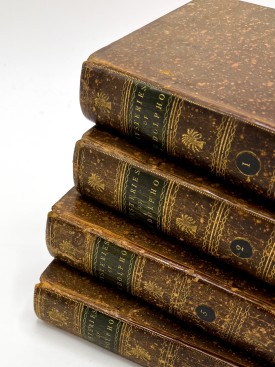
First edition of The Mysteries of Udolpho (1794). |
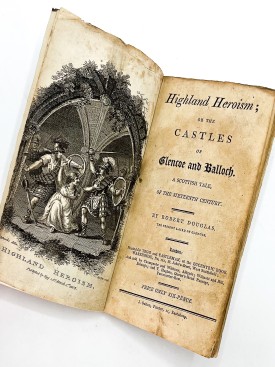
Highland Heroism (1803), an unauthorized gothic chapbook adaptation of Radcliffe’s first book. |
Highland Heroism; or the Castles of Glencoe and Balloch, a gothic chapbook from Tegg and Castleman, “at the Eccentric Book Warehouse,” is an example of how such imitations proliferated on the marketplace. They were cheap, abridged versions of good books like Radcliffe’s, with everything except action and drama removed. Chapbooks “made a regular practice of butchering the classics of gothic romance, compressing them to a fraction of their original length, intensifying the melodrama, and subjecting them to a general rechristening” (Mayo 770). Gone were Radcliffe’s sublime landscapes and meditative poetry. All that was left was melodrama. These versions were significantly cheaper than the original books and spread much wider than their source texts. Marred and melodramatic chapbooks like these were what came to represent gothics as a whole: Catherine’s so-called “horrid” novels. Soon people like Wordsworth would be lamenting the entire “Radcliffe school” (Gillies 2: 158).
Reader reception of various texts is an especially difficult aspect of history to trace, but it is one that book collecting is especially suited to reveal. I refer specifically to how everyday readers responded to the books they were reading; the work of professional critics remains accessible to us, through publications in the Critical Review and elsewhere. But what did, say, a young woman of the 1780s—a woman who lived at the same time as Jane Austen—think of the highly anticipated second novel of Frances Burney, Cecilia? As a book collector, I learned the answer.
In 1784, someone named Bethia Coman acquired a copy of the first edition of Cecilia. She avidly read all five volumes, likely finishing it in the summertime. We know this because of an inscription she added to the final volume of the set, accounting for its odd pink tinge: “By accident a strawbury fell into the Book which has stained the leaves.” At some point, when strawberries were in season, Bethia Coman did not stop reading her book to eat; she kept right on eating while reading—and then made a mess when she was apparently so engrossed in the story’s volume-five climax that she dropped her snack. This is the copy of Cecilia I acquired for my collection. There are many obtainable first editions of Cecilia, even today. But this was the set that I wanted: the one that showed me what it was like, for one reader at least, to read one of Austen’s favorite books in real time.
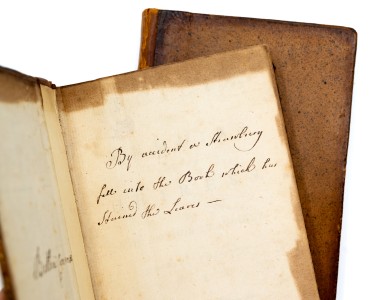
Volumes 4 and 5 of Bethia Coman’s copy of Cecilia (1782). |
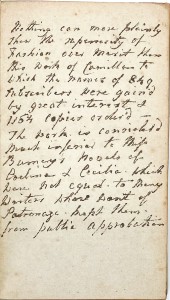
Inscription on the front fly leaf of a first edition of Camilla (1796). |
Similarly, I acquired a copy of Camilla because of its early annotations. They are, however, more critical than typically found. Someone has written on the front flyleaf:
Nothing can more plainly Shew the superiority of Fashion over Merit than this Work of Camilla to Which the names of 849 Subscribers were gain’d by great interest & 1154 copies order’d—The work is considered Much inferior to Miss Burney’s Novels of Evelina & Cecilia which were not equal to many Writers whose want of Patronage kept them from public approbation.
I find this annotation especially fascinating because, in fact, Camilla is my favorite novel by Frances Burney. In Camilla, Burney has perfected what she first began to attempt in Cecilia: to create a cumulative effect of calamity, leading to a climax that transforms her heroine and reinforces her themes. For her part, Austen cites both these works as those “in which the greatest powers of the mind are displayed” in Northanger Abbey (38).
Collecting works from Austen’s era and earlier can be expensive; however, it is a mistake to think that one can only collect expensive books fruitfully. As Janine Barchas has shown in her own collection (documented in The Lost Books of Jane Austen), and as I have seen firsthand since 2017 as co-administrator of the Honey & Wax Book Collecting Prize (an annual award of $1,000 for the best book collection built by a woman in the U.S. under thirty)—copies of later editions of popular books may often be significantly cheaper, yet are still meaning-bearing objects.
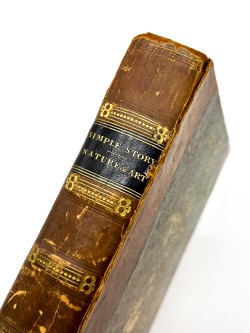
The Bentley Simple Story (1833), published with Nature and Art.
(Click here to see a larger version.)
One acquisition that cost only a fraction of its Austen counterparts was the Richard Bentley edition of Elizabeth Inchbald’s hit novel, A Simple Story. A two-part courtship novel, A Simple Story was first published in 1791 to tremendous acclaim, going through multiple editions before the end of the century and being called by one modern scholar “the most elegant English fiction of the [eighteenth] century” (Castle 290). This edition was published the same year that Bentley reprinted Pride and Prejudice (1833) and was part of the same series, “Bentley’s Standard Novels.” The project was “one of the longest lasting and most influential series in the Victorian period” (Bassett 211), republishing books first printed in the previous standard three-volume format into a new, single-volume format. (As mentioned earlier, Bentley’s editions were also the first of Austen’s novels to be illustrated in Britain, thus exerting an immense influence on the visual iconography of Austen’s works [Looser 19].) Books cannot become part of the so-called “canon” if they are not accessible to readers in the generations after their initial publication. Therefore, reprints have been—until the present digital age, at least—a critical prerequisite for a book’s consideration as canonical. This “Bentley’s Standard Novels” edition is evidence that both Austen and Inchbald were being put forth as contenders for canonicity in the generation after their deaths. One hundred years later, however, only Austen remained on the canonical shelf.
Another humble volume, for which I paid around $40, speaks to how Austen was viewed in the late nineteenth century—fifty-five full years after the Bentley edition, and nearly twenty years after James Edward Austen-Leigh’s influential Memoir that brought Austen renewed critical attention. In “Cassell’s Red Library” of 1888, so-called for the series’ cherry-red cloth bindings and red-stained edges, Austen is one of only four women whose work is included. The other three are Harriet Beecher Stowe (Uncle Tom’s Cabin), Harriet Martineau (The Hour and the Man; Martineau, incidentally, is a very unjustly forgotten author born just a generation after Austen), and Frances Burney (Evelina, by this time the only one of her novels still frequently reprinted). Austen is the only woman who enjoys two selections: Sense and Sensibility and Pride and Prejudice. But we must not read too much into the selection of a single series, which inevitably and unavoidably boils down to the subjective judgment of one or two people. For instance, of the ninety-six titles advertised in George Bell & Sons’ “Bohn’s Popular Library” from 1914, Burney is the only woman included (both Evelina and her Diary and Letters). As of this writing, I see books from this series available from antiquarian booksellers online, even in original dust jackets, for as low as $15.
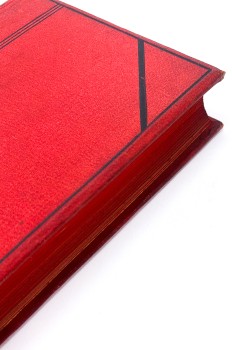
Cherry-red cloth and text block edges of the Cassell’s Red Library Evelina (1888). |
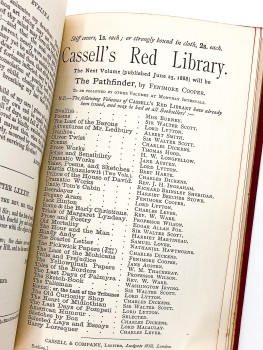
Cassell’s Red Library advertisement bound at the end of Evelina (1888). |
These two examples demonstrate the new significance that paratextual material—in this case, publishers’ ads for their branded series—takes on when one begins to look at books as historical objects. It is the eye of a book historian, or rather, of a collector—simply anyone who acquires books with their historical import in mind. Books speak to us through more than just their texts. They tell us about themselves through their bindings, their advertisements, their repairs, their owner inscriptions, and more.
Paratextual material often has more to say, in fact, than the first message it sends us. For example, a brief study of author portraits in various editions of the authors I collected is particularly illuminating. Upon initially opening an Austen book—especially one before the era when dust jackets became the default banner for marketing the work with flashy designs—the viewer might see a portrait of Austen used as the frontispiece. The story of the portrait used in Austen-Leigh’s Memoir, which is based upon Cassandra’s sketch but “sanitizes and prettifies Austen,” is well known (Nigro). From that publication on, portraits of Austen appeared frequently in editions of her works, often as the frontispiece. But in the context of a larger collection that includes her peers, the inclusion of an author portrait offers more revelations. It took until after Austen-Leigh’s December 1869 (title page dated 1870) Memoir for any of her works to be adorned with her own image. Meanwhile, the first time Frances Burney’s portrait appeared in one of her novels was Derby & Jackson’s 1857 Evelina (Kochkina 96), following her portrait in volume 1 (1842) of The Diary and Letters of Madame D’Arblay. Still, it is a similar pattern: a portrait first appears in a biography of the author, appropriately enough, and once published becomes fair game for inclusion with the author’s works. This evolution took time for women authors in particular because, as Svetlana Kochkina notes, there was often an air of “impropriety of including authors’ portraits in the works of living female authors [that] persisted well into the nineteenth century” (97).
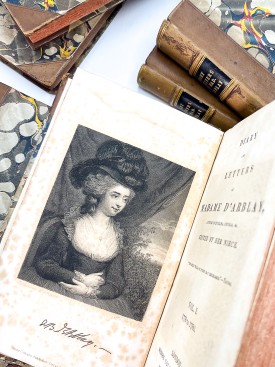
Engraved frontispiece portrait of Frances Burney, vol. 1 of The Diary and Letters of Madame D’Arblay (1842). |
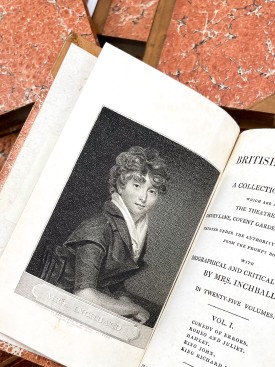
Engraved frontispiece portrait of Elizabeth Inchbald, vol. 1 of The British Theatre (1808). |
Often—but not always. I note at least three exceptions, found in the process of collecting: volume 1 of Catherine Macaulay’s History of England (1763), Hester Lynch Piozzi’s Retrospection (a history of the world, published in 1801), and volume 1 of Elizabeth Inchbald’s British Theatre (1808). All these exceptions use their frontispiece portraits as the well-established convention of signaling that the authors are acting as authorities on their subjects. In other words, it is the exact kind of “presumption” that many male writers of the era criticized and that many women writers avoided. To put this another way, both Burney and Austen would likely have actively rejected any proposal that their portraits be issued as frontispieces in their published books. One may object that this is supposition. It is. But we have more evidence of this likelihood within the books themselves, when we simply stop again and listen to what they tell us: neither Burney nor Austen ever put her name on the title page of any of her novels in her lifetime. Burney’s first novel, Evelina, was issued anonymously; her second, Cecilia, was printed as “By the author of ‘Evelina,’” and so on. Likewise, Austen’s first novel, Sense and Sensibility, was “By a Lady”; her second, Pride and Prejudice, was “By the author of Sense and Sensibility.”
Returning to the evidence of reader response in these later, more humble books, I offer two further examples from books for which I paid an average of $30 each. The first, Twelve English Authoresses, by L. B. Walford (1892), has pencil annotations from an early reader noting the birth date of Frances Burney (1752) and the death date of Maria Edgeworth (1849), establishing a sort of frame for the era, rich in women’s writing, with these two authors as the bookends. Their contributions to literature were indeed epochal, as Austen herself felt: novels by both are name-checked in her famed Northanger Abbey passage referenced earlier. This informally penciled-in boundary of an era is even more interesting in the context of this publication, which includes chapters on Jane Austen, the aforementioned Harriet Martineau, and authors of even later generations, like George Eliot. But this reader was especially preoccupied with the period from Burney to Edgeworth—a period that not only enveloped, but was formative to, Austen’s own writing.
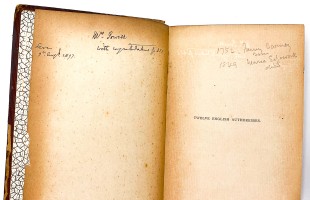
Annotations on Burney and Edgeworth, first edition of L. B. Walford’s Twelve English Authoresses (1892). |
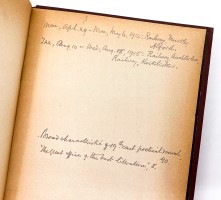
Annotations on railway reading, first edition of William Minto’s Literature of the Georgian Era (1894). |
The second example is a book called Literature of the Georgian Era, by William Minto (1894). I acquired this one initially because of its discussions of Austen favorites like Burney but was surprised and delighted by the unexpected annotations I found within it. One early owner penciled in the circumstances during which he read it, on the rear endpaper: “Mon, April 29—Mon, May 6, 1912: Railway, Murtle [. . . ] Tue, Aug 10–Wed, Aug 18, 1915: Railway.” He read it on the train. Not only that, but he seems to have kept it aside specifically for reading on the train: the two intervals of time recorded are three years apart.
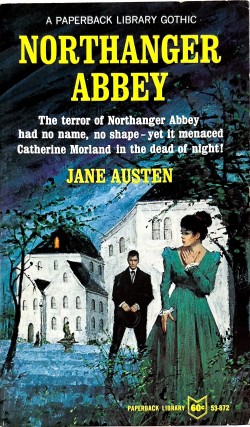
Paperback Library Gothic edition of Northanger Abbey (1965).
(Click here to see a larger version.)
Each new edition of a book is not simply a reprint of its text; it is a time capsule of that moment when it was issued. In 1965, Paperback Library published a new paperback edition of Northanger Abbey. It features a young woman in the foreground, turning away from a menacing-looking man, all in front of an enormous old building with a single lit window. The front cover copy reads, “The terror of Northanger Abbey had no name, no shape—yet it menaced Catherine Morland in the dead of night!” This edition of Northanger Abbey was issued at the peak of the incredible wave of popularity of a certain genre of gothic romance—namely, paperback publications of the 1960s and early ’70s that were colloquially called “women running from houses” books for their immediately recognizable cover design tropes: a beautiful young woman outside at night, in front of a large building with a single lit window. These gothic romances were, in fact, (delightful) heirs to those melodramatic gothic chapbooks of the early 1800s that so transformed and stigmatized the work of Ann Radcliffe. The parodic elements of Northanger Abbey have, in this edition, come full circle: Austen has now joined Radcliffe in seeing her work recharacterized for a particular readership at a particular moment in time.
What do we learn when using book collecting as a method of inquiry? It can tell us something about Austen’s decisions on novel structure and format; about how her reputation differed from those of her favorite authors, both during and after her lifetime; about Austen’s rise to canonical status; about how later generations situated her among her peers; about why some of her favorite authors are so little read today; and about how people have responded over the generations to these authors when they have read them. Looking at these works as a book historian doesn’t always require visiting a special collections library, important as such libraries are. Anyone can participate by entering the antiquarian book marketplace, even at a low level, and becoming a collector. Acquiring such works then serves a double purpose: not only does the collector make progress in her research, but she also becomes a caretaker for these books as historical artifacts, preserving them for the next generation of Janeites.
NOTE
1To select only a few across the past sixty years, see Kenneth L. Moler’s Jane Austen’s Art of Allusion (1968); Jan Fergus’s Jane Austen and the Didactic Novel: Northanger Abbey, Sense and Sensibility and Pride and Prejudice (1983); Marilyn Butler’s Jane Austen and the War of Ideas (1987); and Gillian Dow and Katie Halsey’s “Jane Austen’s Reading: The Chawton Years” (2010).
