Chawton House in Hampshire is an Elizabethan manor house and estate once owned by Jane Austen’s brother Edward. He inherited the estate from the wealthy but childless Knight family, and in 1809 he provided his mother and sisters, Jane and Cassandra, with a cottage in the village (now a museum, Jane Austen’s House) to live in. Austen knew the estate intimately. She dined with family members at the table that still stands in the Dining Room; she frequently walked across the estate to Farringdon; and she was influenced by the place in which she wrote and edited the novels that have made her one of the most famed writers in the world. Today Chawton House is a busy historic house committed to preserving women’s history, facilitating study, and generating public engagement in the rich histories of early women’s writing and of the house, gardens, and parkland. We welcome 20,000 visitors onsite each year and run a lively events program onsite, offsite, and online. Chawton House’s library holds the Knight family’s library on deposit, and it is also home to a unique collection of around 4,500 works by women of the long eighteenth century, complemented by a wealth of modern critical resources. To mark the 250th anniversary of Jane Austen’s birth, we sought to situate Austen within her literary context, celebrating the women writers upon whose shoulders Austen stands.
Sisters of the pen
 Jane Austen’s genius did not come out of nowhere. Raised in a family of intelligent readers who enjoyed the satirical and the ridiculous, she began her earliest surviving works at the age of eleven. She was an avid reader who eagerly followed—and easily parodied—the trends of her day, from highly dramatic sentimental and gothic novels to fussy conduct books. When Austen published her first novel, Sense and Sensibility, in 1811, she entered a vibrant literary marketplace already populated by many professional women writers. Her writing, from her juvenile experiments to her six published novels, was also influenced by the stage. Her first experience of family theatricals—all the rage in the Georgian period—was at the age of seven. In later life, Austen was a regular visitor to the theatre.
These experiences of reading, watching, acting, and laughing were crucial. United with close observation of social interactions and razor-sharp wit, they fed into Jane Austen’s unique style, giving us the memorable characters and scenes so beloved by modern readers. This exhibition places Jane Austen amongst her sister artists—the novelists and playwrights who inspired her and those who, in turn, she influenced.
Part I: The circulating library
“Great Novel-readers”: The role of the circulating library
In the final decades of the eighteenth century, the novel became a female art form. The first year that more novels were published under women’s names than men’s was 1775, the year of Austen’s birth. By the 1790s, 21% of novels had a named female author; 62% were published anonymously.
Novels, often published in three volumes, were expensive, especially as paper costs rose during the Napoleonic wars, from 1803 onwards. In 1813, the three-volume set of Pride and Prejudice cost 18 shillings (almost £1), the equivalent of two weeks’ wages for a laborer. Circulating libraries, which rented books to members, were a more affordable option, charging £1–£2 per year. These lending libraries popped up all over England in the eighteenth century and played an essential role in generating large audiences for women writers. Jane Austen herself used these libraries. In 1798, for example, she subscribed to Mrs. Martin’s library in Basingstoke, writing to Cassandra: “As an inducement to subscribe Mrs Martin tells us that her Collection is not to consist only of Novels, but of every kind of Literature &c &c—She might have spared this pretension to our family, who are great Novel-readers & not ashamed of being so” (18–19 December 1798).
Jane Austen’s circulating libraries
Circulating libraries get a mention in several of Austen’s novels. Both Mr. Collins in Pride and Prejudice and silly Sir Edward Denham in the unfinished novel Sanditon take a dim view of them, with Sir Edward declaring, “‘I am no indiscriminate novel-reader. The mere trash of the common circulating library, I hold in the highest contempt’” (LM 181). But for thoughtful Fanny Price, banished from Mansfield Park to her lowly Portsmouth origins, the circulating library provides solace and agency: “wealth is luxurious and daring—and some of hers found its way to a circulating library. She became a subscriber—amazed at being any thing in propria persona, amazed at her own doings in every way; to be a renter, a chuser of books!” (MP 461).
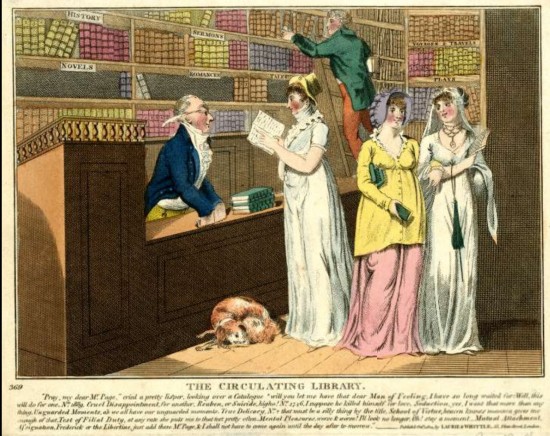
The Circulating Library, by Laurie & Whittle, after Isaac Cruikshank (1804).
(Click here to see a larger version.)
This print by Robert Laurie and James Whittle is based on an earlier watercolor by Isaac Cruikshank. Its satiric caption mocks the female frequenter of the circulating library as she scans the titles on offer: “Seduction, yes, I want that more than any thing. . . . School of Virtue, heaven knows mamma gives me enough of that.”
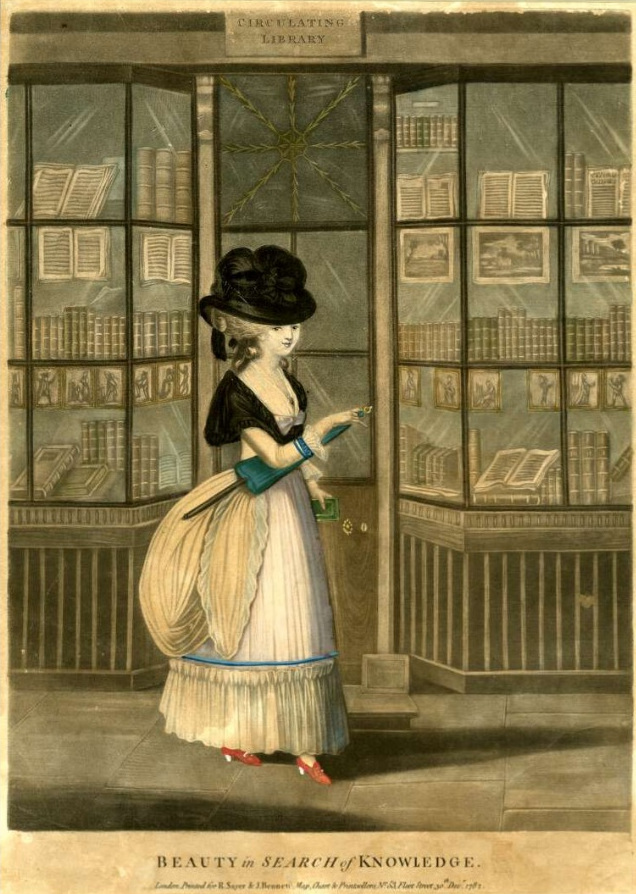
Beauty in Search of Knowledge, Sayer & Bennet, after John Raphael Smith (1782). |
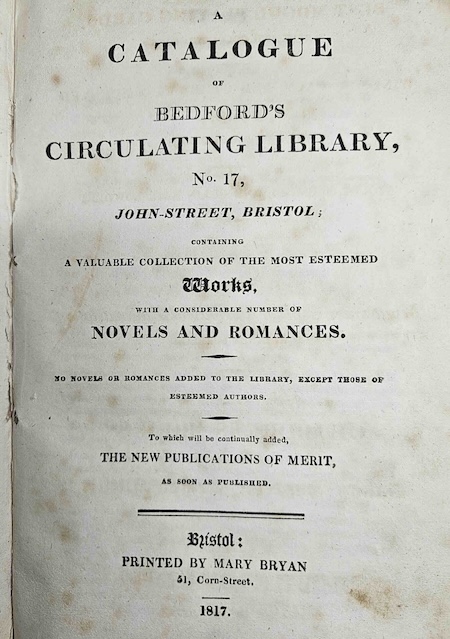
A Catalogue of Bedford’s Circulating Library (Bristol: Mary Bryan, 1817). Chawton House, Acc. No. 1623. |
In Sanditon, even the sensible Charlotte Heywood can be affected by the fictions of the circulating library. “Perhaps it might be partly owing to her having just issued from a circulating library—but [Charlotte] could not separate the idea of a complete heroine from Clara Brereton. Her situation with Lady Denham so very much in favour of it!—She seemed placed with her on purpose to be ill-used” (LM 169). The catalogue from Bedford’s Circulating Library gives a sense of the wide range of novels available to readers, alongside other goods, from hair powder and playing cards to lemon pickle. A twelve-month subscription to Bedford’s Circulating Library would cost one guinea (£1.1s). Alongside a host of intriguing titles, most now entirely forgotten, Austen’s novels Sense and Sensibility, Pride and Prejudice, and Emma are included (but not Mansfield Park).1
Minerva Press: A publishing powerhouse
Several publishers owned circulating libraries. Established in 1774 and housed on Leadenhall Street in London, William Lane’s Circulating Library was one of the largest, with over 20,000 books. From 1790, Lane—responsible for publishing over a third of new London novels over the next thirty years—used his publishing house, Minerva Press, to supply his library’s stock. Six of the seven “‘horrid’” novels mentioned by Austen in Northanger Abbey were Minerva Press publications. Many Minerva novels were also reprinted in America.
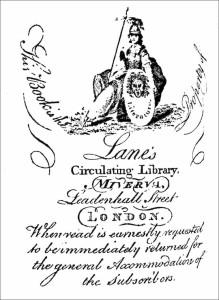
Minerva Press bookplate. |
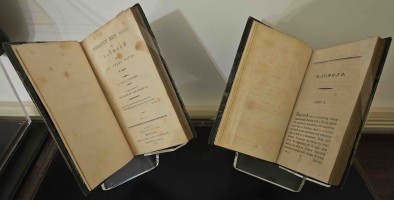
Nobility Run Mad, or Raymond and His Three Wives |
The preface of Nobility Run Mad, or Raymond and His Three Wives, an anonymous novel published by the Minerva Press, opens in a circulating library, with its author/narrator listening for the opinions of visitors on her previous works. The plot includes gambling, adultery, a trip to France, vulgar relatives, and even a short gothic-castle interlude, in which terrifying rustlings in the night turn out to be a squirrel.
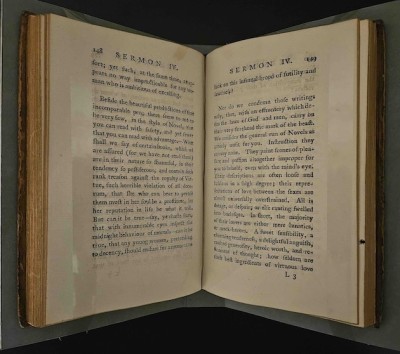
Sermons to Young Women, by James Fordyce (London: T. Cadell & J. Dodsley, 1775). Knight Collection, Acc. No. 8975/K985.
(Click here to see a larger version.)
While circulating libraries did much to expand the readership of women writers, this expansion also generated more violent criticism alongside playful satire. Readers of Pride and Prejudice will recognize Fordyce’s Sermons to Young Women as the work with which Mr. Collins bores the Bennet girls, since “‘there can be nothing so advantageous to [ladies] as instruction’” (77). First published in 1766, the Sermons were widely read; the copy pictured here is the eighth edition. Fordyce represents an extreme version of eighteenth-century anxieties about the corrupting power of reading novels, claiming that few novels can be read by women with safety.
The usual suspects: Jane Austen’s reading list
The first biographies of Jane Austen written by her brother and nephew did a disservice to the breadth of her reading. Samuel Johnson, Samuel Richardson, and William Cowper are all named, but the biographies mention only one woman writer—Maria Edgeworth. Austen’s letters and novels tell a very different story, affording us a glimpse into her rich literary inheritances.
Her letters detail the books read aloud among the family. In January 1807, an old favorite, Charlotte Lennox’s The Female Quixote (1752), is chosen: “I find the work quite equal to what I remembered it,” Austen wrote (7–8 January 1807). The following month, the family read Sarah Harriet Burney’s first novel, Clarentine (1796)—apparently Austen’s third reading, and she is not complimentary, noting that she and the family were “surprised to find how foolish it is” (8–9 February 1807). Almost two decades later, Sarah Harriet Burney was much more taken with the newly published Pride and Prejudice: “I have only just finished, and could begin . . . all over again with pleasure.”
In Austen’s novels, what characters choose to read is telling: books are often used as a shorthand to indicate personality traits. Several novelists and works are mentioned by name. Most frequently recognized as influences on Austen’s writing are Frances Burney, Maria Edgeworth, and the gothic novelist Ann Radcliffe.
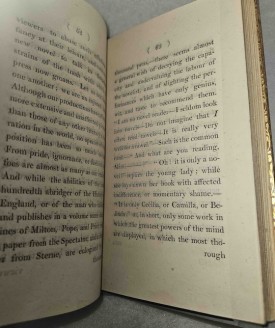
Northanger Abbey, by Jane Austen (1st ed. London: John Murray, 1818). Chawton House, Acc. No. 9905. Gift of Sandra Clark.
(Click here to see a larger version.)
Jane Austen’s posthumously published mock-gothic novel, Northanger Abbey, is open at her famous and spirited defense of novelists and their art. Novels, she claims, are where “the greatest powers of the mind are displayed, . . . the most thorough knowledge of human nature, the happiest delineation of its varieties, the liveliest effusions of wit and humour, are conveyed to the world in the best-chosen language” (NA 31).
Maria Edgeworth (1 January 1768–22 May 1849)
“I can tell you that nothing is more unlike a novel than real life.”
In a letter to her niece and aspiring novelist Anna in 1814, Jane Austen wrote, “I have made up my mind to like no Novels really, but Miss Edgeworth’s, Yours & my own” (28 September). Jane Austen requested that her publisher send Maria Edgeworth a copy of Emma. Although Edgeworth had enjoyed the realism of Mansfield Park, she found that “there was no story” in Emma. She was even less taken with Northanger Abbey, calling it “one of the most stupid nonsensical fictions I ever read,” although she loved Persuasion: “the love & lover [are] admirably well drawn so that we feel it is quite real.” Years later, in 1838, Edgeworth records a relative reading aloud from Emma and Pride and Prejudice: “I liked them better than ever.”
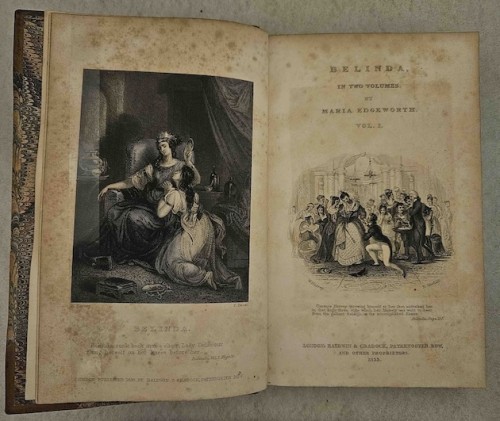
Belinda, by Maria Edgeworth (London: Baldwin & Cradock, 1833). Knight Collection, Acc. No. 9448/K299. (Click here to see a larger version.)
Originally published in 1801, Belinda is mentioned by name in Northanger Abbey. Edgeworth’s story places its naive heroine under the mentorship of a troubled woman of fashion, who is hiding a dark secret.
Our tale contains a moral, and no doubt
You all have wit enough to find it out.
Belinda is essential reading for those interested in Regency masquerades or in cross-dressed duels.
Frances Burney (13 June 1752–6 January 1840)
“But how cool, how quiet, is true courage.”
Burney lost her mother at ten and lived in a large, blended family. (A portrait of her half-sister, the novelist Sarah Harriet Burney, hangs in Chawton House’s Long Gallery.) Despite initially keeping her authorship a secret, disguising her handwriting, and getting her brother to pretend to be the author of her first novel, Frances Burney became one of the most popular novelists of her day. In addition to Evelina (1778), Cecilia (1782), Camilla (1796), and The Wanderer (1814), Burney wrote eight plays, only one of which was staged. Despite having famed actress Sarah Siddons in the leading role, the play was a failure and was withdrawn after one performance. At the age of forty-one, Burney married a French exile, Alexandre D’Arblay. In 1811, she underwent (and survived) a mastectomy without anesthetic, writing a harrowing account.

Cecilia, or Memoirs of an Heiress, by Frances Burney (London: T. Payne & T. Cadell, 1782). Chawton House, Acc. No. 142. (Click here to see a larger version.)
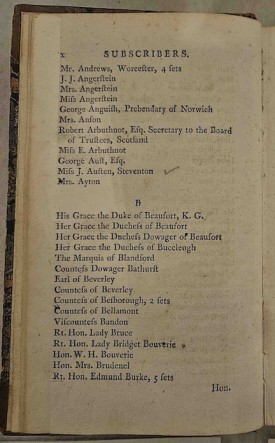
Camilla: or, a Picture of Youth, by Frances Burney (London: T. Payne et. al., 1796). Chawton House. Gift of Juliet McMaster.
(Click here to see a larger version.)
Cecilia, or Memoirs of an Heiress traces the problems of inheriting wealth. When Cecilia’s uncle dies, she inherits a large fortune, but with a catch: she must marry a man who will take her surname. The closing pages famously repeat the words “PRIDE AND PREJUDICE”—a phrase that clearly lingered in the mind of one young admirer. Cecilia is a pleasurable read for fans of heiresses with unsuitable guardians, and of dissipated London life. Frances Burney’s third novel, Camilla, was the first place where Jane Austen’s name appeared in print. At twenty-one, Austen liked Burney’s work enough to pay for the novel in advance, and her name appears in the subscription list as “Miss J. Austen, Steventon.” This rather sprawling novel will satisfy readers who enjoy the disasters of miscommunication or are interested in the perils of shopping without a chaperone.
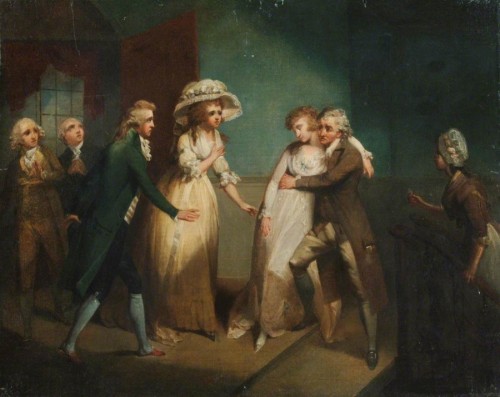
Camilla Fainting in the Arms of Her Father, by Henry Singleton (date unknown). Chawton House, Acc. No. 10395.
Ann Radcliffe (9 July 1764–7 February 1823)
Ann Radcliffe pioneered gothic literature and was recognized by Walter Scott as the founder of the genre. When Radcliffe stopped publishing after The Italian (1797), her retirement led to speculation and gossip. Claims circulated that she had been confined to an asylum because of her vivid imagination, that she had died, and even that she had been captured as a spy in Paris. She was probably just satisfied with her impressive earnings. After her death, the Edinburgh Review perpetuated the false idea that she was a wholly reclusive figure, claiming: “she never appeared in public, nor mingled in private society, but kept herself apart, like the sweet bird that sings its solitary notes, shrouded and unseen.”
The Mysteries of Udolpho became the defining gothic novel of its age, inspiring writers from Jane Austen to Mary Shelley. Orphaned heroine Emily St. Aubert is victimized by her brooding villain of an uncle, Montoni, who imprisons her and his wife in his crumbling castle. Emily’s father instructs her that a “well-informed mind is the best security against the contagion of folly and of vice,” and the novel tests characters’ resolve. Perfect for readers who enjoy fainting, melancholy landscapes, and terrifying things behind black veils.
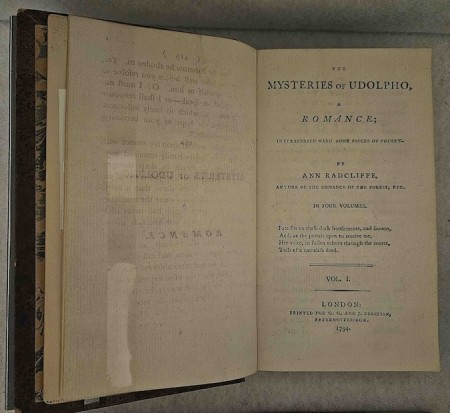
The Mysteries of Udolpho, by Ann Radcliffe (London: G. G. & J. Robinson, 1794). Chawton House, Acc. No. 602. (Click here to see a larger version.)
Regina Maria Roche
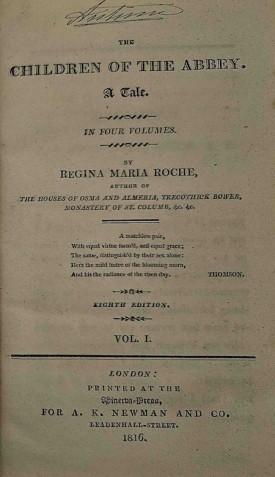
The Children of the Abbey, by Regina Maria Roche (London: Minerva Press, 1816). Chawton House, Acc. No. 5009.
(Click here to see a larger version.)
Pictured here is the eighth edition of The Children of the Abbey, Regina Maria Roche’s popular 1796 novel about siblings defrauded of their inheritance by a forged will. It was reprinted over eighty times in the nineteenth century, with American editions and French, Dutch, German, and Spanish translations. It is favored by Harriet Smith in Jane Austen’s Emma, and she recommends it to Robert Martin. Roche wrote another eleven Minerva Press novels.
Mary Brunton (1 November 1778–19 December 1818)
Like Jane Austen, Brunton published her first novel, Self Control, in 1811. While waiting for Sense and Sensibility to get through the press, Jane Austen wrote from London to Cassandra at Godmersham: “We have tried to get Self-controul, but in vain.—I should like to know what her Estimate is—but am always half afraid of finding a clever novel too clever—& of finding my own story & my own people all forestalled” (30 April 1811). Two years later, she read the Godmersham copy, writing to Cassandra: “I am looking over Self Control again, & my opinion is confirmed of its’ being an excellently-meant, elegantly-written Work, without anything of Nature or Probability in it” (11–12 October 1813).
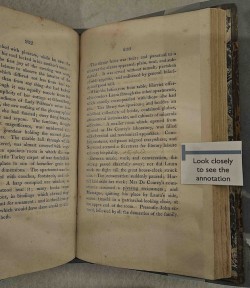
Self Control, by Mary Brunton (London: Longman et al., 1811). Knight Collection, Acc. No. 8973/K102.
(Click here to see a larger version.)
This copy of Self Control is the very one that Austen read while at Godmersham, her brother Edward Knight’s estate. Its heroine, Laura Montreville, spends the whole novel resisting the attentions of creepy Colonel Hargrave, who eventually abducts her. She then fakes her own death, escaping in a canoe. The family annotations dismiss passages as “foolish,” “dry,” and “stupid,” but we think this novel will please readers who like to see villainous libertines defeated by virtue.
Brunton died at forty, having given birth to a stillborn son twelve days earlier, and having published two novels: Self Control and Discipline (1814). She worried about being a woman writer, writing in a letter to a friend: “I would rather . . . glide through the world unknown, than have (I will not call it enjoy) fame . . . to be pointed at,—to be noticed and commented upon—to be suspected of literary airs—to be shunned . . . and abhorred as literary women are . . .—my dear, I would sooner exhibit as a rope dancer.”
Mary Wollstonecraft
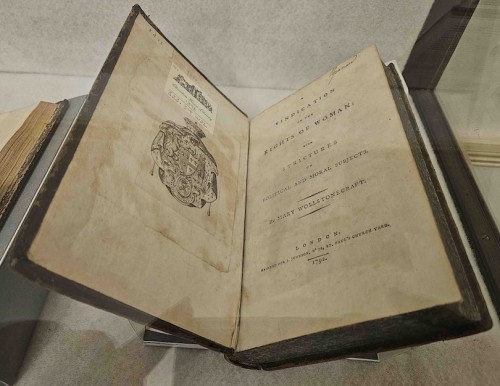
A Vindication of the Rights of Woman, by Mary Wollstonecraft (London: J. Johnson, 1792). Chawton House, Acc. No. 1396. Click here to see a larger version.)
There is no direct proof that Jane Austen read Mary Wollstonecraft’s famed A Vindication of the Rights of Woman. Austen’s work, however, echoes the debates of her time about women’s education. Wollstonecraft argues that women should have rational educations that equip them to be companions and partners in marriage, and good mothers and educators of their children, rather than simply becoming pretty and accomplished trophies.

Our reading recommendations
The following pairings recommend lesser-known writers in our collection, pairing each of Jane Austen’s six novels with a “sister novel” that either influenced Austen or explores similar themes.
Sisters and spouses: Sense and Sensibility and Pride and Prejudice
Jane Austen’s first published novel, Sense and Sensibility (1811), introduces two very different sisters. Elinor is calm, rational, and reserved; Marianne is passionate, impulsive, and idealistic.
Elinor . . . had an excellent heart;—her disposition was affectionate, and her feelings were strong; but she knew how to govern them. . . .
Marianne’s abilities were, in many respects, quite equal to Elinor’s. She was sensible and clever; but eager in every thing; her sorrows, her joys, could have no moderation. She was generous, amiable, interesting: she was everything but prudent. (7)
In the end, we see the depth of Elinor’s feeling, while Marianne makes a sensible marriage decision. If you enjoy Sense and Sensibility, you might like Jane West’s A Gossip’s Story (1796). Imagine if Marianne had married Willoughby, and Elinor had married Brandon. This is the plot of West’s novel, which also follows sisters with opposing natures. Sentimental Marianne chooses to marry the passionate Mr. Clermont, with disastrous consequences. Though much more overtly moralistic, West’s novel shares Austen’s critique of excessive sensibility and offers sharp, ironic commentary that still entertains modern readers.
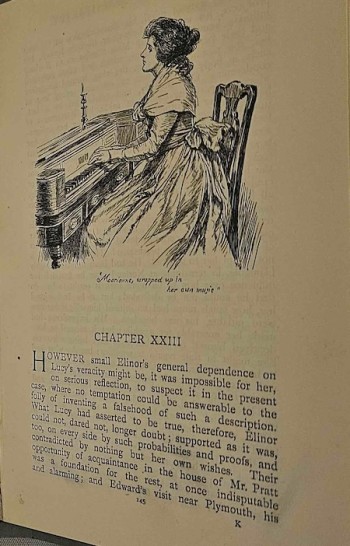
Sense and Sensibility (London: George Allen, 1899). Chawton House, Acc. No. 13857. Gift of Marion Makinson. |
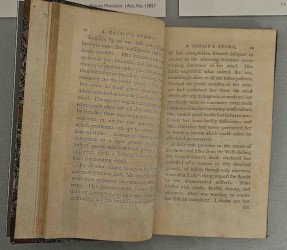
A Gossip’s Story, by Jane West (London: T. N. Longman, 1796). Chawton House, Acc. No. 757. |
This copy of A Gossip’s Story is open at West’s description of sisters Louisa and Marianne, who bear similarities to Austen’s Elinor and Marianne. Austen clearly knew West’s work, writing admiringly of her capacity to write despite “all her family cares” (8–9 September 1816). In an earlier letter to her niece Anna, she is more comically dismissive: “I think I can be stout against any thing written by Mrs West (28 September 1814). Mrs West's last novel, Ringrove; or, Old-Fashioned Notions (1827), bears similarities to Austen’s Emma.
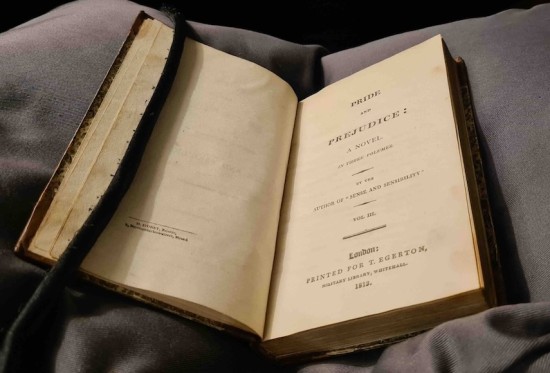
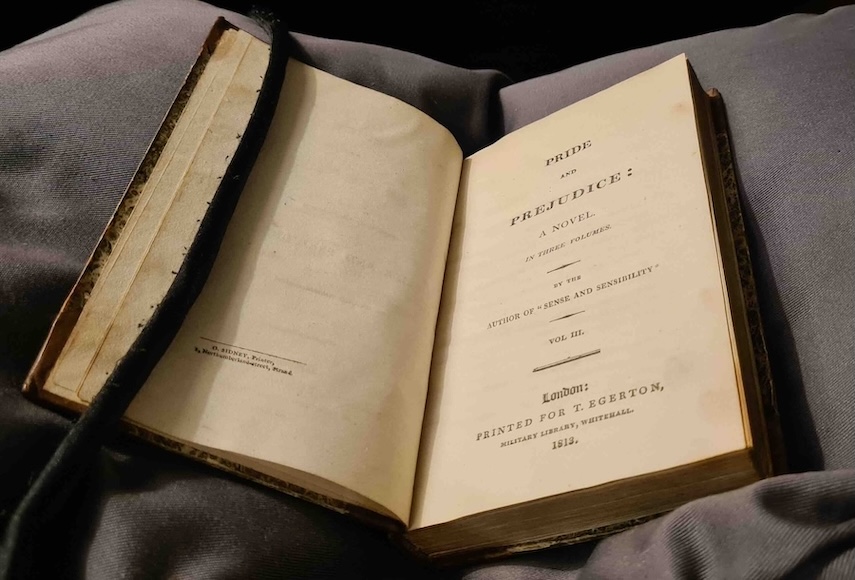
Pride and Prejudice, by Jane Austen (1st ed. London: T. Egerton, 1813). On loan from a private collector. (Click here to see a larger version.)
Pride and Prejudice (1813) pits the wit and independence of its heroine, Elizabeth, against the pride and reserve of the hero, Mr. Darcy. Both come to understand that first impressions can be misleading, and their match is one of intellectual equals. If you enjoy Austen’s novel, try Susan Ferrier’s Marriage (1818). Lady Juliana’s twin daughters grow up in very different worlds—Adelaide in high society, Mary in remote Scotland. Reunited with her cold mother in Bath, Mary navigates snobbery and suitors with gentleness and integrity. Ferrier’s novel explores marriage in many forms, ultimately rewarding its heroine with a partnership of equals. Along the way, expect a litany of embarrassing relatives, and a keen interest in how class pretensions and the marriage market affect women.
Compare Austen and Ferrier:
“I had not known you a month before I felt that you were the last man in the world whom I could ever be prevailed on to marry.”
—Elizabeth Bennet, in response to Mr. Darcy’s proposal (215)“I am only resolved to act in that manner, which will, in my own opinion, constitute my happiness, without reference to you.”
—Elizabeth Bennet, standing up to Lady Catherine (396)
“There’s no talking to a young woman now about marriage, but she is all in a blaze about hearts, and darts. . . . I’ll suffer no daughter of mine to play the fool with her heart.”
—Lord Courtland, to his daughter, who elopes soon after“Heath covered hills and high cheek-bones are the charms that must win my heart.”
—Mary Douglas, the heroine
Marriage, by Susan Ferrier (London: William Blackwood & John Murray, 1818). Chawton House, Acc. No. 7797. |
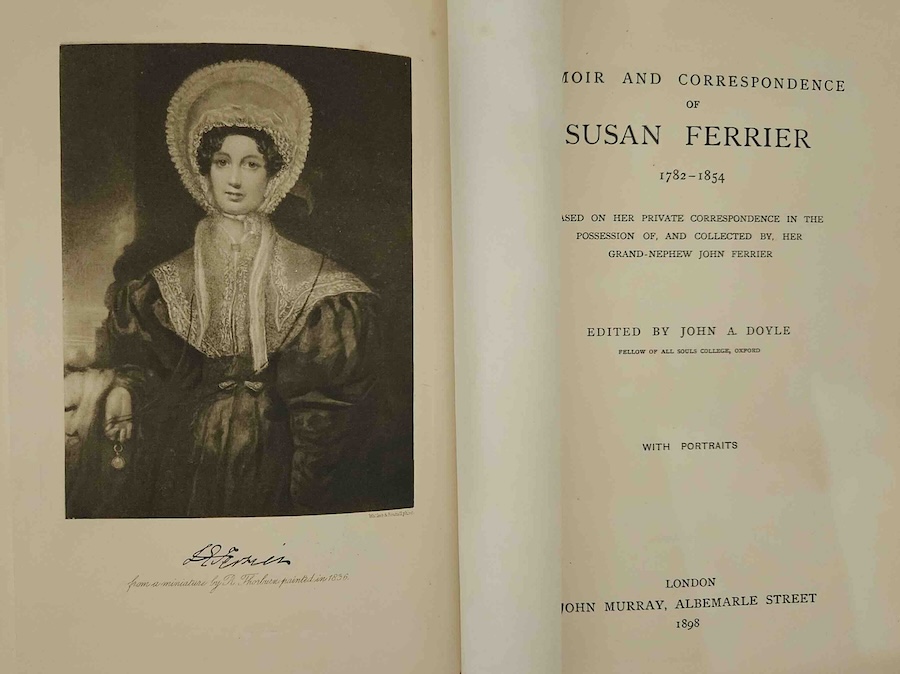
Memoir and Correspondence of Susan Ferrier, edited by John Doyle (London: John Murray, 1898). Chawton House, Acc. No. 1172. |
Like Jane Austen, Susan Ferrier did not publish under her own name, declaring that “I will never avow myself. . . . I could not bear the fuss of authorism!” Her brother undertook negotiations with her publisher, John Murray, who also published Austen’s last four novels. She was paid £150 for Marriage, but her third novel earned her over ten times that amount: £1,700.
Introverts and extroverts: Mansfield Park and Emma
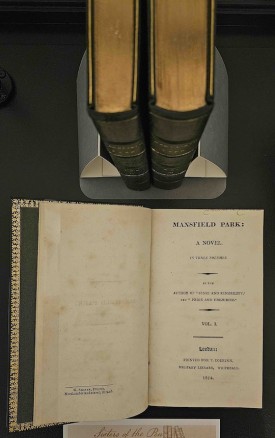
Mansfield Park, by Jane Austen (1st ed. London: T. Egerton, 1814). Chawton House, Acc. No. 9904. Gift of Sandra Clark.
(Click here to see a larger version.)
Mansfield Park (1814) is often seen as Jane Austen’s most challenging novel, in part because of her introverted heroine, Fanny Price. Raised by wealthy relatives, she remains an outsider, neglected by all except her cousin Edmund. The arrival of the lively Crawfords disrupts life at Mansfield, challenging Fanny’s moral steadfastness as the modern and the traditional clash.
The first-edition print run of 1,250 copies of Mansfield Park sold out in six months. Although it was not reviewed by the critics, Austen kept a list of opinions from friends and family that survives in manuscript form. In 1815 she changed her publisher from Thomas Egerton to John Murray, for the second edition of Mansfield Park and a new novel, Emma. Her brother Henry assisted in the negotiations.
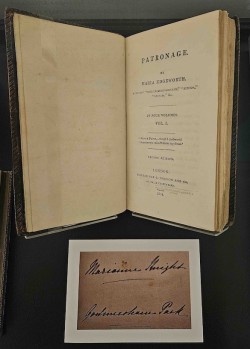
Patronage, by Maria Edgeworth (London: Baldwin & Cradock, 1833). Knight Collection, Acc. No. 9451/K104.
(Click here to see a larger version.)
Maria Edgeworth’s Patronage, published in 1814, a few months earlier than Mansfield Park, follows the worthy Percy family, who are displaced by their scheming relatives, the Falconers. Both novels feature alluring musical performances and amateur theatricals that work to reveal character, especially through virtuous refusals to perform. Patronage champions quiet merit and perseverance in adversity, echoing Austen’s own concern with integrity in the face of shifting social values—including the skepticism of some characters toward life in the country: “the only possible way to make the country supportable was to have a large party of town friends in your house.”
Patronage was Edgeworth’s longest novel. It sold 8,000 copies on the first day of publication, and Edgeworth was paid a hefty £2,100 for it. This copy of Patronage belonged to Marianne Knight, one of Edward’s daughters.
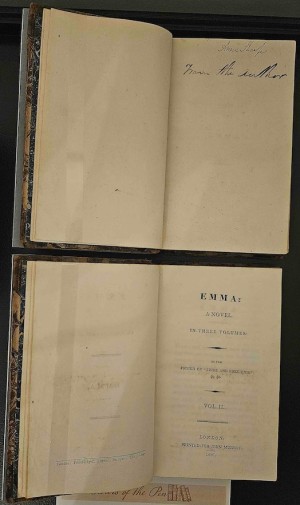
Emma, by Jane Austen (1st ed. London: John Murray, 1816). On loan from a private collector. |
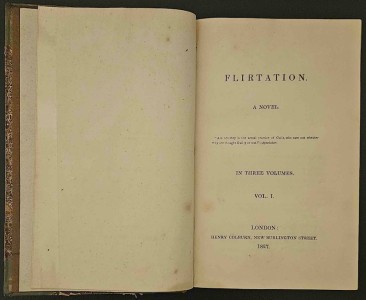
Flirtation, by Lady Charlotte Bury (London: Henry Colburn, 1827). Chawton House, Acc. No. 7770. |
According to her nephew James Edward Austen-Leigh, in writing Emma (1816), Jane Austen was famously aware of creating “a heroine whom no one but myself will much like” (119). Emma’s matchmaking and speculation have potentially disastrous consequences for those around her. Because she is so busy with everybody else’s affairs, Emma herself remains unaware, until the final pages, of the state of her own heart. One of twelve presentation copies given as gifts to friends and family, Jane Austen sent the copy pictured here to Anne Sharp, a former governess to her niece Fanny Knight. Why Anne? The two met at Godmersham. Both intelligent writers, they became firm friends. Of all Austen’s novels, Emma shows the most awareness of the position of the governess, with Emma’s governess, Anne Taylor, enjoying an unusual fate: a happy marriage to Mr. Weston after sixteen years of service to the Woodhouse family.
In 1820, Lady Charlotte Bury received a letter praising Emma as “a very capital performance.” Born the same year as Austen, the former lady-in-waiting published prolifically, writing what became known as “silver fork” novels. These focused on high society, as opposed to Jane Austen’s “3 or 4 Families in a Country Village” (9–18 September 1814). We recommend Lady Charlotte Bury’s Flirtation (1827) for readers interested in the dangers of an activity that, as in Emma, often leads to misunderstandings. In Flirtation, worldly Frances deliberately and dangerously toys with men, even after she is married, claiming, “a man of fashion would not endure his wife if nobody else flirted with her.” Frances links flirtation and reading: “When I read . . . , I read for pleasure: I like Lord Byron.” Although never physically consummated, her transgression has fatal consequences.
Readers and wanderers: Northanger Abbey and Persuasion
Northanger Abbey (1818) explores how reading shapes our understanding of the world. Naïve Catherine Morland, fond of gothic novels, reconfigures her mundane reality into a gothic adventure, casting her host, General Tilney, as the quintessential gothic villain, who has likely murdered his wife. The novel playfully suggests seven “‘horrid’” novels for readers, a list provided by Isabella Thorpe (33). Although published after her death, Northanger Abbey was the first novel that Jane Austen completed. Initially called Susan, it was accepted for publication by Benjamin Crosby in 1803, but he then failed to publish it, and Austen could not buy back the £10 copyright until thirteen years later. By the time Northanger Abbey was published, the gothic craze of the 1790s was in decline, giving rise to similar parodies such as Thomas Love Peacock’s Nightmare Abbey (1818).
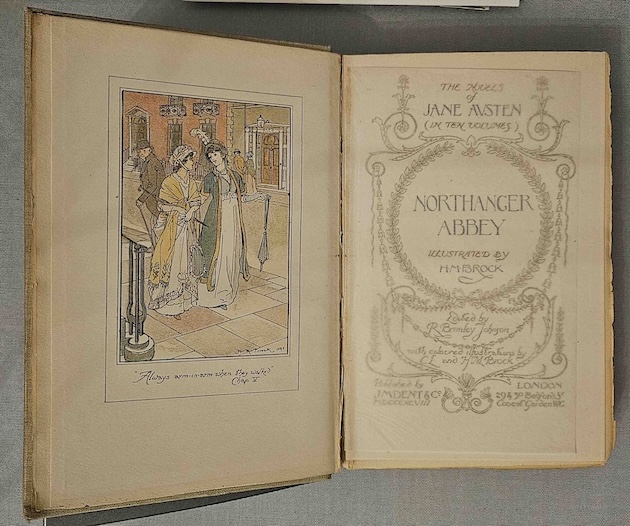
Northanger Abbey, by Jane Austen (London: J. M. Dent & Co., 1898). Chawton House, Acc. No. 13638. |
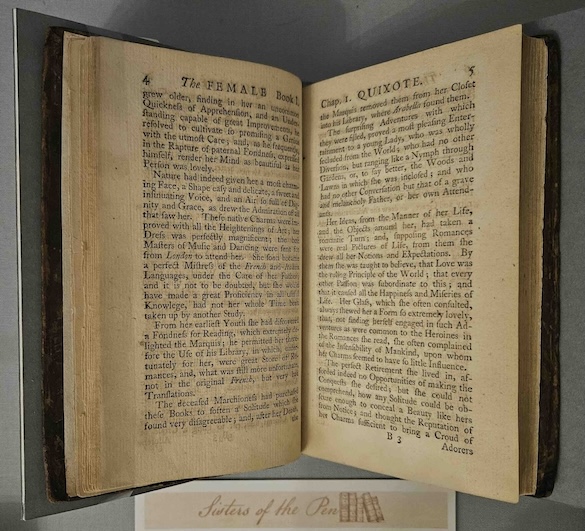
The Female Quixote; or, the Adventures of Arabella, by Charlotte Lennox (London: A. Millar, 1752). Chawton House, Acc. No. 456. |
Our recommendation is an earlier influence on Jane Austen: Charlotte Lennox’s The Female Quixote (1752), in which Arabella, a lover of seventeenth-century romances—full of chivalry, heroism, and heroes ready to die for a single glance from their beloved—misreads reality in similar ways. Our heroine, Arabella, tries to live by the absurd rules of French romances, mistaking ordinary suitors for kidnappers and polite gestures for declarations of eternal love. Lennox’s novel was immensely popular, enjoyed by the Austen family and by Frances Burney, who wrote of Lennox, “I think all her Novels for the best of any Living Author.”
Both Lennox’s and Austen’s heroines are gently mocked, yet both are also somewhat vindicated. Arabella’s rigid ideals are rewarded, while Catherine’s instincts about General Tilney prove partly right, when he cruelly expels her from Northanger Abbey upon learning she is not an heiress.
Austen’s Persuasion (1818) is a quiet, introspective novel about second chances. The heroine, dutiful Anne Elliot, is undervalued by her vain family and regrets the choice she made to break off her engagement with Frederick Wentworth years earlier. Displaced from her family home, she suffers in fashionable Bath, but finds solace in the evocative seaside resort of Lyme Regis.
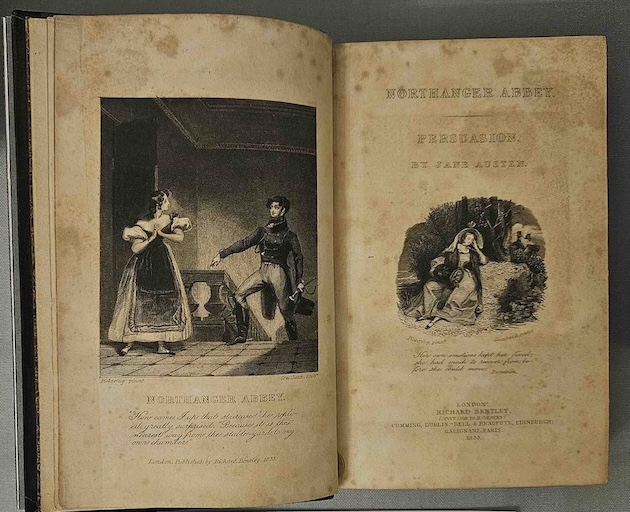
Persuasion, by Jane Austen (London: Richard Bentley, 1833). Chawton House, Acc. No. 13170. (Click here to see a larger version.) |
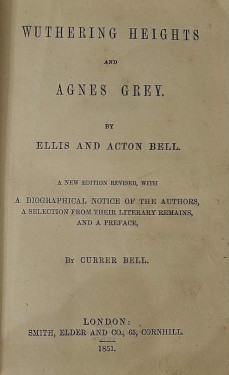
Agnes Grey, by Anne Brontë (London: Smith, Elder & Co., 1851). Chawton House, Acc. No. 13823. (Click here to see a larger version.) |
If you like Persuasion, try a later novel, Anne Brontë’s Agnes Grey (1847), published alongside Emily Brontë’s darker and more violent novel, Wuthering Heights. Like Persuasion, Agnes Grey depicts an overlooked heroine navigating a selfish world. And as in Persuasion, the coast becomes a place of renewal and the possibility of new beginnings. Working as a governess, Agnes is invisible to all but the gentle curate, Mr. Weston. Their slow courtship is full of touching moments that show Weston’s attentiveness. The couple is forced apart when Agnes’s employment ends, leaving Agnes uncertain if they will meet again.
Compare Austen’s and Bronte’s heroes:
“I can listen no longer in silence. I must speak to you by such means as are within my reach. You pierce my soul. I am half agony, half hope. Tell me not that I am too late, that such precious feelings are gone for ever. I offer myself to you again with a heart even more your own, than when you almost broke it eight years and a half ago. Dare not say that man forgets sooner than woman, that his love has an earlier death. I have loved none but you.”
—Frederick Wentworth to Anne Elliot (257–58)“You must have known that it was not my way to flatter and talk soft nonsense, or even to speak the admiration that I felt; and that a single word or glance of mine meant more than the honeyed phrases and fervent protestations of most other men.”
—Edward Weston to Agnes Grey
Earning power
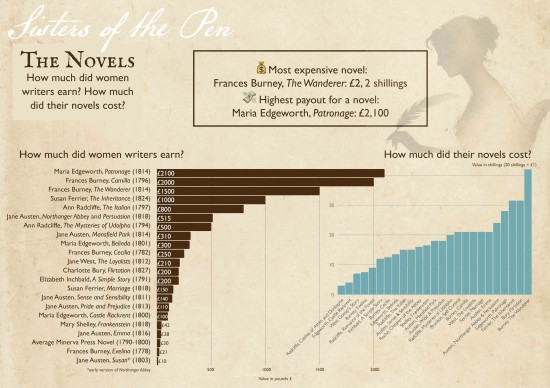
Our infographic on women’s novels gives a sense of how much purchasers were expected to pay for novels, but also how much women writers earned. While Maria Edgeworth, Frances Burney, and Ann Radcliffe made more than enough to live on, a career as a writer was not a feasible financial option for many women writers, with Minerva Press novelists earning around £30 per novel. Jane Austen is at the bottom, with a payment of just £10 for the early version of Northanger Abbey, Susan, which the publisher failed to release. Also low on the list is Mary Shelley’s Frankenstein, despite its being the most frequently adapted novel by a woman from this period.
Part II: The theatre
“The best gifts of the comic muse”: Drama in the drawing room
Today we tend to see novel writing and playwriting as very distinct occupations, but in the eighteenth and nineteenth centuries there was a great deal of traffic between page and stage. Women dating back to Aphra Behn in the 1680s, and including Elizabeth Inchbald in the Georgian period, wrote both plays and novels.
On a structural level, elements of drama such as immediacy, dialogue, character direction, and the creation of scenes all influenced the developing form of the novel. The theatre became a setting and a plot device in novels. Characters visit the theatre or bring the theatre into their own homes in private theatricals.
Jane Austen particularly loved comedy, incorporating strategies of parody and caricature learned from the stage in her anarchic earliest works, written between the ages of eleven and seventeen. These include three mini-plays: The Visit (a dinner-table farce with multiple marriage proposals); The Mystery (in which the mystery is never disclosed); and The first Act of a Comedy (many musical interludes and one stinking partridge). Later, she and a niece comically reworked a favorite seven-volume novel, Samuel Richardson’s Sir Charles Grandison (1753–54), into a short five-act play.
“An itch for acting”: Plays at home
Private theatricals became very popular in the second half of the eighteenth century. For the gentry, plays were rehearsed and performed within family or small neighboring circles. Putting on a play was a sociable activity; the preparation was at least as important as the performance, enabling close collaboration between participants.
Jane Austen took part in private theatricals from an early age. Her older brother James took the lead in staging family plays at Steventon from 1782 to 1789, some of which took place in the rectory barn. These included plays by David Garrick and Richard Brinsley Sheridan, but also works by female playwrights such as Susanna Centlivre and Hannah Cowley. As she matured, Austen shared this early love with younger female relatives. At Godmersham in 1805, she acted alongside her nieces Fanny and Anna in plays likely written by Fanny’s governess at that time, Anne Sharp. These early experiences gave Austen the raw material for one of the most well-known descriptions of a private family theatrical—the staging of Lovers’ Vows in Mansfield Park.
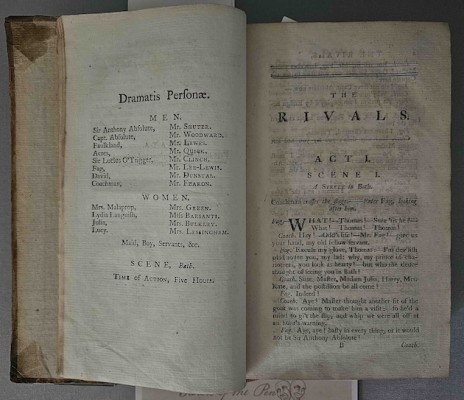
The Rivals, by Richard Brinsley Sheridan (London: John Wilkie, 1775). Chawton House, Acc. No. 6115. (Click here to see a larger version.)
Set in Bath, the satirical play The Rivals follows the romance between Lydia Languish, whose love of novels has made her long for romance and adventure, and Jack, who pretends to be a poor army officer to meet her romantic expectations. It was one of the earlier choices for performance by the Austens at Steventon, and a key influence on Austen’s writing.
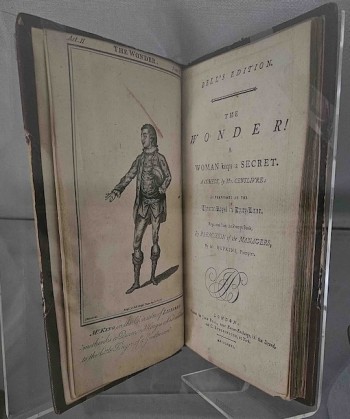
The Wonder! A Woman Keeps a Secret, by Susanna Centlivre (London: John Bell, 1776). Chawton House, Acc. No. 856. |
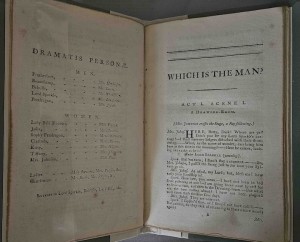
Which is the Man?, by Hannah Cowley (London: C. Dilly, 1784). Chawton House, Acc. No. 865. |
For Christmas 1787, the Austens’ glamorous cousin Eliza de Feuillide came to stay, and they put on Susanna Centilivre’s 1714 play, The Wonder! A Woman Keeps a Secret. In it, two young women thwart the plans of their fathers—a nunnery for one, and marriage to an elderly suitor for the other. Interactions between Eliza and Henry Austen may have informed Jane Austen’s later depictions of amateur theatricals. Hannah Cowley’s Which is the Man? was considered but not chosen for performance during the Steventon Christmas theatricals. In that play, two sisters fall for the same man. Eliza had wanted to play the character of the witty and outspoken Lady Bell Bloomer, a widow just about to marry once more. Cowley wrote fifteen plays in her lifetime, including her most famous, The Belle’s Stratagem (1780), which Austen also knew.
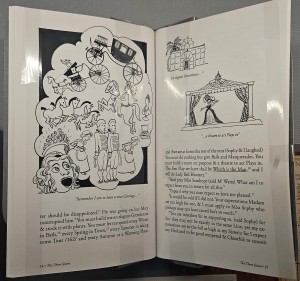
The Three Sisters, in Three Mini-Dramas by Jane Austen, edited by Juliet McMaster (Sydney: Juvenilia Press, 2006). Chawton House, Acc. No. 8751. |
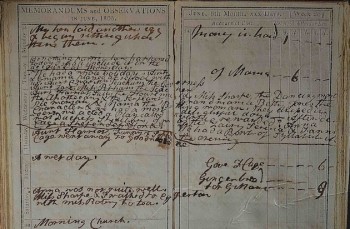
Fanny Knight’s Diary. Facsimile. Reproduced with the permission of Kent Archive Service. U951/F24/2. |
In Austen’s short comic piece The Three Sisters, written when she was around sixteen, Mary Stanhope works through her marriage settlement with her betrothed, Mr. Watts (“so plain that I cannot bear to look at him” [J 74]). Her ridiculous demands include a phaeton, a greenhouse, and a private theatre, where she can perform as Lady Bell Bloomer in Which is the Man?—just as Eliza had hoped to.
Edward Austen’s eldest daughter, Fanny (then still Fanny Austen), wrote about the acting games and theatricals that took place when Jane Austen visited in summer 1805. Cassandra, Jane, and their mother played at school with their nieces Fanny and Anna (James Austen’s elder daughter, also visiting), with the Godmersham governess, Anne Sharp, taking on the male roles and probably also writing the script. The second play Fanny mentions, Virtue Rewarded, was also likely written by Anne Sharp. Fanny Cage was a cousin on the other side of Fanny’s family.
Aunts and Grandmama played at school with us. Aunt C was Mrs Teachum the Governess, Aunt Jane, Miss Popham the teacher, . . . Miss Sharpe the Dancing Master the Apothecary and the Serjeant. . . . They dressed in Character and we had a most delightful day.—After dessert we acted a play called Virtue Rewarded. Anna was the Duchess St Albans, I was the Fairy Serena and Fanny Cage a shepherdess ‘Mona.’ We had a bowl of Syllabub in the evening. (Godmersham, Wednesday 26 June 1805)
A family performance: Jane and Anna’s Grandison
The manuscript play displayed at the center of the exhibition is one of the star items in the Chawton House collection. Unseen until 1977, it captures a collaboration between Jane Austen and her niece Anna. They adapted Samuel Richardson’s lengthy novel into a five-act play, likely planned for a family performance.
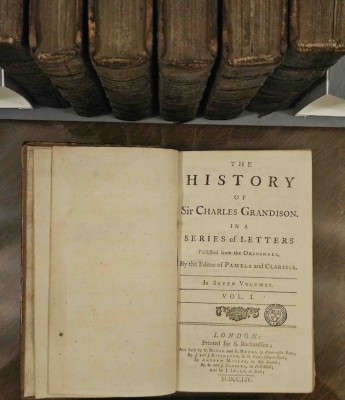
The History of Sir Charles Grandison, by Samuel Richardson (London: S. Richardson, 1754). Chawton House, Acc. No. 990.
(Click here to see a larger version.)
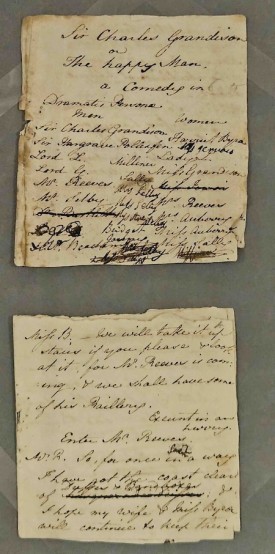
Sir Charles Grandison or the Happy Man, by Jane Austen and Anna Austen (c. 1791–1805). Chawton House, Acc. No. 792. (Click here to see a larger version.)
Early family biographies note that Sir Charles Grandison was one of Jane Austen’s favorite novels. Lengthy even by eighteenth-century standards, it aims to illustrate male virtue. When the heroine, Harriet Byron, is abducted by the rakish Sir Hargrave Pollexfen, she is rescued by Grandison. Although they are in love, he feels himself bound to an Italian woman, Signorina Clementina della Porretta. Many volumes later, Clementina refuses him, leaving him free to marry Harriet.
There is no consensus on the date of the play’s manuscript. Some scholars suggest that it was first drafted by Jane Austen as a teenager in 1791–92. A second part, which can be dated by the watermark on the paper, was likely written in 1800, when Anna was seven and Jane twenty-five. Others suggest that the first act is Anna’s alone and that it was written between 1803 and 1805. The play focuses on the character of the heroine, Harriet Byron. In Act 1, she goes missing after the masquerade. Act 2 shows the wicked Sir Hargrave Pollexfen attempting to force her into marriage. In Acts 3 and 4, after her rescue by Sir Charles, she meets his family, including his lively sister, Charlotte. Act 5 resolves the action with a double wedding. This manuscript offers a rare glimpse of the Austen family’s vibrant literary life.
This reduction of Richardson’s seven-volume novel to a five-act play is the only literary manuscript in Jane Austen’s hand that remains entirely unchanged from when it was first written, still containing the pins (most likely Austen’s dress pins) used to hold it together. It is clearly a working document created to aid performance, and it contains deletions and revisions. Rather than Jane Austen’s polished genius, we see here messy drafting, improvisation, and collaboration.
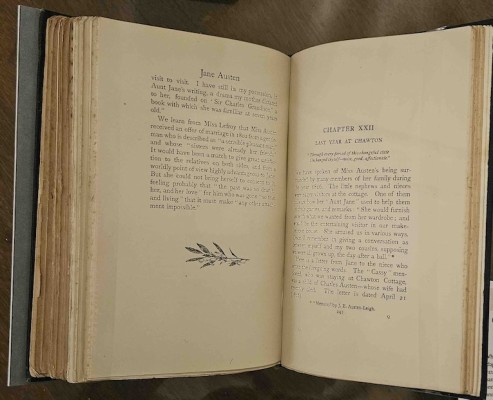
Jane Austen: Her Homes & Her Friends, by Constance Hill (London: John Lane, 1902). Chawton House, Acc. No. 50. Click here to see a larger version.)
While Jane Austen is the scribe of the Grandison adaptation, Austen family tradition reports that the play was dictated to Jane by her niece Anna (later Lefroy). The manuscript—and this story of its authorship—is first mentioned here in the recollections of Anna’s daughter Fanny Caroline Lefroy, recorded in 1902 by Constance Hill.
“Good hardened real acting”: At the theatre
Playgoing was a popular pastime in Regency London. In 1814, box seats at Drury Lane cost six shillings, but the cheapest tickets were just one shilling. A night out included a five-act play and a farce. Theatre was a site of celebrity. Stars who gained fame in the eighteenth century, such as Sarah Siddons and Dora Jordan gave way to new names such as Edmund Kean and Eliza O’Neill. Theatre criticism flourished in newspapers and magazines, giving rise to edited collections of plays like Elizabeth Inchbald’s impressive twenty-five-volume compendium, The British Theatre, which includes her comments on each play.
Beyond Covent Garden, Drury Lane, and the Haymarket, smaller theatres flourished. The theatre craze reached beyond London. The provinces were lively hubs, feeding talent to the capital while hosting touring stars. Jane Austen, far from isolated in the countryside, was an avid theatregoer in Bath, Southampton, and London, visiting with brothers Henry and Edward and niece Fanny. Her letters speak of favorite actors and knowingly assess performances, while her novels reveal a deep knowledge of the theatrical world.
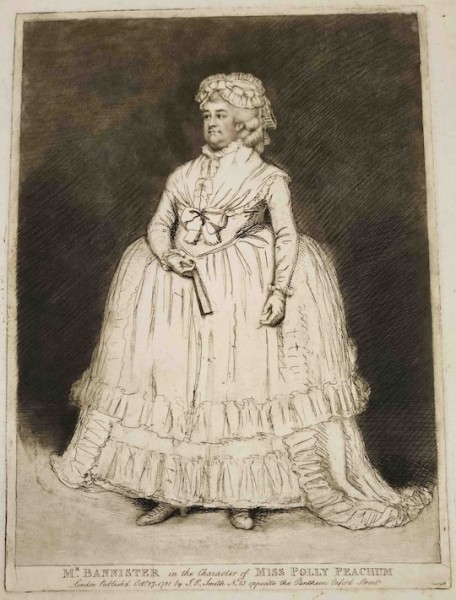
Mr Bannister in the Character of Miss Polly Peachum (1781). Chawton House, Deirdre Le Faye Archive DLF/P/003.(Click here to see a larger version.)
John Bannister (1760–1836) was a hugely popular comedian. Austen saw him perform in Southampton in September 1807.
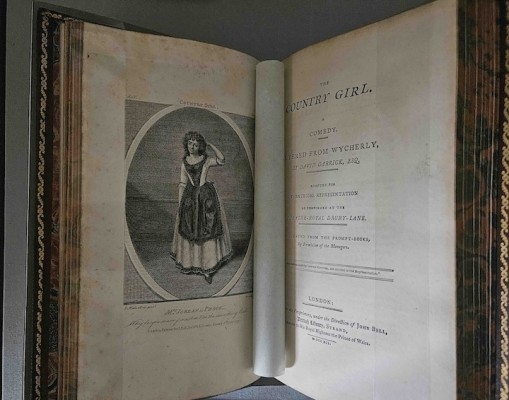
The Country Girl in Bell’s British Theatre, Vol. 13, by David Garrick, edited by John Bell (London: George Cawthorn, 1797). Chawton House, Acc. No. 103.
(Click here to see a larger version.)
The frontispiece to David Garrick’s play The Country Girl depicts leading comic actress Dora Jordan. Jordan came from lowly origins but became mistress to the Duke of Clarence, who became King William IV after her death.
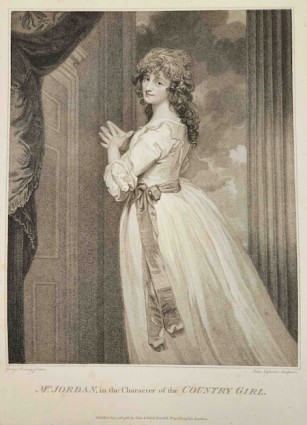
Mrs. Jordan in the Character of the Country Girl (1788), by John Ogborne, after George Romney. Chawton House, Deirdre Le Faye Archive DLF/P/002. |
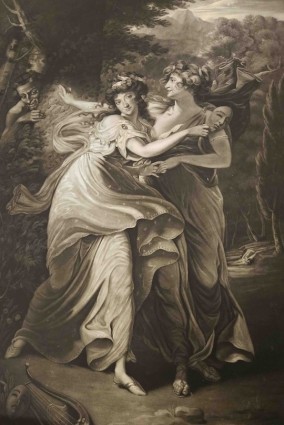
Mrs. Jordan in the Character of the Comic Muse; supported by Euphrosyne, who represses the Advances of a Satyr (1787), by T. Park, after John Hoppner. Chawton House, Deirdre Le Faye Archive DLF/P/001. |
The female lead in The Country Girl was a “breeches” role, in which women dressed in male clothing on stage. Dora Jordan played the role of Peggy for fifteen seasons, between 1785 and 1800. Jane Austen saw Dora Jordan perform in The Devil to Pay in London in 1814.
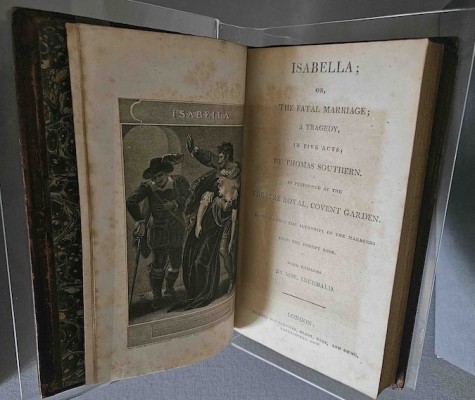
Isabella; or, the Fatal Marriage in The British Theatre, Vol. 7, by David Garrick, edited by Elizabeth Inchbald (London: Longman et al., 1808). Chawton House, Acc. No. 11957. Gift of Isobel Grundy. (Click here to see a larger version.)
The tragedy Isabella; or, the Fatal Marriage, revived by David Garrick from an earlier play, Thomas Southerne’s The Fatal Marriage; or The Innocent Adultery (1694), was likely the last play Jane Austen saw on the stage. Isabella marries again after her husband dies in war, only to discover that her first husband is still alive.
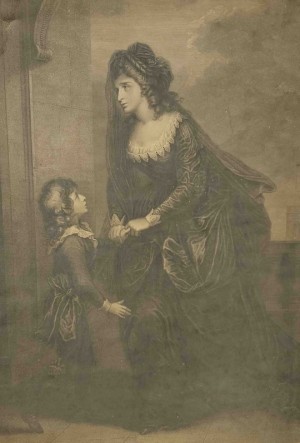
Miss Siddons and her Son in the Tragedy of Isabella (1785), by J. Caldwell, after William Hamilton. Reproduced from the Deirdre Le Faye Archive. |
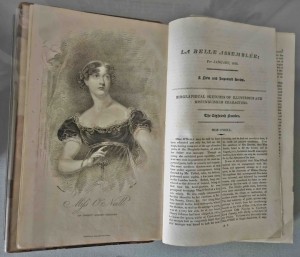
La Belle Assemblée, Vol. 12 (London: J. Bell, 1816). Chawton House. Gift of Mrs. Victoria Hinshaw. Acc. No. 8633. |
The role of Isabella was a reputation-maker, played first by Mary Ann Yates and then by her successor, Sarah Siddons. It was thought to be one of Siddons’s greatest roles. It was not, however, Sarah Siddons that Austen saw playing Isabella, but instead newcomer Eliza O’Neill, who was known as an actress who could move audiences to tears with her sensibility. Austen was not taken in, writing: “I do not think she was quite equal to my expectation. I fancy I want something more than can be. Acting seldom satisfies me. I took two Pocket handkerchiefs, but had very little occasion for either. She is an elegant creature however & hugs Mr Younge delightfully” (29 November 1814).
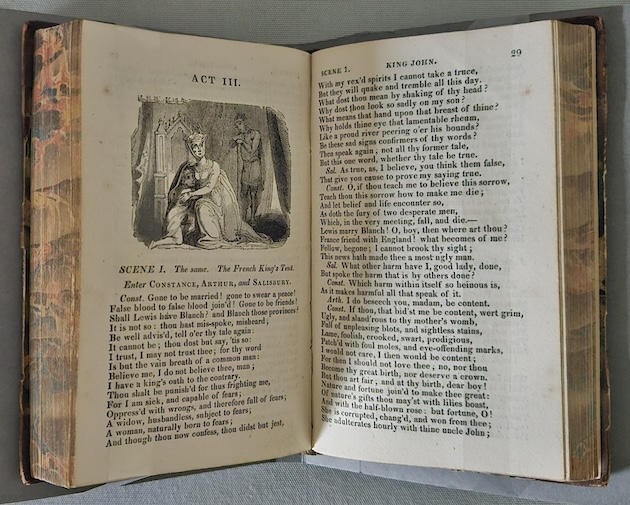
King John, in The Dramatic Works of William Shakespeare, Vol. 3 (London: C. Whittingham, 1818). Chawton House, Acc. No. 663. |
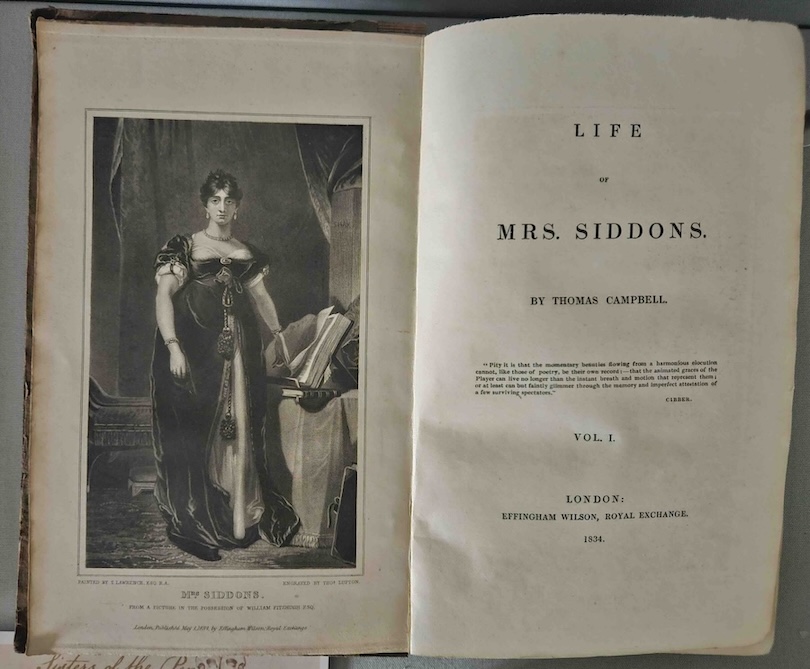
Life of Mrs. Siddons, by Thomas Campbell (London: Effingham Wilson, 1834). Chawton House, Acc. No. 6644. |
Jane Austen narrowly missed seeing Sarah Siddons perform in 1811. When Hamlet was scheduled instead of Shakespeare’s King John (in which she was famous for the role of Constance), they planned to see her in another acclaimed role, in Macbeth, instead. On hearing that she was unlikely to appear, they cancelled. Austen wrote to Cassandra, “I have no chance of seeing Mrs Siddons.—She did act on Monday. . . . I should particularly have liked seeing her in Constance, & could swear at her with little effort for disappointing me” (25 April 1811). Siddons was particularly known for the power of Constance’s grief over her son, Arthur.
Grief fills the room up of my absent child,
Lies in his bed, walks up and down with me,
Puts on his pretty looks, repeats his words
Remembers me of all his gracious parts,
Stuffs out his vacant garments with his form;
Then, have I reason to be fond of grief? (King John 3.3)
In comments on King John in her British Theatre collection, Elizabeth Inchbald notes the difficulty of the play for actors and praises Siddons for her “potent skill in the delineation of woe.”
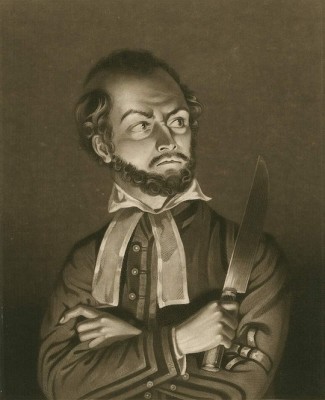
Edmund Kean as Shylock from the Merchant of Venice, by Henry Meyer, engraved from a painting by Walter Henry Watts (mid-1810s). (Click here to see a larger version.)
The actor that Jane Austen was most impressed by was Edmund Kean. She saw him perform as Shylock in The Merchant of Venice in 1814, writing to Cassandra, “it appeared to me as if there were no fault in him anywhere; & in his scene with Tubal there was exquisite acting” (5–8 March 1814).
Jane Austen and the stage
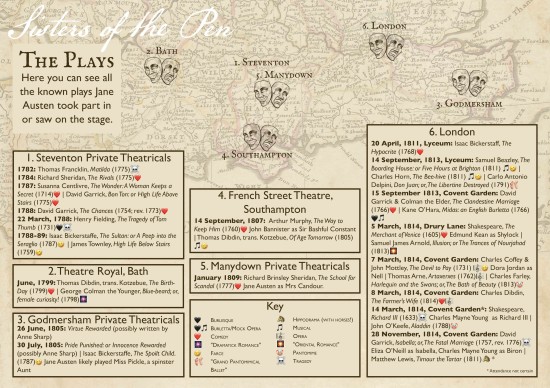
Our infographic on Jane Austen and the stage gathers all the plays that we know Jane Austen performed in for amateur theatricals or saw on the professional stage. It is necessarily incomplete, pieced together from remaining letters or the accounts of relatives such as her niece Fanny, but it gives a sense of Austen’s knowledge of the stage and the variety of performances she attended, from pantomime to tragedy.
“All the world’s a stage”: Lovers’ Vows
Lovers’ Vows is Elizabeth Inchbald’s 1798 adaptation of Kotzebue’s Das Kind der Liebe (The Child of Love, or The Natural Son). It was successful when staged at Covent Garden, despite (or because of) its provocative plot: Agatha is seduced and abandoned by Baron Wildenhaim, and bears his illegitimate son, Frederick. Years later, they reunite. A subplot follows the Baron’s daughter Amelia, who rejects a noble suitor in favor of her tutor, the poor Pastor Anhalt.
In Mansfield Park, when Sir Thomas Bertram leaves “for the better arrangement of his affairs” (36) on his plantation in Antigua, his children and ward are largely unsupervised. The arrival of the charming Crawford siblings and the enthusiastic Mr. Yates sparks a plan to stage a play. After much argument, they settle on Lovers’ Vows. Because Agatha has been seduced, and Amelia is alarmingly forthright about her feelings for Anhalt, Fanny Price concludes that they are “totally improper for home representation—. . . unfit to be expressed by any woman of modesty” (161). But the others relish the emotional outlet. Henry Crawford, playing Frederick, grows close to Maria Bertram, who plays Agatha, igniting a real-life affair. Edmund takes the role of Anhalt, opposite Mary Crawford’s Amelia, and Fanny is forced to watch the man she loves fall for another—on stage and off.
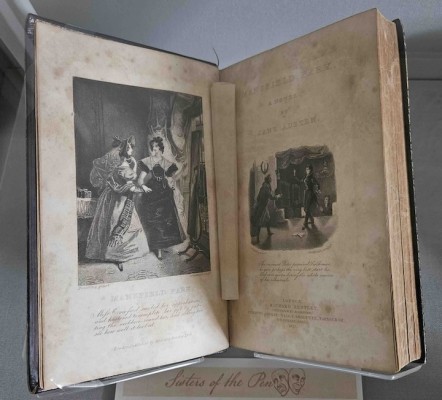
Mansfield Park, by Jane Austen (London: Richard Bentley, 1833). Chawton House, Acc. No. 13170. (Click here to see a larger version.)
Although the Mansfield Park theatricals raise some moral issues for the participants, Austen also underlines the comedy inherent in the situation. Sir Thomas’s unexpected arrival interrupts the first complete run-through, and he later stumbles into Mr. Yates’s rehearsal in the billiard room. Tom Bertram witnesses the scene:
His father’s looks of solemnity and amazement on this his first appearance on any stage, and the gradual metamorphosis of the impassioned Baron Wildenhaim into the well-bred and easy Mr. Yates, making his bow and apology to Sir Thomas Bertram, was such an exhibition, such a piece of true acting as he would not have lost upon any account. It would be the last—in all probability the last scene on that stage; but he was sure there could not be a finer. The house would close with the greatest eclat. (213–14)
Elizabeth Inchbald (15 October 1753–1 August 1821)
One of the few women in our collection to act on and write for the stage as well as to write novels, from an early age Elizabeth Simpson, despite a stammer, wanted to act. At eighteen, she went to London to pursue the stage, against her parents’ wishes. She first rejected—and then married—actor Joseph Inchbald, twice her age. Her debut role was as Cordelia to his King Lear. After Joseph’s sudden death, she drafted her first novel—though it wasn’t published for fourteen years. She eventually gave up acting to focus on her writing. Her 1784 play The Mogul Tale: or, the Descent of the Balloon marked the start of a prolific theatrical career, with over twenty plays to her name, many of them great successes. From 1787, under the pseudonym “The Muse,” she wrote for a periodical; she also wrote two novels, A Simple Story (1791) and Nature and Art (1796). Novelist Maria Edgeworth praised A Simple Story as the most affecting novel she had ever read. Scholars have suggested that Inchbald’s focus on the body in her novels is an export from her years as an actress—the dramatic making its way from stage to page. In 1806, she was commissioned to edit The British Theatre, a twenty-five-volume anthology of plays. Her introductory commentary on each play combined the insights of both an actress and a dramatist.
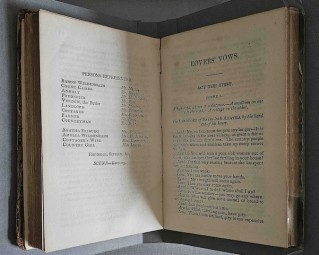
Lovers’ Vows, by Elizabeth Inchbald, in The British Theatre, Vol. 23, edited by Elizabeth Inchbald (London: Longman et al., 1808). On loan from a private collector. |
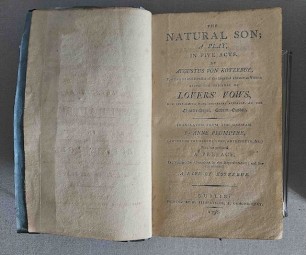
The Natural Son, by Anne Plumptre (Dublin: H. Fitzpatrick, 1798). Chawton House, Acc. No. 11114. |
After her early acting career, Inchbald had increasing success writing for the London stage. Responding to the public appetite for the German playwright Augustus von Kotzebue, in 1798 she adapted Lovers’ Vows to fit the tastes of English theatregoers. Anne Plumptre had been translating her own version of Kotzebue’s play Das Kind der Liebe when she realized that Inchbald was working on the same project. On attending the play, she noted the “Alterations and Omissions” that, to her, meant Inchbald’s translation did not “reflect the Mind, the Principles, and the Genius of Kotzebue.” She intended her own translation to right this wrong, presenting the play “in his own native garb.”
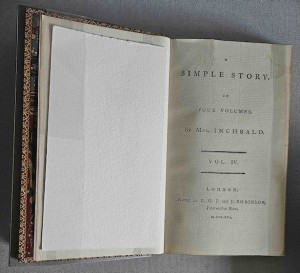
A Simple Story, by Elizabeth Inchbald (London: G. G. & J. Robinson, 1791). Chawton House, Acc. No. 385. |
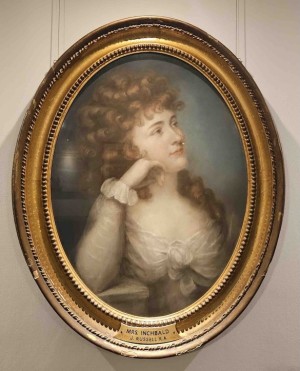
Elizabeth Inchbald, by John Russell, R.A. (mid-1780s). On loan from Isabella Inchbald. |
Far from simple, Elizabeth Inchbald’s debut novel is a saga involving two generations. The first half follows Miss Milner, a headstrong heroine who clashes with her strict guardian, Dorriforth, Lord Elmwood. Despite their different characters, the pair grow to love one another and are married. The second part of the novel begins after Lady Elmwood’s adultery—while her husband is away in the West Indies—and with her death. Banished at the same time as her mother, their child, Matilda, then attempts to reunite with her estranged father.
She is essentially dramatic”: Austen on the modern stage2
Jane Austen is one of the most widely adapted authors after Shakespeare. Her novels have become linked in the minds of the public with Hollywood films and BBC productions. Despite the clear theatricality of her novels, and her reputation as “the prose Shakespeare,” adapting her work was not always a popular idea. In Women Writers: Their Works and Ways (1892), Catherine Hamilton argued that “not one of her novels could possibly be dramatised; there are no telling situations in them; the characters give the interest.” It was not until the late nineteenth century that Austen adaptations took off, but since then, writers have been inspired by her works to produce plays, continuations, sequels, parodies, poetry, and even puzzle books. Adaptation has also been used to question silences in Austen’s work—for example, those involving the slave trade or the servant classes. Whichever adaptations you love, Austen would likely be surprised to see just how much her novels have captured the imaginations of readers and writers throughout history.
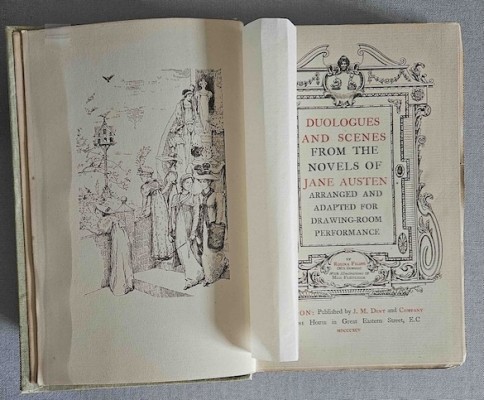
Duologues and Scenes from the Novels of Jane Austen, by Rosina Filippi (London: J. M. Dent & Co., 1895). Chawton House, Acc. No. 1194.
Rosina Filippi’s collection of short plays is among the first-ever adaptations of Jane Austen’s novels for performance. At a time when many thought Austen was unsuitable for the stage, Filippi argued that Austen “is essentially dramatic.” Adapting for amateurs, likely young women and girls, Filippi chose scenes of female empowerment from Austen’s six novels.
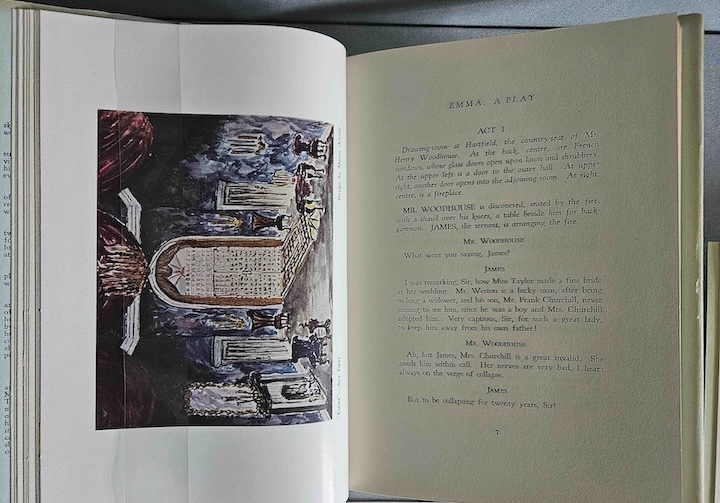
Emma: A Play, by Marion Morse Mackaye (New York: Macmillan, 1941 [1937]). Chawton House, Acc. No. 51. |
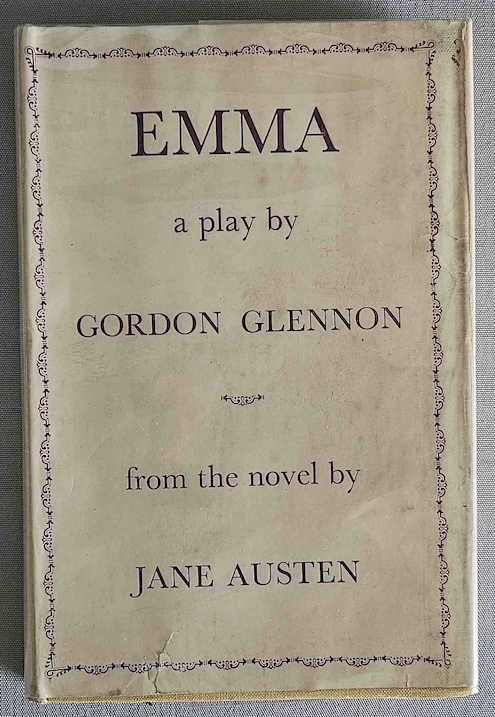
Emma: A Play, by Gordon Glennon (London: Macmillan, 1945). Chawton House, Acc. No. 1258. |
Stage adaptations of Austen grew in popularity during the war and interwar periods of the early twentieth century—likely due to Austen’s connection to “Englishness,” patriotism, and a kind of mythic past. These “light & bright & sparkling” (letter to Cassandra, 4 February 1813) performances helped people to forget about the war, as shown in the pretty stage design for Marion Mackaye’s Emma. A reviewer for the 1945 production of Gordon Glennon’s Emma wrote that, when watching the performance, “we can ourselves escape, feeling for an hour or two as remote from the flinty and steel couch of war as were Emma and Mr. Knightley amid the settees and strawberry-beds of their tranquil Highbury.” Glennon’s adaptation was the first production of Emma to appear on a London stage.
Austen adapted to other genres
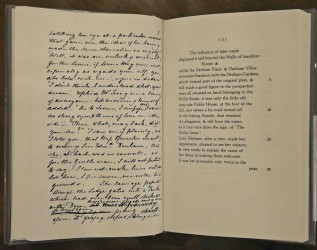
Jane Austen’s Sanditon, by Anna Lefroy (Chicago: Chiron Press, 1983). Chawton House, Acc. No. 1417. |
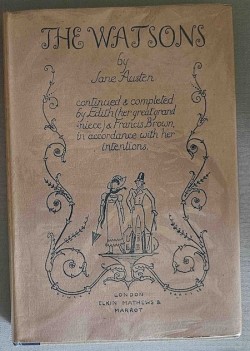
The Watsons, by Edith and Francis Brown (London: Elkin Mathews & Marrot, 1928). Chawton House, Acc. No. 4811. |
When Jane Austen died, she left behind fragments of unfinished novels, including Sanditon. Her literary-minded niece, Anna Lefroy, wrote a continuation in the 1850s, but it was not published until the late twentieth century. Lefroy’s continuation is unfortunately notable for its racial stereotyping of Austen’s only Black character, Miss Lambe.
Another Austen family descendant, Edith Brown (née Hubback, a great-granddaughter of Jane’s brother Francis), also chose to continue one of the unfinished novels, The Watsons. In the preface, Edith Brown captures the jovial spirit of adaptation: “Solemn people can say, if they like, that we should not do this, but I decline to be solemn about Aunt Jane. She was fun, much more than she was anything else, and this has been fun to do.” Her daughter, Helen Brown, wrote one of the first biographical plays about Austen’s life, in 1939.
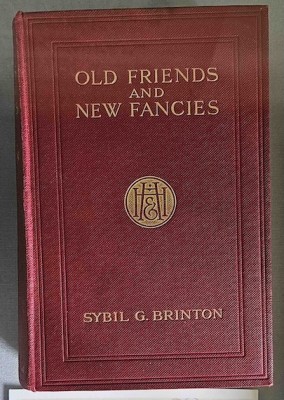
Old Friends and New Fancies, by Sybil G. Brinton (London: Holden & Hardingham, 1913). Chawton House, Acc. No. 1902.
Sybil Brinton’s novel is considered one of the first Jane Austen fanfictions. Old Friends and New Fancies is a sequel to the events of all six Austen novels, bringing together different characters from each. Newly married Mr. and Mrs. Darcy and Captain and Mrs. Wentworth become best friends, while Kitty Bennet is now a protégée of Emma Knightley in London.
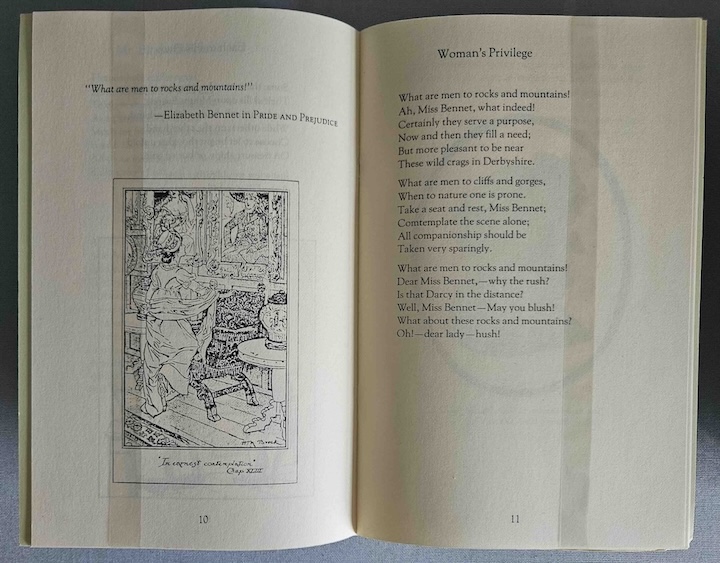
Come into the Garden, Cassandra, by Patricia M. Shepherd (Vancouver: JASNA, 1983). Chawton House, Acc. No. 8701. |
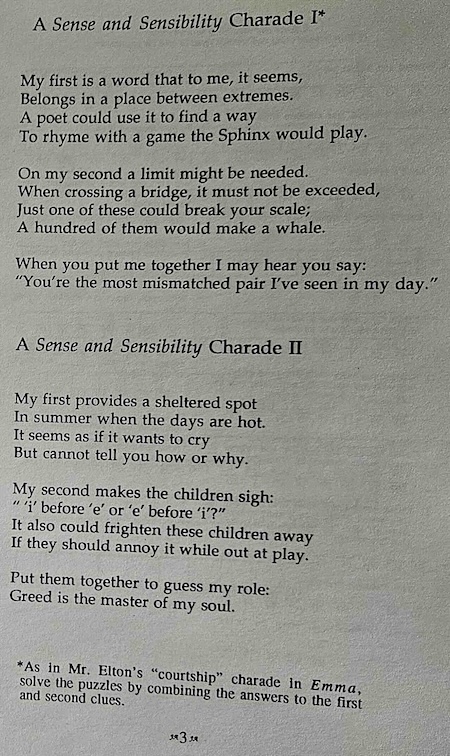
Puzzling Jane Austen: A Collection of Charades, Puzzles and Word Games (Tennessee: JASNA, 1992). Chawton House, Acc. No. 1423. |
Two works, created by members of the Jane Austen Society of North America and published by local regions, went generically further afield. Patricia M. Shepherd’s book of poetry adapts famous lines from Austen’s six novels—such as “‘What are men to rocks and mountains?’” (PP 174)—into poems. In Austen’s Emma, a novel filled with misunderstandings and misreadings, riddles, charades, and word games work as motifs for codes and secrets. These charades were written by the Tennessee branch of the Jane Austen Society of North America. Can you solve them?
Together, the books, plays, and objects in this exhibition reveal Jane Austen not as an isolated genius, but as part of a lively community of women who read, wrote, performed, adapted, and reimagined stories across generations. From the bustling world of the circulating library to the excitement of private theatricals, from Minerva Press bestsellers to modern sequels and stage adaptations, we see how women’s writing has always been inventive, collaborative, and in conversation with its readers. Austen learned from earlier sisters of the pen such as Frances Burney, Ann Radcliffe, and Maria Edgeworth. She in turn inspired later writers, performers, and fans, who continue to respond to and reshape her work today.
ACKNOWLEDGMENTS
Many people assisted in the making of Sisters of the Pen, loaning objects, time and knowledge. In particular, thanks are due to:
- Our generous lenders: the owners of Anne Sharp’s presentation copy of Emma and the first edition of Pride and Prejudice, as well as Isabella Inchbald, Charles Beresford, Anna Hilditch, and the Kent Archives.
- Isobel Grundy, Victoria Hinshaw, Sandra Clark, Juliet McMaster, and Marion Makinson, for generous donations included in this exhibition, which have enhanced our women’s writing collection beyond measure.
- 2024 Visiting Fellow Katie MacLean, for sharing her expertise and curating the section on Austen on the Modern Stage.
- Assistant Curator Molly Maslen, for excessive competence.
- Yvette Carpenter, Carol Knight, Julie Edyvean, the Library Volunteer Team, Richard Bacon, Bob Monk, and Kevin Lockyer, for running the smoothest installation to date and for spending many hours preparing the objects for display.
- Annalie Talent, Katie Childs, and Maddie Windsor, for good advice and proofreading.
It would be impossible to do justice to the numerous brilliant scholars and creatives whose work has enabled us to tell stories about women writers, but this exhibition owes a particular debt to Paula Byrne’s wonderful work on Jane Austen and the theatre, and to the life’s work of the inimitable Austen scholar Deirdre Le Faye.
NOTES
1You can see a scan of the full catalogue here: https://chawtonhouse.org/wp-content/uploads/2025/11/Bedford-Catalogue.pdf.
