Jane Austen’s 250th birth year might be an appropriate time to reflect upon the life and death of another member of the Austen family—in this case, on the career, death, and burial of Charles John Austen (1779–1852), the youngest Austen sibling. In the tumultuous late eighteenth and early nineteenth centuries, tragedies resulting from war, childbirth, accident, and disease were ever-present on land and on sea. Austen’s Persuasion, as noted by many scholars (e.g., Brian Southam, Sheila Johnson Kindred, Maggie Lane), offers an introduction to a variety of deaths on land and sea. Austen’s novel dramatizes the physical threats to life and limb during the period. Persuasion features the early death of Anne Elliot’s mother, the debilitating wound suffered by Captain Harville, the accidental death at sea of the Musgroves’ son Richard, Louisa’s fall on the Cobb in Lyme, the undiagnosed illness of Mrs. Smith, and the unexpected death of Captain Benwick’s fiancée and Captain Harville’s sister, Fanny Harville.
The Austen family lived through precarious periods, in which short episodes of peace alternated with decades of war. At the time, Britain had by far the most powerful navy in the world, and its superiority was largely unchallenged by other nations. In 1810 the British fleet boasted 152 ships of the line (so called because they were able to take part in a line of battle), 390 cruisers, and a host of support ships. In terms of manpower, the Royal Navy had 800 captains, 600 commanders, 3,270 lieutenants, and 142,000 seamen (Lane 75). The Royal Navy’s fleet played a major part in enlarging and defending the British Empire; in addition, the Navy assumed a key role in defending British interests among its various territories. Fundamental to this mission was protecting the key sources of cheap raw materials in the Americas, Africa, and Asia. Europe's largest and most expensive navy sustained this trade.
With responsibility for keeping the sea lanes open, suppressing pirates, and on occasion stripping the French of their Caribbean colonies, the Royal Navy was a crucial component of British foreign policy. The value of a powerful navy and highly trained naval officers cannot be overestimated.
Despite the lack of any naval tradition in the Austen family, it is easy to understand why Francis and Charles decided to join the Royal Navy. Their choice represented a traditional career for the younger sons of clergymen; in addition, the Navy offered excitement, prestige, and the opportunity to share in prize money from captured vessels; and because of the close proximity of the family home to Portsmouth, the home of the Navy, Francis and Charles would have been excited by the impressive size of the fleet and the constant activity in the port.
Both Francis and Charles started their naval careers at the age of twelve at the Royal Naval Academy at Portsmouth, Francis in 1786 and Charles in 1791. The expectation was that boys would stay there for three years or so, before gaining practical experience on ships as volunteers. In addition to doing the work of seamen on board, Francis and Charles would have been allowed on deck to be instructed by their respective captains on various matters, including how to maintain an accurate journal (Southam 24). The life of a volunteer, especially for a fifteen-year-old boy, would not have been easy, but the experiences gave Francis and Charles insights into the hardships that ordinary seamen suffered in their daily lives. Naval officers and sailors faced dangerous and exciting battles at sea, along with shipwrecks, accidents, and the inevitable longueurs on shore when they were stranded, often without hope of securing a commission on another vessel. A career in the Royal Navy meant the inevitable loneliness of long sea voyages, separation from family, disease, and tragedy. This first-hand knowledge and the development of the skills involved would have been invaluable in later years in determining how officers were to treat sailors under their own command.
The Austen boys’ introduction to the British Navy was a common way of securing a naval career. The young Horatio Nelson (later Vice-Admiral Horatio, Lord Nelson), for example, aided by his uncle Maurice Suckling, began his naval career as a seaman in 1771; he sailed for the East Indies in 1773; he died in 1805 at the Battle of Trafalgar. As the battle was beginning, Nelson sent a signal to the fleet proclaiming, “England expects that every man will do his duty.” It seems that the young officers Francis (aged thirty-one) and Charles Austen (aged twenty-seven) complied with the sentiments expressed by England’s greatest naval hero. Both young men sailed to the East and the West Indies, were injured and endured tedious shore leave, garnered prize money, and rose in the ranks of naval hierarchy. But while Nelson’s naval career, like Fanny Price’s brother William’s in Mansfield Park (at least initially), was pushed forward by an uncle, the Austen brothers were in many respects self-made “men of the age,” who advanced through training, skill, intelligence, energy, and service.
Through her naval brothers’ letters home, Jane Austen could engage with all aspects of their careers, travels, observations, and disappointments. Her brothers’ postings in the East Indies and the West Indies intrigued the whole Austen family, especially their stay-at-home sisters, who read their letters with avid attention to detail. It is not surprising that Jane Austen’s naval characters share her brothers’ qualities, their commitment to service, and their bravery in the ever-present dangers at sea as well as on shore.

Charles Austen, Jane’s youngest brother, is my great-great-great grandfather. I’m descended through Charles’s son, Charles John Austen II, issue of Charles’s second marriage, to Harriet Palmer in 1820. Charles John II married Sophia de Bois of Halifax, Nova Scotia, in 1848, and they had six children. His eldest daughter, Frances Cecilia (1853–1923), married my great-grandfather, Captain Lawrence Willan RN, in 1874.
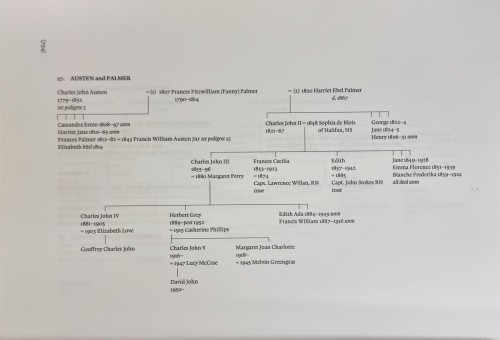
AUSTEN and PALMER family tree. A Chronology of Jane Austen and Her Family 1600–2000, by Deirdre Le Faye (764). By permission of Cambridge University Press.
(Click here to see a larger version.)
This paper evolved because I’ve always been fascinated by Admiral Charles Austen’s life, and I wanted to find out more about Charles the man, sailor, brother, and husband. I wanted to understand how Charles managed to reach the rank of Rear Admiral at the age of sixty-seven, despite experiencing considerable setbacks in his personal and his professional life. I was particularly interested in the last two years of his life (1850–52), when he served as Commander-in-Chief of the East Indies and China Station and led the naval forces in the second Anglo-Burmese war. Following his death from cholera off Prome, Burma (now Myanmar), his body was transported by ship to Trincomalee, Ceylon (now Sri Lanka), where he was buried. I was determined to find his grave.
Born in 1779, Charles was the youngest of the eight Austen siblings and was closest in age to his sister Jane, who was four years older, and his brother Francis, who was born in 1774. Francis enjoyed a glittering naval career, culminating in his appointment as Admiral of the Fleet, the highest rank in the Royal Navy. Francis and Charles were very different personalities, with different career trajectories. Both were Christians, but they had strongly contrasting views of God. Francis’s view reflected religion in its severe and disciplinary aspect, with God in the seat of judgment; Charles believed in a God of love, compassion, and forgiveness (Southam 16). Highly decorated and very professional, Francis comes across as stiff, formal, austere, and rather unapproachable; the impression was that, whatever the circumstances, Francis did things strictly by the book. His fellow officers and crew evidently found him formidable and a strict, sometimes harsh, disciplinarian (Southam 13).
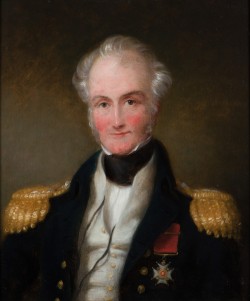
Rear Admiral Charles Austen in the 1840s in the uniform of a captain, wearing the star of the Companion of Bath, by an unknown artist. Private Collection.
Charles also had a very successful naval career, but his progression through the ranks was thwarted by personal tragedies, professional setbacks, and ongoing difficulties in obtaining a commission at sea. Charles was much warmer and more generous than Francis. Maggie Lane points out that “[w]here Francis was doggedly ambitious, Charles was fresh and eager, with a boyish charm which never left him and, and a capacity to inspire affection reminiscent of his father” (95). In Jane Austen’s Transatlantic Sister, her book on Charles’s first wife, Fanny Palmer Austen, Sheila Kindred describes him as a “man who combined good looks and charm with an affectionate disposition and untiring enthusiasm” (14). Handsome and gregarious, Charles was far more fashion-conscious than Francis: he was the first in the family to adopt the new male fashion for short, unpowdered hair. As Jane wrote to Cassandra, “Martha writes me word that Charles was very much admired at Kintbury, and Mrs Lefroy never saw anyone so much improved in her life, and thinks him handsomer than Henry” (21–23 January 1799; qtd. in Lane 118). Charles’s niece Anna Lefroy, at the age of 70, reminisced about Charles’s “very remarkable sweetness of temper, & benevolence of character”; and she praised his “tall, erect figure, his bright eye & animated countenance [which] would have given the impression of a much younger man; had it not been for the rather remarkable contrast with his hair, which originally dark, had become of a snowy white” (qtd. in Southam 16).
In keeping with his thoughtful personality, Charles was generous to a fault, and he was even rebuked by his sister Jane for spending his prize money on gifts for his two sisters. In one of her letters to Cassandra, Jane wrote that Charles “has received 30£ for his share of the privateer & expects 10£ more—but of what avail is it to take prizes if he lays out the produce in presents to his Sisters? He has been buying Gold chains & Topaze Crosses for us;—he must be well scolded. . . . I shall write again by this post to thank & reproach him.—We shall be unbearably fine” (26–27 May 1801; qtd. in Hubback and Hubback 59).
In 1807, while based in Bermuda, Charles married the seventeen-year-old Fanny Palmer, the younger daughter of John Grove Palmer. As their portraits show, they made the perfect couple: the dashing naval officer and his beautiful young bride, who enjoyed an idyllic life in Bermuda. They soon started a family with the births of their daughters Cassandra Esten (1808) and Harriet Jane (1810). The Austens spent as much time together as Charles’s naval duties permitted, with Fanny accompanying him on five separate return journeys to the British naval base at Halifax, Nova Scotia, where maintenance and refitting work was undertaken (Kindred 33). Charles’s posting inevitably came to an end, and he was required to return home, with Fanny and the two children in tow. A third daughter, Frances Palmer, was born in 1812. With no new commission on offer or home to go to, the family took up residence for a time on board HMS Namur, a guard and receiving ship moored off the coast of Sheerness in Kent. Compared to the glorious climate in Bermuda, England was often cold and wet; there was little privacy on board, and seasickness was a perennial problem (Willan). Tragedy struck in 1814 when Fanny died, having given birth to a fourth daughter, who lived for only three weeks. Absolutely distraught, Charles blamed himself for his failure to provide a comfortable and secure home for his wife and their young children (Lane 172).
Entrusting care of the three girls to Fanny’s sister Harriet Palmer (1786–1867), who lived in London, Charles sought solace through work: he took command of the 36-gun frigate HMS Phoenix. But disaster made its way into Charles’s life once again. In 1816, through absolutely no fault of his own, on a voyage off Smyrna (what is now Ismir in Turkey), the HMS Phoenix was wrecked after errors by its pilots. Despite being unanimously cleared at the inevitable court-martial, Charles suffered the stigma of having commanded a warship that sank at sea. As a result, he had to wait a staggering ten years before securing another command. Under duress, Charles subsequently took a shore-based job in Cornwall for the Coast Guard service (which he hated). It meant, however, that he would be close to his young children.
As Charles and Harriet spent an increasing amount of time together, they became romantically involved. In 1820 they married. Although marriages between a widower and his deceased wife’s sister were not illegal, some Austen family members disapproved of the marriage between a man and his wife’s sister and placed the blame on the wife, not the husband. Austen family and friends commented on Harriet’s drab personality, at least relative to the attractive and charismatic Fanny, who had bonded so well with Charles’s family. Cassandra had previously written about Fanny to her cousin Philadelphia Walter: “His Bermudan wife is a very pleasing little woman, she is gentle and amiable in her manners and appears to make him very happy” (qtd. in Lane 161). Some of the Austen family viewed Charles and Harriet’s marriage as a one of convenience rather than love. Others felt that Harriet was difficult to like and referred to Harriet’s ongoing health issues as problematic. James Edward Austen-Leigh, Charles’s nephew, had a more extreme view and described Harriet as “plain & sour countenanced” and “intollerably vulgar” (qtd. in Kindred 182). About Charles’s remarriage, Mrs. Austen wrote to her granddaughter Anna Lefroy that “one must pity her . . . tho one can’t much like her” (qtd. in Nokes 525). Harriet was almost certainly a quieter, more reserved, and more serious person than Fanny, but she was extremely fond of her nieces and had willingly embraced her new-found responsibilities. Despite willingly taking on the role of stepmother to her sister’s three children, Harriet never received the credit and recognition that she deserved. Charles and Harriet went on to have four children of their own: Charles John II (1821), George (1822), Jane (1824), and Henry (1826), but only Charles John II lived beyond the age of 25—a source of great sadness for both parents. Strangely, but perhaps tellingly, out of the many portraits of the Austen siblings and their spouses, there are none of Harriet.
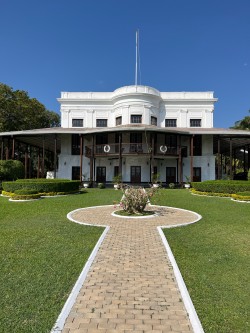
Admiralty (“Navy”) House, Trincomalee (March 2025). Photographed by author.
(Click here to see a larger version.)
After serving what the Admiralty deemed to be sufficient punishment for the shipwreck, in 1826 Charles returned to sea as captain of HMS Aurora, a 44-gun frigate that was ordered to the Jamaica station. The years 1826–30 were arguably some of the best of Charles’s professional life, as he played a crucial role in two key areas: intercepting slave ships bound for the U.S. and the Spanish colonies of Cuba and Puerto Rico, and supporting those states of South America that were seeking independence from Spanish rule. Following his next appointment as Flag Captain of HMS Winchester, tragedy struck for a third time when in 1830 Charles fell off a mast, was badly injured, and was invalided home. His career was seriously interrupted again. During these dark times—Fanny’s death, the shipwreck and court-martial, and the dreadful accident at sea—Charles’s personality shone through. As a believer, he was certainly helped by his faith, but his positivity, cheerfulness, charm, and resilience in the face of adversity played a very significant role. Above all, he was a family man and spoke with pride about being able to serve alongside his two sons on board HMS Bellerophon from 1838 to 1841. Writing in his journal about the bombardment of Acre (Syria), he said: “Admiral signalled ‘cease firing,’ up boats, and then piped to supper, and sat down with the two boys to a cold fowl, which we enjoyed much” (qtd. in Lane 224). Eventually recovered from his injuries, Charles was promoted to Rear Admiral in 1846. Four years later, at the age of seventy-one, he was appointed Commander-in-Chief of the East Indies and China Station, one of the most senior positions in the Royal Navy, with the sphere of influence encompassing the Indian Ocean, the coasts of China, and its rivers. Traveling to Alexandria on the P&O Steamer Ripon with Harriet and his two eldest daughters, Charles crossed the desert and made his way to his headquarters at Trincomalee on the East Coast of Ceylon (now Sri Lanka). He took up residence at Admiralty House (commonly known as “Navy House”), located in the Navy Dockyard. Trincomalee would prove to be Charles’s last deployment.
Charles’s life in the Eastern waters was overshadowed by the second Burmese War (1852–53), a conflict that ultimately led to his death from cholera. The origins of the war stemmed from opposition by British traders, led by the East India Company, to restrictions placed on trade (especially teak), excessive customs duties, a clampdown on bullion smuggling, and general interference with shipping (Pollack 487). The problem was exacerbated when the local Governor of Rangoon was believed unfairly to have had arrested two masters of British merchant ships, accusing them in both cases of killing a crew member. What was essentially a local dispute soon escalated when Lord Dalhousie, the Governor-General of India, felt compelled to act, dispatching a small naval force to resolve the issues. The Burmese immediately made concessions, including the dismissal of the Governor. The situation worsened, however, under Commodore George Lambert, the naval commander appointed by Dalhousie to investigate the situation. Described as the “combustible commodore” (Pollack 493), he angered the Burmese first by demanding hefty financial compensation and then by ordering the blockading of the port of Rangoon and the seizing of the king’s own royal barge. With no obvious solution in sight, Dalhousie assembled an expedition consisting of a much larger force of naval ships and troops from the Madras Army and the Bengal Army, reinforced by a small British Army contingent of three infantry battalions.
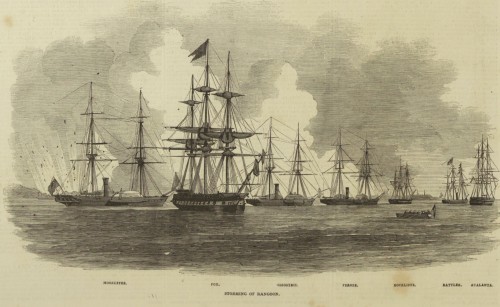
The British fleet at the storming of Rangoon, 14 April 1852.
Illustrated London News 26 June 1852.
(Click here to see a larger version.)
Commanding the naval force, Charles Austen temporarily transferred his flag to HMS Rattler and arrived off the mouth of the Rangoon River on 1 April 1852 alongside HMS Fox, HMS Hermes, HMS Salamander, HMS Serpent, and a gunboat. Launched in 1843, HMS Rattler was a 9-gun steam screw ship and one of the first British warships to be fitted with screw (propeller) propulsion. As naval architects pondered over whether the future of marine propulsion should be propeller- or paddle-based, HMS Rattler was pitted in competition against the paddle-driven HMS Alecto and won on all counts—a defining moment in naval history, as thereafter new British warships would be driven by propellers.
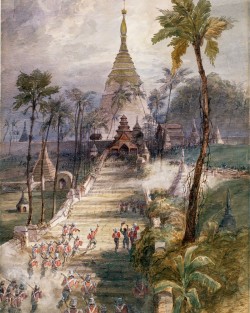
The 18th and 80th Regiments of Foot Storming the Shewdagon Pagoda, 12 April 1852, by John North Crealock (1852). Courtesy of National Army Museum.
(Click here to see a larger version.)
The expeditionary force took Martaban (now Mottama) after a short naval bombardment. A week later Charles led the attack from Rattler against the outlying defenses at Rangoon, enabling General Godwin and troops from the 51st (2nd Yorkshire West Riding) Light Infantry and the 18th (Royal Irish) to land ashore (“Second Burma War”). Charles was not used to this type of warfare. Instead of attacking French frigates on the high seas, the navy’s role was to weaken the land-based defenses and support the subsequent invasion of the troops. Although there was some opposition from land-based artillery, the Burmese Navy was largely nonexistent and represented no threat. On 14 April, 120 seamen offloaded artillery from the fleet and dragged the guns into position in front of the Great Dagon (or Shwedagon) Pagoda. After two days of shelling and fighting, the capture of Rangoon was completed, culminating in the storming of Burma’s most prestigious and sacred pagoda.
The Shwedagon pagoda is believed to have been built over 2,500 years ago, while the Buddha was still alive, thereby making it potentially the oldest Buddhist stupa in the world. The pagoda is of particular significance because it was believed to contain the remains of the four previous Buddhas of the present kalpa, a period of time in Hindu and Buddhist cosmology. Standing at 170 meters high, the stupa contains multiple layers embellished with priceless gemstones. The top part of the pagoda is lavishly decorated with thousands of diamonds and rubies, with a 76-carat diamond at the very top. The capture of the pagoda was seen as a highly valuable prize and a cause of great British celebration. Following the capture of the pagoda in 1852, two bronze cast bells, one large and one much smaller, were removed by the British Forces and presented as a gift to Admiral Charles Austen to celebrate the victory. The smaller of the two bells has an inscription celebrating the storming of Rangoon.
Both army and navy casualties at the capture of Rangoon were low. The army lost 17 killed and 132 wounded; although naval casualties were minimal, cholera had a truly devastating effect. The disease spread quickly, and Charles Austen was among the casualties. With the hostilities halted, Charles was persuaded to leave Rangoon and go to Calcutta, where he recuperated at the home of the Governor-General. A few months later, he returned to Burma and to duty, his health apparently restored. Charles assumed charge of the combined military and naval force that pursued the retreating Burmese northwards. He hoisted his flag on board the Pluto, a steamship owned by the East India Company, and undertook a reconnaissance of the town of Prome on the banks of the Irrawaddy. But Charles succumbed a second time to cholera and waited to be relocated. Coincidentally, the Pluto was accompanied by HMS Hastings, which was under the command of his nephew and son-in-law, Captain Francis William Austen Jr. Married to Charles’s third daughter, Frances Palmer, his nephew no doubt provided comfort and solace during the last days of his life. While waiting for his steamship squadron to arrive, Charles managed to remain cheerful and positive during the last few days of his life. On 30 September he wrote in his diary: “Up at 6 o’clock after a good night, then onto deck with my book. I had a guest for dinner, Mr Shotton from the 35th Regiment” (AUS/163). On 2 October: “Went ashore and rode around the island. I managed a game of backgammon, . . . but my eye sight is not good.’’ The next day: “On deck before 6 o’clock to see the sunrise. Read prayers at the church service. To bed at 8.30 without taking my wine and water and slept all the better for it.” On 6 October he made his last entry in his diary: “Managed a bit of toast for breakfast. Weather still very hot and my complaint continues. I heard a report that two steamers have been seen at anchor some miles away. Wrote this and a letter to my wife, and read the lessons of the day.”
Admiral Charles John Austen died on 7 October 1852 at the age of 73.
Many tributes to Charles were paid by his fellow officers, crew, and other members of the expedition, and he was widely praised for his exceptional leadership qualities. One of his officers wrote home to the Austen family: “Our good Admiral won the hearts of all by his gentleness and kindness while he was struggling with disease, and endeavouring to do his duty as Commander-in-Chief of the British naval forces in these waters. His death was a great grief to the whole fleet. I know that I cried bitterly when I found he was dead” (qtd. in Southam 53). With his body on board, the Pluto came alongside HMS Rattler at Bassein and transferred the mortal remains of Charles Austen on 14 October 1852. The Rattler’s log reveals that she arrived at Dutch Bay, Trincomalee, on 26 October, and Charles’s body was landed. The 15th Regiment then took charge and provided an escort to Admiralty House. The following day (27 October) the funeral party escorted Charles’s body to the cemetery and fired a 13-gun salute to signify the end of the ceremony. There were no records at the time as to the location of the grave (HMS Rattler Ship’s Log).
I now fast-forward to the present day and my own visit to Sri Lanka in March 2025.
Located in the northeast portion of Sri Lanka, Trincomalee has the deepest natural harbor in South Asia and was consequently of crucial importance during colonial expansion in the seventeenth and eighteenth centuries. It was originally occupied by the Dutch, but in 1795 the British took control of Trincomalee with the capture of Fort Frederick and Fort Ostenburg. Trincomalee eventually replaced Bombay as the headquarters of the East Indies Squadron and remained in British hands until 1958, when it was handed over to the Sri Lankan Navy (Clements 126).
My father, Commander D. P. Willan RN, had always intended to visit his great-great-grandfather’s grave but had been thwarted not only by his own service in World War II, but also by such events as the Sri Lankan Civil War (1983–2009) and the tsunami (2004). Unperturbed, he was determined to ensure that Charles’s grave was located, even if he was unable to visit it himself. In the past there had been uncertainty about the actual location of the grave, and in the absence of any officially recorded information about its whereabouts, there was an assumption that it was in one of two military cemeteries at Trincomalee—on Sober Island or in the Navy Dockyard. Writing speculatively to the Commander-in-Chief at Trincomalee in 1984, my father appealed for assistance, and his request was picked up by Captain Clancy Fernando, who at the time was the Commandant of the Naval and Maritime Academy at the Navy Dockyard. Captain Fernando was subsequently promoted to Admiral and placed in command of the Sri Lankan Navy before being assassinated by terrorists in 1992.
With the invaluable help of Nishan Fernando, Admiral Fernando’s son, I obtained some fascinating insights into the last two years of Charles’s life. At the age of 14, Nishan had embarked on systematically searching the old burial grounds of Trincomalee, eventually finding the grave in 1984 at St. Stephan’s Cemetery on the Esplanade in the middle of the town (Fernando). There was a clue here: the cemetery overlooks Dutch Bay, which was referred to in HMS Rattler’s log and is within a mile of the Dockyard, a perfectly reasonable distance for the burial party to march. The grave was clearly identified by the following inscription:
Sacred to the memory of His Excellency C. J. Austen Esq.
Companion of the Most Honourable Order of the Bath.
Rear Admiral of the Red and Commander-in-Chief of Her Majesty’s Naval Forces on the East Indies and China Station.
Died off Prome, the 7th October 1852 on the river Irrawady against the Burmese Forces aged 73 years.
Following her visit in 2012, Jane Maxwell, a member of the Jane Austen Society, wrote that the grave had been in poor condition, with the graveyard partly overgrown and neglected (Maxwell 39). Nishan has continued to assume responsibility for the grave, albeit informally, and for that I’ll always be very grateful. He also very successfully lobbied senior officers of the Sri Lankan Navy about the importance of repairing and maintaining the grave—so much so that Rear Admiral Y. N. Jayaratne generously approved the full restoration of the grave in 2021. The senior officers at Trincomalee expressed their pride in “looking after” Charles, especially as he is so far from home. They also very kindly arranged a “spruce-up” of the grave immediately before my visit.
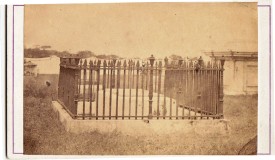
Charles Austen’s grave at Trincomalee (c. 1880). Photographed by A.W. Andree of Colombo. |

Charles Austen’s grave at Trincomalee (March 2025). Photographed by author. |
The Navy Dockyard is the centerpiece of Trincomalee and includes the magnificent “Navy House” where Charles Austen was based from 1850 to 1852. Acquired by the Royal Navy for £1,750 in 1810, it can be accessed by land or sea; it has its own private pier. Navy House is not normally open to the public, but thanks to the efforts of Nishan and his mother, Monica, we were granted special access. We were lavishly entertained by senior officers from the Sri Lankan Navy, who warmly welcomed us and were delighted to hear more about my great-great-great-grandfather and his famous sister. I was even asked to sign a copy of Emma for the Navy House Library, a truly humbling experience. Clearly, the ties between the British and Sri Lankan Navies are still strong.
Exploring Charles Austen’s former home was an emotional experience, as I tried to imagine what life had been like there over 170 years ago, especially for a man who was so far from home and family. I felt a great sense of pride when I saw Charles’s name on the list of Commanders-in-Chief of the East India Station, albeit with the poignant note: “died while on station.” With Nishan’s invaluable help, I also discovered more about the fate of the two bronze bells that were presented to Charles following the capture of Rangoon. The smaller one went first to Aden, then on to Bahrain, where it stayed until Britain’s withdrawal from the Gulf. This bell, with the inscription “Presented by the captors at the storming of Rangoon 14th April 1852 to Rear Admiral Austen C.B. Commander-in-Chief of the Naval Force employed on that occasion and left by him at the Admiralty House Trincomalee as an heirloom,” was moved to Aden by the Royal Navy in September 1958, when the Trincomalee Naval Base was handed over to Ceylon. Following five years in storage at HM Naval Base Portsmouth, this bell is on permanent loan to, and sits in the fireplace of the Admirals’ Room in, Jane Austen’s House at Chawton (“Austen Bell”).
The much bigger bell takes pride of place at Navy House in Trincomalee. It is not known whether it was a gift from the Royal Navy to its Sri Lankan counterpart or was simply too cumbersome and too heavy to transport to Aden.
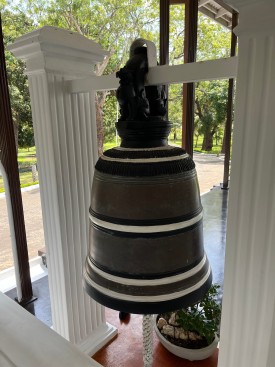
The large ancient bronze bell at Admiralty (“Navy”) House, Trincomalee (March 2025). Photographed by author. |
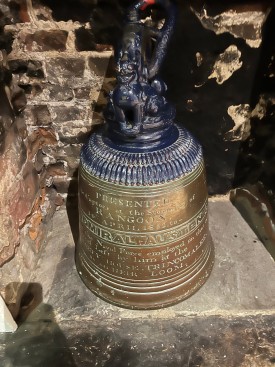
The smaller ancient bronze bell at Jane Austen’s House, Chawton (February 2025). Photographed by author. |
Close to the bell at Navy House is a wall-mounted plaque with the following inscription:
Two Ancient Bronze Temple bells from the Great Dagon (Schwedagon) Pagoda were captured by the British Forces during the Second Anglo Burmese War (5th April 1852 to 20th January 1853). The Bells were presented to Rear Admiral Charles Austen, Commander-in-Chief of the East Indies and China Station (14th January 1850 to 7th October 1852). Although he was headquartered at Trincomalee, Ceylon and occupied the Admiralty House (Navy House), Charles transferred his flag to HMS Hastings and led the British Naval Expedition up the Irrawaddy in the siege of Rangoon. One Bell with the inscription “Presented by the captors at the storming of Rangoon 14th April 1852 to Rear Admiral Austen C. B. Commander-in-Chief of the Naval Force employed on that occasion and left by him at the Admiralty House Trincomalee as an heirloom” was moved to Aden by the Royal Navy in September 1958 when the Trincomalee Naval Base was handed over to Ceylon. It is currently displayed at the Jane Austen House Museum in Chawton.
The second, but much larger Bell, remains at Navy House, Trincomalee.
This plaque is presented to Navy House, Trincomalee by Nishan Fernando, son of Admiral Clancy Fernando, Commander of the Sri Lankan Navy (1st November 1991 to 16th November 1992) to mark the visit of Mr David Austen Willan, great-great-great grandson of Rear Admiral Charles Austen.
Despite facing many challenges, Charles Austen relished the dynamic life that carried him from home in Hampshire, England, to the East and West Indies, the territories of a burgeoning new world. He served with honor in the Royal Navy’s exciting seafaring days; was revered by those he served with; and was praised for his generosity, astute leadership, and personal qualities. He died in difficult circumstances a long way from home, but that was not unusual in the days of the British Empire and a very large Royal Navy. It is a special tribute to Charles that Nishan Fernando, who found Charles Austen’s grave in the cemetery on the Esplanade, persuaded senior members of the Sri Lankan Navy to renovate my great-great-great-grandfather’s grave. Like me, Nishan Fernando and senior members of the Sri Lankan Navy are enormously proud of Rear Admiral Austen, beloved brother of Jane.
ACKNOWLEDGMENT
This article is dedicated to my good friend Nishan Fernando, who through his tireless efforts has been instrumental in preserving the memory of Charles Austen. For this he deserves our sincere and heartfelt thanks.
