In May 1813, Jane Austen attended several art exhibitions in London with her brother Henry, which she described in a letter to their sister, Cassandra. On Friday 21 May, Jane and Henry viewed what she called the “Exhibition in Spring Gardens,” held by the Society of Painters in Oil and Water Colours in a rented venue (Zohn; Roget 1: 233). There, as she wrote to Cassandra the following Monday, “I was very well pleased . . . with a small portrait of Mrs Bingley, excessively like her” (24 May 1813). The portrait, Austen declared, “is exactly herself, size, shaped face, features & sweetness; there never was a greater likeness. She is dressed in a white gown, with green ornaments, which convinces me of what I had always supposed, that green was a favourite colour with her.” Austen remarked too that, while the same art show contained “no Mrs Darcy,” she hoped to find a convincing version of that character “in the Great Exhibition which we shall go to, if we have time;—I have no chance of her in the collection of Sir Joshua Reynolds’s Paintings which is now shewing in Pall Mall, & which we are also to visit. . . . I dare say Mrs D. will be in Yellow.” “The Great Exhibition” was the annual summer show hosted by the prestigious Royal Academy of Arts, a mainstay of the London social calendar. Austen’s second reference was to a retrospective of the career of the late portraitist Joshua Reynolds.1 Continuing the same letter on “Monday eveng,” Austen reported having “been both to the Exhibition & Sir J. Reynolds’,—and I am disappointed, for there was nothing like Mrs D. at either” (24 May 1813).
This letter has long intrigued readers and scholars, given that Austen famously supplies few physical descriptions of her characters. In Pride and Prejudice, Jane Bennet is generally considered a great beauty and Elizabeth Bennet a close second, but all we learn about their faces is that Elizabeth has “dark eyes” (26), described by Mr. Darcy as “‘fine eyes’” (30). While recent, beloved screen adaptations show Jane as blonde and Elizabeth as brunette, this distinction appears nowhere in the novel itself. Because the art exhibitions Austen viewed are a matter of historical record, her letter raises the exciting prospect that a portrait that exactly matched how Austen imagined Jane Bennet as a married woman could be rediscovered.
In a 1988 article confidently titled “The Likeness of Austen’s Jane Bennet: Huet-Villiers’ ‘Portrait of Mrs Q,’” the literary scholar Martha M. Rainbolt presented an unsubstantiated guess that has since been repeated as if it were fact. From the printed catalogue of the Society of Painters in Oil and Water Colours’s 1813 exhibition in Spring Gardens, which had previously been examined by Lance Bertelsen, Rainbolt determined that a “highly probable” candidate was “Portrait of a Lady” by “H. Villiers” (42). Unable to locate the original artwork, she speculated—without evidence—that it was the basis of an engraving by William Blake, published in 1820, which shows a woman wearing a white dress tied with a green ribbon.2
Rainbolt was convinced, she explained, by the sitter’s “sweetness and ‘cheerfulness of manner’” (42). To her, these subjective qualities outweighed the lack of an additional green element to match Austen’s description of “ornaments” in the plural (41–42). A crucial flaw in Rainbolt’s research was that she examined just one copy of Blake’s print, at the British Museum, which her article reproduced in black and white (42). She apparently did not know that additional copies of Mrs Q are extant, fifteen of which the Blake scholar Robert Essick described in meticulous detail in his 1983 catalogue (191–94).
The selection of seven Mrs Q prints reproduced in Figure 1 demonstrates why comparative study of copies of an engraving is essential, as they can vary considerably in appearance. (To accentuate the contrasts, we have cropped the images in Figure 1 to remove the title portion of each engraving; for an example of a complete print with its title, see Figure 10.) What’s more, the British Museum print viewed by Rainbolt survives as a cut-down oval with only a hint of the original background. As we will explore in our final section, the details of that background are key to understanding the implicit political significance of Mrs Q.
Notable differences among copies can result from the multistage process of making an engraving. Several artisans contributed to this process, which resulted in prints offered at a range of price points. The lines and shading of an original painting or drawing were rendered by a professional engraver, who used a sharp stylus to produce indentations in a metal printing plate. That plate was inked by a printer and placed in a specialized press, which applied great pressure to extract all the ink from the plate’s deep grooves. One copy at a time was printed, with fresh ink applied to the plate before each impression (Griffiths 30–31). Monochrome prints, in black or brown ink, were the least expensive and therefore the most widely circulated images of people, places, and objects. Even those not able or willing to purchase could peruse displays at printshop windows, as Admiral Croft memorably does in Persuasion, critiquing the lack of realism in naval scenes (183).
Printing in color involved carefully dabbing ink of different colors onto the appropriate portions of the engraved plate. As a result, each copy of a colored print is unique, however much care was taken by the printer to achieve uniformity (Gascoigne 26a). The most labor-intensive, most expensive prints featured additional color, in the form of watercolor or gouache, which was added by hand to each printed sheet.3 Thus the fidelity of the finished print to the original artwork depended on the respective skills of the engraver, the printer, and the watercolorist. That level of fidelity would not have been known to the purchaser.
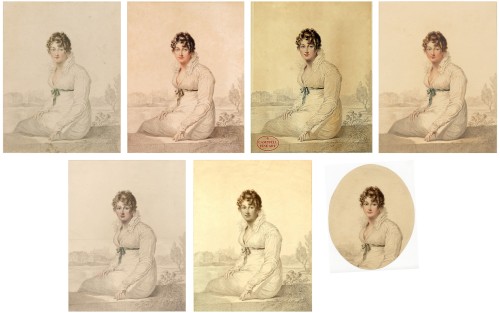
Figure 1. William Blake, after Jean-François Hüet-Villiers, Mrs Q (London: I. [John] Barrow, 1820). Details and image credits for all figures are listed below.
(Click here to see a larger version.)
These versions of Mrs Q differ strikingly. The color of the ribbon, pivotal to Rainbolt’s identification, ranges from olive to blue. Of course, color can change in appearance over time: Bertelsen quotes the art historian John Murdoch as stating that “[g]reens often do not survive as greens, but resolve under the effects of light into a kind of yellowish brown (sometimes, but not invariably)” (“Portrait” 37–38). Equally importantly, the sitter’s expression and affect vary substantially, thanks to changes in the intensity of the brown ink as well as in the color applied to her eyes, lips, and cheeks. In some copies, the image has been unmistakably eroticized by the addition of hand tinting on the sitter’s breasts and arms, which creates the effect of a translucent garment; painted-in nipples are visible in a few instances as well. What the lost original portrait looked like is impossible to discern.
As Juliette Wells explained in her plenary address for JASNA’s 2025 AGM, she had serious doubts, when closely examining the copy of Mrs Q held by the Morgan Library & Museum, that it matched Austen’s description of an ideal likeness of Jane Bennet Bingley (“Genius and Ingenuity”). Curious to see what internet-enabled image searching, a tool unavailable to 1980s scholars, might reveal about artworks displayed at the 1813 Spring Gardens exhibition, she initiated an investigation in collaboration with Rodney Yoder, with contributions by Avery Yoder-Wells. In addition to online records of museum collections and art auctions, our research encompassed a wide range of primary and secondary sources, both print and archival, that neither Bertelsen nor Rainbolt consulted.
We begin by sharing a fresh list of candidates for the “Mrs Bingley” portrait derived from the exhibition catalogue, followed by capsule summaries of the respective artists’ careers. Digital images of rediscovered artworks allow readers to judge for themselves whether the women portrayed resemble Jane Bingley. Next, we offer the first-available survey of the output of the prolific artist Jean-François Hüet-Villiers.4 We introduce Georgiana Lawrell Quentin, the often-misidentified sitter of Mrs Q, who was rumored to be a mistress of the Prince Regent, later King George IV. We establish the political context of the 1820 publication of the Mrs Q print by John Barrow, which explains the suggestiveness of the sitter’s pose and affect in many copies. We conclude that it is once again an open question what portrait struck Austen as the perfect likeness of her character.
Possible portraits
In an era before art museums or dealers’ galleries, exhibitions in venues rented by artists’ societies offered the public cultured entertainment while allowing artists to sell their works, burnish their reputations, and attract future commissions. Catalogues printed to accompany these shows reveal that many artists belonged to multiple professional organizations and exhibited their works in venues associated with each.
What Austen termed the “Exhibition in Spring Gardens” was the annual show of an organization founded in November 1804 by a group of professional watercolorists to provide opportunities for them to exhibit artworks in that medium, which carried less prestige than the oil paintings that received prime placement at Royal Academy shows (“Exhibition of the Society” 25; Fenwick and Smith 36). The Society of Painters in Water Colours, as it was originally called, held its inaugural show in May 1805 and admitted its first woman “associate exhibitor,” Anne Byrne, in December of that year (Roget 1: 208).5 After a financial and structural collapse in 1812, the organization was renamed the Society of Painters in Oil and Water Colours, as Kristen Miller Zohn has explained. Thereafter, the Society (as we will henceforward refer to it) mounted “open” shows, meaning that non-members could exhibit; it also began accepting portraits, which had previously been excluded (Roget 1: 285–87). The 1813 exhibition that Austen attended was thus the first to include portraits, oil paintings, and works by non-members. In 1820, the group decided that the addition of oil paintings was not a success, and the organization reverted to its original name and mission (Wilcox 68; Roget 1: 400). It exists today as the Royal Watercolour Society.
As was typical at the time, the Society’s exhibitions featured artworks hung “as close as possible to one another,” from eye level up to the ceiling (Fenwick and Smith 40). A sense of the viewer’s experience is conveyed by a contemporary depiction of an exhibition the Society held a few years before Austen visited, in a different location (Figure 2). Similar-looking landscapes of different sizes are crowded together, much less visually appealing than are the colorful, individualized characters in the foreground—most of whom are not looking at the artworks. The scene evokes Austen’s confession to Cassandra, apropos of attending an art show in London in 1811: “my preference for Men & Women, always inclines me to attend more to the company than the sight” (18–20 April 1811).
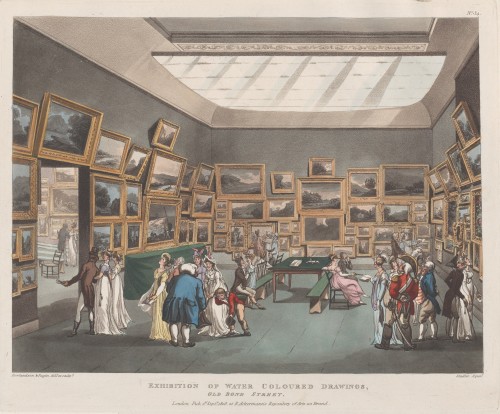
Figure 2. Joseph Stadler, after Thomas Rowlandson and Auguste Pugin, Exhibition of Water Coloured Drawings, Old Bond Street, from Microcosm of London, or London in Miniature (London: R. Ackermann, [1809]).
(Click here to see a larger version.)
Two hundred fifty artworks were hung, the vast majority of which were landscape paintings. As was customary at the time, no identifying labels accompanied each artwork. Thus Austen and other attendees at the Society’s 1813 show did not know works’ titles or artists’ names unless they consulted the exhibition catalogue, which was priced at sixpence, in addition to the one-shilling entrance fee (Exhibition [1]). As can be seen in Figure 3, the catalogue recorded titles and the surnames and first initials of artists; names and addresses of the eighteen members and twenty-nine non-member exhibitors were listed at the end (Exhibition 14–16). Since Austen did not include the artist’s name or the portrait’s title in her letter to Cassandra, we can assume that she neither bought nor had access to a catalogue. It is unlikely, then, that she would have been aware that—as Zohn has recently pointed out—three women artists were represented in the show.
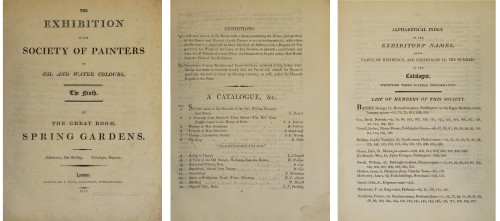
Figure 3. The Exhibition of the Society of Painters in Oil and Water Colours. The Ninth. At the Great Room, Spring Gardens (London: J. Booth, 1813), [1, 5, 14].
(Click here to see a larger version.)
While works’ titles implied (or, for portraits, explicitly stated) their genre, only rarely were size and medium mentioned; an exception was Hüet-Villiers’s Portrait of a Lady in the Character of Hebe,—Miniature on Marble (151). (A prefatory statement announced that “[p]ictures in Oil and in Water Colours, Portraits, Models, and Miniatures, are admitted into the present Exhibition” [Exhibition (2)].) To find out which works were for sale and at what price—information not to be found in the catalogue—a viewer had to consult a separate book, in which “prices (independent of the Frames and Glasses) of such Pictures as are to be disposed of” were recorded (Exhibition [5]). The Royal Watercolour Society’s archives, while missing the price book for the Society’s 1813 show, contain a copy of the catalogue annotated with certain sale prices, which sheds light on the disposition of several artworks relevant to our investigation.
The gender of each painting’s subject is clear from its title. The table below lists all portrayals of female subjects, plus two portraits of men (113 and 241) that, as we will explain, represent members of the same family group as the three other works by Robertson (15, 116, and 246). In the right-hand column, an asterisk marks the seven works we identify as candidates for “Mrs Bingley,” according to each title’s indication of the gender, age range, social class, and rusticity of the subject; the initials “LB” and “MR” identify those works previously considered by Bertelsen (in “Miniatures”) and Rainbolt. Artists’ names appear in the order that we will discuss possible works by them; titles are grouped by artist.
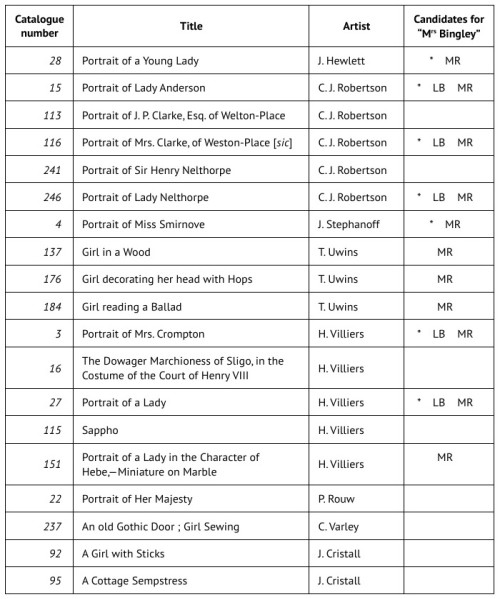
The classical garb of Sappho (115) and Hebe (151) is certainly incompatible with the dress that Austen described. As Bertelsen cogently argued, Austen would have minded greatly if “the costumes were wrong” (“Miniatures” 357). Of course, portraits evidently of women much older than Jane Bingley can be ruled out, such as Rouw’s of the Queen (22). Hüet-Villiers’s The Dowager Marchioness of Sligo, in the Costume of the Court of Henry VIII (16) is doubly disqualified by the sitter’s dress and age.
Bertelsen contended that Hewlett’s Portrait of a Young Lady (28) should be removed from consideration, on the grounds that in Austen’s day a “young lady” would likely describe someone in her teens (“Portrait” 37). We, however, are keeping Hewlett’s work under consideration, bearing in mind that the portrait Austen saw was “small” and may have been viewed at a distance. We concur with Bertelsen that any artwork with “girl” in its title is an improbable match for Jane Bingley, a married woman aged twenty-three (“Portrait” 38 n2). While Austen’s narrator and her characters frequently employ the terms “girl” and “girls” in Pride and Prejudice, the final such usage in the novel is Lady Catherine’s disparagement of Elizabeth as an “‘[u]nfeeling, selfish girl!’” (396), which occurs before she or Jane marries.
We note, moreover, that the titles of the genre works by Uwins (137, 176, 184), Varley (237), and Cristall (92, 95) signal rural scenes of sitters in humble circumstances, which are very unlikely to have struck Austen as resembling “Mrs Bingley.” Nevertheless, since Rainbolt took the Uwins works seriously, we have investigated them as well, for comparison’s sake.
The most obscure candidate on our list is Hewlett’s Portrait of a Young Lady (28), because it is the only known mention of a portrait by this artist. James Hewlett (1768–1836) worked in Bath and was primarily a flower painter (Cust 26: 309–10). He exhibited at the Society and the Royal Academy, as well as at another organization, the Associated Artists in Water Colours, of which he became a member in 1811 (Catalogue of the Fourth Exhibition 4). Between 1807 and 1815, Hewlett exhibited eighteen paintings by our count, the great majority of which are compositions of flowers or fruit. His other work on view at the Society’s 1813 show was titled Composition of Flowers (Exhibition 6). Surviving works by Hewlett, including those in the collection of the Victoria and Albert Museum, are technically adept and highly detailed. Yet his proficiency as a portraitist can only be guessed.
The curatorial work of Sylvie Patry and Anne Robbins in reconstructing the 1874 founding exhibition of the Paris Impressionists has called attention to the considerable challenge of matching a title in a nineteenth-century catalogue with a surviving artwork (6, 268). The title by which an artwork is known may have changed over time or been lost. Unless a portrait’s sitter was eminent in some way, her or his identity may well have been forgotten. What’s more, an artist may have produced multiple versions of the same subject under similar or identical titles, as the Society’s exhibition catalogues reveal. In consequence, relatively few artworks can be definitively verified through contemporary descriptions and subsequent chains of provenance (ownership history). An artwork that was commissioned or purchased by a prominent individual or institution, or that was famous in its own day, has the best chance of being confidently identified.
Unfortunately, few Regency-era watercolor portraits meet these criteria. According to Stephen Lloyd, a small watercolor of a non-famous individual, unlike a large and expensive oil painting, would typically have been commissioned by the sitter’s family for domestic display or exchanged between romantic partners (39). Such artworks may have been passed down to subsequent generations but would very seldom have entered the art market or been displayed in museum collections until the twentieth century.
The difficulty of definitively identifying a surviving portrait with a historical individual, even when a sitter was explicitly named, is apparent in the case of two of the three artworks attributed to Robertson that are candidates for “Mrs Bingley”: Portrait of Lady Anderson (15) and Portrait of Lady Nelthorpe (246). Rainbolt believed that she had found images corresponding to these artworks, both of which she dismissed on the grounds that the sitters were too old to be “Mrs Bingley” (38–39). We have discovered, however, that Rainbolt was mistaken in her identifications, based on a faulty understanding of the generations of the Nelthorpe family.
Charles John Robertson (c. 1779–after 1830) contributed portraits and miniatures to exhibitions hosted by the Society, the Royal Academy, and the Associated Artists in Water Colours. He began his career in the town of Gainsborough in Lincolnshire and moved to London by 1813 (Exhibition of the Society 15). Located near Gainsborough was Scawby Hall, the seat of the Nelthorpe family. All five of the portraits Robertson exhibited in the 1813 Spring Gardens show represented members of that family. Sir Henry Nelthorpe, the subject of 241, became the seventh baronet in 1799, upon his father’s death; after his 1807 marriage, his mother was known as the Dowager Lady Nelthorpe. Thus 246 depicted Sir Henry’s wife, Margaret, Lady Nelthorpe (b. 1780), while the “portrait of Lady Nelthorpe in 1795” by Thomas Lawrence that Rainbolt discussed represented Sir Henry’s mother before she was widowed (38–39). Entries 116 and 113 portrayed, respectively, Sir Henry’s older sister, Anna (b. 1772), and her husband, John Plomer Clarke, whose Northamptonshire estate was Welton Place. Entry 15 depicted Sir Henry’s younger sister Frances, Lady Anderson (b. 1774), who was married in 1802 to Rev. Sir Charles Anderson, baronet of Lea Hall, Lincolnshire (Debrett 1: 315, 1: 411–13). Henry Raeburn’s portrait of Lady Anderson “in the late 1780s” (Rainbolt 39) was therefore of Sir Charles’s mother.
Based on a description published in 1929 by Basil Long in his authoritative reference work British Miniaturists, Bertelsen proposed that 246 corresponds with a privately owned portrait on ivory, signed “C. J. Robertson” and dated April 1813 (“Portrait” 37). Figure 4 shows the portrait of Lady Nelthorpe auctioned by Christie’s in 2001, which the curators identified as the artwork viewed by Long. A “small portrait” this certainly is: 7 11/16” x 5 9/16”, according to Christie’s. It could also be called a “large miniature,” a term in use during the Regency to distinguish works of this size from conventional eighteenth-century oval miniatures of approximately 2” x 3” (Long xviii). (Rainbolt’s discussion of the distinction between “miniature” and “small portrait” does not acknowledge the concept of the larger miniature [41].)
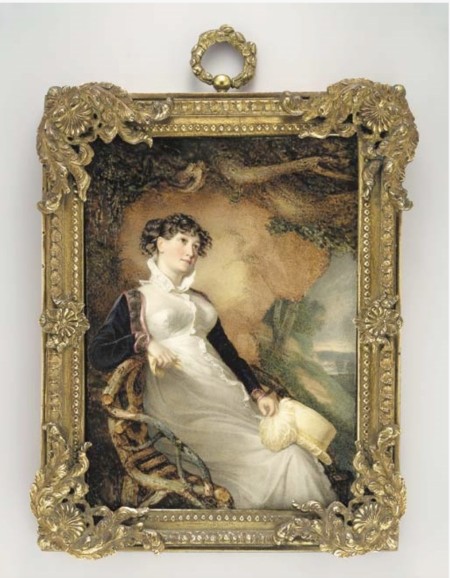
Figure 4. C. J. Robertson, Portrait of Lady Nelthorpe (1813).
Margaret, Lady Nelthorpe turned thirty-three in 1813, and she certainly appears young and blooming enough to resemble Jane Bingley. While Lady Nelthorpe wears a white gown, however, her outer garment, according to the Christie’s curators, is purple with a pink border, and her hat is cream-colored. Greenery is present in the background and could be said to embellish the scene. The “green ornaments” mentioned by Austen, however, must be personal adornments; otherwise, they would not confirm that the color was “a favourite” of Jane Bingley’s (24 May 1813).
As Long notes, Robertson’s “miniature of Lady Nelthorpe” was exhibited at the Royal Academy in 1814 (369). Robertson may have submitted the same artwork two years in a row to different societies, or he may have painted Lady Nelthorpe more than once, perhaps in different sizes or media.
Portraits can be—indeed, generally are—quite flattering. Thus Robertson’s portraits of Lady Anderson (15) and Mrs. Clarke (16) remain candidates for “Mrs Bingley,” though both sitters were aged around forty. We can but hope that these works will yet come to light.
More renowned than Robertson, and consequently better documented, were exhibitor James Stephanoff (c. 1786–1874), who painted Portrait of Miss Smirnove (4), and Society member Thomas Uwins (1782–1857), represented by Girl in a Wood (137), Girl decorating her head with Hops (176), and Girl reading a Ballad (184). As we have explained earlier, the titles of Uwins’s works alone make them quite unlikely matches for “Mrs Bingley.” To enable readers to undertake their own assessment, we have included digital images of several of his watercolors.
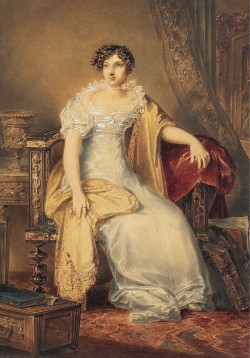
Figure 5. James Stephanoff, Portrait of Miss Smernove (1811).
(Click here to see a larger version.)
Stephanoff, a watercolorist celebrated for his historical scenes, exhibited about 300 works across every London artists’ society in his very long career. The Royal Academy exhibition catalogue for 1812 includes a Portrait of Miss Smernove by him, which may be the same as the Portrait of Miss Smirnove he exhibited at the Society in 1813 (24). The spelling difference in the title is not telling; such an unusual surname could easily have been misspelled by the printers of the Society’s catalogue. At the Society’s 1813 show, Stephanoff also exhibited Portrait of a Gentleman (17).
The image of Portrait of Miss Smernove, signed by Stephanoff and dated 1811 (Figure 5), shows a full-length watercolor. Measuring 17” x 21”, it depicts a young lady in a white gown and a fringed gold shawl, surrounded by symbols of wealth, none of which, alas, is green. We leave it to readers to reach their own conclusions regarding this sitter’s beauty of features and expression. (Bertelsen, who lacked access to an image of this portrait, drew the questionable conclusion that a sitter designated “Miss” would appear too young to match Jane Bingley [“Portrait” 38 n2].)
A prolific artist, portraitist, and illustrator in both watercolors and oils, Thomas Uwins rose to eminence in the Royal Academy with his scenes of country life and Italian peasants, many of which were subsequently engraved. Sales records from the Society’s 1813 exhibition indicate that all three of his paintings on our list found buyers.6 His prices were inexpensive: five to seven guineas, while other artists’ works went for fifteen guineas and up. This significant difference suggests that Uwins’s paintings were smaller and/or less detailed than the works of fellow exhibitors.
As Rainbolt determined, Uwins’s output in the Regency is dominated by picturesque rural scenes rather than formal portraits (38). Figures 6 and 7 show two examples of Uwins’s rural scenes, one an impressionistic sketch, the other highly finished. The latter, for which no title survives, may correspond with Uwins’s A Cottage Door in Buckinghamshire (‘Yon cottager, who weaves at her own door…’), catalogue number 55 in the Society’s 1810 exhibition (Uwins 1: 150). Figure 8 presents Uwins’s watercolor of a girl gathering hops, alongside two engravings of it, one undated and one from 1891. Note that William Finden (1787–1852) altered both the image and the title. That Charles Oliver Murray (1842–1923) engraved the work again in 1891 demonstrates the strong and enduring appeal of the image.
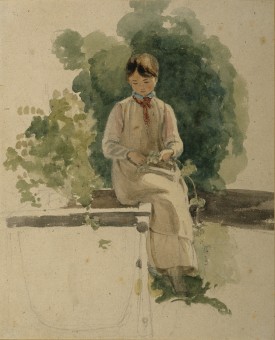
Figure 6. Thomas Uwins, Girl Stripping Hops (date unknown), 9 ½” x 12”. |
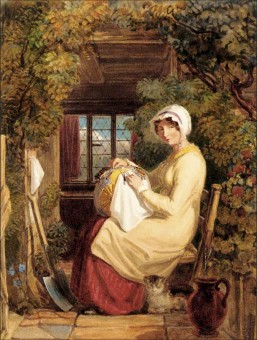
Figure 7. Thomas Uwins, watercolor showing woman making lace (original title and date unknown), 9” x 12”. |
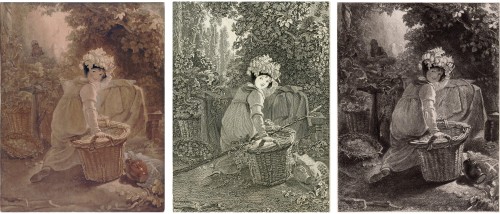
Figure 8. Left to right: Thomas Uwins, The Hop Gatherer (1813), 10” x 13”; William Finden, after Thomas Uwins, The Hop Girl (working proof, date unknown), 5” x 7”; Charles Oliver Murray, after Thomas Uwins, The Hop-Gatherer (publisher unknown, 1891), etching on woven paper, 7 ½” x 9 ½”.
(Click here to see a larger version.)
From 1811 to 1813, Uwins produced a series of watercolors showing hop-fields and farm workers engaged in the harvest, many with similar titles (Uwins 1: 34–36, 1: 150–52). This multiplicity casts significant doubt on Rainbolt’s certainty that she located engravings based on all three Uwins works in the Society’s 1813 exhibition (38). Given that the young girl portrayed in his 1813 watercolor The Hop Gatherer (Figure 8) is adding a stalk of hops to a garland on her head, it may perhaps be the same work that was exhibited as Girl decorating her head with Hops (176). Girl Stripping Hops certainly supports the argument that a sitter described as a “girl” would look far too youthful for Jane Bingley. And, of course, the rustic settings, country pursuits, and stylized features of all these works by Uwins confirm how distant his subject matter was from portraits of gentlewomen.
Hüet-Villiers and Mrs Q
As we noted when reviewing the Society’s 1813 catalogue, two of Hüet-Villiers’s paintings merit consideration as “Mrs Bingley”: Portrait of Mrs. Crompton (3) and Portrait of a Lady (27). We have been unable to find a plausible identification for Mrs. Crompton or any other references to this artwork. If it survives today, it could well be identified only as a portrait of an unknown woman.
We turn now to evaluating evidence concerning whether Hüet-Villiers’s Portrait of a Lady could plausibly, or at least possibly, have been the basis for Blake’s Mrs Q engraving. We will assess the portraits Hüet-Villiers contributed to the Society’s 1813 exhibition in the context of his career: how many works he exhibited, when, and where; the known sizes of his works; and which of his works were engraved and published. We will then correct the historical record concerning the sitter of the Mrs Q engraving, Georgiana Lawrell Quentin, and establish the circumstances of the print’s publication.
Born in Paris to a family of artists, Jean-François Hüet-Villiers (c. 1772–1813) exhibited portraits and animal studies at the Paris Salon from 1799 to 1801 before emigrating to London (Catalogues 1799: 32, 1800: 37, 1801: 34). At the 1803 Royal Academy show, he exhibited portraits of Frederick, Duke of York (King George III’s second son), and his wife, Frederica, Duchess of York, the latter of which is reproduced in Figure 9 (Exhibition [1803] 19). Royal Academy catalogues from 1805 to 1808 identified Hüet-Villiers as “miniature painter to their R. H. [Royal Highnesses] the Duke and Dutchess [sic] of York” (Exhibition [1805] [39]).
While Hüet-Villiers’s most popular works are extant in numerous engraved copies, not many originals survive. Catalogues and engravings make clear that his celebrity portrait subjects included other royal personages, military officers, and theatre and opera performers. Hüet-Villiers’s fashionable miniatures are well represented in modern collections and regularly appear at auction, though few sitters can be confidently identified. Hüet-Villiers also produced large-scale watercolors and oils of landscapes and animal studies, as well as architectural drawings.
Hüet-Villiers exhibited with the Society only once, in the 1813 show Austen attended. Two months later, in July 1813, he died suddenly: “in the prime of life,” according to an obituary (“Death Notice”). We will return to the significance of the seven-year gap between his death and Barrow’s publication in 1820 of the Mrs Q print engraved by Blake.
The five paintings Hüet-Villiers showed in Spring Gardens in 1813 represent but a tiny fraction of his prodigious output, as we have ascertained through our survey of exhibition catalogues. During the decade Hüet-Villiers lived in London, he exhibited at least fifty-four artworks at the Royal Academy; nine at the British Institution’s annual winter shows; and a remarkable seventy-five with the Associated Artists in Water Colours, of which he was an original member, during the five years that organization was in existence, from 1808 to 1812 (Roget 1: 230).7
By our count, among these artworks were seventeen portraits of unidentified ladies. Nine of these, including one of a “young lady,” were exhibited at the Royal Academy; seven at the Associated Artists; and one, of course, at the Society in 1813. If Hüet-Villiers exhibited the original of Mrs Q—and there is no way to know whether he did—the odds are that it appeared in a Royal Academy or Associated Artists exhibition.
That so many of Hüet-Villiers’s portraits of gentlewomen were exhibited without the sitter’s name attached accords with social conventions of the time concerning the display of portraits of individuals at public exhibitions. Austen herself acknowledged concerns of privacy and propriety when, after registering her disappointment that she saw no picture of “Mrs Darcy,” she added, “I can only imagine that Mr D. prizes any Picture of her too much to like it should be exposed to the public eye” (24 May 1813). Catalogues make clear how many sitters consented to the exhibition of their likenesses but not to the publication of their names. The 1814 Royal Academy show, for example, included 339 portraits, with 77 sitters remaining anonymous (Exhibition [1814]). Portraits of private individuals, as opposed to public figures, generally appeared on temporary loan from their owners and were not offered for sale, because such artworks would have had value only to the sitters’ family and friends. The shared understanding was that portraits were exhibited to generate future commissions for the artists, rather than income from sales. As the 1808 catalogue of the Associated Artists’ show declared, “of course, the Portraits are not to be sold” (emphasis in original).8
We have observed in relation to Robertson’s portrait of Lady Nelthorpe that the term “miniature,” as used during the Regency, could certainly encompass what Austen called “a small portrait.” According to Long, Hüet-Villiers produced “large miniatures on marble, about a foot high” (448). Portrait of a Lady in the Character of Hebe,—Miniature on Marble (151) may well have been a similar size. The archives of the Associated Artists in Water Colours confirm that Hüet-Villiers exhibited works between one and two feet in height. In preparation for the organization’s inaugural exhibition in 1808, each member submitted the framed dimensions for all the artworks he or she planned to show (two members, plus additional exhibitors, were women). Hüet-Villiers listed eleven “Miniatures and Drawings,” of which the smallest measured 1’2” high by 1’ wide and the largest 3’ high by 2’5” wide.9 Evidently, Hüet-Villiers himself used the term “miniature” to encompass works of varying dimensions.
The portrait portion of the Mrs Q print measures 11 9/16” x 9” (Essick 191), and Rainbolt surmised that the lost original was similar in size (41). If so, the original would certainly fit in with what we have established of the sizes in which Hüet-Villiers worked.
How engraved versions relate to Hüet-Villiers’s originals in terms of both size and subject matter is illuminated by three surviving artworks and corresponding engravings: two depictions of a woman in the character of Hebe, and the portrait of the Duchess of York that he exhibited at the Royal Academy in 1803. Hebe was Hüet-Villiers’s most popular subject, to judge by the five separate engravings that we have located, which range from 5” x 7 1/2” to 20” x 25”.10 Two distinct originals, neither of which is signed, survive as well: a monochrome drawing with ink wash, 19” x 26”, and a color version in pastels, 20” x 25”.11 Since the model for Hebe has her left breast fully exposed, she can reasonably be assumed to be an actress rather than a gentlewoman; the Yale Center for British Art identifies her as the Irish actress Miss [Elizabeth] O’Neill.12
A rectangular watercolor on ivory, Hüet-Villiers’s Frederica, Duchess of York (1803) measures 4” x 6” (Figure 9). It appears to be the source image for a similarly sized oval engraving published in 1807. Notably, the engraver, Luigi Schiavonetti, not only altered the shape of the portrait but moved the setting outdoors and changed the sitter’s dress. These substantial differences vividly demonstrate that an engraved portrait cannot be assumed to closely reproduce its source—an important point to bear in mind when considering Mrs Q.
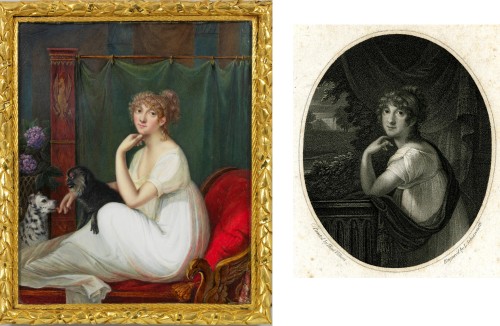
Figure 9. Left, Jean-François Hüet-Villiers, Frederica, Duchess of York (1803). Right, detail of Luigi Schiavonetti after François Huet Villiers, Her Royal Highness the Dutchess [sic] of York (London: Colnaghi, 1807).
(Click here to see a larger version.)
Blake’s engraving depicts Georgiana Quentin, née Lawrell (1784–1853), not, as Rainbolt and others have erroneously claimed, Harriet Quentin.13 The Lawrell family’s wealth derived from the East India Company, and Georgiana’s parents were in the Prince Regent’s circle. In 1811, Georgiana married Colonel (later Sir) George Quentin (1760–1851), who had emigrated from Hanover in Germany. George Quentin became a favorite of the Hanoverian royal princes of Britain, including the Duke of York. In 1811, the Prince Regent appointed him as his aide-de-camp and as commanding officer of the Tenth Hussars (Dodd 330).
As Lloyd explains, miniature portraits were often exchanged between romantic partners. These private tokens affirmed love, embodied desire, and gave comfort during separation (39). In Mrs Q, Georgiana wears no wedding ring on her left hand, although one was added in watercolor in most copies of the engraving (Essick 199). If the original portrait also featured a ringless sitter, Hüet-Villiers may have painted Georgiana Lawrell prior to her engagement to George Quentin, for an earlier admirer. Another possibility, which we consider more likely, is that Col. Quentin commissioned the portrait at the time of his engagement or wedding.14 Since the Duke of York was the patron of Hüet-Villiers and, in a sense, of Col. Quentin, the choice of painter would have been logical. It could also be the case that Hüet-Villiers created the likeness on spec, before or after Georgiana Lawrell married, in the hope that an admirer, not her husband, would buy the portrait.
Mrs Q is unique among engravings of Hüet-Villiers’s portraits in two respects. First, Georgiana Quentin was not a celebrity. While a market certainly existed for cheap reproductions of princesses’ and actresses’ portraits, Mrs. Quentin was a private individual, albeit a socially prominent one. What’s more, as we have noted, almost seven years elapsed between Hüet-Villiers’s death on 13 July 1813 and Barrow’s publication of Mrs Q on 1 June 1820 (the date appears on the engraving). Every other engraving of an artwork by Hüet-Villiers was first published during his lifetime, with one crediting him as co-publisher.15 His portraits of famous people (e.g., members of the exiled French royal family, actors and impresarios, generals and war heroes) were typically engraved and published almost immediately after they were exhibited, as we have determined by surveying catalogues and extant engravings.
The spur to sell, circulate, and profit from Georgiana Quentin’s image in 1820 resulted from the political crisis incited by the unresolved status of the new king’s disastrous marriage. George IV ascended to the throne on 29 January, and in June his long-estranged wife, Queen Caroline, returned to England from Italy to popular acclaim. The King and Queen were enlisted as figureheads in power struggles between Tories and Whigs throughout the summer and fall of that year, with the King’s extramarital affairs frequently invoked by radical Whig partisans and in popular protests (Worrall 169–70; Hibbert 146–57). One of those rumored affairs was with Mrs. Quentin. Amplifying insinuations dating from 1814—the year after Hüet-Villiers’s death—that Col. Quentin may have owed his speedy advancement to his “pretty wife” (George 9: 437), thirteen caricatures published in 1820 and 1821 publicly linked a “Mrs. Q—” or “Mrs. Q—n” to the new king (George 10: 52, 10: 759).
Barrow entered the fray first with Mrs Q and then with a companion print, Windsor Castle, published in 1821 (Figure 10). Painted by Barrow himself and engraved by Georges Maile, Windsor Castle depicts a woman seated at a piano, turning her head to look at the viewer, with the titular royal residence in the background. The sitter has been identified as the elder daughter of the Marchioness of Conyngham, who was the acknowledged mistress of George IV from about 1819 until his death in 1830 (Hibbert 214–20, 324–31).
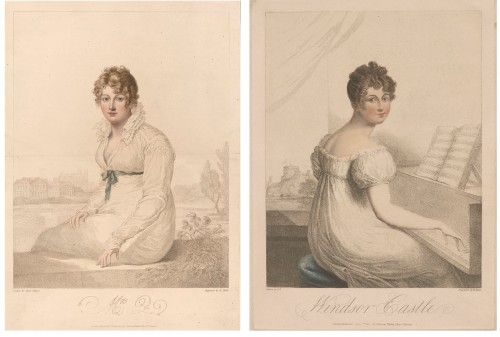
Figure 10. Left, William Blake, after Jean-François Hüet-Villiers, Mrs Q (London: I. [John] Barrow, 1820); right, Georges Maile, after I. B. [John Barrow], Windsor Castle (London: I. [John] Barrow, 1821).
(Click here to see a larger version.)
By choosing the title Mrs Q, Barrow encouraged viewers to remember the caricatures of “Mrs. Q—” or “Mrs. Q—n” and to recognize the sitter as one of the King’s supposed mistresses. Angus Whitehead has contended that Barrow took advantage of the widespread popular sympathy for the Queen to market his new engraving (97 n106). Whitehead speculates, furthermore, that Barrow likely knew Hüet-Villiers and may have owned the original portrait of Mrs. Quentin after the painter’s death in 1813.16 Certainly, the Quentin family would not have loaned the portrait to Barrow to be engraved for publication, so the artwork must not have been in their hands by 1820.
The political goal of Mrs Q—to embarrass and discredit the King by reminding the public of his sexual and romantic history—helps explain several elements of this print which are otherwise puzzling. We have noted in our introduction the eroticizing effects of hand-tinting on several copies, with watercolor added to create the appearance of flesh beneath fabric and even of nipples. Such overt sensuality served Barrow’s purpose, as did the addition of a wedding ring to highlight the implication of adultery. So too did the outdoor setting, with a view across the River Thames toward Eton College, an atypical choice for an intimate portrait. This background implies that the sitter was situated within Windsor Castle, a location strongly associated with the King—and subsequently reinforced by the companion print, which featured a background view of the castle. Since Barrow painted the Marchioness’s daughter himself, it is entirely possible that he also created the background of Mrs Q, diverging from Hüet-Villiers’s original portrait: recall Schiavonetti’s wholesale reworking of Hüet-Villiers’s miniature of the Duchess of York (Figure 9).
Conclusion: Letting go of Mrs Q
Our case against Mrs Q has exposed the significant variations among extant copies of the engraving. As we have argued, these differences make it impossible to infer the appearance of the lost original portrait. We have uncovered the circumstances of the print’s publication, which explain the suggestiveness apparent in many copies. By illuminating the career of Hüet-Villiers, we have conclusively demonstrated that no evidence links Mrs Q with the portrait that so excited Austen when she viewed it on 21 May 1813. We have corrected the historical record concerning Georgiana Lawrell Quentin.
Though we have decisively dethroned Mrs Q, as it were, we have not succeeded in proposing a convincing new candidate. We hoped that an investigation of the Society’s 1813 catalogue with the aid of twenty-first-century digital search tools might yield results unattained by 1980s scholars. In this we have been disappointed. We have uncovered two valuable points of comparison—the portraits of Lady Nelthorpe and Miss Smernove—but, regrettably, no new sitters with lovely faces in white dresses with green ornaments. As portraits long in private hands continue to surface at auction, and as more images become digitally available of works held in collections, it is conceivable that one may correspond to Hüet-Villiers’s Portrait of Mrs. Crompton or Robertson’s portraits of Lady Anderson and Mrs. Clarke.
We call on museum curators to update their records for copies of Mrs Q so that both artist and sitter are accurately identified. Scholars and fans, we ask for your help in spreading the word that Mrs Q has no verified connection with how Austen imagined Jane Bingley. Which portrait struck Austen as being as “exactly” like Jane (24 May 1813)? We are all as eager as ever to know.
NOTES
1Deirdre Le Faye’s endnote for “the Great Exhibition” incorrectly identifies it as “the British Academy exhibition at Somerset House, which opened 3 May” (424 n5); the hosting organization was the Royal Academy. For a speculative virtual reconstruction of the Reynolds show viewed by Austen in 1813, see Janine Barchas. Catherine Roach has illuminated the judgment calls and pitfalls inherent in any such endeavor to reconstruct an historical art exhibition.
2Blake, the visionary artist and poet, took engraving jobs to make ends meet (Whitehead 94 n93).
3Hand coloring could also be added later by or at the behest of an owner, as is the case with the copy of the Mrs Q print held by the Morgan Library & Museum (Figure 1, top left). A penciled note signed “F. L.” and dated 29 May 1884 on the reverse of the sheet records that, because the original had been printed in “a very inartistic manner . . . , Miss Kate Greenaway has been so kind as to complete the colouring & to neutralize as far as lay in her power the original brick dirty red on the face & neck” (Essick 194). Essick has identified “F. L.” as Frederick Locker-Lampson; Kate Greenaway (1846–1901) is the noted children’s author and illustrator. It is unknown whether the title portion of this copy was trimmed away at the same time.
4The son of the artist Jean-Baptiste Hüet (1745–1811), Jean-François added “Villiers” to his surname. Period and modern print sources variously render his name as “Villiers Huet,” “V. Huett,” “François Huet,” “Huet Villiers,” “François ‘Villiers’ Huet,” “François Villiers-Huet,” and “J. Huet, Villiers.” These variations pose a considerable challenge to the effort to build a comprehensive list of his artworks. We refer to him as Jean-François Hüet-Villiers, based on his signature to the letter quoted in note 7.
5For the differential terms on which the Society admitted women and men as associate exhibitors, see “Exhibition of the Society” (33).
6The Society recorded works’ sales in specially bound versions of the exhibition catalogue; those for the 1805–16 exhibitions are bound into one volume (Archives of the Royal Watercolour Society, C1).
7The Associated Artists, intended by its founders to be a democratic alternative to the exclusionary Society (Wilcox 56), took pains to inform the public in the catalogue for their first show that “[t]he whole of the works forming the present Exhibition, are new to the Public.” (Catalogues from exhibitions of the Associated Artists in Water Colours from 1808 to 1812, bound together into a single volume, are held by the National Art Library, Victoria and Albert Museum, London, 200.B.314.) Hüet-Villiers’s correspondence demonstrates that he took very seriously the responsibility of contributing as many high-quality works as possible to the Associated Artists’ shows. “None of its member [sic] can be more anxious to Support it than myself,” he averred in 1809, promising that “the number of pictures I could Send next exhibition . . . will be at Least equal in number to those I have Sent this year, and certainly more Capital” (J. Hüet-Villiers to J. Papworth, 22 June 1809, National Art Library, Victoria and Albert Museum, London, MSL/1907/912/296).
8National Art Library, Victoria and Albert Museum, London, 200.B.314.
9J. Hüet-Villiers, “Miniatures and Drawings,” National Art Library, Victoria and Albert Museum, London, MSL/1907/912/157.
10Charles Turner, mezzotint etching after Huet Villiers, Hebe (London: T. Macdonald, 1814), 19 7/8” x 13 3/8”, British Museum, London, 1977,U.1242; H[enry] Dawe, mezzotint engraving after Huet Villiers, Hebe (publisher unknown, apparently from a set, c. 1810s), 7 ½” x 5 1/8”, British Museum, London, 2010,7081.4809; Charles Turner, after François Huet Villiers, mezzotint engraving depicting Hebe (London: Huet Villiers; Colnaghi, 1811), proof copy before title, 30” x 20”, British Museum, London, 1867,1012.147.+; H[enry] Meyer, color engraving after Huet Villiers, Hebe (London: S. Knight, 1814), 20 1/8” x 14 ¾”, “from the original in the possession of T. Harper Esq.,” British Museum, London, 2010,7081.7222; E. F. Lambert, lithograph after Huet Villiers, Hebe (London: S. Knights, 1826), 8” x 5 7/8”, British Museum, London, 1875,0213.309.
11François Huet Villiers, untitled painting depicting Hebe (unknown date), watercolor, British Museum, London, 1953,0918.1; Huet Villiers, Portrait of the Goddess Hebe (c. 1810), pastel drawing, listed for sale by OneTwoThreeJewels, https://www.etsy.com/listing/1498463026/huet-villiers-pastel-portrait-goddess, retrieved 25 July 2025. The latter, which is accompanied by a contemporary ink inscription noting that “this picture was engraved by Hy. Dawe,” may be the work Hüet-Villiers exhibited in 1809 with the Associated Artists as “Hebe; in Chalk” (National Art Library, Victoria and Albert Museum, London, 200.B.314). An undated engraving of “Hebe” by Henry Dawe after Hüet-Villiers is held by the British Museum (2010,7081.4809).
12Charles Turner, after François Huet-Villiers, Miss O’Neill as Hebe (1811), mezzotint on paper (proof copy without inscription), Yale Center for British Art, New Haven, Paul Mellon Fund, B1970.3.677.
13The confusion about Mrs. Quentin’s first name results from the conflation of her with the famous courtesan Harriette Wilson by a scurrilous and pseudonymous 1822 pamphlet purporting to be the “Memoirs of the Life of the Celebrated Mrs Q—.” This wholly fictional “memoir” used disguised names throughout, featuring as protagonist “Harriet W—n.” It also included a pirated re-engraving of Blake’s Mrs Q. Though the British Museum gives Mrs. Quentin's first name as Georgina, primary sources consistently use the spelling Georgiana. For a fuller account, see Yoder.
14Of the seventeen portraits of unidentified ladies that, as we have noted, Hüet-Villiers contributed to British shows, five were exhibited between 1810 and 1813. We reiterate that there is no way of knowing whether he ever exhibited the original of Mrs Q.
15Charles Turner, after François Huet Villiers, Hebe, “published June 1811, by Huet Villiers, 36, Gt. Marlborough Street, & by Messrs. Colnaghi & Co., Cockspur Street, Charing Cross.” Proof made before title was added, British Museum, London, 1867,1012.147.+.
16Recall the possibility that Hüet-Villiers created the portrait of Georgiana on his own initiative but failed to find a buyer. If he then kept it, it would have been sold with his effects after he died, as was common practice. Because his death was sudden and unexpected, he would not have had time to dispose of his works himself.
