
Austen Chat: Episode 33
March 5, 2026
Jane Austen & Needlework: A Visit with Jennie Batchelor
"Elizabeth took up some needlework, and was sufficiently amused in attending to what passed between Darcy and his companion." —Pride and Prejudice
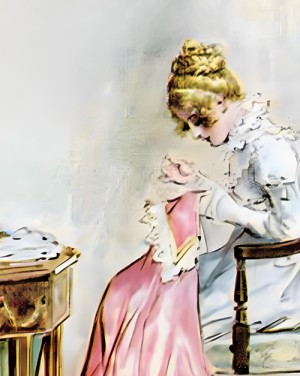 Jane Austen often wove needlework and other domestic crafts into her novels in thoughtful and meaningful ways. In this episode, Professor Jennie Batchelor joins us to discuss Austen’s own skill with a needle and explore how she used such “women’s work” to reveal her characters’ strengths and flaws, illuminate their social and power dynamics (think Mrs. Norris and Fanny Price), and reflect their thoughts and feelings.
Jennie Batchelor is a professor of 18th-century and Romantic studies and Head of English and Related Literature at the University of York. She was also the inaugural Postdoctoral Fellow in Women’s Writing (1660-1830) at Chawton House Library and the University of Southampton. She has published widely on women writers of the eighteenth and nineteenth centuries, on early magazines, and on women’s work, dress, and craft. In 2020, she published Jane Austen Embroidery with Alison Larkin, which includes 15 stitching projects based on 18th-century patterns.
Show Notes and Links
Many thanks to Jennie for joining us on Austen Chat!
Related Links
- Learn more about Jennie and her work on the University of York website.
- Follow Jennie on Instagram @batchelorjennie and on Facebook Lady's Magazine Project.
- Read about the 2025 Austen and Turner exhibition co-curated by Jennie Batchelor in this illustrated essay: "Austen & Turner: A Country House Encounter." Jennie Batchelor and Chloe Wigston Smith. Persuasions On-Line, Vol. 46, No. 1 (Winter 2021).
Related Reading
-
"Stitching Women: A Short History of Embroidery and What It Means in the Novels of Jane Austen." Robin Henry. Persuasions On-Line, Vol. 42, No. 1 (Winter 2025).
 Listen to Austen Chat here, on your favorite podcast app (Apple Podcasts, Spotify, and other streaming platforms), or on our YouTube Channel.
Credits: From JASNA's Austen Chat podcast. Published March 5, 2026. © Jane Austen Society of North America. All rights reserved. Illustration by C.E. Brock for Mansfield Park, J.M. Dent & Co., 1908, cropped. Theme Music: Country Dance by Humans Win.
Transcript
This transcript has been lightly edited for clarity and readability.
[Theme music]
Breckyn: Hello, Janeites, and welcome to Austen Chat, a podcast brought to you by the Jane Austen Society of North America. I'm your host, Breckyn Wood, from the Georgia region of JASNA. My guest today is Jennie Batchelor. She is a professor of 18th century and Romantic studies, and head of English and Related Literature at the University of York. She was also the inaugural Postdoctoral Fellow in Women’s Writing (1660-1830) at Chawton House Library and the University of Southampton. She has published widely on women writers of the 18th and 19th centuries, on early magazines, and on women's work, dress, and craft. In 2020, she published Jane Austen Embroidery with Alison Larkin, which includes 15 stitching projects based on 18th century patterns. Welcome to the show, Jennie.
Jennie: Hi, Breckyn, nice to be here. Thank you for having me.
Breckyn: Yeah! Okay. So, to start, can you tell us a bit about your Austen origin story? When did you first encounter her works?
Jennie: Well, I would love to say it was through the books first but actually it was through an adaptation. I think it's true of many more people than care to admit it. But I was nine years old; I can pinpoint it precisely—I'll explain why in a sec. I was nine years old, and my mum and my sister and I loved old movies. My dad really loved sports, and, because my dad loved sports so much, we couldn't talk when sport was on in the house. On a Sunday afternoon, we would head up to mum's bedroom with a very, very, very bad, old black and white television that didn't work terribly well. But we used to watch black and white movies on it, and one Sunday afternoon they happened to be showing the Greer Garson/Laurence Olivier Pride and Prejudice. So, we watched it, and I don't think I'd ever heard of Jane Austen before that point, and we watched the movie, and I just completely fell in love with it. I thought it was so funny. Yeah, I thought it was so funny. I didn't realize at the time that the dresses were all wrong, and they were like cast-offs from Gone with the Wind.
Breckyn: Yeah, they make me laugh every time.
Jennie: But I just loved them. But mostly—I loved the wit, I loved the warmth— but I mostly loved, as everyone does, Elizabeth Bennet. I loved that she did archery, even though then I found that she doesn't do it in the book, but, you know, I just loved everything about it, and I just became really intrigued by it. And I think I must have asked my mum some questions about it. We didn't have any Austen novels in the house, but mum had read—I think my mum had read Pride and Prejudice and probably Sense and Sensibility. But in any case, the reason why I know I was nine is because I became so obsessed I asked for the novel for my next birthday, my 10th birthday. So for my 10th birthday, my mum and dad got me—I've still got it downstairs, it was actually like the—it's a two-volume set with illustrations, like 19th-century illustrations of Jane Austen's novels. And the first volume is really weird. It's like it's chronologically—so it's Pride and Prejudice, Mansfield Park and Persuasion. But that was what I got when I was 10 years old, and then I read Pride and Prejudice. It took me a long time to get around to reading the others, but that was where it all started.
Breckyn: Ten is young to start reading Austen. That's awesome. My mom got me a complete set of Jane Austen, like in one volume, when I went for my 16th birthday, because I had watched the Keira Knightley Pride and Prejudice. That was my gateway drug. So, it's okay; it's okay if adaptations—because now I've read all of the books many, many times. But I watched that movie, fell in love with it, and then for my 16th birthday, my parents got me the complete set, which was really nice. What a great origin story. I love—that black and white adaptation is something else. It's a lot of fun.
Okay, let's talk embroidery. I actually have recently gotten into embroidery, and I quickly got obsessed. I think it's like really slow, meditative coloring. You know how adult coloring books became a thing a while ago? I feel like embroidery is the next level of that. And so I just picked up a $5 kit, and it was really easy to get started. But what kind of embroidering and other needlework would Austen and her characters have been doing?
Jennie: Yeah, well, so many different kinds of it. Let's think about Austen, maybe first of all. We're quite lucky in that we've got some surviving examples of needlework that either we know for sure she did or that she was—almost certainly are needleworks that were by her. We can say with confidence the kind of stuff that she was doing. And, of course, we've got lots of references in her letters to supplement what hasn't survived. So, like all women of her generation and like all of her women characters, she would have known how to do, broadly speaking, two kinds of needlework. In the broader sense, would be plain work and then fancy or decorative embroidery.
Plain work is keeping and maintaining household linen, which isn't just tablecloths and napkins, it's things like men's shirts. Jane Austen talks about making Edward's shirts, and being the neatest in the party, and that kind of thing. She was very good at that—and things like handkerchiefs and so forth. But decorative embroidery and needlecraft is another kind of needlework that would have been practiced at the time. There is—in Jane Austen's House in Chawton, there's a beautiful Indian whitework shawl with these beautiful satin stitch crosses on it, which we don't know for 100% sure if that's Austen's work, but family legend has it that it was her work. There's also in Jane Austen's House that beautiful medallion quilt that she seems to have made with her sister and her mother.
So, there's different kinds of needlework but that's just—in a sense—that's kind of the tip of the iceberg, because, in addition, characters in her novels do this. We have examples in her novels of characters doing knitting, like Mrs. Smith in Persuasion, who's taught knitting by Nurse Rooke; things like carpet work, which Mrs. Jennings and Fanny Price have in common; and much more elaborate kinds of needlework. There's a whole different range of different kinds of needlework for different kinds of functions: from the purely utilitarian or largely utilitarian to decorative and beautiful embroidery, and any and everything in between. There's just—there's a lot of needlework in Austen's life and in her novels.
Breckyn: Well, I'm so glad I have you here because we've already run into a term that I don't know. What is carpet work? Are you making a carpet? Are you working with material that is carpet-like? Does carpet mean something completely different?
Jennie: It doesn't mean—it's not carpet work in the sense of the carpet that's under my feet right now, but it's the kind of—I mean, there are people who still do carpet work today. It's like a sort of pulling through of materials through to make different kinds of upholstered furnishings, as it were. Yeah, so that's the sort of—there could be incredibly decorative work, carpet work. There's lots and lots of different kinds of work at this time. I mean, one of the things that's really important to remember in an Austen novel, I always think, is that each different kind of needlework that's practiced would have been so familiar to her readers at the time when she was doing it, that it sort of conveys certain kinds of nuance and meaning and so forth that it's quite easy to lose as a modern reader, you know?
Breckyn: Can you tell us—why do you think it's interesting? What does carpet work say about Mrs. Jennings as a character? Because that's golden literary analysis that you can shed some light on for us.
Jennie: Well, I don't know so much—I find Mrs. Jennings the most peculiarly opaque character in all sorts of ways. I don't know that it tells an awful lot about her. It's the fact that she shares this with Fanny Price, I guess, which is more interesting. Fanny Price, to me, is the more interesting person here because she is a bit like Austen, really. She is somebody—in needlework terms, at least, she can run the whole gamut of these skills, right? So, she will do anything and everything, including all the stuff that no one wants to do, like running up seams, which is like—in the pecking order of needlework—is the lowest of the low, which is why she's so darn useful. Because Fanny will just do the stuff that nobody else either has the skills or the inclination—
Breckyn: Like the workhorse of the family.
Jennie: Yeah. Yeah, she can do it, but then she goes right the way through. You mentioned carpet work, but you know she also does other kinds of needlework in this novel, and she can do things that are really, really practical to the highly skilled and potentially decorative needlework. There's an incredibly interesting scene, I always find, in Mansfield Park, where—there are all sorts of moments in many of Austen's novels where needlework gets brought out or needlework is around when something emotionally really quite difficult is happening. And poor old Fanny Price has a lot of emotional difficulty in Mansfield Park. And there's a great moment when Mary Crawford, who isn't necessarily known for her empathy, I guess, in some senses, can see, can just see how excruciating things are for Fanny Price in that moment and comes to her, and they end up having a sort of coming together around looking at a piece of needlework that Fanny Price is working on, which is actually nothing to do with the needlework itself, I don't think, or what the actual kind of needlework is. But it's a wonderful moment where it becomes a point of connection between these two women who ordinarily—I mean, they're rivals, right? They're rivals in this novel, but there's this moment where you think, "Actually, Mary Crawford—there's more to Mary Crawford than meets the eye. Maybe in another novel they would be friends."
So, I don't know, there's a whole range of things here which are about the specifics of the kind of needlework that people are doing, and what that may or may not tell us about the characters. You know some people do really good needlework in a Jane Austen novel, and we understand that as a marker of their skill and ingenuity. Elizabeth Bennet is pretty good at needlework, and we all like Elizabeth Bennet. And there are some women who are really bad at it, and it tells us something bad about them. And then there are, sort of—I don't know, there's a lot of nuance around all of these different examples. Austen's always using needlework, I think, in a way that is more than just the detail of the thing itself.
Breckyn: Absolutely. Yes, it's deliberate and subtle. No, I like what you said about how there's always something else going on beneath the surface. Another example I thought of from Mansfield Park is when Fanny Price is slowly starting to be intrigued by Henry Crawford against her will. It mentions that he's reading aloud, and she's doing needlework, and slowly the needlework gets slacker and slacker in her hands, and she's kind of ignoring it as she is clearly—she's trying to act like she's not listening and she's not paying attention, but you can tell by the needlework—it's sort of this metaphor for what's going on inside of her. Which is interesting.
Jennie: That's a really great example, and that's a very specific one where, as you say, materially, you get a kind of access to her—what's going on in her mind—through what's actually being produced by her hands. And there are lots of other moments that aren't quite as literal as that but where you get—I mean, Elizabeth Bennet does the same thing, right? Needlework is often a cover, you know. It's something that women are doing, but while they're doing it there's usually something else happening at the same time. And so, women can be engaged—as Elizabeth Bennet is when she picks up her work and she's listening to Caroline Bingley talk to Darcy—and it's allowing her to observe, to digest, to really get a grip of the dynamics of what's going on around her, while seemingly she's doing something else entirely. It doesn't look like that's what she's doing, but we can see as readers that that's exactly what she's doing. Or there are other times when needlework, or indeed other craft activities, are used by Austen characters because they really want to keep something hidden, so that they can look as if they're—as you say, like Fanny Price can look as if she's absorbed in her work.
But actually, what we can see in the work that she's doing is that she's unraveling, but she's trying not to look like she is, and needlework is a kind of cover there.
Breckyn: Absolutely. Unfortunately, needlework and other women's domestic crafts are often viewed as these tedious, oppressive things—like activities that women were forced to do that they didn't really enjoy. At least that's how they're usually portrayed in historical fiction written by modern authors. But what are your thoughts on that? I think that that's an unfortunate—like, we've kind of thrown the baby out with the bathwater in doing that.
Jennie: Yeah, I think that's right. I mean, okay, lets—I mean, we have to be mindful here that there were definitely women in Jane Austen's lifetime who felt exactly that same way about needlework: that it was oppressive, it was something that women were supposed to do to keep their hands busy and stop their minds from growing and developing. And that's certainly how people like—for instance, Mary Wollstonecraft in A Vindication of the Rights of Woman, is really, really, really concerned and writes very powerfully about how women should be allowed to cultivate their minds. They shouldn't just be forced to spend their leisure in these, as she saw it, quite enervating, tedious, repetitive activities. Of course, there are lots of women who have to earn a living by sewing of different kinds in this period. And I'm sure not all of them thought that this was a wonderfully creative, meditative practice for them to be involved in. But I think, like you say, I think that narrative has just become the dominant one. And that's a real shame, because what that doesn't allow us to see, if we just hold on to that, is the number of women for whom this kind of needlework was a hugely important creative outlet, actually.
And I would put Jane Austen in that category, both herself but also some of the characters in her novels as well. One of my very favorite anecdotes about Jane Austen, which I'm sure many people listening to the podcast will know, is one by Marianne Knight, one of her nieces. She talks about being at Godmersham Park, which is Edward Austen Knight's house where Marianne lived, and Marianne and Jane Austen are sat by the fireside in Godmersham. They're sewing together—didn't say what but presumably embroidery—they're sitting together by the fireside. And Marianne Knight recalls Jane Austen bursting out laughing, putting her needlework down, running to the table that was right next to them, scribbling something frantically, and then going back to her needlework. And I just love that story because, for me, it's a wonderful—it wonderfully encapsulates what I see in her fiction, what I see in her letters and in some of the characters in her novels, where writing and sewing—pen in one hand, needle in the other—these things are mutually reinforcing activities. It's not like you turn your brain off when you sew. I guess you could if you wanted to, but one of the things that a lot of people who do various kinds of crafts now, including needlecraft, say is that one of the things that's great is your hands are doing one thing and your mind can do another. And Jane Austen's novels show characters doing that all the time. And sometimes their thoughts can be uncomfortable or difficult ones, like Fanny Price experiences, but sometimes they can be hugely creative. Who knows what Jane Austen was going to the table to write, but it could have been one of her novels. It creates a space for thinking and reflection.
And also, I think the other thing is that there's a very big difference, obviously, between women who are doing this as a leisured pursuit. We often have this—the other image I think we often have about needlework in this period is that women are sitting there in absolute silence doing needlework because they have to. But read Jane Austen's letters. These are often—I mean, of course, some women sewed on their own, but usually this is a sociable activity. You know, Fanny Price is sewing in front of Henry Crawford. Elizabeth Bennet has got the Bingleys and Darcy around her. And when women come together and sew, there's gossip, there's chat, there's laughter, there's storytelling. You know, it's a sociable activity. It's not about silence and repression, or at least it doesn't have to be. And I think we get a lot of that wrong if we focus on those for whom needlework represented something very different. But it meant different things to different people, doing it in different contexts and for different reasons.
Breckyn: Absolutely. And I see a parallel here with her as a pianist as well. I mean, she's good with her fingers. She's nimble. She was a lifelong pianist. Piano was something that maybe also allowed her to take a break from her writing and think about something else, or maybe do something with her fingers and still think about her writing. I think it could be both. Like this sewing and needlework can be a break and a reprieve to quiet your mind, or it can also be something to keep your hands busy while your mind is really active. I think it can serve both of those benefits, like the piano did for her.
So that being said—talking about how these domestic crafts don't necessarily need to be this like, oppressive sort of activity, I do want to mention how Mrs. Norris uses needlework as a way to constrain an oppressed Fanny, which—it's not needlework's fault. Clearly, Mrs. Norris is the one at fault here. But there's just several scenes, and it's really good. So, one of them is where she's been going back and forth all day, like running errands for Mrs. Norris and for Lady Bertram. She's got a headache so she's lying down on the sofa, and Mrs. Norris says, "That is a very foolish trick, Fanny, to be idling away all the evening upon a sofa. Why cannot you come and sit here, and employ yourself as we do? If you have no work of your own, I can supply you from the poor basket." And then she goes on about, like "I've just like—I nearly—I almost broke my back by cutting it out."
And, of course, this is insane and ridiculous because Fanny has been working all day at Mrs. Norris's beck and call. So that's one example. And I want to talk too— come back to it—about the word "work" and what it means, because I think that that's something that also can get lost on modern readers— that Jane Austen never uses the word "embroidery." She sometimes says "needlework," but I did a word search, and that phrase that we use now, she never uses it in the novels. But whenever she's talking about "work," almost exclusively it means needlework, is that right?
Jennie: Yeah, exactly. If you go back to an Austen novel and look at the number of times that she uses—well, she refers to characters being "at work" or "picking up their work," or, yeah, it almost, as you say, invariably it means needlework, and that's really common. I mean, "work" is the cultural shorthand of the day—and had been for many decades before she started writing—for needlework. And I think Jane Austen is really attuned to the implications of that. So again, I guess this takes us back to what we were saying before about different women having different experiences of doing needlework. If you take a Mary Wollstonecraft kind of view, confusing women's work as if the sum objective they could—like the main objective they could have in life is to do needlework—to confuse those two things, like needlework is women's work, that's what women are supposed to do—that's a problem, right, for somebody like Wollstonecraft; I can completely see that. But I think one of the things that Jane Austen is really interested in, and I guess this comes—I think this comes across really strongly in that quotation that you just read out—she's someone who's really interested in women's work and how characters in her novels, how society at large, values or doesn't value women's work.
And I think one of the things that Jane Austen is really—because, you know, people will say, "Well, you know, there aren't many laboring women in Austen's novels." I mean, Jane Fairfax having to contemplate being a governess is like the worst thing. It's so bad the only thing you can do to stop yourself from doing that is marry Frank Churchill, which is just as ghastly a decision to have to make, I think, but anyway . . . So, you know, work is this sort of specter, paid work is this sort of specter, and we don't want women to fall into work because that would be disastrous. But I think Austen is really attuned, and her novels are really attuned, to how society may not appropriately value different kinds of work that women do.
Mrs. Norris is a really good example of this. As you've just said, Fanny is the most diligent, hardworking character—you know one of the most hardworking, diligent characters in all of Austen's fiction. She's been working all day long, and Mrs. Norris is not recognizing any of that. There's so much irony in those brief lines that you quoted. Saying, "Fanny, you shouldn't be idling away on the sofa." What we all know, and we're laughing at when we read that, is that she's really talking about Lady Bertram. When Lady Bertram is—yeah, she's always on her sofa. And what is she doing when she's on her sofa? Well, she's sewing things, you know, "some long piece of needlework of little use and no beauty." She's a terrible needleworker.
So, you know, there are so many layers of irony there that are making—where Jane Austen is, by the careful repetition of words and echoes and returning to the sofa, putting it together with sewing, making us think about Lady Bertram. What she's doing, I think, in a really ingenious way—she's making us think about, "Okay, what are women doing in this novel? Who are the women we respect? What do we respect them for? What is the work of women in this novel? And whose work gets valued and whose doesn't," you know? And Fanny Price clearly is somebody who is industrious, can do all of these things, and we are being invited to value and like and respect. So, yes, I think it's a really—I think the question of—she's really interested in needlework, and she always uses needlework in really interesting ways. I think it's also a way for her to engage in these bigger conversations about what women do with their time, how the things that they do are valued or not valued.
And I think her novels have some really interesting and sometimes quite provocative things to say about that.
Breckyn: Yeah, absolutely. And everything that Mrs. Norris does is—like, Fanny will work quietly all day in the corner and not expect any praise or attention or thanks for what she does. But everything that Mrs. Norris does, she has to announce it five times and talk about how she's nearly breaking her back. And so she uses needlework and her work as a way to sort of bludgeon everybody to pay attention to her. Like another scene is later when William, Fanny's brother, is trying to tell everybody about his adventures at sea, right? They haven't seen him for years, and he's come back with these tales. It says, "With such means in his power he had a right to be listened to; and though Mrs. Norris could fidget about the room, and disturb everybody in quest of two needlefuls of thread or a second-hand shirt button, in the midst of her nephew's account of a shipwreck or an engagement, everybody else was attentive." I love that part so much. So, again, it's just like, it has to all be about her, and even if we're talking about two needlefuls of thread, she's going to walk in the middle of the room and make everybody pay attention to her.
And so again, this needlework or—she's using it as an excuse for something else, for something larger. It's a representation of the greater flaws in her character.
Jennie: Yeah, that's right. And, generally, I would say bad needleworkers in Austen's novels are people that we're not supposed to give much time to. Like Lady Bertram is a good example. You know, there are other—I mean, Charlotte Palmer is quite good at needlework in Sense and Sensibility.
Breckyn: We're going to talk about her silk landscape? What is that?
Jennie: Oh, well, so stitched pictures was a whole beautiful genre of needlework at the time and could take many different forms. So, there are lots of surviving stitched pictures from this period. Some are—so landscapes, which is what Charlotte Palmer does, a landscape in colored silks. So silk shading, so using a variety of different stitches, sometimes combined with other craft forms. Sometimes people might, for instance, do a stitched picture of a figure, like a portrait of an individual, where perhaps the face was done—was drawn or in watercolors, and then they would stitch the clothing and the trees and the garden or whatever.
Breckyn: That's cool.
Jennie: Yeah, or they could be entirely stitched. Many schools that taught decorative embroidery in Britain, but also in America, would have different—would teach how to do various kinds of stitched pictures. Some pupils would stitch pictures of the school that they attended, or landmarks in the town, and so forth. We don't know exactly what this stitched picture is that Charlotte Palmer does. We know it's good, and it's on show.
Breckyn: I have the line about Charlotte from Sense and Sensibility. It says, "Over the mantelpiece still hung a landscape in colored silks of her performance, in proof of her having spent seven years at a great school in town to some effect." Again, she just always with these lines, with these like multi levels of irony—we just talked about how, like, Austen really cares about women's work, and she values it, and she uses it. But then she's also—this is kind of a slam at women's education, right? Charlotte goes off for seven years, and this is all—like, literally, she's got the T-shirt. This is all she has to show for it—of her, quote, unquote, education.
Jennie: Exactly. And I think sometimes, again, that's a quotation that could very often—you could see quite clearly how people could read that and think, "Oh, this is Jane Austen being disparaging about needlework, and, you know, this woman who's sort of pretty, seems quite—well, she has nothing else to show for herself after all those years, except for this stitched picture." But I don't think that's the point at all, and certainly not if you take it in the context of the other novels. No, because I think what she's saying is the problem with Charlotte Palmer is she's got the skills to do the needlework, but she's got nothing else. She's got nothing else to show for herself. So, the really good needleworkers, the characters who are really good at needlework and who we really admire in Austen novels, are always women like Fanny Price, like Elizabeth Bennet, who combine wit and intelligence and other skills of the mind as well as the hand. Like it's the two things coming together. It's like Austen sewing, going to the table, writing, coming back again. You have to have the two things together. If all you can do is stitch a picture, but you can't engage in intelligent conversation, or you don't read, or you're not interesting—I mean, what on earth is it for, you know?
But she doesn't see a kind—these two things, as I say, always go hand in hand, I think, for Austen. So, you know, that's Charlotte Palmer's problem. It's not that, "Oh, isn't it a shame that she's done it? She's really good at needlework, therefore she must be really, really stupid." It's like, "Well, she's done a really, really bad—she's done a really great picture and she hasn't properly educated—." It's not a "but," it's not...
Breckyn: It's not mutually exclusive.
Jennie: It's the two things. No, exactly. I think that that's part of the problem. If she'd been able to do a great stitched picture and had actually learned something at school—
Breckyn: Yeah, then we'd be having a different conversation—
Jennie: It'd be a different story.
Breckyn: —about Charlotte Palmer. Yeah, no. Absolutely. Let's talk about some other domestic arts and crafts from the Regency period. You gave an excellent plenary lecture at the Jane Austen Summer Program last year that I was privileged to attend. It was entitled "Much use and more beauty": Transatlantic Domestic Arts in the Era of Jane Austen. And now—so that title, you already did the quote, that's a reference to Lady Bertram, right?
Jennie: Yeah, yeah. Exactly.
Breckyn: Because she did—she sits around doing things "of little use and no beauty."
Jennie: "And no beauty." Yeah.
Breckyn: It was just like a double slam on her. So what are some of the arts and crafts besides needlework that you discussed in that talk?
Jennie: Well, actually, part of the problem in doing the talk was that there were so many that I could have talked about, and so I had to narrow it down. So in the talk I specifically focused—I did do some stuff about needlework, particularly embroidery, so I didn't talk about knitting and carpet work and other things. But some of the other crafts that I talked about included drawing, which is very prominent in many of the novels. There's a lot of drawing, particularly in Sense and Sensibility, with Elinor Dashwood, who is very adept at drawing, and uses drawing in a really interesting way to claim ownership of their new home when they're dislocated after their father's death. Elinor is also good at other crafts as well, of course. There's that wonderful moment where she paints those—
Breckyn: Screens?
Jennie: The screens, yeah, which, you know, Mrs. Ferrars thinks are absolutely wonderful until the moment when she realizes that Elinor has made them. And then, of course, she's absolutely obliged to just, sort of, you know—
Breckyn: Push them aside.
Jennie: —disparage them and push them away, you know. And that's another great example—another kind of technique that Austen uses repeatedly in her novels, where there are several moments where characters are talking about things that women make, and they're not talking about the things.
They use the thing as a way to talk about the woman who's made them. So, that's another example. So, I talked a lot about drawing and a little bit about painting. Another thing I talked about quite a bit because I'm really interested in it is filigree.
Breckyn: Tell us what that is. What is filigree?
Jennie: Well, I'd love to be able to do this and to do it well, but I'm going to stick to sewing for now because I'm a bit better at that. But I guess right now in America it's more commonly called "quilling." So this is when you have rolled papers that you can roll in different ways to produce different kinds of shapes and swirls and effects in the paper, that you would then pin and glue onto particular objects to decorate them. So, you often see in museum collections now, you might see filigree tea caddies, for instance, or—There are some extraordinary, extraordinary filigree works that are done by girls and young women and married women from Jane Austen's lifetime, that include other media, like painting and wax and other things, to create really wonderful sort of three-dimensional pictures, or screens, and other things. And you can also make sort of utilitarian—beautiful utilitarian objects as well with filigree work, so as well as tea caddies, baskets, and of course, that's the Austen reference because there's a filigree basket in Sense and Sensibility that gets mentioned. So, I'm really fascinated by this. It's really lovely. You know, it was a really intricate craft form. Still is. You know, you could make the papers from things that you had at home. You could buy papers. You might dye your own papers for filigree work, and you could do them in all sorts of lovely colors if you wanted to. You'd have to cut and roll them.
Breckyn: I was just going to ask how does it stay long-lasting or sturdy, if it's just paper? Like, rolling it up sort of reinforces it, but would they lacquer it? Or how does it last?
Jennie: Well, yeah. So, I mean, some of the paints would have acted as a kind of preservative as well.
Breckyn: Well, so you mentioned it, and I really enjoyed what you had to say in your talk about the filigree basket from Sense and Sensibility, because it only increased my dislike of Lady Middleton. It's a very long quote. I'm going to truncate it a little bit, but I'm going to read—here's the scene from Sense and Sensibility. Lady Middleton says, "'I am glad,” said Lady Middleton to Lucy, 'you are not going to finish poor little Annamaria’s basket this evening; for I am sure it must hurt your eyes to work filigree by candlelight. And we will make the dear little love some amends for her disappointment to-morrow, and then I hope she will not much mind it.' The hint was enough, Lucy recollected to herself instantly," and she makes some excuse. And she's like, "No, I would never do that to little Annamaria." And so she's going to start working on it right away, as soon as Lady Middleton snaps her fingers. And Lady Middleton says, "'You are very good, I hope it won't hurt your eyes—will you ring the bell for some working candles? My poor little girl would be sadly disappointed, I know, if the basket was not finished tomorrow, for though I told her it certainly would not, I am sure she depends upon having it done.' Lucy directly drew her work table near her and reseated herself with an alacrity and cheerfulness which seemed to infer that she could taste no greater delight than in making a filigree basket for a spoilt child."
What are your thoughts on that?
Jennie: Oh, my gosh. I mean, it's just the most brilliant example of passive-aggressive behavior in a novel of this period, or maybe any period. I mean, it's just obvious—because, of course, it's an utterly unreasonable request. I mean, if you think about—so, I mean, one of the things I think it's hard for us to grapple with as modern readers of Austen is trying to do some of the things that the characters are doing without the benefits of electric light, right? And you can say, "Well, they're used to it," and what have you, but this is a moment in the novel which is really advertising the unreasonableness of this request by making it clear that Lucy is going to have to do really intricate, eyesight-challenging work—
Breckyn: In the dark, basically.
Jennie: —without the benefit of adequate light, because she's going to have to do it by candlelight. She's going to have to stay up late. She's going to have to do this with inadequate lighting. And it's really intricate and time-consuming work, as Jane Austen knows darn well, which is why we later, very quickly after this learn that Elinor agrees to help Lucy do this, which is—given what we know about what's going on with Lucy and with Elinor—I think is kind of an act of friendship and solidarity on Elinor's part that maybe Lucy doesn't deserve.
But I have to say, one of the things I said in the paper—and I know this won't be a universally popular view—but I think, if this is an episode that makes me dislike Lady Middleton more, it also makes me like Lucy Steele a lot more because I think—yeah, because I think what I—you know, you sort of see—I mean, she does some—you know.
I'm not a complete Lucy Steele apologist, but I think one of the things that you can see here, and again, in some ways it's not that dissimilar to what we saw in the Mrs. Norris/Fanny Price thing earlier, is that one of the things that I think Austen does—she does so many clever things simultaneously around these kinds of moments where she's using needleworks and craft of different kinds—is she's really good at using them to expose particular power dynamics or dynamics within relationships between people.
Breckyn: That's a great phrase. Power dynamic is exactly what's happening here and what was happening with Mrs. Norris and Fanny earlier.
Jennie: Yeah. I mean, Lucy has no choice, right? She's been given—ostensibly, on the level of language, Lady Middleton is saying, "Oh, well, you don't have to do this." And of course, what she's saying is . . . "But you do."
Breckyn: Snap. Do it.
Jennie: Like "You really do." And Lucy knows that, and so she does it. And okay, it's not entirely without disinterest on Lucy Steele's part because she's trying to ingratiate herself, but what choice does she have, really? Just like, does Fanny Price have a choice? No. So, and again— different again—but when you—going back to the example of Elizabeth Bennet taking up the work, and listening to Caroline Bingley, and really sussing out what the dynamic is between her and her brother and with Mr. Darcy—you know, it's another moment where a craft is on the table or in someone's hand, and the thing in and of itself is interesting, and it's allowing Jane Austen to raise all sorts of questions in her reader's mind about women and work and the value of what they do with their time, but it's also a really clever narrative device and enables us to go, "Oh, okay. I understand what's going on between these characters right now way better than I did before you put this on the table."
Breckyn: Absolutely. I love it. It's so fascinating how many layers she's able—and then even that is a metaphor, right? Like these layers, and we're interweaving, and the threads—I mean, it's right there. The metaphor is right there. And so it just works so perfectly on so many levels. Oh, and I was going to say, given what we already know about the Middleton children, you can easily imagine Annamaria crushing this under her foot, like the next—just like crumpling it immediately—this hours and hours of work. These children are spoiled and ungrateful and rambunctious. And so I think you also—I think there's a very real risk of this delicate paper thing being given to a three-year-old—which, why would you give anything like this to somebody that young?—and it immediately being destroyed. So I think there's that element as well.
Jennie: It's just—yeah, I totally agree. I mean, it's—that's something else, I think, that runs through her novels, is that, you know, one of the things that—I don't know, say, Lady Bertram can't see, or Mrs. Norris can't see—is that made things have value. I mean, Lady Bertram just makes bad things, so nobody values them. So, they make things, and they shove them in rooms they can't see or whatever. But characters like Fanny Price, for instance—she's got her objects around her in her room, and they have a kind of emotional value to her, which I think really, really matters. And I think characters who have a disregard for objects into which people have put work and effort, and in some cases love—not in this case, but in other cases—these are things we should value. And when characters don't, like what Mrs. Ferrars thinks, "Oh, this is absolutely delightful, but no, I can't possibly like this because Elinor made it."
Breckyn: You mentioned—I just want to real quick go back to Mrs. Smith from Persuasion because you mentioned her before. She is knitting in her convalescence, and I think, in my mind, she was knitting them and selling them because she's so poor, right? She's living in a single room, and she's sick. But no, she's making these things—she's knitting these little pincushions and needle cases so that Mrs. Rooke can sell them so that she can give money to the poor. And that's incredibly beautiful for her, in this time of deep distress, both financially and physically and health-wise, for her to still be thinking of others. I think that also tells us a lot about Mrs. Smith as a character.
Okay, well—so this is kind of a slight detour away from the handicrafts, but last year, in honor of Austen's 250th, you curated an exhibit at Harewood House—I hope I'm saying that right—in Leeds, about Austen and 19th-century landscape artist, J. M.W. Turner. And that was a big thing for you last year, so I just wanted to give you a chance to tell us about that. How was that? Why those two people? What do they have in common? And what kind of items were on display?
Jennie: Sure. Well, yeah, it was just the most extraordinary thing. I still can't quite believe it happened, and that it came together in the way that it did. It was a—so, the exhibition was a collaboration between the University of York, where I work, and a number of my colleagues, including Richard Johns and Marjorie Coughlan in History of Art at York, and my colleague, Chloe Wigston Smith, in English. And we worked with Harewood House, who has a Turner connection. So, Turner, as a young artist in his early 20s, one of his earliest patrons was the Earl of Lascelles, whose home was Harewood House. And Turner had painted many portraits, country house portraits, of Harewood House itself and the landscape. So, the Turner connection came through Harewood House, but the Turner-Austen connection is a really—it's sort of on several levels. First of all, it was also Turner's 250th anniversary of his birth in 2025. So that was the first point of connection. But then, as we started to think about what it would mean to put these two extraordinary icons in their respective media—you know, literature and art together—what would it mean given the coincidence of their birth, we found all sorts of other interesting connections.
And there is actually—one thing I'm really interested in, is a family connection between the Turners and the Austens. So, we know that Jane Austen saw some of Turner's work in 1813 when she was with Henry and going to exhibitions in London, because we know what was in the catalogs of the exhibitions that she went to. But we don't know for sure whether Turner read any of Austen's work—but it's hard to imagine he would have been ignorant of the novels that she wrote, and, because he outlived her by many, many years, of course, that by the time she was known publicly as the writer of her novels, that he wouldn't have heard of her. But also there are family connections, which suggest something altogether more interesting, which is to say that Turner had a cousin called the Reverend Henry Harpur, who lived in Tonbridge in Kent, who he spent a lot of time with. And actually, Henry Harpur oversaw the Reverend George Austen's first curacy, right? So there is a family connection between the Austens and the Turners. So the families are in each other's orbit. And then there's an interesting Austen connection to Harewood via the Lascelles family, which is one of my favorite works of Jane Austen criticism.
One of my favorite books about Jane Austen ever is by Mary Lascelles, and it's about Jane Austen and her art. It was written in 1939. It's a beautiful, beautiful book of Austen criticism, which also uses that language you were just talking about—threading and weaving and so forth—all the way through to talk about her writing, which I find interesting in a book about her art—that Mary Lascelles is talking about craft. Anyway, she's a member of the Lascelles family. She didn't live at Harewood, but she presumably had access to the Harewood library, which incidentally included a first edition of Sense and Sensibility that was read by multiple generations of the family. So, we put the two together to try and think about what would it be like to allow them to meet at Harewood, effectively, in 2025. And so we had an extraordinary array of Turners on display: watercolors to extraordinary oil paintings. Some belong in Harewood's collections, but we had loans from dozens and dozens of lenders, including the Tate. We had Turner's watercolor set, one of his watercolor sets.
Breckyn: Like his actual—?
Jennie: Yeah, one of his watercolor sets. Yeah, it was extraordinary. So we had lots and lots of Turners, and we put them in—because, of course, one of the things that both figures have in common is the country house, right? Both of them. So, Turner is painting country houses as a visiting artist patronized by the people who own those houses. Austen is certainly familiar with those kind of houses—her brother's living in one of them, for goodness' sake, in Godmersham—but is writing about them with that sort of outsider perspective. You know, like it's a world she knows, but it's a world she doesn't quite belong to, which is something I think you can also see in Turner's art. So, we were trying to think about that, really interesting. But, in terms of Austen, let me tell you, goodness me, so we had various Austen letters, we had one of the music books, the manuscript music books associated with the Austen family. We had first editions of the novels, including ones that were in the Harewood collection, and from others that we got on loan from elsewhere. But one of the things that—
Breckyn: You're burying the lead here, Jennie.
Jennie: I know. I'm getting to it. We had the the manuscript of Sanditon, which was just extraordinary. It was—I hadn't actually seen the physical manuscript myself. Obviously, I've looked at the digitized pages of the manuscript many, many times. And the first time I saw it was when we did the press launch for the exhibition, and we divvied up who was going to introduce the room of the exhibition. And we had a room which was about the end of creative careers, and we had the one about the end of Austen's life. And we had the manuscript of Sanditon next to first editions, both in boards and then a bound edition of Sense and Sensibility next to the manuscript of Sanditon. And I saw it, and I didn't think I was this kind of academic, but I just welled up and started to cry. I just couldn't believe that I was there. And one of the wonderful things about the exhibition was that we had a fabulous Writer in Residence and a wonderful Artist in Residence. Dr. Rommi Smith was a Writer in Residence who's writing this extraordinary poetic sequence of exchanges between Austen and Turner, which is fabulous and very moving. But Lela Harris, who was our Artist in Residence, in that same room that we had the Sanditon manuscript, did a portrait of Miss Lambe.
Breckyn: It's beautiful. I really like it.
Jennie: And it's just gorgeous. And I encourage everyone to Google it.
Breckyn: Yeah, a new portrait of Miss Lambe. It's really cool because it's unfinished as a portrait as well—deliberately, right? It's sort of like a work in progress, and that echoes the fact that...
Jennie: And it's done on a collage of official papers that are part of the historic stationery of Harewood House. And of course, like most houses of that time, it's a Palladian mansion. It was built in the 1760s. It was built—it's a house and an estate and a family who made their wealth from the profits of the transatlantic trade in enslaved people, and who had many plantations in the West Indies. And, of course, one of the other conversations that we staged in the exhibition was around Austen's writing around the transatlantic slave trade and some of Turner's artistic interventions around that as well. So, Lela's portrait of Miss Lambe is wonderful in kind of reckoning with that really complex history in the very materials that she's used to put it together. It's unfinished. It's a woman of color on paper that belonged to a family whose entire wealth is based on the trade in enslaved Black people.
Breckyn: I mean, like we were saying before, "With Austen, a lot of layers, right?" A lot of different sources of meaning.
So that is amazing. I made it to England in 2025 and to Jane Austen's House for the first time, but I did not make it all the way up to York, which is too bad. But I've followed it online. I followed you on Instagram. Every time you posted about it, I was like, "Ooh, Harewood House looks amazing. I would love to come visit it someday." We'll go.
Jennie: And we did do a—so, Chloe Wigston Smith and I did do—because we were very aware—we had 55,000 visitors, which was just extraordinary—but we know that lots of people who wanted to go couldn't get to it—so we've done a kind of walkthrough of the exhibition with as many illustrations as we could possibly pack into it, which was part of the most recent issue of Persuasions [On-Line] that came out in 2025. So if people want to just see some of the things—just some of them, but some of the things that we had on display—they can look at them in that article and get a virtual interaction with the exhibition.
Breckyn: Wonderful. This has been such a rich conversation, Jennie. Thank you so much. Where can listeners go to learn more about you and your work?
Jennie: Well, one thing they can do, I guess, is to have a look at some of the work that I've done on craft in particular, if they're interested in that. So, the trade book that you mentioned at the beginning, Jane Austen Embroidery—it's very much a how-to book, so if you want to learn to sew like Jane Austen, it will teach you how to do that. But it's got lots of sort of contextual pieces by me about Jane Austen's life and about sewing and things, so they can certainly read that to get a good flavor. If you head on to the University of York's website and just put my name in there, you'll be able to see all the different things that I'm working on, and things that relate to my interest in Austen, like women's magazines from the period and other stuff. They would be the best two places to go to, I think.
Breckyn: You're also on Instagram, like I said, if you want to see pictures inside Harewood House.
Jennie: Oh, yeah, I'm on Instagram. And I'm on Blue Sky. And I'm also on Facebook under the name, under a name that people don't always find me on first time, which is Lady's Magazine Project, because I'm very interested in this particular—
Breckyn: That's one of your books.
Jennie: Yeah, I'm very interested in that particular periodical, which is a magazine Jane Austen read, so there's another collection there.
Breckyn: That would be like a whole another episode. I really wanted to talk about the Lady's Magazine because it's so interesting. Well, thank you so much, Jennie.
Jennie: Thank you.
Breckyn: Dear listeners, I just wanted to end today's episode by saying thank you. Austen Chat now has over 100 five-star reviews on Apple Podcasts. We are thrilled and so grateful for everyone who has left a review. If you haven't left a review yet, please consider giving the show five stars on Apple Podcasts. The more reviews we get, the easier it is for new Janeites to find us. Join us again next month for another episode. In the meantime, I remain yours affectionately, Breckyn Wood.
[Theme music]
