
Austen Chat: Episode 34
April 2, 2026
Jane Austen & Hypochondriacs: A Visit with Sarah Marsh
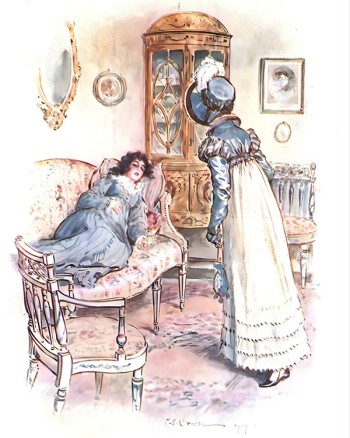
"So, you are come at last! . . . I am so ill I can hardly speak." — Mary Musgrove, Persuasion
Jane Austen's novels feature a number of characters we might describe as "hypochondriacs" today: Mr. Woodhouse, Mary Musgrove, and Mrs. Churchill, to name a few. Although she never used the word herself, Austen was adept at exploring how the worries and complaints of individuals preoccupied with their health affected the people around them.
Professor Sarah Marsh joins us in this episode to discuss health and medicine in the Regency era, the parallels between the health of individuals and the health of the British nation in Sanditon, and Austen's reflections on her own declining health during the final months of her life.
Sarah Marsh is an associate professor of English at Seton Hill University and director of the Jane Austen Summer Program. She has presented and published extensively on Austen, literature, and medicine, including the article “‘All the Egotism of an Invalid’: Hypochondria as Form in Jane Austen’s Sanditon.” Her forthcoming book, Novel Constitutions and the Making of Race: A Literary and Legal History of Slavery in the Anglophone Atlantic, 1688–1818, will be published by Oxford University Press.
Show Notes and Links
Many thanks to Sarah for joining us on Austen Chat!
Related Links
- Learn more about Sarah and her work on the Seton Hill University website.
Related Reading
-
"Sickness and Silliness in Sanditon." John Wiltshire. Persuasions 19 (1997): 93-102.
 Listen to Austen Chat here, on your favorite podcast app (Apple Podcasts, Spotify, and other streaming platforms), or on our YouTube Channel.
Credits: From JASNA's Austen Chat podcast. Published April 2, 2026. © Jane Austen Society of North America. All rights reserved. Illustration by C.E. Brock for Persuasion, J.M. Dent & Co., 1909. Theme Music: Country Dance by Humans Win.
Transcript
This transcript has been lightly edited for clarity and readability.
[Theme music]
Breckyn Wood: Hello Janeites, and welcome to Austen Chat, a podcast brought to you by the Jane Austen Society of North America. I'm your host, Breckyn Wood from the Georgia Region of JASNA. Listeners, we all like to think we're a Darcy or an Elizabeth, but the older I get, the more I realize I'm embracing my inner Mr. Woodhouse. Leaving my house late at night to attend loud parties? No, thanks. Early bedtime in my cap and jammies? Sign me up. Here to discuss with me Austen's sometimes lovable, often frustrating hypochondriacs is my guest, Sarah Marsh. Sarah is an associate professor of English at Seton Hill University and the director of the Jane Austen Summer Program. She has presented and published widely on Austen literature and medicine, including an article titled "'All the Egotism of an Invalid': Hypochondria as Form in Jane Austen's Sanditon" [The Routledge Companion to Jane Austen, 2022]. Her book Novel Constitutions and the Making of Race: A Literary and Legal History of Slavery in the Anglophone Atlantic, 1688-1818 is forthcoming from Oxford University Press. Welcome to the show, Sarah!
Sarah Marsh: Hey, Breckyn, thanks for having me.
Breckyn: Sorry that I sort of fumbled at the end of your book title. I was like, oh, it's still going.
Sarah: It's very long. They like the—they like the titles to be descriptive so they are findable. So it is very long. It's like the whole book is on the cover.
Breckyn: That's what I love about actually 18th-century books in general. It'll just be like two-and-a-half-paragraphs long title. It'd be like—
Sarah: Exactly.
Breckyn: —"a dictionary or rather, blah blah blah." Like, I mean, Johnson's dictionary is actually like a hundred-word description of what's happening. Anyway, okay.
Sarah: We're going back. We're going back to it.
Breckyn: Yeah, we're embracing it. Okay, so to start, can you tell me a bit about your Austen origin story? When did you first encounter her works?
Sarah: Yes. Okay, so this is a little bit of a long story. It has two parts. When I was a senior in college, I was engaged to be married. And before my boyfriend proposed to me, he went to my parents to ask permission. And my dad said two really wonderful things that make him kind of like a latter-day Mr. Bennet. He said, "As to the marriage," he said, "you'll have to ask Sarah." He said, "But before you ask her, please wait until she is finished with her education." My boyfriend did not follow my father's—
Breckyn: Wait, is this your husband? Is this going to involve a broken engagement? I just need to know now. Or is this current husband? Oh, my gosh. Did you go on to get a PhD? Waiting until you're done with your education could take forever!
Sarah: My boyfriend did not follow my father's second instruction to wait until I was done with my education. He actually proposed to me while we were studying away the very next semester. He proposed to me in Paris.
Breckyn: Oh my gosh, Sarah. So romantic.
Sarah: And I said “yes,” as you do. And then, as you might expect, the engagement fell spectacularly to pieces. And the ring that I was given in Paris, I returned at a gas station on the Pennsylvania Turnpike in March. It was about this time of year, actually. Okay. So, my engagement falls apart.
Breckyn: This is like an Austen novel. I am on the edge of my seat.
Sarah: And so, that summer—it was actually the summer between college and grad school—I was, you know, I'm moping around because I'm not engaged anymore. It's kind of like that postgraduate slump that a lot of people go into. And I was house sitting for one of my professors, just getting ready to move to Pittsburgh where I went to graduate school. And I found this box collection of DVDs. And I was like, "Oh, Pride and Prejudice. What's this?" And so, I watched the BBC Pride and Prejudice, and I was in. I had not read a book until I watched the film first.
Breckyn: Jennie Batchelor last month just talked about how she watched the Laurence Olivier black-and-white version, and that was her introduction. And my introduction was the 2005 Keira Knightley. Wherever Jane finds you, she finds you.
Sarah: She does. She does, yeah. So, I soothed my broken heart by watching Jennifer Ehle and Colin Firth fall in love on screen. And the rest is history. And then, many years later, I did get engaged again. I married the second person who proposed to me, kind of like Elizabeth.
Breckyn: There you go. The right one.
Sarah: Yeah. I think so.
Breckyn: That is so lovely. I'm glad. Okay. I fully, fully believe that the books are medicinal and the movies are medicinal as well. And there's lots of evidence to say—like they gave Jane Austen's novels, along with others, to men who were convalescing in World War I and World War II. And it—I love that. I love that aspect of literature as medicine, because it absolutely can stitch your heart back together. So, I love that.
Sarah: Well, it's so relevant to what we're going to talk about today, because Jane Austen has these different conceptions of what it means—well, she has a conception of what it means to be really sick and then a different kind of conception about what if you just think you're sick? And I do think the books are meant to heal the person who is genuinely ailing. I'm sure we'll talk about that more.
Breckyn: This is such a great segue. Okay, let's talk hypochondriacs. In several of your articles, you highlight this double meaning of the word "constitution," and you discuss the relationship between the health of the individual and the health of society or of the nation. Can you talk more about that, particularly in relation to Sanditon?
Sarah: Yeah, so, the answer to this question is pretty deep in the history of medicine. Folks have a general sense of what humoral medicine is. It's that old medieval system—actually you could trace it all the way back to the ancients in classical Greece and Rome. There is the sense that the body had these four humors flowing through it: bile, blood, phlegm, and choler. And the balance of those humors was reflected as the health of the body. If you had one of the humors in excess, that meant that your health was off-kilter in some way or another. Or I guess I should say, if your health was off-kilter, it meant that your humors were out of balance.
When I teach this system to students, I invite them to imagine a world where you can't really see the inside of your body. This is a world before stethoscopes and X-rays. People don't really know what the inside looks like, but that doesn't stop them from trying to explain what's going on. And so, what do you do? You look outward. You see things like the four seasons. You see things like heat and cold and air and fire. And you interpolate from those things you can see to describe the things that you cannot see. And so, you get this humoral system. It really had not changed all that much by the end of the seventeenth century, beginning of the eighteenth century. And even today, whenever we have the sniffles, what do we say? "I have a cold," right? That's a humoral idea. The cold has gotten into my body.
Breckyn: Many mothers still believe “don't go outside and get cold and wet or you will get sick,” right? And maybe there is a little bit of truth in it, in that that does suppress your immune system, blah, blah, blah. But yeah, I think that those old wives' tales are definitely still firmly ingrained in us.
Sarah: Yeah. And I always tell my students that these ideas hang on in the lexicon even after the science changes. And so, this system that people used to describe what was happening to their bodies before anybody had any idea of what a germ was—it still hangs on in the language. Yeah, right—everybody's grandma or grandpa has said, "Gotta put a hat on if you're going outside. You want to catch cold?"
Breckyn: My husband goes even further and still just fully embraces the humoral system and says that his humors are in a disarray whenever he—he also just, like, always channels his inner Mr. Bennet. But he says—we say that in our house all the time, "I'm not really sick, but my humors are in a disarray, like I'm just a little off." That's how we explain it.
Sarah: Yeah. And so, to get back to your question about politics—this idea of a bodily constitution where your humors are all in balance and that's what makes you healthy—became this really powerful metaphor for describing civil government during the reign of the Stuarts. The idea became extremely important because the Stuarts were claiming a divine right to rule. They were advancing theories of their absolute power. And so, there was this sense that the constitution of the English government—the courts and the crown and the people—were out of balance because the king had too much power. And so, this idea that balance as the thing that makes you healthy persists in both the medical metaphor and the governmental metaphor. And, of course, our American system comes broadly from the English system—from the English common law. So, we still have this ideal of balance in the body politic.
Breckyn: And I will admit that I still have not fully read Sanditon. I don't know what's holding me back from Sanditon. I'm just lazy or I don't—something is holding me back from reading it. Okay, so, I still haven't read it so we're actually not going to spend that much time on it. But I did read your articles about it, and I thought what was really interesting is, again, there's this parallel between the ailing, aging British public—and they are the ones who remove to the coast. They go to these health resorts like Sanditon to try and take the air and improve their health. And this is also post-war Britain, and Britain itself is sort of in crisis. It's a country that's ailing and things are falling apart, and we don't really know who we are post Napoleon. I don't know if you wanted to say anything more about that, but that's kind of—that continues on that theme of "constitution" being a double meaning.
Sarah: Yeah, I think that's absolutely right. I think there's a crisis of national identity following the Napoleonic wars. There is no longer that sort of "rally around the flag effect" that you see for a very long time. And in the sense is a question of how the nation will be constituted when we no longer have this threat in the form of Napoleonic France. You also have things like post-war inflation. Men are coming back from the Napoleonic wars with horrible injuries, and how do we take care of these people? And there is really interesting collapse of class distinctions that are so important to Austen. And in Sanditon, you have all of these people who are going to this resort in order to see and be seen. It's very like Persuasion in that way—the role that Bath plays in Persuasion. And what happens in Sanditon, I think, is this triumph of human solipsism. All of these people are so interested about themselves—or interested in themselves, sorry—that they can't constitute a community with one another because they're just so busy narrating their symptoms, and getting their teeth pulled, and trying to figure out what kind of meals they should be taking, and what sorts of walks they need, and how they should be inside, and what's the temperature of the room. It's not unlike our contemporary culture of wellness, where people are like, what's the skin care? And how many peptides should I be taking? And what's my collagen supplement?
Breckyn: Keto, and vegan, and how many different types of—no dairy, no soy, no this, no that. Gluten free.
Sarah: Yeah. And the effect of these things— I mean, and we should say, right, there are legitimate—
Breckyn: There are people with real health concerns.
Sarah: Absolutely. Yes. And we should absolutely take care of people who are suffering from conditions. At the same time, I think Austen is really interested in what happens to people when the condition itself becomes an imaginary phenomenon and is true discursively, because people are talking about it, but may not be true in fact. And that effect is amplified in the novels, of course, because these are not real people with real bodies. These are all literary characters who don't have a physiology at all, right. Except for what Austen imagines. So, it's a very cool place to think about these ideas.
Breckyn: Okay, I will admit to not fully knowing what solipsism means. I've heard it before, but I could not define it.
Sarah: So, the solipsist, I think—I have to check myself on this—but it's like self-centeredness to the point of almost pathology.
Breckyn: And that is, I think the biggest—that's one of Austen's biggest criticisms of hypochondria. The problem with hypochondria is that it becomes self-obsession and it's just, it's a form of pride, and it's a form of narcissism, really. And so, when I think of the main hypochondriacs in Austen—and there are more—think of Mr. Woodhouse, Mary Musgrove, and Mrs. Churchill; they are kind of some of the big ones. And it seems to me what they all have in common is that they use their feigned illnesses to get attention and to exert control on those around them. Now, the text is not as critical of Mr. Woodhouse as of others. He's kind of portrayed as this harmless, benevolent old man who's actually not that old, but his habits sort of make him seem older than he is. But I've always seen him as like nearly a villain because of how self-absorbed and controlling he is in the name of health. I mean, the fact that Emma nearly refuses to marry Mr. Knightley and almost doesn't get her happy ending because of Mr. Woodhouse drives me insane. What do you think of that, Sarah?
Sarah: So, I think Mr. Woodhouse is interesting to consider in light of Jane Austen's biography. Austen's family relocated from Steventon to Bath in 1801, ostensibly for the health of Jane Austen's mother, Cassandra. It's pretty clear that Austen did not want to move to Bath. She writes effectively nothing during the years her family is in Bath. And there are some scathing letters that she writes to Cassandra about the people she meets in Bath. So, this was a period of genuine dislocation for Austen. I think part of Austen's reaction to her parents’ decision was also one of offense that she was being taken to Bath to be paraded on the marriage market. And so, during that time she is in this period of—scholars think—very low spirits. The letters are missing. Cassandra destroyed a significant number of them, some scholars think, because they were full of pretty raw emotion that Cassandra did not think should survive for posterity.
And so, when we think about a character like Mr. Woodhouse, who is very health-obsessed and does use that as a way of controlling his family, I think the key is what you said—that Emma almost doesn't get her happy ending because of Mr. Woodhouse. And it's the "almost" that I think is the whole pie for Austen, because she did experience a time of her life when "almost" was not part of the calculus, right. She had to go. She didn't have a choice. And Emma, as it turns out, does have a choice. Well, the thing about Mr. Woodhouse that's so interesting is that he's not actually sick. He's just really worried about getting sick.
Breckyn: Yeah. He never once gets an actual illness in the entire course of the novel.
Sarah: He's into prevention. Maybe he likes gruel that much. Yeah, it’s so interesting to bring up the ending of Emma because I had never thought about it in tension with the time that Austen spent in Bath.
Breckyn: I never have either. That's an interesting thing that you brought up.
Sarah: Well, and it's an interesting supersession of—you know, Mr. Woodhouse moves into this sort of childlike role, and then the Knightleys will effectively be the parental figures. So, it's an interesting generational inversion. Austen loves to do stuff like this. She does it actually in Sanditon. Sir Edward Denham is the nephew of Lady Denham, and there are all these jokes in the text about how she is the one propping him up in her old age, when the normal expectation is that the younger person might prop you up, and the wealth is kind of flowing in the wrong direction. It's not—it's a very strange novel. Everything is out of whack in the way that the economy functions, in the way the social politics are functioning. Nobody knows who is who in Sanditon. It's kind of like—
Breckyn: The humors are in a disarray in Sanditon.
Sarah: They are.
Breckyn: Socially and financially, and—
Sarah: They are. Tell your husband he's in good company when he's out of sorts.
Breckyn: That's funny. Okay, so an interesting thing I came across in preparing for this is that even though we're using the word "hypochondria"—or "hypochondriac"—it's not a word that Austen uses—at least not in the novels. I'm not certain about all of the letters. But I have this quote from Emma, and she uses the word—which I don't think I've ever noticed before—"valetudinarian," which sounds to me like "valedictorian" or something. But "valetudinarian" is how she describes Mr. Woodhouse. She says, "for having been a valetudinarian all his life, without activity of mind or body, he was a much older man in ways than in years; and though everywhere beloved for the friendliness of his heart and his amiable temper, his talents could not have recommended him at any time." What a really great scathing review by Jane Austen. And so, before we hit Record, you said some interesting things about the word "hypochondriac" versus "valetudinarian."
Sarah: Yeah. So, there are—there are three terms that are important in the eighteenth century to describing the phenomena we've been sort of tossing around here: "hypochondria," "hysteria," and "valetudinarianism." The hypochondriac was originally sort of a male melancholic. George Cheyne described this figure in his book The English Malady, which was published, I think, in 1733. And the idea was that the hypochondrium in the anatomy is just this part of the lower part of the abdomen. And the idea was that if you spent a lot of time stooped over reading your books, you could make pressure on this part of your body, and it would stop up the humors—and this would cause general disorder and low spirits over time. I mean, this was Cheyne's argument: that this melancholia was a distinctively English kind of disposition. It came from the wet, gloomy weather—the northern climate that tended to keep people indoors and subject to contemplation and the heaviness of spirits. And then by contradistinction, the word "hysteria," which comes from the Greek word for "womb"—the same word that is the root of hysterectomy—was associated with the womb being out of place in the body. And hysteria was a particularly feminine illness.
Then you have the third category of the valetudinarian, and this person is not actually sick. This person is worried about being sick, but doesn't actually get sick. This is Mr. Woodhouse. And so, during the period of the eighteenth century, really interesting stuff is happening with these terms. Medicine is making some really interesting strides. Forward, backward, sideways—I don't know how you count it, but medicine's changing. So, during Austen's life, these categories are changing, and they have started to collapse in on one another in interesting ways. And it does shift a lot for us today. When we talk about somebody who always thinks that they're sick and may not actually be sick, we call that person a hypochondriac. We don't really have gendered terms anymore necessarily. We think of hysteria as being more associated with the nerves, and certainly it was during Austen's lifetime. This is tied up in the culture of sensibility and the sensitivity to the outside world that was thought to inflect women's nervous systems and constitutions more pronouncedly than it did for men. The great study of this is Barker-Benfield's The Culture of Sensibility. That book is still the authority on what was happening around these conceptions of the nerves and the senses during the eighteenth century.
Breckyn: I do appreciate that Austen gives us a prominent male hypochondriac, and that it's not all just like, "Oh, silly women, always just pretending that they're sick." I think he is one of the main ones, and she shows that this is not a gendered problem.
Okay, I had this thought while I was prepping for this, and I want to know what you think. Austen's hypochondriacs are almost always rich people who don't have anything better to do with their time. I'd throw Lady Bertram in this mix. She's not a full-blown hypochondriac, but she's described as having "a little ill health and a great deal of indolence." Such a great line. Do you think that this is Austen's way of criticizing the landed gentry and their idleness?
Sarah: Yeah, absolutely. Austen's really interested in the ways that physical activity makes a person alive or not to the world. And Lady Bertram is such a fascinating figure in this respect. She's so indolent. She's so entirely given over to excessive leisure that she essentially can't be trusted to look after her own children when—
Breckyn: Barely her pug—I feel like she's going to smother that pug by accident.
Sarah: The pug barely makes it out alive. It's really interesting, and this is why Mrs. Norris is left to the superintendence of all the children. And Mrs. Norris, of course, doesn't do a good job either. But it's really that Lady Bertram can't be trusted. And the Mansfield Park example is really interesting because Lady Bertram's indolence, in part, is made possible by the family's income from the plantation in Antigua, which Sir Thomas has gone to attend to. Because Mrs. Norris tells us the income is unsettled. We don't get a lot of information about what has unsettled it. But the wealth that makes leisure possible for Lady Bertram is the reason her husband has to leave, and then the family implodes while he's away. So, there's the sense that a lack of activity is just as injurious to the family and the body politic as perhaps too much—as overexertion, overexposure, those kinds of things.
Breckyn: Yeah. Time and again we see that Aristotelian golden medium in Austen, that she's just—we're always striving for just the center line—not too much, not too little of anything.
Sarah: I do really think the novels are exercises in that balance. I think that's—effectively, that's the three-volume structure of the novel, right. Like thesis, antithesis, synthesis. It's the accomplishment of the mean that informs the novels at the level of structure, of plot. I think this is why they're such a pleasure to read and why they feel like medicine to us—because you do end up with that balance at the end.
Breckyn: That's so satisfying.
Sarah: It is. It really is. Another interesting upper-class figure of decline is Anne de Bourgh. She's so ill that she can't be presented at court, and so her marriage has to be arranged by her mother and her aunt. And, of course, it doesn't actually happen. And, you know, there's the sense that these aristocratic lines just won't continue, because these people are so frail. And this was an obsession of people during the early nineteenth century: thinking about the way that intermarrying and inbreeding in the aristocracy—
Breckyn: Darwin showed up just in time. Which is ironic because he also married his own cousin and then had weak children, and he's like, “Ah, I should have known better.”
Sarah: Should have known better. Yeah.
Breckyn: Okay. Oh my gosh, we've got so much to talk about. I think the one last thing that I do really want to talk about is Marianne. She is an interesting case in this because her serious illness is very real. It is not imagined, but it's brought on by her own bad behavior, basically—her overly self-indulgent, overly sensibility-obsessed behavior. And so, her illness serves as a catalyst for self-reflection and for change in really interesting ways. You've told me before that Marianne is an inversion of the "Crazy Jane" archetype that was very common in the eighteenth century, but I had never heard of that. Can you explain that for us?
Sarah: Yeah. Crazy Jane was this folk figure who was typically a servant girl who was abandoned by her lover—typically a guy named Henry, although there are variations on this. And there are also variations on the plot. Sometimes she's jilted at the altar. Sometimes she's left pregnant by this abandoning man. But the upshot is that she ends up wandering the moor all alone, exposed to the elements. And this is a tragedy. I mean, we're to understand, I think, that this person will never find a place where she can be safe, where she can have the child that, in some versions, she's pregnant with. And so it's kind of a cautionary tale about being too sexually available. And I think what Austen is really interested in—one of the things she's really interested in in Sense and Sensibility—is this idea of exposure. When you are out on the marriage market, you have to be exposed to a certain degree in order to court a husband, right? You have to be out in society, but you can't be too out or you call your sexual propriety into question.
Here's that Aristotelian balance again between, you know, propriety or not. And this is the entire drama with Willoughby. Have they gone too far in driving around by themselves? Are they showing too much affection publicly? And I think Austen leaves this kind of open question, which is resolved when Willoughby is called away for reasons related to the same trope that we'll learn about later on. And Marianne falls into this very serious illness that is not made up. I think the text is very clear that Marianne is quite sick, even close to death. I think parts of the way that the episode at Cleveland is narrated suggest that Austen was really searching for terms to describe the consciousness of a person who is close to death. She's really interested in this in Sense and Sensibility. And then the reason that Willoughby has abandoned Marianne is in fact the Crazy Jane plot. This is the second—
Breckyn: The second generation of the Crazy Jane plot, which is named the same. They're just like—they're kind of interchangeable. It's like, oh, it's another Eliza, right? Another Crazy Jane—somebody getting knocked up by an irresponsible man, but really, it's her fault, right.
Sarah: Yeah. My students started calling them Eliza One and Eliza Two, because there is that mirroring effect from generation to generation. And so, Eliza Williams, the second Eliza, is the woman whom Willoughby impregnates and then disappears. And then, of course, Colonel Brandon has to run around and try to find out where she is and make sure she doesn't have to deliver her baby in the margins of society. And so, I think we can be pretty sure that Austen wants us to see Marianne as an alteration to that older lore about Crazy Jane. For me, the interesting thing is the difference between what happens to Eliza Williams—the stock Crazy Jane plot—and what happens to Marianne Dashwood, because she recovers from her illness, she re-enters society, and she makes a respectable marriage that is quite clearly happy, if not the full-blown romance that she once envisioned for herself.
And I think one of the great questions of that novel is what makes the difference? I think it's a few things, the most important of which is the relationship with Elinor, because Elinor is Marianne's nurse through that illness. Marianne says something really remarkable when she makes her recovery and she's talking with Elinor about how her conduct exposed her in all of these ways to this really devastating downfall. Marianne says, "when I think about my conduct and what it might have been, I compare it with yours." So, yeah, the great love in that book is between Marianne and Elinor. Absolutely. And I think that, speaking biographically, that was very real for Jane Austen. She and her sister, Cassandra, were very close. And in fact, early in life, Cassandra was engaged to a man named Tom Fowle, who died of fever. He was deployed to the Haitian revolution. Britain sent an expeditionary force when the slave revolt broke out in what was then called Saint-Domingue. And Cassandra's fiance, Tom Fowle, went as a chaplain with that particular deployment. He died of yellow fever while he was abroad, and Cassandra is known to have accepted the news of Tom's death with incredible resolution and strength. She was devastated. She never married.
Ruth Perry thinks that this event actually led both of the Austen sisters to sort of take marriage off the table. Cassandra responded to this extraordinary loss with such steadfastness and discipline, and I think Austen must have had that in mind when she was thinking about how Marianne responded not to the death of Willoughby, but to his abandonment, and that there are these two ways of responding to loss.
Breckyn: That's beautiful.
Sarah: It's a really beautiful story, and I think Austen is really interested in how—how do we experience loss in a way that doesn't cause us to lose our dignity or our lives? These novels are very often read as love stories—these wonderful marriage plots with all this complexity—and certainly they are that. But they also have these truths to teach us about the nature of human suffering and what we do with grief when it befalls the human heart. And those lessons are transcendent too.
Breckyn: Yeah. Absolutely. So, we're getting into Austen biography, and I think that's where I'd like to end. I want to circle back to Sanditon, because the focus on illness and health resorts is particularly interesting, considering the fact that Austen wrote it as she was suffering from the disease that would soon kill her. But even as she's actually dying, Austen deploys such wry, self-deprecating humor about it. In May 1817—two months before she dies—she writes a friend, "Believe me, I was interested in all you wrote, though with all the Egotism of an Invalid I write only of myself." You used that as a quote in your article. So, how can the fact that Austen was dying shape our understanding of Sanditon and of her attitude towards hypochondriacs? I just think it's so funny that even to the very end, she retains her humor and her perspective, really. She's like, "Well, yeah, I'm dying, but I'm not gonna make a big deal about it." And I love her for that.
Sarah: It’s a real model for how to live until the very end. She writes that—as you say, she's months away from dying. And scholars are not, to this day, entirely sure what Austen died of. There's a really interesting genre of literary criticism that tries to diagnose either fictional characters or people who died in the eighteenth or the seventeenth century, and we don't quite know what they died of.
Breckyn: Addison's disease is what I've heard the most often. I don't even really know what that is, but I've heard it.
Sarah: Yeah. These are really interesting theories, and I think it speaks to the urgency people feel today to understand as much as they can about this woman's life. This is like the people who are living in the medieval period, and they don't know what their insides look like, but they really, really want to know. I think people really, really want to know what happened to Jane Austen. So they take these contemporary diagnoses, which are sort of discursively out of joint with the way Austen would have understood her own health, and they try to describe what happened. But I think Austen—whenever she's writing that letter to Anne Sharp in 1817—she is just full of irony, and she is unafraid of directing it at herself. And that, to me, is such a great strength of her character that comes through at the very end. She couldn't have felt well. It was hard for her to go out. It was clear that she was dying.
Breckyn: She mentions the sofa. She becomes a Lady Bertram, where she's having to spend the whole day—and you have to believe after creating a character like that, that she kind of hated it. She doesn't seem like she would enjoy that.
Sarah: When she was just determined not to—she knew how that way of living—that manner of being—could make a person very contemptible to their relatives. That that kind of condition could cause a person to obtrude on the lives of other people. She was bent on finding something to poke fun at, something to continue to humanize herself. And what that is, I think—in the sort of largest possible sense—is Austen continuing to turn outward instead of deciding to collapse in on herself. And that is the lesson, perhaps.
Breckyn: I love that. I find that so admirable about her. One more quote from that letter that I came across because of your article was—she says to Anne Sharp, "I am now really a very genteel, portable sort of an invalid." It's like she doesn't want to inconvenience anyone too much or want anyone to think that she's taking herself or her disease too seriously. And I think there is a little bit of fear there—of her becoming one of the hypochondriacs that she had satirized so much.
Sarah: Yes. She's very—it's really like a razor's edge there, I think, with the serious concern about being a burden to other people and then being a "portable" invalid? It's very—I never read that without thinking of The Importance of Being Earnest and "my invalid friend Bunbury." And I think that kind of fun—that sort of wink about maybe being sick and maybe not being sick, and maybe I'm an invalid because I just really don't want to come to your party—You know, we've all lived through this, having lived through Covid, right? Now being sick is this thing—you're like, "Oh, I'm sick. I can't come out." You're like, "Yes, I'm sick! I can't go out." And it's Mr. Woodhouse.
Breckyn: Yeah. Time to get in my pajamas.
Sarah: Yeah, yeah, exactly. And it becomes this absolutely bulletproof alibi for not having to go out.
Breckyn: Uh-huh. We didn't get around to talking about the people who are actually sick in her novels. Like Jane Bennet becomes really sick. And I think there's a little bit of satire on the other side, where Jane Bennet is very sick, but she's like, "Oh, I just have a fever and a sore throat and a headache, and, like, I'm vomiting blood a little bit, but it's fine." I'm exaggerating. She only has a couple of those symptoms, but she doesn't want to be a burden, and she's being very silly. People love her, and they want to take care of her.
Sarah: Yeah. It’s also a really interesting comment on Mrs. Bennet because, you know, Mrs. Bennet is the one who sent her out on horseback in the rain.
Breckyn: In the cold and rain. And, you know, that's how we get sick—if we get wet when we're cold.
Sarah: Yeah, exactly. And Mr. Bennet has this really funny line, "If Jane dies—
Breckyn: "It will be a comfort to know it was in pursuit of Mr. Bingley."
Sarah: Exactly. And so, it really tells you how closely the details of a woman's health are tied to her prospects on the marriage market. And it's a way of imagining the future of Britain—if you have this healthy young woman—this is an argument that Alistair Duckworth makes—if you have a healthy young woman who can bear children and have a family, you can think about the future. This was particularly true during the Regency when Princess Charlotte was imagined as this figure who was going to come to power and save Britain from all of her parents' wild infidelities and debaucheries. And tragically, Charlotte died during childbirth. Now, Jane Austen wasn't alive when Charlotte died. Charlotte died the November after Austen in 1817. So, Austen didn't see that, but she would have been very aware of the idea that this young woman was being elevated as this sort of future of Britain. And I think we can see that in the way Austen envisioned some of her female characters.
Of course, men's health matters as well in Austen's fiction. Think of how differently Mr. Collins is described by distinction to somebody like Mr. Darcy. So, I think there's a whole other area of exploration too with men's health. But Austen is very clear that there is not a lot of space between a woman's health and her marriage prospects.
Breckyn: And then, as you said, since the family unit is the basic unit of society—if we don't have healthy individuals who marry each other and have healthy children, then we cannot have a healthy society. Fascinating, fascinating stuff! This has been such a rich conversation. Where can listeners go to find out more about you and your work? You've got a book coming out.
Sarah: Oh, yeah. My book will be out later this year. It's called Novel Constitutions and the Making of Race: A Literary and Legal History of Slavery in the Anglophone Atlantic, 1688, which is basically Oroonoko, to 1818, which is Frankenstein. So that's the range of the novels that I treat. The book is about how the discourses of the English Civil War—about the freeborn status of Englishmen—were adapted during the colonial period into the institution of chattel slavery. And my book effectively reads those pro-slavery and anti-slavery currents in Atlantic-world thought from the English Civil wars up to the eve of the American Revolution. So that's the historical period. It will be out later this year, hopefully in the 250th birthday year of the Declaration of Independence. Keep your eyes peeled for that. I'm very excited that it's going to be out in the world. I've worked on it for about a decade and a half, so—
Breckyn: Oh, my goodness. Yes, that is the culmination of a lot of hard work. Well, thank you so much for coming on the show, Sarah.
Sarah: Thanks, Breckyn. It was such a pleasure; I really enjoyed this. Thank you.
Breckyn: Dear listeners, I just wanted to end today's episode by saying thank you. Austen Chat now has over 100 five-star reviews on Apple Podcasts. We are thrilled and so grateful for everyone who has left a review. If you haven't left a review yet, please consider giving the show five stars on Apple Podcasts. The more reviews we get, the easier it is for new Janeites to find us. Join us again next month for another episode. In the meantime, I remain yours affectionately, Breckyn Wood.
[Theme music]
