
Austen Chat: Episode 36
June 4, 2026
Jane Austen: Material Girl — Paula Byrne and Hilary Davidson in Conversation
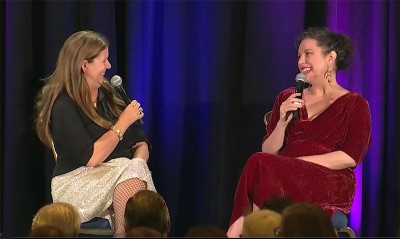 It's Austen Chat's third anniversary! To mark the milestone, we're delighted to share Jane Austen: Material Girl—a conversation between authors Paula Byrne and Hilary Davidson recorded at JASNA’s 2025 Annual General Meeting. Both have written extensively about the significance of material objects in Austen's life and work. Tune in for their lively discussion of ordinary things—toothpick cases, lace cards, muslin shawls, flannel waistcoats, and more—and their extraordinary importance.
Paula Byrne is a best-selling biographer, literary critic, and novelist. She is the author of The Real Jane Austen: A Life in Small Things, which explores her life through the objects around her; The Genius of Jane Austen: Her Love of Theatre and Why She Is a Hit in Hollywood; and the novel Six Weeks by the Sea, which blends fact and fiction to imagine Austen’s visit to the seaside in 1801. As an Austen expert, she has also frequently appeared on television, broadcast on radio, and consulted on period dramas. Beyond her Austen scholarship, Paula has written best-selling biographies about Dido Elizabeth Belle, Mary Robinson, Barbara Pym, Kathleen "Kick" Kennedy, Evelyn Waugh, and Thomas Hardy.
Hilary Davidson is a dress, textile, and fashion historian and curator, and Chair and Associate Professor in the School of Graduate Studies at the Fashion Institute of Technology in New York. She has curated exhibitions, lectured widely, and published extensively. Her books include Dress in the Age of Jane Austen: Regency Fashion, Jane Austen’s Wardrobe, and A Guide to Regency Dress.
Show Notes and Links
- Learn more about Paula and her work on her website. You can also follow her on Instagram and X.
- Learn more about Hilary and her work on her website. You can also follow her on Instagram and Bluesky.
Related Reading/Listening
-
“Looking-Glasses at Odd Corners”: Biographical Method and the Art of Reflection." Paula Byrne. Persuasions On-Line, Vol. 46, No. 1 (Winter 2025).
-
“The unmeaning luxuries of Bath”: Urban Pleasures in Jane Austen’s World." Paula Byrne. Persuasions No. 26 (2004): 13-2.
- Hear more from Hilary about Jane Austen's personal wardrobe in Episode 3 of Austen Chat: Jane Austen & Her Wardrobe: A Visit with Hilary Davidson
 Listen to Austen Chat here, on your favorite podcast app (Apple Podcasts, Spotify, and other streaming platforms), or on our YouTube Channel.
Credits: From JASNA's Austen Chat podcast. Published June 4, 2026. © Jane Austen Society of North America. All rights reserved. Theme Music: Country Dance by Humans Win.
Transcript
This transcript has been lightly edited for clarity and readability.
[Theme music]
Breckyn Wood: Hello, Janeites, and welcome to Austen Chat, a podcast brought to you by the Jane Austen Society of North America. I'm your host, Breckyn Wood, from the Georgia Region of JASNA. Dear listeners, this episode marks our three-year anniversary! If you've been with us from the beginning, thank you so much for your support. If this is the first time you're tuning in, welcome! After hosting 35 episodes, I'm taking the summer off— but the podcast isn't. We have several special episodes and guest hosts lined up to keep the Austen conversation flowing, and I'll be back in the fall. This month we have a birthday treat for you. We're sharing "Jane Austen: Material Girl," a lively conversation between Paula Byrne and Hilary Davidson that was recorded at JASNA's 2025 Annual General Meeting in Baltimore.
Paula Byrne is a best-selling biographer, literary critic, and novelist. She is the author of The Real Jane Austen: A Life in Small Things, which explores her life through the objects around her, The Genius of Jane Austen: Her Love of Theatre, and Why She Is a Hit in Hollywood, and the novel Six Weeks by the Sea, which blends fact and fiction to imagine Austen's visit to the seaside in 1801. As an Austen expert, she has also frequently appeared on television, broadcast on radio, and consulted on period dramas. Beyond her Austen scholarship, Paula has written best-selling biographies about Dido Elizabeth Bell, Mary Robinson, Barbara Pym, Kathleen "Kick" Kennedy, Evelyn Waugh, and Thomas Hardy.
Hilary Davidson is a dress, textile, and fashion historian and curator, and chair and associate professor in the School of Graduate Studies at the Fashion Institute of Technology in New York. She has curated exhibitions, lectured widely, and published extensively. Her books include Dress in the Age of Jane Austen: Regency Fashion, Jane Austen's Wardrobe, and A Guide to Regency Dress. Enjoy the episode!
Hilary Davidson: I just want to say, first of all, thank you to Paula for doing this with me and for the fantastic title of our talk. . . conversation. That— We were talking about what we want to talk about and what we, what we have a shared interest in in Austen. And it is about materiality and things. And Paula just went, "Jane Austen, Material Girl," with her usual aplomb. And I think that's such a great way to sort of summarize the— how— what we share in our love of Austen. And in fact, we are friends because of our shared love of—
Paula Byrne: Why don't we tell that story? Should we tell the story of how we met?
Hilary Davidson: Yeah, okay. The full, the full story or the— Yeah, okay. Alright, so in—
Paula Byrne: Jane Austen brought us together.
Hilary Davidson: Jane Austen brought us together.
Paula Byrne: As many people here have been brought together through a love of Jane Austen. The reason we're friends is because of Jane Austen.
Hilary Davidson: So, I think it was 2010, which is, oh my god, 15 years ago. . . and I was a curator of fashion and decorative arts at the Museum of London. And a television company came to the museum to ask if they could film some Regency dress from the costume collection as part of something they were doing about identifying an early 19th -century portrait. So that was all the information I got. It came to me as the dress curator, and I get lots of requests for this, so I worked on it, I had meetings, and they knew nothing about my work on Jane Austen's pelisse, which I'd already engaged with by that time. And so by the time they finally actually sort of said, "All right, so this is the portrait that we're going to be , to be looking at," and they showed it to me, I just went, "Oh, look, it's Jane Austen." And they went, "Why did you say that?" And I went, "Oh, I've been working on what Austen looks like, and you know, she's got Francis's nose, and they went, "Well, that's actually what we're looking at, trying to see if we can identify this portrait that belongs to Paula Byrne." And one day in the costume store at the Museum of London, Paula Byrne and Kathryn Sutherland came in. And we worked together on the— that documentary about your portrait and trying to see whether it was Jane Austen. And that's what this "thing" —and looking at the details of her dress and trying to sort of analyze this portrait in terms of how would this have related to fabrics and cut and time of day.
Paula Byrne: And you were just so brilliant because— Hilary, because she makes dresses and shoes as well as being a fashion historian, has such a deep understanding of fabric. And I always wanted her for the program. So, she didn't know what I knew. So, it was just the BBC saying, "Hey, do you want to just do this?" And she was so amazing, because when we went into the museum, she had three beautiful dresses, and she could date them exactly by the sleeve, by the cut, even the way— I couldn't believe it, because my portrait had this sort of —what Kathryn Sutherland says, you know, "the bum and the bonnet," because the bum sort of sticks out because of the fabric. And so Hilary said, "Look, this is what happens in 1814 to dress," and she demonstrated how the fabric sort of billows out to give this silhouette, and she was just fantastic. But it was all a bit formal, so we weren't really friends, and then many years later she came to Oxford and she's like, "Do you want to meet?" And I'm like, "Yes, you were on the program," and we were— and we've been great friends since then.
Hilary Davidson: Exactly.
Paula Byrne: So, we thought it'd be fun to do a talk about Jane Austen as material girl. So why don't you start with some clothes, and then we can take it from there?
Hilary Davidson: So that's what —I came to Regency dress through Jane Austen. The reason I've now written three books— much to my surprise, I tell you— about Regency dress is because of Jane Austen and because of working on this pelisse and kind of starting with the figure of her and trying to see if there's another way into Austen through this garment. Could I prove the provenance? Could I look at what is held in this garment —the material qualities —and see if that could tell us about how that might belong to Austen? So for me, she's the seed of all Regency dress. And from then I kind of—she became the lens that I look at Regency dress through. And when I came to my second book, Jane Austen's Wardrobe, again, I was looking for those small details, those kind of tiny elements, those traces at which we've heard in so many talks this weekend of, you know, the tiny magnitude of her genius. And I'm— so I was also—I was interested in those small details that she gives us— or that might be gestures in the world around her— that are alternative ways into this person that people want to know so much about. And I feel like your Life in Small Things was doing something similar.
Paula Byrne: Oh, definitely, and I love that quote about the sponge cake— that, you know, she's even interested in a sponge cake— because I think she —someone with such a capacious mind and imagination is interested in "stuff," and I really like "stuff," you know, and I love fashion, and I never think it's frivolous. I think women feel very empowered when they wear the right dress, and so— and I love the fact that Jane Austen is, well, she is obviously my favorite author and she's serious, but she loves— she does little drawings of her cloak and lace, and she's so interested in fashion, and she's so interested in headbands, and that's the sort of thing I really love because it really brings her alive for me. But I— we were talking a bit, you know, in preparation for this talk about the things that I— again, I think I mentioned this in my talk— that there are objects that I couldn't include because I only had so many chapters, and people have said, "Oh, you know, again, what are the things you didn't include?" And I really like the toothpick in Sense and Sensibility.
Hilary Davidson: Mr. Ferrars's toothpick.
Paula Byrne: Robert Ferrars's toothpick. And you know, I'm always beating myself up with things that I didn't do as opposed to the things that I did do. I'm always like, "Why did I leave that out?" But I think Jane Austen— you know, the physicality of these things— and I think small things particularly really interest me. And I just love that moment when Elinor is pawning her mother's jewels, isn't she? And she goes into that jewelery shop. Do you remember? And Robert Ferrars is picking a toothpick. And he spends 15 minutes picking— or is it John? Who is it? Which one is it? Which one is it? John Mullan, you'll know. Yeah, it's Robert; I'm right, it is Robert. It's Robert, or is it a case? I knew John would know. But it— and all I just remember it takes him 15 minutes, and that there's just a moment when the authorial voice says, you know, he wouldn't really choose earrings. John wouldn't have chosen earrings for his sisters. And its earrings, toothpicks, small things— but somehow they take on this sort of incredible magnitude about sort of meanness, and we think of Mrs. Ferrars in that amazing chapter when she disinherits her sister-in-laws and ends up saying, "Well, we'll just send a few pheasants," you know. Jane Austen's just very attuned to material things. And these girls have nothing, and they really are relying on the— relying on the kindness of strangers. But somehow the toothpick— I thought, "I could have written a whole book on that toothpick." But it sort of escaped me.
Hilary Davidson: But it's that —I think that
Paula Byrne: Or toothpick case.
Hilary Davidson: It's what, um— I think what's so fascinating about things and Austen is she's living in a time of increasing material production and, therefore, consumption. But things have greater meaning. There's fewer of them. They're harder to get. They're better made. They last longer. They have more value in them. And people are more cautious and careful about them and how things accrue to you, how you take care of them, how you might give them to others. And so things are really, really important, especially in the kind of domestic, more female world of Austen. Things have greater significance. And to kind of pay attention to the qualities of those materials and those things is to kind of also to help understand the world as Austen was experiencing it and as her characters do, and as her wider family do. It's a kind of an attention that we lose to a certain extent by the sheer, vast gluts of stuff that we have around us all the time and can throw away and not have to think about recycling. So that just the meaning of things for Regency Society is much, much more important.
Paula Byrne: Well, I was always interested in things coming back across the ocean. So, I think I was talking to somebody tonight about Philadelphia, who was Jane Austen's aunt. And also, why is she called Philadelphia? I mean, it's so extraordinary. And no, this is a girl who worked in a milliner's and —so this is Jane Austen's father's sister. And there was another one, Leonora, who we sort of really lose Leonora. But Philadelphia, I, we recently— well, I say recently, but recently-ish— discovered worked in a milliner's in Covent Garden, which was a real— Hilary will well know— was a really horrible life, and people didn't live very long. It was just backbreaking, underpaid work. And so Philadelphia went off to find herself a husband on the fishing fleet, which was the name of the ship that took you to the West Indies— to the East Indies to find a husband when she's sort of 16 or 17— I mean, or even younger. I mean, I can't remember. I know she meets Clive of India's wife on the boat and they become firm friends. And you think, my goodness, can you imagine what that's like being that young girl, hoping you might find a nice rich doctor— and she did. So, well done, Philadelphia. But I was always really interested in the stuff that comes back and forth. And when— I remember reading Jane Austen's juvenilia and thinking, "why is she mentioning mangoes and curry sauce and Indian shawls in her juvenilia?" And she writes a short story about a girl like Philadelphia, who goes off to find a husband in Bengal. And you think, "but that's because her aunt's sending stuff, and then the Austens are sending stuff back, like embroidered waistcoats and books." And it's stuff again, like stuff's going back and forth. Pipes of Madeira are being sent from Bengal. And I just— I just— that really brought Jane Austen's world alive, but in a kind of global way of stuff coming back and forth.
Hilary Davidson: Well, in you know, the European settlement in Australia— settlement invasion– it happens in 1788—and by the time, you know, by the time the free settlers are coming out, people shop from the colony of New South Wales. Back in Britain— they send lists back saying, "Can you go to my shoemaker and get three pairs of this, and I want this ribbons from this retailer, and actually, I need, you know, this much muslin." And they're shopping at a distance exactly the same way they would in London. So the person who's shopping next to, you know, Jane or Cassandra Austen when they're doing theirs, it might be going out to the other side of the world, but it's kind of Britishness through things, but they're— those connections are allowing this stuff to move out that they think are important enough to take with them in their new life. They have meaning for them, and, you know, the access to things. The colony of New South Wales is also trading directly with India. You know, they're getting lots of those fabulous goods directly out there, and that world of consumer goods that's really starting to sort of open up that the Austens were so much a part of, especially with Frank and Charles in the Navy, because one of the great things about the Navy is the privilege, which is your tax-free import allowance. So when, you know, Lady Bertram is— she's very pleased about William Price's position as a midshipman on a merchant man because she can have an Indian shawl— "I think I'll have two shawls, Fanny." —and because William can bring them back in tax-free. That's what she's concerned about: the duty-free shopping. And it's these kind of like personal connections about things, and you know, the wonderful— you've got a chapter on shawls in the Life in Small Things and, you know, what the shawl does, especially as a kind of an item that was made traditionally in Kashmir for men, and then becomes this hugely popular European item that's imitated by European manufacturers. You know, there's a— there's a whole history of the world in just this one object.
Paula Byrne: And spices. I —when I was doing research for my novel, I was consulting Martha Lloyd's household book, which some of you will know, won't you? Do you know the household book? Oh, isn't it just the best source? Like, you know, they made cold cream for their faces. I'm like, 'I want to make that, like today."
Hilary Davidson: I've done that.
Paula Byrne: Like, have you done that? I mean, it's just —and you sort of flip it, you know, you get all the cookery stuff, and then you flip it, and you get, you know, how you have a rash and here's a cold cream, or it can be a cold cream for your face. But I was really intrigued that there were recipes for Frank's favorite curry. So they're getting the spices; they're getting stuff brought over, and Martha Lloyd's making— So, I had this moment when Frank says, "Can you make me one of your curries?" And we all know he married her eventually when she's like 70. So I think they might have fallen in love over curry. Curry sauce. But I find that just endlessly— I think I really like the quotidian. I really like utterly mundane, ordinary stuff. And that's why I love Jane Austen saying, you know—even a sponge cake. I want to know all the details of it— because I just love the quotidian. I love this because I think ordinary is never ordinary. Ordinary always seems to me very extraordinary. That's probably why I like Barbara Pym as well. You know, she'll make a whole story out of a string bag, and what people put in a string because you can see it. And so, I just like the ordinary. So— and I just love that book because you just— you get to know, you know, Martha. What are wigs? I made wigs the other day. I made Martha Lloyd's wigs; they're just like buns. I just love it. I'm just like, this is just brilliant stuff, you know— syllabubs and all this stuff— and because you've got to have access, especially the spices.
Hilary Davidson: And it's also like the ordinary tells you what people take for granted. You know, both you and I have lived in different countries, and I'm totally fascinated by grocery stores, right? So, you know, American grocery stores— I go in like an anthropologist, like, "ooh, you do this and you do this, and you can't get, you can't get lemonade here." Like, not like we understand lemonade. And like you can get this and you can't get that. And it's just fascinating, because it tells you what the conventions are, what people do, what they value. And so, to sort of do that in the past, it brings out all of these things that you know, a Regency person, I think would be like, "Why are you interested in our spice cabinet," or whatever it is? But it tells you what their normal is. What is—What are they— What do they assume about being human in the world in a certain way?
Paula Byrne: I think Jane Austen uses objects just as I said with the toothpick. She doesn't really waste anything. And I think if she thinks it's important, it's probably important.
Hilary Davidson: Yeah.
Paula Byrne: So, I really like that moment in Sense and Sensibility when Elinor is having a bit of a face-off with Lucy. And you know, Elinor slightly tried to find out, you know, how much she knows about her man. And she knows, because Lucy's begun to tell her, that she's secretly engaged to Edward Ferrars. But they're kind of having this duel over a filigree basket. And I'm like, "Why a filigree basket?" What is going on there with the filigree basket?
Hilary Davidson: The one that they're— the one that Lucy doesn't finish, or the one where she gets passive-aggressive—
Paula Byrne: You know, the horrible little spoiled child, Annamaria. We all remember Annamaria, don't we? Because she's absolute—she's such a monster, Lady Middleton's child. She's just— I think Jane Austen is utterly brilliant on children. I think she really understands and gets children. I still think the funniest moment is when— well, two funny moments, when— who's the little boy who has a fight with Mrs. Bennet about "when I'm older, I'm going to drink alcohol"? And she says, "No, you're not." And he says, "Yes, I am." And she says, "No, you're not." And she has this like row with a five-year-old. And it's just like hilarious. And then the other lovely moment is when the Knightley, John Knightley children are in the carriage and it's raining and they trace raindrops; they're racing raindrops down the window of the coach. And I think only somebody who's really interested in children would see that detail, because Jane Austen is interested in children, and she sees them, but also she doesn't really like spoiled children, does she? What does she say? " I'd love to give that child a wholesome thump." And that is still one of my favorite quotes. And like many a time I said to my three children, "You're gonna get a wholesome thump if you don't— if you're not careful. And Jane Austen said that's okay. So I will give you a wholesome thump."
Hilary Davidson: It's a literary wholesome thump. None of your common old garden ones.
Paula Byrne: And children—why was I saying children? Oh, the filigree basket. But so, Lady Middleton, you know, she is so obsessed with her children; they're so horrible. And Lucy's trying to ingratiate herself with Lady Middleton. So she's making this filigree basket, and then Elinor sort of offers to help her, and there's, there's a world going on there in that moment, just like when Edward, when he— before he proposes to Elinor and he's so overcome, he picks up—he takes up a pair of scissors, and he starts cutting fabric in any random way, like he's—
Hilary Davidson: This is the sheath, which just like—yeah.
Paula Byrne: It's just—and he—and it's just a brilliant metaphor, you know. We know how he feels just by "I'm just going to pick up these random scissors and just cut something." And she's sort of looking at him saying, "Is this a proposal? What is actually—what is really going on here?"
Hilary Davidson: "You're just ruining my stuff. Like—"
Paula Byrne: Do you know that—remember that moment?
Hilary Davidson: Yeah.
Paula Byrne: So, let's just talk about the flannel waistcoat, just for two seconds. Because we talk about the flannel—Hilary and I just sit there talking about Jane Austen all the time, even when we shouldn't be. We're like— so I know you told me about the— his flannel waistcoat, but please tell everyone.
Hilary Davidson: All right, I'm gonna have to— I'm about to make true confessions time here. All right. So, I really like late -Georgian flannel underwear. I had a dream the other day that I was kind of— because I'm the chair of a master's degree, so lots of my students— they all have to do a thesis project. And in my dream, I was in some sort of situation where I got to do a thesis project, and in an unlikely fashion, this wasn't something that was like a burden or obligation. It was like, "Yay, I get to write a thesis." And my dream brain was going, "what would I write a thesis on if I was gonna do it now?" And my dream brain went, "late- Georgian flannel underwear," and it started organizing the article that I wanted to write on this. And I woke up going, "I think I better start my article on late -Georgian flannel underwear." So I did. So, Paula, I can tell you like so much about— I could just talk the rest of the evening about Colonel Brandon's flannel waistcoat.
Paula Byrne: Okay, but it's not sexy, Hilary, is it? Can we just get that— so is it sexy?
Hilary Davidson: Well. . . well, well, well.
Paula Byrne: Marianne says, you know, she can't really get excited about a man who wears a flannel waistcoat.
Hilary Davidson: Well, this is— Okay, for me, actually, the flannel waistcoat is a com— it's one of those Austen multi-layered genius moments. Because, all right, are we all settled in? Are we ready to hear about flannel waistcoats? All right, so yes, Marianne absolutely says, you know, "but for me it conjures up rheumatism and all sorts of aches and pains of old age." And it absolutely does. So a flannel waistcoat— I showed one in my talk— wool goes next to the skin or over your shirt, and it IS worn in sickness. There's a moment in the letters where Austen talks about "my uncle is still in his flannels; he's getting better again." So it's a fabric of warmth and softness, and, you know, sort of think about like, you know, things we wear in jersey, like sweatsuits, now. So, yes, it absolutely is a sign of age or infirmity, but it's also a military garment. And if you look at military advice manuals throughout the late 18th and early 19th centuries, they are full of . . . flannels. And if you're going to the tropics, you take flannels because they're going to stop the [unintelligible] perspiration and regulate your temperature and stop you falling ill. Are you going to sea? Take flannels, because they— wool holds warmth when it's wet. It'll keep you safe. Are you going to the Indies? Take flannels just in case. And Colonel Brandon was stationed in the East Indies. When he comes back to England, he's colder. He's wearing flannel waistcoats as a sign of his military service in an area that means he's kind of temperature regulating. But there's a third meaning, because of course, Austen— you know, third meaning. And it's in as far back as Lord Chesterfield's advice to his son that an old man would do better to wear a flannel waistcoat than to take a young wife to his bosom. So she's making a cultural reference to the perception of age difference between Brandon and Marianne, which in Austen fashion, you know, it's both ironic and non-ironic, because he is going to take that young wife to his bosom, and he's only 35. You know, he's 35, 17. So it—
Paula Byrne: That's brilliant, Hilary. That is— no, your link is brilliant. That is brilliant.
Hilary Davidson: It's a triple meaning in that one— in Marianne's dismissal, for people at the time, there are all of these echoes that tell you exactly what their relationship is, what Colonel Brandon did, and how she perceives him and foreshadows their future relationship.
Paula Byrne: And there's also the context—because as she's saying that—she's just before then, she said, "Of all costumes, Willoughby's riding—hunting jacket is—or riding jacket—is the best." So the context there is Willoughby's got this gorgeous hunting jacket or riding jacket—it's one or the other—and then you get the flannel waistcoat. So it's, again, she's drawing our attention to how clothes—they are costumes.
Hilary Davidson: And Willoughby— she's attracted to what Willoughby has on the outside, and she's dismissing what Colonel Brandon has on the inside. And that's gonna flip around by the end of it. That Willoughby's "seeming" is what's attractive to her, but the solid, plain, dependable warmth that Colonel Brandon has next to his skin, that's what she's gonna end up with.
Paula Byrne: The other object I found though, which was one of my objects, was the card of lace. Because, do you remember Jane Austen's other aunt stole a card of lace?
Hilary Davidson: And if she'd been accused, she would have been sent to New South Wales.
Paula Byrne: You probably would have been an ancestor.
Hilary Davidson: Exactly. She could have been, could have been my great-great-granny.
Paula Byrne: But, and that was because a card of lace was over a pound, so it was a very valuable item. And you all know the story, don't you? That she pocketed it— was apprehended. And you know that her own doctor said she was a kleptomaniac, and that she stole a plant. She stole a plant from a garden center many years later. So she was getting some thrill from stealing because she didn't need to; she was rich. That's always fascinated me. And then, of course, Cassandra Austen saying, "Shall I send Jane and Cassandra to prison to keep you company?" Can you imagine Jane Austen in prison with her aunt?
Hilary Davidson: Who she didn't much like.
Paula Byrne: W ho she didn't really like very much.
Hilary Davidson: So, yeah.
Paula Byrne: So, objects do— I mean, that's just another example to me of how, again, the quotidian, a card of lace— it doesn't seem very big, but in fact, that can change your whole life. Well, she could have been transported.
Hilary Davidson: Their on the First Fleet, which is the first range of ships that took convicted transportees to the colony of New South Wales, which will become Australia— but doesn't really become so till about 1817. (I know you care.) So, it's— when you look at the— what people were convicted for, 40% of them were sent to Australia for stealing an item of clothing. And it, you know, it could be a handkerchief, um, lots of, you know, small portable things: a watch, a handkerchief, sometimes a length of fabric. But that was enough to like, that's it. You're gone to the other side of the world and you're not coming back.
Paula Byrne: That's so shocking, isn't it?
Hilary Davidson: And you know, if you guys hadn't become independent, they wouldn't have had to settle Australia. So, thanks.
Paula Byrne: It's all your fault.
Hilary Davidson: Could have been a much quicker trip if you hadn't, you know, gone all independent.
Paula Byrne: John.
Audience Question: [Unintelligible]
Hilary Davidson: So the question is from John, with fabulously encyclopedic rundown, about the difference between Austen's pleasure and interest in fashion in her letters and the way that she uses clothing in the novels, where anybody who is actively interested in clothing is sort of— has— there's a suspicion about their character. They're frivolous, they're vain, they're immoral, and there's a sort of direct connection between active interest in fashion and sort of weak character. Would that be a good summary? Just, they're silly. And so, this is really partaking of a lot of the conventions about what fashion is supposed to do in Austen's time. And there's a long-standing idea of— there's an image of fashion as a tyrant. And fashion is something, something that's gonna swoop down and get you. And if you are too interested in fashion and in the vanities and the superficialities, you will be swept away by it. And that for— especially for the middle classes, they're caught in this tension between having to know enough about what is in fashion to be seemly and appropriate, but not too fashionable so that you might look vulgar or French. Whoops. But then also not being out of fashion, so that you are, you know, dowdy or not looking like you're holding your position in society. So it was kind of like quite a narrow, a narrow Goldilocks Zone, to use the the planetary metaphor. But it's, it is true that if Austen mentions clothing in the books, it's because it's— she's making you pay attention to an aspect of that person's character. And the people who talk about the clothing the most, the way they talk about it tells you about their character, usually in a negative way. So, that is kind of holding to a lot of the conventions about what fashion should be doing and the amount of attention that someone should pay to fashion, which people negotiate in all sorts of ways. You know, Maria Edgeworth has fantastic examples of relating conversations about fashion that, you know, someone says, "Well, how often do you dress when you go to the country?" And someone says, "Oh, twice a day." And someone says, "No, no, no, you must think about it seriously, you know, changing four times a day." And it is, it is kind of used to show a kind of a silliness or a triviality in character, but what people felt about it in their personal lives seems to be different as well. And Austen is almost like toeing the cultural party line by her use of fashion within the novels [unintelligible].
Paula Byrne: I don't agree with you actually, because I think— I don't think that is true. Well, it's may— it's sort of true, but it's not altogether true, because there are two moments that I think— where it becomes really important. And there's one moment when Mary C— when Fanny, you know, they're all sitting by in Sotherton Court, and Henry and Mary, uh Maria, are going off beyond into the wilderness, and Fanny says, "Be careful, you might tear your gown on the spikes." And it's a deeply symbolic moment, which foreshadows the adultery— the spike being a phallic symbol— and you will tear your gown, and that foreshadows the adultery. So I think that's not frivolous. And I think the other moment that's not frivolous is when Lydia, who's been living with Wickham, doing all sorts of stuff in London, and then she comes back and she shouts out "Her maid must fit— mend the slit in my gown." I'm sorry, if that's not a vagina, then I don't know what it is. Because it's never— nothing's really frivolous with Jane Austen. And I think there are two moments that are actually deeply symbolic, and she doesn't really go for symbolism. So when we have these symbolic moments in dress, I think that's really critical.
Hilary Davidson: But I think that's what I mean. She wants you to pay attention. And there are also moments where like Lizzy Bennet is working on a bonnet, and you know, there's moments where the heroines are sort of doing needlework, but again, the quality of the needlework is what's important. So Lady Bertram, who is, spends a whole lot of time doing carpet work of, you know, no value and no taste— that even, like she can't even get through that without Fanny's help. But then there's— Fanny is supposed to be working on— Mrs. Norris is very clear to call attention that there's work in the poor box that Fanny could be doing, which is kind of good, virtuous, moral making of clothing to give to the poor. So again, it's like every— if Austen mentions clothing, she wants to tell us something, because there's so little description in it. And what's interesting to me as well is—
Paula Byrne: And e ven Elizabeth's dirty petticoat is important.
Hilary Davidson: Exactly.
Paula Byrne: Because she's running in the rain to see her sister,
Hilary Davidson: And she's hoiked up the outer
Paula Byrne: And you know, the Miss Bingleys are being really snobby. I mean, I think that's really important that they're looking down on her dress, and "Oh look, look how dirty it is." And then Mr. Darcy's like, "Oh, well, you know, she's— her complexion's all lovely, and it shows how much she loves her sister." So I feel like nothing really is frivolous, really. I think even that dirty petticoat reveals a lot about who Elizabeth is.
Hilary Davidson: And what I find interesting too is that Northanger Abbey is the "clothesiest" of Austen's novels. And not just in things like Mrs. Allen or Isabella Thorpe, but we get more detail of the men's clothing— about, you know, great coats and things like that. And I wonder, if she'd spent— if she'd had more time working on Northanger Abbey, if those would have been erased. Because, you know, thinking about, like, Lady Susan and the kind of the— we heard the sort of the wit and wickedness and panache of Lady Susan. I feel like in the later works, there's a lot like— she writes and then she takes away and takes away and takes away. And I wonder if Northanger Abbey would have lost a lot of its clothing if she'd had more time to work on it and kind of leave only the moments that she feels most tell us what it is that she needs to, and she's removing everything else that doesn't do exactly what she wants it to. But that's just my— that's my feeling. But I think it's interesting that the earliest finished is also the most clothy. The most clothy.
Paula Byrne: I love that. Mr. Rushworth's pink satin cloak is just—
Hilary Davidson: Satin. Exactly.
Paula Byrne: It's so delicious. I know that's a theatrical costume, but I just love the detail of his 42 speeches and his satin cloak. You know, again, it's just— she has such fun with it, doesn't she? It's brilliant.
Hilary Davidson: Mrs. Elton being as— this is one I love— Mrs. Elton being "as elegant as pearls and lace can make her." Burn.
Paula Byrne: Yeah, love it. Sorry, there was a question.
Hilary Davidson: So, the question is about how Henry Tilney's knowledge of muslin fits into the, this idea. He's pulling her leg. Um, yeah, he's kind of— he's making conversation and slightly making fun of her and pulling her leg at the same time. But I think he also probably— of all Austen's heroes, I think he is the one who would know about muslin. Like he might be, he might be kind of making—
Paula Byrne: He's more effeminate, isn't he, than the others. He's definitely more effeminate.
Hilary Davidson: He's kind of alert to small things. And also just to go back to the spices— this is something else that I—I really love this detail. So, you know, he's talking about the difference, he's talking about a true Indian muslin and, you know, it being a bargain. And if he could get it for four shillings at that point, it really was a bargain. But I found these recipes in a couple of books for making your muslin smell like true Indian muslin, by packing it into a basket with spices. And then I found some other references for British manu— British muslin manufacturers —sending it back to India and then having it—having it repacked and sent from India, and it's because it's packed into the hold with all of those spices that it picks up a certain smell. And so, I was thinking as well about, like, could you smell an Indian muslin? Is Henry Tilney like, you know— if he does have this ability, is it not just about that material quality, but is there like this exotic fragrance, which is how it's described in this recipe book, you know, to give it an exotic fragrance. So if you want Indian muslin, you basically pack things up in a basket, in a cupboard with spices for six months, and it will be like the genuine article.
Paula Byrne: I love that. And also, I wanted to ask you, Hilary, because clothes denote behavior in Jane Austen. So, I was always fascinated in Mansfield Park by a moment when Tom Bertram gets very confused about who's out and who's not out. And it's a Miss Sneyd that he meets, I think, at Ramsgate— I can't remember. And he mistakes the sister, because one has a closed bonnet, and one— do you remember this?— and one has an open bonnet. And the closed bonnet is the girl who's not out, and the open bonnet is the girl who's out. And he— one of the girls is behaving in a very brash way. So Tom Bertram thinks, oh, she must be out. So he starts flirting with the girl with the open bonnet, and then he discovers he's really slighted the sister who is the older sister; he shouldn't have flirted with the younger sister. So, I think she's still always got that sensitivity of how clothes denote conduct. It's never frivolous. I feel like that's a really important moment. And he says, "I got into trouble. I got the wrong sister." Do you remember that moment?
Hilary Davidson: Yeah.
Paula Byrne: So, can you talk a little bit about closed and open bonnets?
Hilary Davidson: It's a very— those nuances of who's out— I looked into that for the first book, and I couldn't find more information about it, which I think is actually a really interesting data point. Because one of the things that I'm really interested in doing when looking at Regency clothing is trying to sort of get at how people at the time perceived it. You know, if they're looking at clothing, how do they know if that's French or in the French style? How can you see that in these small details? And it's something like that— about the way you might wear it. I mean, there's things about putting your hair up— you're obviously grown up and out. So, you know, the half-up hair down in screen adaptations does my head in. But that's— it's actually really hard to kind of capture some of those nuances.
Paula Byrne: But he must— when he says that he must have met— he gets it wrong, and he's in trouble because he's got the wrong girl.
Hilary Davidson: And because it's Austen, we know that would matter.
Paula Byrne: [Unintelligible]
Hilary Davidson: Yeah.
Paula Byrne: And remember William Price when he says he reaches out his hand to Fanny and he says, "Oh, that queer fashion on your hair." And I love the fact that he's in the Navy, and I'm always interested in how the Navy also affects fashion after the Battle of the Nile.
Hilary Davidson: He says, "I first saw it in Gibraltar."
Paula Byrne: Yes, he says, "I first saw it in Gibraltar," so that fashion has come. And he just reaches his hand out to Fanny's head and says, "Oh, that queer fashion. It's come," you know, and I love the way he notices.
Hilary Davidson: Yeah.
Paula Byrne: It's just a lovely little moment that William Price notices his sister has this fashionable hairstyle that he's also seen in Gibraltar.
Hilary Davidson: Which of course brings us to, you know, probably the most— the least frivolous use of clothing or dress in Austen, which is the topaz cross. And that incomplete crossover between the, you know, gesture between siblings and the gesture of fraternal love that is in Austen's life that seems to be reflected in fiction between William and Fanny Price in this incredibly beautiful expression of—
Paula Byrne: It's just a gorgeous moment, that, isn't it? And there's two chains, and again, she doesn't really do symbolism a lot, does she? But when she does, we sort of sit back, and you know— Henry gives her the chain surreptitiously via Mary, and the chain doesn't fit, and then Edmund gives her a simple gold chain. And you can tell something about Jane Austen's taste, I think, in that Fanny doesn't want the rather gaudy chain. She's so relieved that Edmund's chain fits her topaz cross. And I think the sentence says something like "to unite the two people she loved most in the world." It's deeply beautiful and symbolic. And I was always very moved by Fanny's schoolroom. She sort of gets— she goes into the East Room.
Hilary Davidson: You write about that so beautifully.
Paula Byrne: The schoolroom hasn't changed, and on the windows— on the mantelpiece is a picture that William sent Fanny with this mast that's so high, and it always moved me to tears. It's just she— it's just William being a midshipman, and it's all wrong, the perspective, but he sent it to Fanny, and she has so little that this is one of her most precious items, which is just HMS Antwerp, isn't it? Do you remember? And it's sort of all skew -whiff, and it's all a bit out of kilter, and it's the perspective wrong. And it's —to me, it's just a deeply symbolic moment. And then, of course, when Sir Thomas lights the fire in that room, um, even though he's so angry with her for not marrying Henry Crawford, he still lights the fire to keep her warm because she's so cold. And there's nothing in that room. There's a faded footstool badly worked over by Julia. Remember? It's all the things nobody wants, and Fanny's just the repository of stuff that nobody really cares about, except, I think, HMS Antwerp and the family silhouette.
Hilary Davidson: Yeah, it's really— and I mean, in thinking as well about in Mansfield Park as well, there's all the pride and joy of William's new uniform as a midshipman and this kind of complete sartorial transformation into this new position and into this new life. And how exciting for him as well to have completely new sets of clothes and the kind of the freshness being worn off because of when he is allowed and isn't allowed to wear them. But that kind of like, you know, the pride of showing off this newly embodied, growing young man.
Paula Byrne: Oh, that's a lovely moment. And then there's Betsy's knife, talking about stuff. Do you remember the siblings of Fanny? So Betsy and Susan fight over this paper knife, and I think I'm right in thinking that Fanny— she's just like, what is going on? These kids are having this fight, and I think she just buys another knife or something. So, she does something, doesn't she, to sort it out? And it's almost like Fanny then becomes the giver of things. So, Fanny's always been receiving stuff nobody wants, but I think part of her growth and her emotional growth is "I can not just be the beneficiary of Mansfield Park, but I can give to others. I can take Susan to the circulating library. I can give another knife to solve— So I think it's a really subtle but really, really beautiful moment when she becomes a giver as opposed to someone who [unintelligible].
Hilary Davidson: And also giving something that she knows somebody wants. Because as someone who's received things that people want to give her without kind of thinking about whether she likes it or not, she can she can give her sister something that she knows her sister wants, which is also a— you know a pleasure in agency and choice perhaps that she's facilitating.
Paula Byrne: And then Edmund giving her pen and paper— when it's the first thing anybody gives her at Mansfield Park— when she's crying on the stairs, and he says, "Cousin, why are you crying?" And she just wants to write to William. And he says, "It's so easy. I'll just—" and then she says, "We'll frank the letter." And she's like, "Oh, how do we frank the letter?" And she's absolutely freaked out. But the gift of that— gift of pen and paper and communication, I think these— they're very small moments, and I do think Jane Austen forces us to pay attention, because these things are sort of deeply, deeply important. She's given us clues all the time. So I think I think we do well to pay attention to small things.
Hilary Davidson: And it's also, I mean, which think about the materiality of a letter. You know, we're so used to encountering them as the content and what Jane and Cassandra are writing to each other about. But just think about the— you know, as Kathryn Sutherland has looked at so beautifully, the actual materiality of the letters and the way that they're often double crossed, and trying to get as much into this little , this little thing, this small thing that transmits so much emotion and information and family connection, and does such a job of cementing and circulating family feeling. And all of the kind of the ceiling wax, and the quality of the paper, and the way that it's been handled by all these people getting between the family— like the actual, the thing of a letter is something that we sometimes again forget for the content of the letter.
Paula Byrne: Should we do one more thing and then wrap up?
Hilary Davidson: And then we'll let you go and dance.
Paula Byrne: Just to follow from that, I was so thrilled to go back to Chawton Cottage this— recently and to see the carved letter case that Frank made for Jane Austen, which I've never seen before. And I think he made two. And I think it's— am I right in thinking they're quite recent acquisitions? The family have only just lent them to the House Museum? And it's the most beautiful carv— because we know he carved, and he is very like Harville, isn't he, with making toys, and carving things, and making fishing nets, things, stuff, children's toys. And Frank said in that letter to that— to an American woman years later, "I like to think Captain Harville's a bit like me" because he fashions toys and he made a little sort of butter churn, didn't he, for Fanny Knight? And he made nets, and he was a great sewer because you have to sew when you're a— you sew when you're on board a ship. But the letter case I'd never seen before. And it's so moving, you know, it's just the most beautiful— It's got J A. He carved her initials. Has anyone seen it? No, it's— I honestly think it's new because I was like, "Oh, is that the letter case?" And I was— because I'd read about it recently— and I think they said, "Oh, we've only— the family have only just allowed us to show it, just, I think, for this year. But it's another thing, and I'd love to have written about that for my Life in Small Things— the letter case— because, I mean, you just take an object and you can do so much with that. But I think it's —you can Google it and you'll see it. But it— and it's quite slender, because I was thinking, how many letters can you get in it? I was imagining it always to be like a box, but it's not. It's a case. You know, it's a slender case for her letters, and to me, that again— the power of a brother's love. Her letters were so important. I think we always blame Cassandra for destroying all the letters, but Frank's granddaughter destroyed all of her letters, and I'm like, hang on a minute, like we're always having a go at Cassandra. I'm like, he cherished— and also how difficult is it to keep letters that are water-stained, at risk of fire, at risk of war. And he treasured all of those hundreds of letters that Jane Austen wrote, and he made her a letter case, and he preserves them. And his flipping granddaughter or grandniece or somebody thinks in a good—" yeah, I'll just burn those." And you know, I always think we don't tell that story enough. So that's my final object.
Hilary Davidson: And your final objection.
Paula Byrne: My final objection.
Hilary Davidson: Thank you very much. I think we've definitely run out of time, but thank you so much for coming.
Paula Byrne: Thank you, everybody.Breckyn: Dearest listeners, I am pleased to announce that Austen Chat now has over 200 five-star reviews on Apple Podcasts. Thank you so much for your support. If you haven't yet given us a rating, please consider leaving a 5-star review on Apple Podcasts so more Janeites can find us and join our Austen-loving community. Again, thank you. I remain yours respectfully, Breckyn Wood.
[Theme music]
