
Austen Chat: Episode 38
August 6, 2026
Jane Austen Wrecked My Life: A Visit with Laura Piani
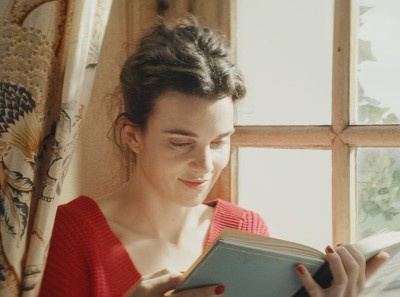
Camille Rutherford as Agathe in Jane Austen Wrecked My Life, Courtesy of Sony Pictures Classics
“The first one, the very first one, is like opening a door to another portal somehow.”
—Laura Piani on reading her first Jane Austen novel.
Join us for a conversation with Laura Piani, writer and director of the romantic comedy, Jane Austen Wrecked My Life. In this episode with guest host Janet Saidi, she shares how Austen's novels and life choices, Austen fandom, and her own experiences inspired the development of the heroine, Agathe, and her journey.
Laura Piani studied film and literature in Paris and Rome, then worked as a bookseller at Shakespeare and Company in Paris while studying screenwriting. She went on to write for French film and television before making her feature film directorial debut with Jane Austen Wrecked My Life (2024/2025), distributed by Sony Pictures Classics.
Show Notes and Links
Many thanks to Laura Piani and Janet Saidi for joining us on Austen Chat!
- Learn more about the film and Laura Piani on IMDb and Wikipedia.
- Follow Janet Saidi (aka Plain Jane) at The Austen Connection.
 Listen to Austen Chat here, on your favorite podcast app (Apple Podcasts, Spotify, and other streaming platforms), or on our YouTube Channel.
Credits: From JASNA's Austen Chat podcast. Published August 6, 2026. © Jane Austen Society of North America. All rights reserved. Photo courtesy Sony Pictures Classics. Theme Music: Country Dance by Humans Win.
Transcript
This transcript has been lightly edited for clarity and readability.
[Theme music]
Breckyn Wood: Hello, Janeites , and welcome to Austen Chat, a podcast brought to you by the Jane Austen Society of North America. I'm your host, Breckyn Wood, from the Georgia Region of JASNA. If you're a regular listener, you know that after hosting 35 episodes, I'm taking a break until the fall, but our podcast isn't. To keep the Austen conversation going, we've invited a special guest host we know you'll enjoy.
Stepping in as host this month is Janet Saidi. You may already be familiar with her work. She's the creator of The Austen Connection, a blog and podcast that connects Austen's literature to the pop culture and current events of our world today. She's also a professor at the Missouri School of Journalism, where she's a producer at the School of Journalism's NPR affiliate, KBIA. In addition, Janet's journalistic work has appeared on NPR, the BBC, PBS, The Los Angeles Times, and The Christian Science Monitor. She's the author of Jane Austen, the Original Romance Novelist, published by Simon and Schuster's Adams Media last September. And she's a member of JASNA. Enjoy!
Janet Saidi: Hi, everyone, I'm Janet Saidi, and it's a pleasure to be here and share my conversation with Laura Piani, the French writer and director best known for her romantic comedy, Jane Austen Wrecked My Life. The film had its world premiere at the Toronto International Film Festival in September 2024 and was released in theaters in the U.S. and Canada by Sony Pictures Classics in May 2025. It celebrates romance and story and books and reading and art, and also—not only Jane Austen, who is the spirit animating this film—but also Jane Austen readers, Jane Austen fans. It's all there at the beginning of the film, right through the film, and to the very end of this film. If you aren't familiar with it yet, Jane Austen Wrecked My Life is about French bookseller and would-be writer Agathe. She's invited to a Jane Austen writing retreat in England, which inadvertently leads to her opening her heart and becoming a published author. Here's our conversation with Laura Piani.
Okay, we're rolling. Hi, Laura.
Laura Piani: Hi.
Janet: Thank you for taking the time to chat. I'm really looking forward to talking to you about the film. My first question really is why Jane Austen? You wrote this film, directed the film. It's a real celebration of art, story, literature, literary history, all of it at once. And I want to unpack all of that. But first of all, just why Jane Austen?
Laura: Why Jane Austen? I think because I wanted to do a—to write a rom-com since a long time. And I think Jane Austen created rom-com. So, I was a big, big admirer. I remember the pleasure, the joy that I had as a reader. And then when I started to think about this character's journey—who is dreaming to write and never managed to finish the first chapter, who's dreaming about love and, you know, who's never able to go after a first meeting, etc.—I thought, "Okay, in a comedy, who could she blame," you know? "And what about if she was blaming the person who created a work that is still resonating so much with so many people nowadays"? And so, I think she inspired me in her work as much as in her life—also, the choices that she made.
So, yeah, altogether it was obvious that she would be the one to blame for this character's block somehow. And I wanted to also, you know, pay a tribute and use all the references that I love about adaptations—about Jane Austen movies. But because I am French and so I don't own Jane Austen—she's not mine somehow, you know? I'm a stranger; I'm an outsider—I didn't want to do an adaptation of Jane Austen. I wanted to, you know, have, like, a step back to look at it from a different perspective.
Janet: Okay, well, so many of the conversations, Laura, and the dialogue in this project are exactly about that, to help—I mean, I don't own Jane Austen. She's not mine to share, but I feel like I—maybe as a public radio producer and as a journalist, I'm used to going into spaces, and I just really wanted to lift up. There are so many people telling stories of Jane Austen across the globe. I don't know if you've discovered that. Have you as discovered international Jane Austen, maybe even through this film?
Laura: Yes, yes. I tried to research when I was writing the script, and I cannot tell you the huge tenderness I had for this when I discovered that you had, like, all these Jane Austen societies meeting, sometimes getting dressed as in a Jane Austen book. I thought, "Okay, the world is going mad, but at least we have these people who are like, you know—yeah, who moved me." So it was also about that, somehow. Yeah.
Janet: That's really wonderful. And I mean, of course, it's the only way that Jane Austen will stay relevant, right—and should stay relevant—is through this sort of inclusion internationally, you know. Okay, so I have more questions about that, but let me just back up a little bit. When did you first encounter Jane Austen as a reader?
Laura: I started to read Jane Austen when I was 13, and I was thinking about that the other day. I really remember the young version of myself obsessed with boys and love and trying to understand what was this, like, big mess that I was feeling inside of me. And I don't know who mentioned Jane Austen, but I started to read Sense and Sensibility, and I liked it, but I was, you know, trying to read quickly because I wanted a kiss or I wanted to—and it was too much, this tension that she was building for nothing, you know? And so, I remember reading Jane Austen again as a bookseller when I was working at Shakespeare and Company and I was more confident so I could read in English. And I remember reading Sense and Sensibility again 10 years later and laughing out loud and being, like, amazed by her wit, by her humor, by the feminist, the political questions she was raising in her books that I didn't see at all when I was too young, actually.
Janet: Yeah.
Laura: These two moments—my relationship with Jane Austen.
Janet: Yes, and Laura, I mean, you are young, and so you'll continue to have that experience in 10 years and 20 years as you read Jane Austen. It's such a profound thing about Jane Austen. So, you just mentioned Sense and Sensibility. That's where you started. Sense and Sensibility is kind of a—gets a starring role as the protagonist of this film, Agathe, recommends at—she also works at Shakespeare and Company, which we need to talk about. But Agathe gives a book to a customer and says, "Let's start with Sense and Sensibility. So, you got to choose any Jane Austen book in that moment. Why Sense and Sensibility there? Is it because it's still your favorite?
Laura: It's not my favorite, because then I read Persuasion, and Persuasion, like, killed me—moved me—will haunt me forever. So Persuasion is definitely the biggest source of inspiration in terms of characters building, in terms of, like, thinking about Agathe, who thinks that—because Persuasion moved me so much because I remember thinking, "Oh my God, this woman is 27, and she feels like life is over." And it's something very feminine, you know. Everything is made for women to feel that at some point it's over for them, you know—at so many ages, at so many steps. And she was—she understood that, Jane Austen, already—that we had to address that: the absurdity of thinking as a woman, 27—that it's too late. It's over. The train passed, and you just didn't take it. And this was so beautiful and so strong and so important to address that I think it stayed with me a lot.
And when I thought about my main character, I really wanted her to say that. "I feel like an old flower who didn't get enough water," you know. "It's over for me." A nd so, I believe in optimistic films also that say that it's never too late. That we should never stop hoping. But to answer your question about Sense and Sensibility, I think it's probably a very simple reason. It's the way I mentioned it to you. It's the first book I read. When you enter into Jane Austen's world, everything counts. And I think it's also so beautiful—all these conversations that we can have about who do you feel the closest to, and what books resonate the most, and everything. But the first one, the very first one, is like opening a door to another portal somehow, you know? And so, I cherish this remembrance. That's why I wanted her to say that.
Janet: Well, it doesn't surprise me at all that you say Persuasion, because it—the tone, and the visuals, and the mood of this film is so much Persuasion. It's quirky, and the publication Deadline called it "breezy and insightful." But it's much more. It's really soulful. It's very soulful and funny but somber, and you really evoke that tone from Persuasion. Laura, can you talk about that a little bit?
Laura: Thank you. I think what I was really trying to do—what I really wanted to do, was to do a melancholy comedy more than a romantic comedy. Because I think when I started to write, I experienced grief myself that was not expected. And so I was—I remember reading my first draft and thinking I need to address this question that I'm going through, because writing is also a way to, you know, to deal with life and to address things that you cannot solve in your real life. And so I wanted to mix what I was going through to a rom-com. That is a beautiful genre, because you have so many chords to embrace and things to play with, you know? But I—it was not so easy to do a rom-com about grief at the end, you know. And as always, I think comedy comes from tragedy, of course— comes from very sad things, at least the comedy that I like.
And so, slowly, slowly, you know, it's—sometimes it's something theoretical, but sometimes it's also very unconscious. And you discover what you're doing by doing it, really. And then it's after only that you can speak about it. But while you do it, it's quite intuitive and and not— you don't intellectualize what you're doing when you write sometimes. At least I don't. So, slowly I find I was looking for the right music, the right tempo. And I realized that it would be about grieving. It would be about how to deal with absence—all kinds of ghosts, all the ghosts that we are surrounded with, the broken-heartedness, you know. This poem at the end—that is the real way to deal with life—that we should not try to fix, because that's the only way we can be sincere and that we can write, etc. So, it would be about all of these things, but I wanted it to be entertaining, light, and funny also— and quirky, as you said. So, it's a real balance between, you know, emotional scenes and slapstick, absurd physical comedy. And I believe that life is like this also. You know, the craziest laughs I had were during funerals sometimes. I believe that life is really like this, and that cinema movies should embrace that.
Janet: Absolutely. Those are such great points, Laura, and thank you for sharing that. Listening to you, it reminds me that yes, Jane Austen—in some ways it's an exploration, like you say, not always conscious. It can be an unconscious—very artistic, but it's an exploration of grief. Also, you know, something occurred to me when we first started talking—listening to you that—about, you know, women feeling like life is over at 27. I feel like it's also an exploration that is helping someone cope with anger as well. I feel like Jane Austen probably had some anger. You could really—it really comes out in the biting humor. So, it's just kind of a search for resolution, right? And a search for comfort and love and affection and all of these things, really, through art. D o you want to talk more, Laura, about the nature of the grief that you were going through? And did it help you find resolution to go through the process?
Laura: Yeah. Yeah, yeah. I was grieving for the two grandparents that really raised me and made me read and, you know, encouraged me, and counted a lot. And so the hand of the father is really like the hand that I felt when I lost my grandfather one day. You know, I just felt it. So, of course, not really—like I haven't seen it, but I felt this encouragement. It's also very weird, you know. You write things, you do things, and then you realize afterwards what's really going on in your mind. But I realized when the film was released in France, the night of the premiere, I realized that maybe this film was also about encouragement, and how it's not possible to write anything without having someone to write for. And how it's not possible to go through life, and the wounds, and the pain, and the things that we all have, without sometimes these hands that are—I don't know how to say it right in English. Forgive my English—you know, that someone is giving you a hand.
Janet: Yes. Absolutely, yes.
Laura: And that somehow all the secondary characters that I have in my film are demonstrating this, you know, for this main character: the sister, the good friend, this couple at the writer's residency that are helping writers to write, you know. The woman that is based on my grandmother—this woman who quotes Wordsworth about the small gestures of love that are the best thing in life.
Janet: Laura, it's—you talking about the guiding hand is interesting because—this is kind of esoteric, but there's a philosopher who's very big in the 18th century, Adam Smith, who talks about the invisible hand. So I feel like even that part of what you're doing is coming from that 18th century in Austen's world—about how we are connected. I love the encouragement theme.
So, Agathe is grieving, and it's her parents she's grieving. And her friends insist—really don't even ask her—insist on getting her to a writer's residency. So it is about encouragement as helping someone be human, helping someone reach their potential, helping someone do their art, most importantly, which is a really, really lovely part of the film. So, Laura, you are writing Agathe. You're Agathe's creator. And you said that you, as the writer of this, needed to find someone to blame, which leads me to a great theme in your film and in Sense and Sensibility especially, which is that opposition between romance and romanticism and realism and practical. So Agathe feels, "Oh, I've had these dreams." I think that's probably where the title Jane Austen Wrecked My Life is coming from, right? We all have these dreams. I feel like a lot of Jane Austen readers and watchers wonder, should I be looking for this in my own life? Can you talk a little bit about—and that's also, I have to say, another big philosophical duality that's happening in the 18th century. So Jane Austen's being a philosopher, but she's also talking about life and love and how we navigate it. Can you talk a little bit about that theme?
Laura: I think when I started to think about that story, I thought that I didn't want to do another rom-com about a woman saved by love. Saved by a man. The difference between Jane Austen books, where women had to get married to survive most of the time because they had no choice, really, and so, in order to survive, it was better to be in love with someone than to have to marry the wrong guy, just—okay. But these kinds of stories—either you adapt a book of Jane Austen today or it makes no sense, because most of us—when we're lucky—we don't need to get married to survive. So in 2025, when you do a rom-com—as a woman specifically—you don't want to show that again, you know? So that's why I wanted her to have a dream—another dream, something that would fulfill her life. And actually, I think I was very much inspired by Jane Austen herself, you know—this decision to not get married because probably she would spend her life taking care of others and she would have stopped writing, right?
So, to answer your question, I wanted Agathe to have this dream, and I wanted her to be able to reach that dream before she could recognize love, you know? And I wanted her—before being able to write—I wanted her to fantasize about love. Because I believe that fantasizing about love—having these high— these ideals that are unreachable—is the perfect way to not actually ask yourself the right question about how to fulfill your own life. And I'm really not saying—I don't have a message. I think we do what we can, really, you know? But I hate this new hype of self-development where you have to focus on yourself first, because I believe that we need to find our voices and our—you know, the meaning of being alive. It's different for each of us, but you do it through relationships, through being in a relationship with people. I don't believe that we should do that on our own. It makes no sense. It's the beauty—it's the all kinds of connections that we have that make us discover who we are, and it's a never-ending cycle.
So, I don't know if I answered your question, but I do feel that it's interesting in 2025 to use all of this, but to also show that a woman character who is the hero of a rom-com—it's more important for her in my film that she writes this book than anything else. And because she writes her book, she's able to recognize love—not the ideals of the romance—the love.
Janet: That's wonderful. That's wonderful. I love it so much. We need to wrap up, but the only other thing I had to ask—I mean, I have many other questions, but the only really fun one that I think you might want to answer really quick before going is about Shakespeare and Company. I just will say for listeners, this film starts and ends with Shakespeare and Company, which is in some ways—like you're saying, Laura—it's starting with her work, it's starting with book, it's starting with her art, it's starting with her identity in this place that has such a rich, diverse literary history. I just have to throw out for listeners that these women that started Shakespeare and Company were, like, they were queer, they were very innovative, they were artists, and they created the modernist movement by being the only ones who would publish James Joyce. So, you know, there's some real badassery going on at Shakespeare and Company. Do you want to just talk about—you worked at Shakespeare Company, you put your character at Shakespeare Company. Do you want to say anything about that?
Laura: Yes, yes, I think Shakespeare and Company is really the starting point of this film. My years there as a bookseller were, like, formative—really, like, helped me to be who I am, I think. So I would say that I remember working there at night. We had night shifts from four o'clock to eleven, which is quite rare for a bookshop. And I was a student, a film student, and then a young scriptwriter. And I kept working there because, first, I was very, very, very willing to observe the clients and the crowd and to recommend books. My passion was to actually wait for customers to ask me for advice, and then I would ask them a few questions about who they were and what they were doing in Paris, and then I would try to find the right book for them or for the gift they wanted to make.
And then I also—it stayed in my mind , this whole period of my life, because I was surrounded by people who were young writers, young musicians, actors, you know, all kinds of people and booksellers. And we were all sharing a strong feeling of being misplaced in the world we were living in, you know. We didn't—I put it in the film—we felt that we didn't belong to the right century. We felt that sometime feeling of inadequacy with the world, and this feeling was probably why I started to write, and this was so precious, this feeling. So, Shakespeare and Company is a refuge, is a sanctuary, and is also a place where I felt that no matter what happened, we'll have books. We'll all—we'll always have books, you know?
Janet: Yes, and you made Jane Austen French, Laura. Well done. You made Jane Austen all the things. Thank you so much, Laura Piani.
Janet: It's been a pleasure hosting this episode of Austen Chat. Thank you for listening, everyone. Now go out and hang out at your favorite bookstore. I'm Janet Saidi. You can follow me as Plain Jane at the Austen Connection Project at AustenConnection.substack.com. And you can listen to more episodes of Austen Chat on your favorite podcast app, on JASNA's YouTube channel, or on the website at jasna.org. See you there.
[Theme music]
