This article presents a new theory about the creative genesis of Sir Walter Elliot’s Baronetage, the figurative device looming so large in the first and last chapters of Jane Austen’s Persuasion (1817). Most readers will recall the gratification that Sir Walter derives from consulting his “book of books” (7) and annotating the margins of the Elliot entry—a superb stroke of comic character-building on Austen’s part but also a motif that gestures towards her wider interest in social snobbery and the contemporary print culture that captured, enabled, and reinforced it. Scholars have noted that baronetages constituted a real eighteenth-century publishing phenomenon and have speculated that Austen had a specific text in mind when composing her entries about the Elliot family. For example, constructing a brilliant argument about Persuasion’s cross-fertilization of aristocratic and naval charactonyms, Janine Barchas suggests that Austen was “probabl[y] . . . gesturing to the latest edition” of Debrett’s Baronetage of England, published in 1815 (Barchas 207–08).
I argue that a more likely candidate to have inspired Austen is a baronetage less well-known than Debrett’s: the anonymous two-volume edition of the New Baronetage of England printed for William Miller and Edmund Lloyd in June 1804. This edition was kept in the library at Godmersham Park, which Austen used intensively for two months during late 1813 (Sabor, “Godmersham” 34–35). Moreover, selected entries are annotated in precisely the fashion that Austen attributes to Sir Walter. In this article I introduce the reader to the Godmersham Park Baronetage, build a case that it was annotated by Austen’s niece Fanny Knight (1793–1882) around 1810–12, and consider evidence that Jane Austen may have consulted it when she was planning Persuasion. In a similar spirit to Gillian Dow in her recent article addressing Marianne Knight’s books, I unite bibliographic analysis with other evidence in the service of a “speculative detective story” (Dow 152), arriving at a Clue/Cluedo-like verdict: it was Fanny Knight, in the Library, with the Baronetage.
The digital resource Reading with Austen provides a virtual recreation of the library at Godmersham Park, the home from 1797 of Austen’s brother Edward (1767–1852), who had been adopted by Thomas and Catherine Knight. It enables one to browse the same bookshelves as Jane Austen and to trace books that still survive. One such holding is the New Baronetage of England. Part of the Knight Collection, this set is now in Chawton House Library, where in 2024 I found that it contained marginal annotations to sixteen entries: Sebright, Dering, Knatchbull, Acland, Bowyer, Hales, Honywood, Fagg, Filmer, Dyke, Oxenden, Bridges, Fludyer, Geary, Hoare, and Hawley. The ink hand of the annotator appears to date to the early nineteenth century and precisely replicates the formulaic practice that Austen reports in Sir Walter: notes of births, marriages, and deaths, a few of which precede the printed volume’s publication date of 1804, but more of which postdate it. The annotations therefore both flesh out the printed information and bring it up to date.
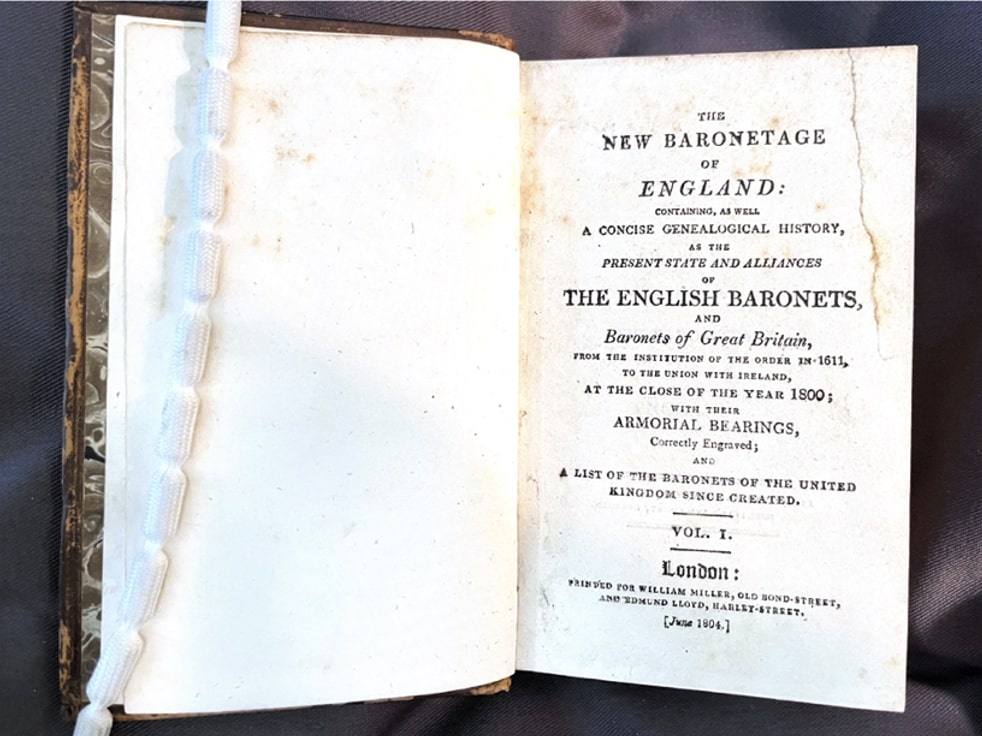
FIG. 1. |
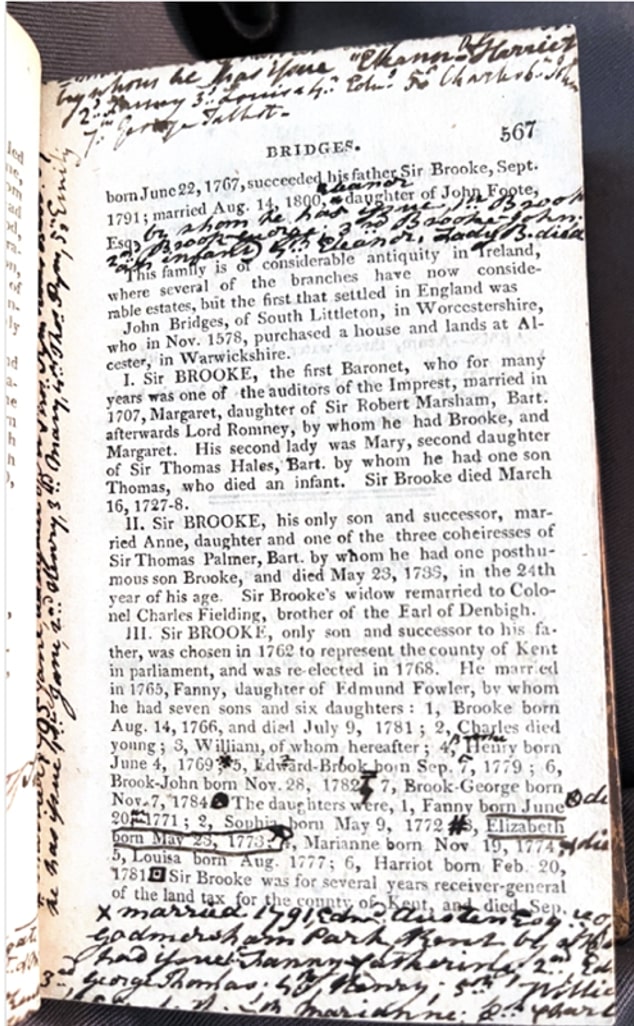
FIG. 2. |
|
FIG. 1. Title page of the first volume of the Godmersham Park Baronetage. |
|
I am far from the first person to notice these annotations. While I was working at Chawton House, Collections Manager Emma Yandle and Deputy Director Kim Simpson showed me a 2019 exhibition catalogue written by Gillian Dow and Katie Halsey, which featured the Baronetage and noted its potential importance. For that exhibition, the second volume was displayed open at the most heavily annotated entry, for the Bridges family (2: 566–67; see Fig. 2). In their catalogue, Dow and Halsey note that “the pages have been re-trimmed and possibly rebound,” meaning that much of the annotator’s text has been lopped off. They decline to date the handwriting but suggest that Elizabeth Bridges Austen or Edward (Austen) Knight are likely annotators. They also consider the possibility that Austen “could have been familiar with” this Baronetage, as well as the prospect that “the interest in family history demonstrated by the annotations of the Bridges entry suggested Sir Walter’s additions to the Elliot family’s entry” (17–18).1
I had initially approached the Godmersham Park Baronetage as part of a broader interest in naming, identity, and information management within eighteenth-century print culture, and in the ways in which forms such as the peerage directory might have shaped the composition and material form of the novel. But I quickly tumbled down the rabbit hole of its unique origin story. Encouraged by Dow and Halsey’s foundational description, I wondered whether I could push their observations any further. I knew the annotations would not prove to be in the hand of Jane Austen herself, since Peter Sabor had already audited all traced volumes from the Godmersham Park library (Sabor, “Godmersham” 36) with that question in mind. But, like Dow and Halsey, I thought it possible that she had read them, and that her experience of doing so had informed the Sir Walter conceit. Could I accurately date the annotations and attribute them with confidence? And could I build a stronger case that Austen was familiar with this copy, and that it inspired her composition of Persuasion?
Dating the annotations
It seemed that if I wanted answers, I could not avoid wading into the weeds of Austen-adjacent genealogy. Thankfully, Kim and Emma put me in touch with Martin Caddick, House Historian at Chawton House and an expert on the Bridges and Knight families. Martin was beyond generous in sharing his knowledge of these networks. The dating and attribution sections of this article are co-research for which, if any credit is due, he deserves at least an equal share.
We started by trying to date the moment(s) of annotation. Thankfully, all the insertions appear to be in the same hand. The range of dates—both written in by the annotator, and inferable from the noted births, deaths, and marriages—can therefore locate the inscriptions in terms of events that the annotator knew had happened, and events that he or she probably didn’t. Martin, for example, spotted something interesting in the annotations to the Knatchbull family entry. The annotator lists the first three children of Sir Edward Knatchbull (9th Baronet), the youngest of whom, Edward, was born in early 1810. He or she does not, however, list Sir Edward’s subsequent children, beginning with Charles, born in the summer of 1811, implying that the Knatchbull annotation was probably made after Edward’s birth but before Charles’s. Elsewhere is one annotation that postdates Charles’s birth—a reference to the death of the Rev. Brook John Bridges in 1812, which indicates that the annotator was active in or after that year, even if he or she did not update the list of Knatchbull children. The annotations, then, were probably added at different times. Overall, the two volumes contain sixteen complete handwritten dates spanning the period 1791–1812. Five fall within the 1790s, and eleven within the 1800s. The year 1810 is mentioned four times. The period 1810–12, then, seemed like a good time to focus enquiries about attribution. Who had access to the Baronetage then and might have “Sir-Waltered” it?
Identifying the annotator
Martin and I first examined the families selected for annotation, hoping that this choice could tell us something useful. All sixteen were based in the south of England, many in Kent. Using Le Faye’s Chronology and Letters, we identified the central nodes of the network (see Fig. 3) as the Bridges and Knatchbull clans, which met in the union of Edward Austen (later Knight), whose adoptive mother, Catherine Knight, was born a Knatchbull, and his wife, Elizabeth, née Bridges.2 Edward and Elizabeth’s children might be said, at least in terms of the fictive kinship conferred by a surname change by Royal Licence, to combine Bridges and Knatchbull blood.
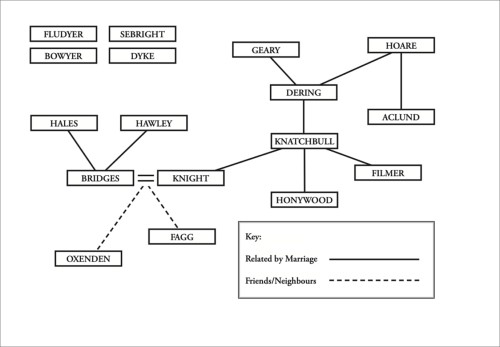
FIG. 3. Diagram showing known relationships between the families annotated in the Baronetage.
(Click here to see a larger version.)
Of course, the Baronetage belonged to Edward and Elizabeth: it was kept in their private library, and it’s unlikely (though not impossible) that a visitor would have scrawled on its pages in such a proprietorial fashion (Sabor, “Godmersham” 36). Elizabeth initially seemed an especially strong candidate, because of the detailed annotation provided for the Bridges entry and the fact that the annotator encircles her birth date—a mark, presumably of importance, given to nobody else. On closer inspection, however, the dates don’t work. Elizabeth died in 1808, so she could not have made the annotations referring to 1810 or 1812. And in fact, though part of it is trimmed away, her death as well as her birth seems to be recorded in the annotations (see Fig. 2). Elizabeth Bridges Austen was not our woman. For Edward, however, the dates seemed more promising; he lived until 1852, so he could easily have made all the annotations. Finally, we turned to Edward and Elizabeth’s children. The eldest, Fanny, was in her late teens during 1810–12. Interestingly, she has often been seen as a bit of a snob, with a strong interest in family lineage and rank—at least later in life, when she wrote an infamous letter accusing her Aunt Jane of a lack of “refinement” (Le Faye, “Fanny Knight’s Diaries” 22; Wilson 139) and spent time writing out a list of her descendants (List). Given this relevant characteristic, we decided that Fanny was just old enough to be in the frame as well.
My interest in Fanny was sharpened when I used Le Faye’s Chronology to check whether the families annotated in the Baronetage are mentioned in Fanny’s extant pocket books (daily diaries), from their commencement in 1805 to 1813. During this period, she frequently spends time with the Oxenden family, especially the “delicious” Mary (Chronology 403). In 1805, she notes dining with Sir John Fagg (314). In 1810 she sees Wyndham Knatchbull (389) and writes to Arabella Honywood (390) and Harriet Hales (390). In 1812 she meets Mr. Hoare (424) and calls on Lady Filmer (434). Altogether, during this period Fanny mentions nine of the sixteen annotated families. We also find records of some of the events recorded by the annotator. In 1810 she reports “Uncle [Brook] John [Bridges]’s marriage with Charlotte Hawley” (Chronology 394), remarked by the annotator (Baronetage 566). In 1812 there is a glum sequel with the “melancholy news of poor dear Uncle Johns death” (Chronology 426): this too is recorded in an annotation (Baronetage 566). Likewise, Fanny’s pocket book mentions her mother’s demise in 1808: “Oh! The miserable events of this day! My mother, my beloved mother torn from us!” (Chronology 358). The annotator records this death, alongside the encircled record of Elizabeth’s birth (Baronetage 567; see also Fig. 2).
This was striking but far from conclusive, since anyone known by Fanny would have been known by her father too. To close the case, we needed to turn to attributive paleography. Martin and I obtained examples of Edward’s and Fanny’s handwriting, dating them to 1810–12 where possible.3 I fed co-occurring words and other formations (e.g., dates) into a table, and compared both hands with the annotator’s entries. Due to the three sources’ different types of semantic content, the most powerful evidence for attribution came from a direct comparison of personal names. I found examples of Henry, William, and Austen(s) across all three of my sources. Anne, Fanny, Mary, and Sophia co-occurred across both the Baronetage’s annotations and Fanny Knight’s writing. Unfortunately I could not find them within Edward’s smaller corpus, so I supplied, as the next best thing, words that began in a similar manner (e.g., Annex’d for Anne; Family for Fanny; Maximilian for Mary). Selected results are displayed in Fig. 4.
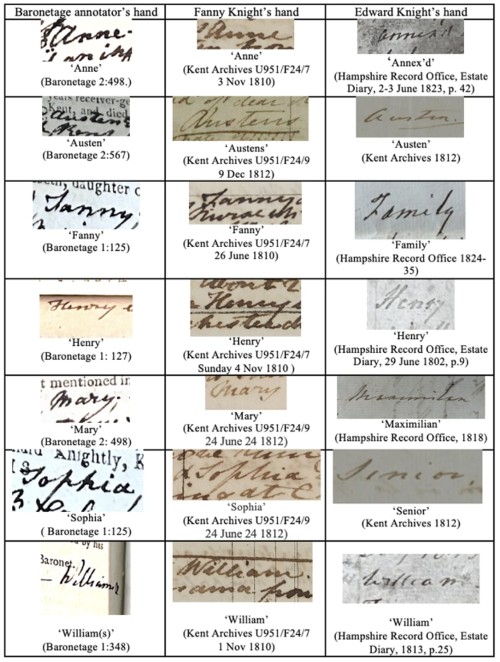
FIG. 4. Examples of handwriting from the annotator of the Baronetage,
Fanny Knight, and Edward Knight.
Details from holdings belonging to, and with kind permission of the Knight Collection, on deposit at Chawton House; Kent Archives; and Hampshire Record Office.
(Click here to see a larger version.)
I am relatively confident that the annotations in the Baronetage are Fanny’s work. Although these two hands display minor variations—attributable to a different pen, paper, or angle of inscription—the letters are generally formed in the same manner and proportion. Comparison with Edward’s hand provides an illustrative contrast. In the Anne and Austen rows of the table, the annotator and Fanny consistently join the downstroke and the concave cross-stroke on their capital As, whereas Edward uniformly leaves a gap between the two. Similarly, the annotator and Fanny use a down-tick on the capital F for Fanny, whereas Edward uses a loop when beginning Family. The annotator and Fanny both form the capital H of Henry in one smooth cursive line, resulting in a loop, whereas Edward forms his capital H from three separate strokes. And the annotator and Fanny both join the W of William to the dot of the subsequent i, whereas Edward joins it to the downstroke instead.
A combination of contextual and paleographic evidence, then, makes it likely that it was Fanny Knight, in the library, with the Baronetage. If her Aunt Jane happened to see the Baronetage between 1812 (when the annotations were probably made) and 1815 (the date, according to Cassandra Austen, of Persuasion’s composition), then Fanny’s annotation might be considered a prototype for Sir Walter Elliot’s most memorable characteristic. That is, if Jane Austen ever saw her niece’s handiwork. But did she?
Austen in the library
Thanks to Peter Sabor’s scholarship, it was easy to establish that Austen used the Godmersham Park library in late 1813. It was more challenging to prove that she read the Baronetage while doing so. Although Austen’s letters dating from this visit sometimes discuss her reading, there is, alas, no mention of the Baronetage (Sabor, “Godmersham” 34–35). A tantalizing snippet in one letter, however, indicates that baronets may have been on her mind. On 26 October 1813 she reports to Cassandra that the party at Godmersham received a visit from “Mr Deedes & Sir Brook,” adding, “I do not care for Sir Brook’s being a Baronet I will put Mr Deedes first because I like him a great deal the best.” Although I don’t wish to hang too much weight on this remark, such a remixing of the conventional social order—muscling a baronet out of the way for a mere meritorious Mr. to take precedence—bears a certain similarity to the activity of the Baronetage’s annotator, who assumes the authority to insert new names into the print record.
Furthermore, we have tentative evidence that Austen read nobility lists, including a Baronetage, around this time. On 10–18 August 1814, nine months after leaving Godmersham, she wrote to another niece, Anna Austen, an aspiring novelist who had asked some questions pertaining to the drafting of her novel Which is the Heroine? Austen writes: “I am quite ashamed to find that I have never answered some questions of yours in a former note.—I kept the note on purpose to refer to it at a proper time, & then forgot it. . . . There is no such Title as Desborough—either among the Dukes, Marquisses, Earls, Viscounts or Barons.” Why would Anna ask her aunt to confirm that no such title as Desborough existed? Either Jane Austen carried in her head an encyclopedic knowledge of the nobility, or Anna thought her well placed to consult a source that would give her the required information. I think the latter more probable. It is likely that the “former note” from Anna was addressed to Austen while she had use of the Godmersham Park library, that her aunt consulted the Baronetage and the other peerage directories there to answer it, and that she then neglected to communicate her findings until the following year. If so, then Jane Austen would certainly have seen Fanny Knight’s annotations—eighteen months before, according to Cassandra, she started writing Persuasion and gave the world Sir Walter (Le Faye, Family Record 222).
There are two extant references to Persuasion in Jane Austen’s hand. Both appear in letters addressed to Fanny Knight. On 13 March 1817 Austen writes, “I have a something ready for Publication, which may perhaps appear about a twelvemonth hence.” Ten days later, she tells Fanny, “You will not like it, so you need not be impatient” (23–25 March 1817). Why wouldn’t Fanny like Persuasion? Some suggest that, recently having declined proposals from John Plumptre, Fanny might have seen something too close to home in Anne’s early rejection of Wentworth and the regrets that followed (Harris 27–29). But it’s also possible that her aunt had made mischievous use of the Baronetage that Fanny had annotated, with especially diligent attention to her own kin—and that her niece might feel a little sting in the portrayal of Sir Walter.

Does it matter whether Fanny Knight annotated a book, or Jane Austen saw it? I think so. First, because the annotations are not the only material within the Godmersham Park Baronetage that may have shaped Austen’s ideas for Persuasion. For example, I was intrigued to read, beneath one of the annotated entries, a colorful footnote about the life of Lady Harriet Acland, who followed her husband on his military campaigns.
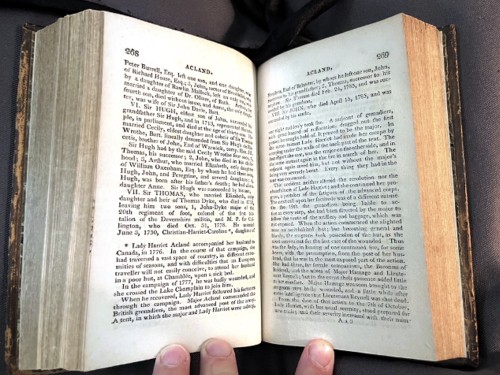
FIG. 5. Baronetage (1: 268–69). Knight Collection, on deposit at Chawton House.
(Click here to see a larger version.)
As can be partly seen in Fig. 5, the admiring editor uses an extensive footnote to recount Lady Harriet’s adventures, praising her cheerfulness, fortitude, and devotion to her husband. Such a description is strongly redolent of Persuasion’s Sophy Croft, a “‘great traveller’” (76) who has lived with her husband on board five ships (75). Of course, Austen had closer connections who accompanied husbands to sea—in 1814, the wife of her brother Charles gave birth on board his ship (Le Faye, Family Record 216). It is still possible, however, that nuggets of interesting lives like Lady Harriet’s might, alongside Fanny Knight’s Sir Walter-esque annotations, have provided imaginative fodder for Austen’s composition process in a manner that deserves further investigation.
Second, if my hypothesis is correct, then it means Austen was conceptualizing or planning Persuasion earlier than scholars have conventionally supposed. Where we don’t have extant manuscripts or other hard evidence, we often imagine novelists working in tidy chronological order. Thus Le Faye conjectures that during the 1813 visit to Godmersham, Austen “was either starting to make notes for Emma or else writing the final fair copy of Mansfield Park” (Family Record 206). Subsequently, drawing on Cassandra’s memorandum of the dates of composition, Le Faye states that Austen began Persuasion on 8 August 1815.4 But, as any novelist knows, the composition process often doesn’t work this neatly. One acquires bits and pieces—anecdotes, metaphors, snippets of dialogue—all over the place and puts them on a sort of mental pinboard, which one then keeps for months, years, even decades. The pinning process underlies the planning of a novel, a process that generally precedes beginning to write it. All this leads me to pose a question: how might we understand Persuasion differently if we entertain the possibility that Austen was thinking about Sir Walter—and Sophy Croft—as early as 1813?
Third, my theory puts Fanny Knight, Jane Austen’s favorite niece, squarely at the center of not only her affections—which we already knew—but also her imaginative ecosystem during her final years. Building on the scholarship undertaken by Dow and Halsey, Sabor, Barchas, and others, this article has suggested that if we wish to understand Austen’s imagination and composition process, we must look to the evidenced channels of information, ideas, and sociability that we know—or think it likely, with evidence—she actually sought, accessed, and enjoyed. Specifically, I have argued that to understand the context for the composition of Jane Austen’s last and best novel, we must look to her reading, such as the Baronetage—and to her family, like the still understudied figure of Fanny Knight.
NOTES
1This catalogue was first printed for a 2009 exhibition curated by Dow and Halsey to accompany the academic conference “New Directions in Austen Studies,” which was held at Chawton House Library in 2009. They published it the following year, as an online exhibition, in a special issue of Persuasions On-Line. Chawton House re-launched the exhibition for a public audience in 2019.
2Four annotated entries—Fludyer, Sebright, Bowyer, and Dyke—are surnames for which, around 1812, there is no mention in either Le Faye’s Chronology or her Letters. Martin Caddick noted, however, that there are references to Sam Fludyer (1832) and Sir P Dyke (1832, 1833) in the later diaries of Charles Knight (Edward Knight’s son), which are held at Jane Austen’s House.
3Kent Archives holds a complete run of Fanny’s pocket books between 1805 and 1872. I drew examples from her pocket books for 1810 (U951/F24/7), 1811 (U951/F24/8), and 1812 (U951/F24/9). Examples of Edward’s writing dating from this period are unfortunately not so plentiful: I found only one letter dating from 1812 (Kent Archives U390/E68). I therefore used documents in his hand in the Hampshire Record Office, which cover a broader chronological period. These are indicated by date in the table and are referenced fully in the Works Cited. I am indebted to Martin Caddick for obtaining relevant samples on my behalf.
4Cassandra’s memorandum is reproduced in Austen’s Minor Works, facing page 242.
