Many readers of Jane Austen speak of the profound effect that her novels have had on their lives. At a panel discussion at JASNA’s 2025 AGM in Baltimore, readers who think it’s time to pay those insights forward focused on Austen’s “transformative imagination” to help the audience think about ways our engagement with Austen’s works can implement positive change in our wider communities.
Introduction: The Practice of the Humanities
Celia Easton
When I began college in 1974, I paid my tuition in part with a United States National Defense Student Loan. I chuckled about how I, as an English major, would be doing my part protecting, promoting, and increasing the technological capabilities of my country. In my retirement, however, I find it less funny. In higher education, today’s students are turning away from the arts and humanities. “Learn something practical,” they’re told, “or you’ll end up with a job in which the only line of poetry you’ll recite is, ‘Do you want fries with that?’”
We assembled this panel at the Baltimore AGM to argue that literature, history, and philosophy are not mere entertainment or mind games. JASNA is an organization that can demonstrate not just a love for humor, wit, and Regency outfits but for a practice of the humanities.
In her plenary talk from the Denver AGM, Claudia Johnson posits that Jane Austen’s readers are not trying to escape from the world through an idealized trip back in time (16–17). Rather, Johnson suggests, Janeites bring Austen into their world to help think about solutions to social problems, not to avoid them. Community engagement and social impact, this panel contends, is not charity, philanthropy, or Emma Woodhouse’s superficial relief for the “other.” Community engagement connects people to work together productively in addressing community-identified priorities.
A practice of the humanities applies the complex tools of ethics, truth-seeking, and empathy to our actions in our communities. We need the humanities now more than ever to cultivate connections and combat the voices of division. Jane Austen’s fictional worlds might fit on a two-inch square of ivory, but they are not simple. Unlike so much of the binary political and social rhetoric of the twenty-first century, Austen’s writing reminds us that there are very few absolutes. “Us or them” thinking separates people, each side claiming a perfect truth. Lady Catherine is an “us or them” thinker. But Austen abhorred “pictures of perfection” and looked at the world as at once both flawed and full of potential. She was the loving daughter of a clergyman, but her characters include selfish, hypocritical, mean-spirited, and stupid churchmen. She created a whiny, bossy mother in Mrs. Bennet—but one whose actions are motivated by the kind of love that knows she must protect her daughters from future impoverishment. Austen expressed her commitment to the abolition of the slave trade, yet she allowed several characters to prosper through the labor of West Indian slaves. If you are looking for easy, don’t read Jane Austen. Have we grown too comfortable with what’s familiar to us? Austen writes comedies, the genre that gives us hope for improving the world, as well as the space to fail and try again. This is the practice of the humanities.
Our panel brings together two kinds of experts: long-time JASNA members who have put Austen’s values into practice, and a Baltimore community engagement specialist. The panel originated when Alice Villaseñor met Danielle Battle at a conference in Western New York. Dani works with Baltimore youth, particularly in the areas of quantitative literacy and reading. In her public talks, she helps audiences find the tools to become effective members of their communities. When Alice described the conference to me, and especially after I corresponded with and spoke with Dani, we knew that we couldn’t come to Baltimore without giving more JASNA members the opportunity to hear from her.
Dani Battle began the session in Baltimore with theoretical and practical approaches to engaging, affecting, and being affected by local communities. Renata Dennis, who has led JASNA community outreach programs in Georgia, including long-term partnerships with libraries, provided a history of JASNA’s relatively new Equity, Diversity, and Inclusion (EDI) Committee (now renamed Diversity, Equity, and Inclusion, or DEI). Lisa Brown outlined the success of that committee’s Book Box program. Agnes Gawne shared the details of Puget Sound’s outreach through scholarship awards to local student essayists. And Alice Villaseñor described a successful Southern California partnership engaging predominantly Latinx high school students who excitedly read Sense and Sensibility through the filter of the novel’s adaptation From Prada to Nada.
Connecting with Local Communities
Danielle Battle
Note: Technology issues interrupted the transcript recording of Dani Battle’s talk to JASNA on October 9, 2025. The following summarizes her key points.
From Midwestern elementary school leader and mathematics professor to community activist in Baltimore’s Cherry Hill
Dani began her talk by introducing herself to her audience. “Who am I?” she asked. She described herself as a mixed-race Black woman from a middle-class family but suggested that the audience would understand her best through the stories she tells. Dani experienced a self-awareness of “otherness” in junior high school. Although she felt that she “cracked the code” on surviving middle school through her fashion choices and hair styling, she remembered one quiet girl whose clothing and hair almost made her a target for bullying. She wondered why anyone would make those choices, until the girl showed up in the line Dani was working at a local soup kitchen’s Thanksgiving. Understanding quickly washed over her, and—Dani told the audience—she still carries a piece of that girl in her heart.
What is community?
Dani pointed out that our understanding of community has evolved since Covid. The pandemic made geography less important than other connections, and many people found community with friends spread around the world. Community is defined by the impact of our actions, whether small or great. In fact, Dani, preferring the term social impact over community engagement, calls herself a social innovator. Social innovators focus intentionally on small groups that mutually learn and grow though social interaction and create organic solutions to and supports for community problems.
The Rich Program focuses its work in Cherry Hill, the largest public housing community in Baltimore City. It was designed for Black veterans of the Second World War, and it is physically sectioned off from the rest of the city. Young people in Cherry Hill live in a community that has reinforced social oppression.
The challenges
Today’s youth are often as affected by social media as they are by face-to-face interactions. Dani and her husband (a Baltimore native) wanted to make a meaningful difference in the lives of young people, so they started their non-profit Restoring Inner-City Hope (RICH program) in 2011 to love, inspire, and empower youth and families in Baltimore.1 So when RICH program workers interact with kids in Cherry Hill, they meet them with hugs, they ask them questions, they remember their names, and they remember what is going on with their families. They model new cultural experiences to challenge young people to try new things, such as thinking about art through a tattoo museum, or learning to deal with emotions during a session with improvisational comedians. Young people need diverse experiences in their communities as foundation for personal growth. Their programs include art projects; science, technology, engineering, and mathematics (STEM) tutoring; and experiences that promote social-emotional learning.
Some projects are met with skepticism. For instance, opening a juice bar in a neighborhood that is essentially a food desert received little initial support from outsiders. But the organizers insisted on high-quality, nutritious products and a commitment that community members be involved in—not just consumers of—the juice bar. Since its doors opened, the community has supported and benefited from this endeavor. New ideas, Dani reminded the JASNA audience, demand patience and understanding. To the surprise of the skeptics, the juice bar has been a great success and has had a positive impact on the Cherry Hill community.
Transformative imagination
Dani asked the audience to think about ways local JASNA regions could make connections in their own communities. Jane Austen, Dani noted, understood social impact in a way that sounds familiar to twenty-first-century readers. She wrote about relationships within small communities. Through her satire, Austen laid bare the problems faced by those whose voice and agency are squelched by the powerful, the rich, and the socially self-interested. All Austen’s novels challenge systems of inequality based on gender and economics. Austen had a transformative imagination—just what we need to discover ways of improving lives and energizing the disempowered.
Dani emphasized the importance of building relationships and nurturing community connections. This kind of effort takes research and conversation, honoring the community’s role in defining community needs and values. When we help young people grow, Dani explained, we honor their parents and the impact of their life experiences on their children. This respect empowers both current and next-generation community leaders.
Several members of the audience shared their experiences as teachers and community educators as they offered ideas about connecting their interest in Jane Austen with their desire to effect positive change in their towns and neighborhoods. Dani, as a professional educator who also creates less formal educational opportunities for Baltimore youth, encouraged teachers to bring their whole, authentic selves to their work, and to encourage young people to do the same. When teachers show students that they are open to new ideas and are willing to take risks, students will follow their lead.
One audience member brainstormed about a Jane Austen-themed mentorship program where volunteers could discuss her novels and their adaptations with community members. The audience latched onto Dani’s “food and love” theme: to incorporate food, music, and cultural activities to bring people together. Their biggest take-away was Dani’s advice to honor the experiences of the local community rather than imposing external solutions.
Finally, Dani asked the audience to consider this question: “What does a transformative imagination look like in your community?” Some answers came from the next four JASNA speakers.
JASNA’s Equity, Diversity, and Inclusion Committee 2020–25 and Where to Go from Here
Renata Dennis
After Jane Austen’s death, many members of her family created the myth of a prim “Aunt Jane” that readers today know masks Austen’s wit, satire, and biting social commentary. But how many Austen fans are equally guilty of promoting a very narrow view of Jane Austen, emphasizing love stories, teas, and lace while ignoring questions of social class, economics, and gender? I recently met a woman at a social gathering who was curious about my involvement in JASNA. Evidently, she was forced to read Austen in a school that followed an exclusively Eurocentric pedagogy. Lumping Jane Austen with a “classic” curriculum that ignored works featuring minority voices or critiques of the status quo, this woman considered the idea of reading any more Austen novels repulsive.
I took this as an opportunity to discuss several themes in Austen that relate across cultures:
- Class, privilege, and power in society
- Limited opportunities for women outside of marriage
- Complicated family dynamics
I listed the many modern ethnic adaptations of Austen’s works, in both film and written form, such as Bride and Prejudice, Bridget Jones’s Diary, Clueless, Unmarriageable, and Pride. I told her about the Facebook page “Black Girl Loves Jane”; books and articles written about Dido Belle; Austen’s own mixed-race character, Miss Lambe; and Vanessa Riley’s Austen-inspired books on Caribbean women with power and influence. New readers are breaking the “classic” mold of Jane Austen and laying bare a much wider and more inclusive view of the Regency period.
I can only assume that it was enlightening for her to hear about the recognition of women of color who were Austen’s contemporaries and current adaptations, because she was busy scanning sites on her cellphone as we spoke.
This experience should be a reminder to us all as we introduce Austen to new audiences. Some people may have had prior toxic exposure to her works. “Jane Austen is for everyone” (as graphic artist and Janeite Georgie Castilla has said), but we may have to be sensitive and creative in our presentation.
The JASNA EDI Committee was chartered in mid-2020. In June of that year, then-President Liz Philosophos Cooper wrote an unprecedented editorial in the JASNA email Social Distancing with Jane Austen, a supplement to the JASNA Update, regarding the murder of George Floyd. In the autumn of 2018, a JASNA strategic planning meeting had identified (among others) two goals: “increasing the diversity of our membership and promoting the reading of Jane Austen among more diverse audiences” (Cooper). In December 2019, George Justice had been asked to chair a committee to work on these goals, and in her Social Distancing email, President Cooper announced that the committee would also be “chartered to develop processes and recommendations to ensure that all members feel welcome within our organization and feel encouraged to report any incidents of racism that may occur during a JASNA or Regional event or discussion.”
One of the first tasks the committee decided upon was to write a JASNA Diversity and Inclusion Statement. This statement was submitted to the Board but rejected in its original form. A special meeting of the Board was called in May 2021 at the request of the EDI Committee, at which a revised Diversity and Inclusion Statement was approved. The EDI Committee’s Charter was also presented and approved at this meeting.
In conjunction with the EDI Committee’s Charter, the Board initiated or approved activities that involved the EDI:
- Creation of a JASNA Community Guidelines Statement;
- Selection of a person to fill the role of JASNA Ombudsperson (Georgie Castilla served as the designated EDI member on the selection committee);
- In collaboration with the Conference Director, Linda Slothouber, creation of the AGM New Voices speaker category and grant.
The Committee later created and proposed to the Board the Jane Austen Book Box program. (Lisa Brown discusses the details of this initiative below.) The Committee has held one town hall meeting for Regional Coordinators, in which much of the discussion centered on how best to involve minorities, men, and young persons in JASNA.
The institution of Community Guidelines is significant, and the Ombudsperson—a position formally established by the Board of Directors in May 2021—has been helpful. Several incidents of DEI-dysfunction in JASNA Regions have involved the intervention of the JASNA Ombudsperson. The EDI Committee strongly encouraged the need for JASNA Board members, the EDI Committee, and Regional Coordinators to participate in DEI training. Current President Mary Mintz engaged a consultant for an online training for Board members in May 2024; a training for members of what is now the DEI Committee and Regional Coordinators is pending.
To increase the participation of a more diverse group of speakers, the EDI Committee polled JASNA regions asking them to share the names, dates, and titles of presentations given by Persons of Color (POC). This POC Speakers Bureau list has been submitted to the Vice President for Regions and is available to Regional Coordinators. (A special thanks to the California’s Southwest Region for its large and detailed submission.) The JASNA’s New Voices Breakout Speaker grant was created, starting with the 2023 AGM, to increase the diversity of AGM speakers. Two EDI Committee meetings over the last five years have discussed the selection of AGM speakers and presenters. At the second, in early 2025, Diversity Committee members discussed representation and diversity among the 2025 AGM plenary speakers named in the early announcements. The 2025 AGM had the most diverse group of speakers at a JASNA AGM so far.
At the 2024 AGM Board meeting, the EDI Committee submitted a proposal for a member survey that would elucidate member demographics. JASNA appears to have an aging population, but there are no hard numbers on ages, educational backgrounds, and other demographic information. The proposal for a member survey to include demographic questions to help shape JASNA’s future member services was approved. During 2024 the EDI committee submitted proposed questions on member demographics and accessibility to JASNA’s President. Along with Web Services Manager Iris Lutz, the committee met with Kate Jorgensen (Regional Coordinator for JASNA–Central and Western New York, and now a member of the DEI Committee) to discuss technology and other innovations to assist in accessibility for members at AGMs and regional meetings.
Misconceptions about DEI
The term DEI and what it represents has always been controversial, but in the last year it has become pejorative for some people. Correctly implemented, all DEI does is look at an organization and ask the following questions: Who is not in the room? Why are they not in the room? Is there something that we in charge are doing or not doing to prevent full participation?
I am often at events and mention that I am with the Jane Austen Society of North America. The response often includes “Oh, I love Jane Austen,” and “I didn’t know there was a Jane Austen Society.” Here’s what I think:
- Among other things, this kind of response means that JASNA has a communications problem. Why are people not aware of us?
- One former member of the DEI Committee said that her friends who are POC feel uncomfortable in a majority White JASNA meeting. Representation matters. People feel more comfortable participating in an organization when they see others with whom they can identify.
- Gatekeepers need to be open to addressing their own issues of control, and to be creative in thinking “outside of the box” and including others in decision-making. All of us in leadership in JASNA should be working to replace ourselves, mentoring others to take JASNA well into the twenty-first century.
The Jane Austen Book Box Program
Lisa Brown
The Jane Austen Book Box is an on-going JASNA project that provides age-appropriate Jane Austen books to schools, libraries, and community organizations. As a subcommittee of JASNA’s EDI team, funded by JASNA, our purpose is to introduce Austen to younger and more diverse audiences. The types of books chosen depend on recipients’ needs, but they can include everything from board books for the youngest readers to young-adult adaptations of Austen’s novels, as well as Austen’s own works.
Lena Yasutake of the Connecticut Region was the originator of the Book Box idea and tried out an early version of the program at a school in her home state. I renewed the project in 2021, and we solicited applications across North America. The first books were given out in 2022. Since then, we have given books to five or six organizations each year, including three in Canada. Two JASNA regions—New York Metropolitan and Maryland—have formed book box committees based on the national model, and the Orlando Region has created its own similar but independent book program.
Each year, we receive between twenty and thirty applications (application forms are available on our webpage) from educators and librarians.2 We evaluate the applications and award grants on a rolling basis. We favor applications from schools with diverse student bodies that provide detailed descriptions of their Austen modules, student engagement with educators or librarians, and methods for distributing the books to the students after the modules have been completed. The books must be given to the students to keep and take home. The Book Box program works closely with Jane Austen Books, which has set up a special section of its website for Book Box recipients and provides the books at a discounted rate.3
The Book Box program has provided books to large public high schools in Chicago and Vancouver, summer reading programs in Texas and Louisiana, and board books for young families at a library in Ontario. We’ve had an increase in charter school applications, and this year we awarded book boxes to our first charter school recipients.
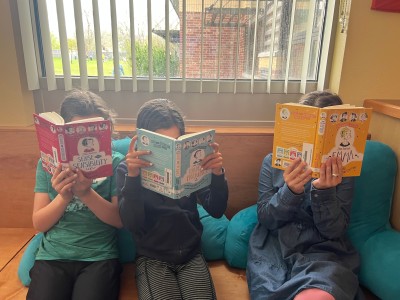
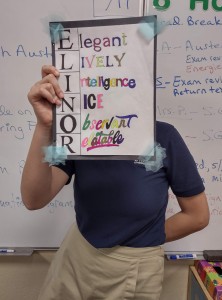
In their reports to the committee, Book Box awardees frequently include photos of the recipients’ school projects. Because we include photos on the JASNA website, we ask teachers and librarians to ensure that students’ faces are not shown. As a result, we get some photos in which Austen masks protect student privacy, and others that make creative use of the books to share their excitement without revealing their identities. Through the Book Box program, Jane Austen’s work has inspired art projects by high schoolers, scrapbooks made by middle schoolers, and modern television and film versions of Pride and Prejudice. Other groups sponsored third graders for a Jane Austen tea party and had students learn to dance Regency style.
We’ve had a great deal of early success with the Book Box program. What’s in our future? We are eager to receive more Canadian applications and to support reading projects across the provinces. We will strive for more engagement with JASNA regional groups. I would also like to expand the program to beginner adult readers and incarcerated readers. Improved literacy for beginning adult readers will create better reading skills for their children and grandchildren. More literacy means more Janeites!
Puget Sound Region Scholarship Essay Contest
Agnes Gawne
In 2017 and 2018, the Puget Sound Region (covering the Greater Seattle area of Washington State) held scholarship contests awarding a $500 prize for high school students and a $1000 prize for college, university, or advanced-degree students. In addition to the monetary prizes, the region sponsored a one-year membership in JASNA for each winner.
One Puget Sound member served as chairperson of the scholarship committee and assembled a six-member panel to devise the rules and to grade the essays. The scholarship contests were announced at our local meetings, and JASNA members shared the scholarship contest information with their contacts in local schools. We also posted the scholarships on the state’s Washboard.org website—a free, web-based scholarship-matching clearinghouse for Washington State residents and students, and a simple, central scholarship search-and-application resource.
For the 2017 contest, the theme was “Social Improvement in Jane Austen’s Emma.” The winning essays were:
- University/Graduate Level ($1,000): “Fortune, Work, and Strict Decorum: Social Improvements in Emma”
- High School Senior ($500): “Human Connection Through Music and Dance”
Both scholarship winners attended one of our regional meetings to read their essays and answer questions from the members. The college-level winner continued as a member of JASNA for a few years.
For the second year of the contest, we were eager to attract more essayists, so we increased our outreach to high school counselors and local college- and university-level English and humanities departments. After a review of our process for the first year, our committee issued a topic more relevant for the generation living through the #MeToo movement of late 2017:
Identify one or more incidents that could be termed sexual harassment or sexual predation in a Jane Austen novel, and explain why the term applies. Discuss how the characters of the novel deal with the damage caused by the incident(s). Was justice done? How are their methods similar to or different from how our society today deals with such problems?
In addition to making more academic contacts, we again advertised the scholarship via Washington’s Washboard.org.
In 2018, our scholarship committee received many more entries than in the previous year. We received some incredible essays (based on four different Jane Austen novels), making decisions very difficult. Although the twenty-first century describes sexual harassment differently from the ways readers may discover it in Austen’s novels, it was fascinating to see how our contestants could relate Austen’s characters and plots to their lives in 2018. The winning essays were:
- University/Graduate level First Place ($1,000): “George Wickham, Pride and Prejudice’s Libertine”
- High School First Place ($500): “John Willoughby: Sexual Predation in Austen’s Sense and Sensibility”
- University Honorable Mention ($75): “‘I Cannot Submit to This’: Manipulation and the Marriage Plot in Northanger Abbey”
- University Honorable Mention ($75): “‘A Small Hole in Her Heart’: Sexual Harassment in Mansfield Park”
- High School Honorable Mention ($50): “Sexual Harassment in Pride and Prejudice”
Although the two first-place winners were attending schools out of the area and were unable to join us for a meeting, two of the university-level honorable mention awardees were able to attend a local regional meeting to read their essays and answer questions. Sadly, we did not see any of the awardees again at a future meeting. I don’t know whether the two who won awards out of state were able to attend meetings in the regions they were studying in, but we did provide them with information about the other JASNA regions.
Partnerships or social impact
Besides the essay contest, we have found other ways of connecting with the community. Although our financial support is not large, the Puget Sound Region routinely makes connections with local theater companies when a play related to a Jane Austen work is being performed. We have also found that regional improvisational theater groups sometimes embrace the English Regency or Jane Austen as their evening “theme,” and we have both promoted JASNA and supported the arts through small funding of such groups.
Further, once active members of the Puget Sound Region began to think about our social impact, we discovered allies and formed local partnerships. We have worked with the Washington Regency Society and Costumers of Color to bring Jane Austen’s writings into their scope of interest. Although those societies are chiefly interested in costume, dance, and social customs, we have found them very welcoming to presentations that tie Jane Austen and her writings to their primary focus.
University of Southern California Joint Educational Project/Neighborhood Academic Initiative Writing–Mentoring Partnership
Alice Villaseñor
In 2011 (the bicentenary of the publication of Jane Austen’s Sense and Sensibility), I worked with Jaqueline Barrios, a high school teacher, to infuse some Jane Austen into a writing–mentoring program we had piloted the year before. This University of Southern California program pairs USC students with public high school students in the USC Neighborhood Academic Initiative (NAI).
NAI is a pre-college enrichment program for first-generation, college-bound students attending Los Angeles Unified School District (LAUSD) high schools near the USC campus. The goal of the seven-year program is to prepare low-income students (and their families) for college. The time commitment for NAI scholars and their families is intense (e.g., Saturday academy, after-school tutoring, SAT prep courses, cultural enrichment activities). Every morning the students take their LAUSD math and English courses on the USC campus before being bussed back to their “home” schools.4
Although the NAI program is very successful, we designed the mentoring program to address a common problem among first-generation college students: NAI students often felt a lack of personal connection to USC, in terms of meaningful relationships with the faculty and non-NAI students and staff. As one student put it, before the mentoring program, her experience with USC was mostly one of “buildings”—office and classroom space—rather than the “people” inside the buildings who supported her academic efforts. The mentoring element of the partnership was extremely inspiring to both the high school and college student participants. The high school students were eager to impress their college mentors. And the college students were determined to master Austen to set a good example for their mentees.
In addition to the general goal of providing meaningful connections through books, we wanted to emphasize that literature is not just something you learn about because it gets you into college (or, in the case of the college student participants, gets you a grade in a college course). One way to emphasize the life-long nature of reading is to plug into reading communities involving life-long readers, such as JASNA and the Dickens Project.5 Since JASNA sponsors an annual essay contest, we started our connections with JASNA by having my college freshmen mentor the high school students through the process of writing essays. The local JASNA region (JASNA–Southwest) was sponsoring a two-day conference on Sense and Sensibility, and the organization invited the high school students and their teachers to join in on the fun.
Additionally, we were lucky to connect with the filmmakers of From Prada to Nada (2011), a contemporary re-telling of Sense and Sensibility set in twenty-first-century Los Angeles. All the students in the program were invited to attend the film’s premiere. Moreover, the original screenwriter (Craig Fernandez) and one of From Prada to Nada’s producers (Linda McDonough) discussed the process of adapting Austen to film at a Q&A session that followed a free screening on the USC campus. Because this event was attended by the students and their families, we were able to tie our study of Austen into NAI’s larger goal of including the entire family in the process of education.
Most of the high school students in the program are native Spanish speakers. Since From Prada to Nada was marketed specifically to this population, it was enormously useful in helping students understand Austen’s text and in facilitating vital conversation about Austen’s story. From Prada to Nada features two separate Los Angeles lifestyles: the “Prada” lifestyle the Dominguez sisters enjoyed while their father was alive and the “Nada” lifestyle that the sisters experience in East Los Angeles because of their father’s death. The film’s emphasis on the displacement of the Dominguez sisters from their family home (and culture) offered students a perspective on Austen’s Dashwood sisters that the young readers could easily grasp. It allowed students to identify personally with Austen’s characters, and it offered instructors the opportunity to talk frankly and openly about structural inequalities in Austen’s culture, as well as in our own—and the ways in which these inequalities affect accessibility to high culture like Austen’s texts.6
NOTES
1For more on RICH, see its website: https://www.therichprogram.org.
2A description of and application materials for the Jane Austen Book Box program can be found on JASNA’s website: https://jasna.org/programs/jabookbox/.
3See the page at Jane Austen Books: https://www.janeaustenbooks.net/collections/jasna-jane-austen-bookbox.
4A good overview of the NAI program—which boasts a 100% high school graduation rate and a 99% college graduation rate—is provided on the webpage of the Leslie and William McMorrow Neighborhood Academic Initiative: https://communities.usc.edu/educational-partnerships/nai/.
5We established the ongoing relationship between the Dickens Project and NAI at this time as well by having the mentors and mentees also work on Great Expectations essays. For more information about how the relationship between NAI and the Dickens Project has since evolved, see the “High School Students” page of The Dickens Project website: https://dickens.ucsc.edu/education/high-school.html.
6This focus on improving the accessibility of English literature to the Latinx community became a major goal of the stage adaptations of Austen and Dickens novels later produced by the NAI theater program. More information about some of these productions can be found on the LitLabs webpage: https://litlab.ucsc.edu.
